PKP Kap. 1
 Call Kai
 Learn
Learn Practice Test
 Spaced Repetition
 Match
Match Flashcards
 Knowt Play
1/5

There's no tags or description
Looks like no tags are added yet.
Name | Mastery | Learn | Test | Matching | Spaced | Call with Kai | Chat |
|---|
No analytics yet
Send a link to your students to track their progress
6 Terms
Why is personality psychology relevant and what goals does it pursue?
Relevance:
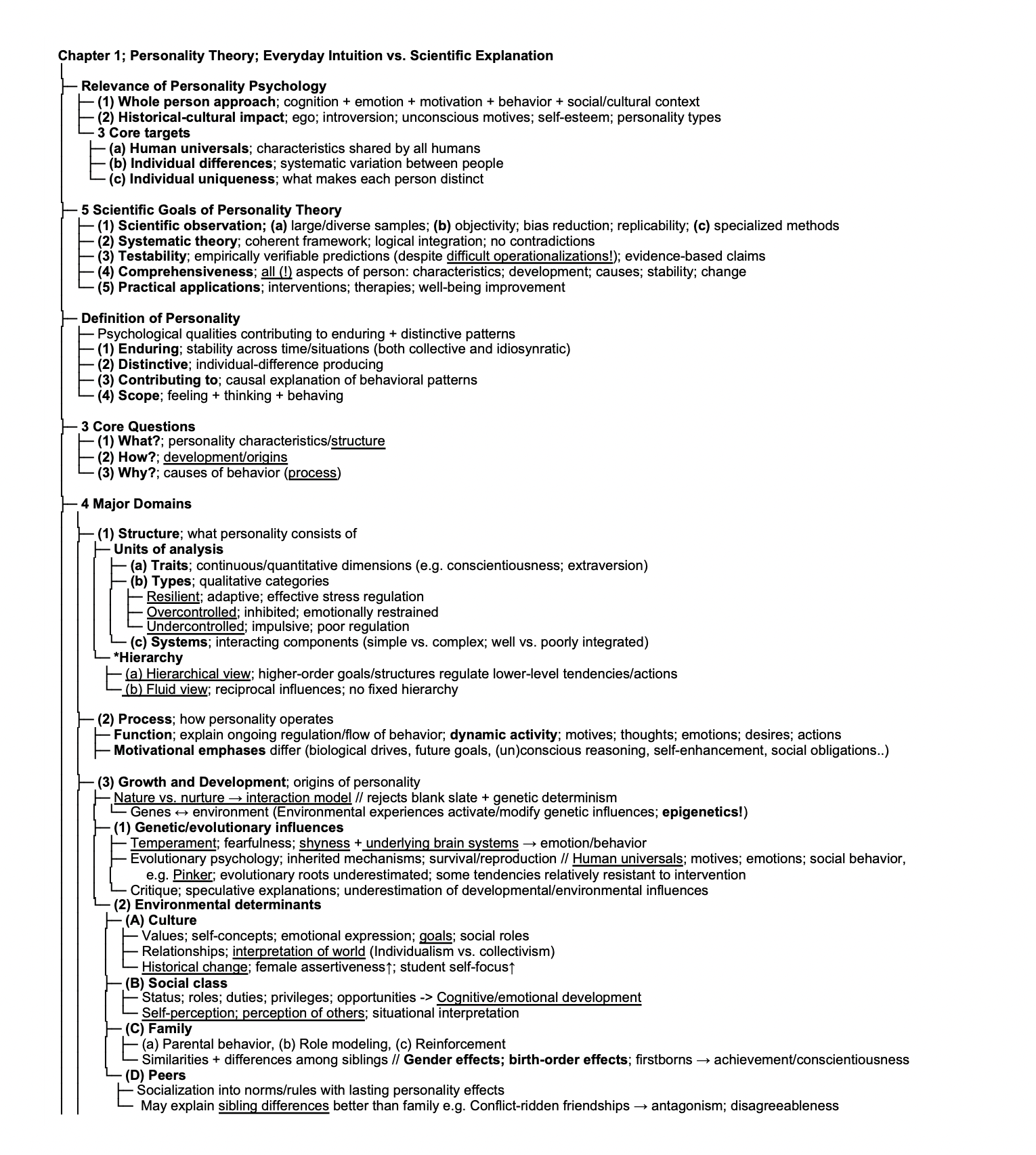
Focus on the whole person; integrates cognition, emotion, motivation, behavior, and social/cultural context (vs. isolated processes such as memory or perception)
Historical-cultural impact; concepts influence everyday thinking (ego; introversion; unconscious motives; self-esteem; personality types) with core topics:
human universals (characteristics shared by all humans);
individual differences (systematic variation between people);
individual uniqueness (what makes each person distinct)
Goals of scientific personality theories:
Scientific observation: (a) large/diverse samples; (b) objectivity and bias reduction; replicability; (c) specialized methods to study mental processes, emotions, and biological systems
Systematic theory: coherent framework; explanations logically integrated; no contradictory assumptions
Testability: empirically verifiable predictions; evidence-based claims despite complex constructs (such as motives; emotions; goals; conflicts; unconscious processes)
Comprehensiveness: explains all major personality characteristics / questions; lifespan development; causes; stability; change
Practical applications: development of interventions; therapies; methods to improve well-being
Which questions does personality psychology seek to answer, and how does it address them?
Personality = psychological qualities (C) contributing to (i.e. causally explaining on both collective and idiosyncratic levels) (A) enduring (stable across time/situations) and (B) distinctive (individual-difference producing) patterns of (D) feeling, thinking, and behaving; goal = explain causal factors underlying these patterns
Core questions: (1) What? → What characteristics make up personality? (2) How? → How did these characteristics develop? (3) Why? → Why does a person behave as they do?
Major domains used to answer these questions:
Structure (what personality stably consists of; “building blocks”); theories with differing units of analysis:
Traits: continuous / quantitative dimensions (e.g., conscientiousness; extraversion)
Types: qualitative categories (e.g., resilient; overcontrolled; undercontrolled)
Systems: integrated (well / poorly) organization of interacting personality components (simple / complex)
*Hierarchy: higher-level structures/goals may regulate lower-level tendencies/actions (e.g. trait theories); alternative view = fluid reciprocal influences rather than fixed hierarchy
Process (how personality operates); Dynamic psychological activity: motives; thoughts; emotions; desires; actions
Different theories emphasize different motivational systems: biological drives; future goals; conscious reasoning; unconscious motives; self-enhancement; social obligations → Explains ongoing flow and regulation of behavior
Growth and Development (how personality develops/originates); explains (A) universal developmental patterns and (B) individual differences
Genes ↔ environment interaction (not nature vs. nurture!); environmental experiences can activate or modify genetic influences (epigenetics); not blank slate / genetic determinism!
Genetic/evolutionary influences → temperament (fearfulness; shyness / potential change with exposure) & underlying brain systems; inherited psychological mechanisms promoting survival/reproduction with emphasis on human universals (motives; emotions; social behavior), vgl. Pinker: some psychological tendencies deeply rooted in evolutionary history, relatively resistant to social intervention, BUT criticism → speculative explanations, underestimation of developmental/environmental influences
Environmental determinants:
(A) Culture → values; self-concepts; emotional expression; goals; social roles; beliefs about what matters in life; influences individualism vs. collectivism, relationships, interpretation of the world (female assertiveness + self-focus of American undergrads) + cultural influences can change historically
(B) Social class → status; roles; duties; privileges; opportunities; cognitive/emotional development; shapes self-perception, perception of others, and responses to situations
(C) Family → (a) parental behavior; (b) role modeling; (c) reinforcement; creates similarities and differences among siblings; gender and birth-order effects (e.g., firstborns often more achievement-oriented and conscientious)
(D) Peers → socialization into behavioral norms and social rules; lasting influence on personality development; peer experiences may explain sibling differences better (!) than family experiences; conflict-ridden friendships associated with more antagonistic and disagreeable behavior styles.
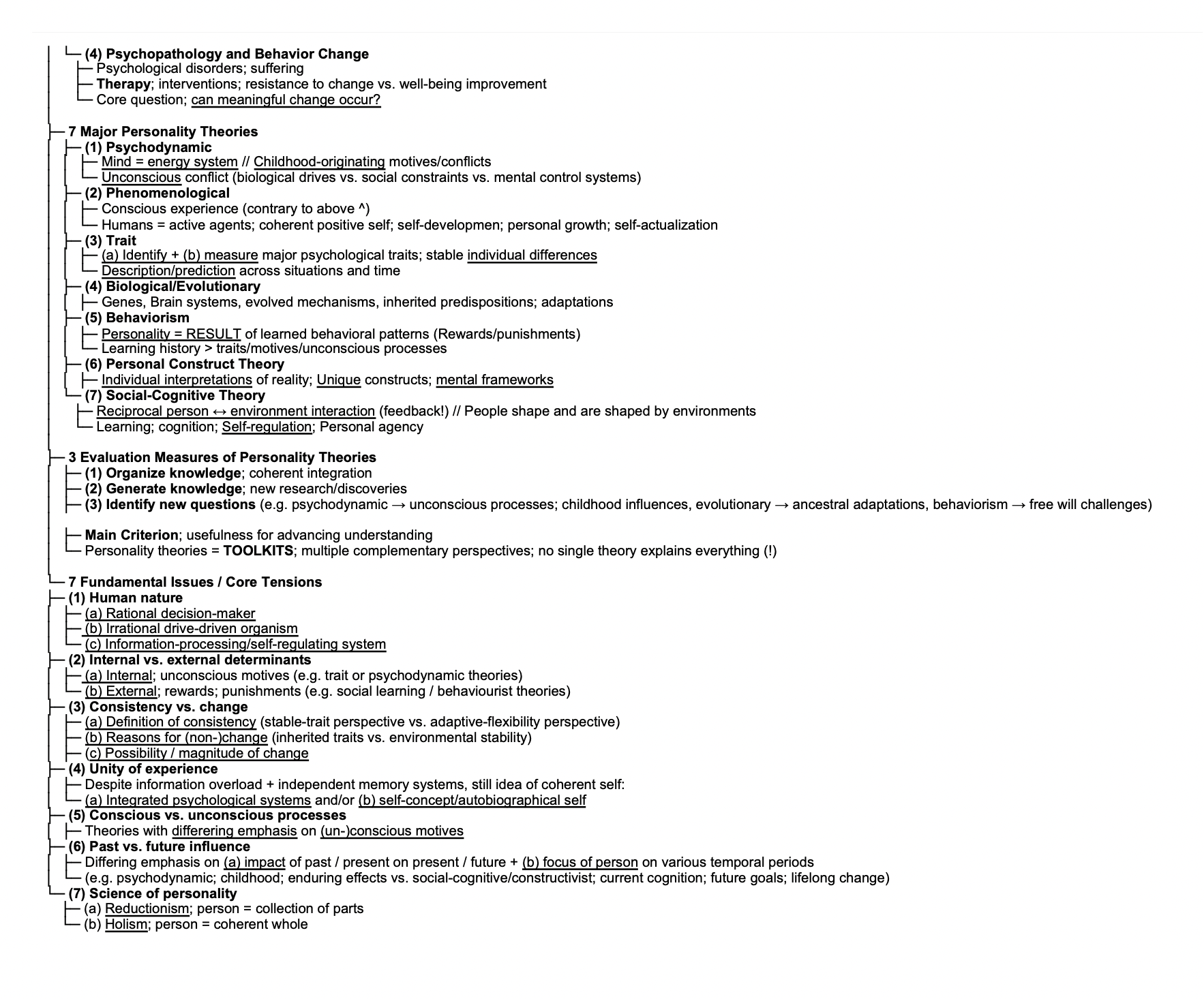
Psychopathology and Behavior Change (how personality changes / metamorphoses) → Explains psychological disorders, suffering, resistance to change + basis for therapy, interventions, and improving well-being → can theories can explain and facilitate meaningful change?
What are the major personality theories, and how does one go about evaluating them?
Major personality theories:
Psychodynamic theory: mind = energy system; personality = unconscious (!) conflict among biological drives, social constraints, and mental control systems; behavior driven by unconscious motives/conflicts originating in childhood
Phenomenological theory: emphasis on conscious experience, self-development, personal growth, self-actualization; humans = active (!) agents striving for fulfillment and a coherent positive self
Trait theory: (a) identifies and (b) measures stable individual differences; seeks major trait dimensions; traits used to describe and predict behavior across situations and time
Biological/Evolutionary theory: emphasis on genes, brain systems, evolved psychological mechanisms; personality explained through inherited predispositions, neural processes, and adaptations promoting survival/reproduction
Behaviorism: personality = RESULT (!) of learned behavioral patterns shaped by rewards and punishments; focus on learning history rather than traits, motives, or unconscious processes
Personal Construct Theory: personality reflects individual interpretations of reality; people develop unique constructs (mental frameworks) for understanding events, relationships, and experiences
Social-Cognitive Theory: reciprocal interaction between person and environment; emphasis on learning, cognition, self-regulation (!), personal agency; people both shape and are shaped by their environments
Evaluation of personality theories:
Organize knowledge: integrate findings into a coherent framework
Generate knowledge: stimulate new research and discoveries
Identify new questions: open previously unexplored areas of inquiry (e.g. psychodynamic theory → unconscious processes; childhood influences; Evolutionary theory → ancestral adaptations; Behaviorism → challenges to free will)
Toolkit perspective: No theory explains everything; Theories ≠ right vs. wrong; each provides unique concepts, methods, and explanatory tools → Evaluation criterion = usefulness for advancing understanding, not absolute correctness
What are the fundamental issues personality theories must address?
Philosophical view of human nature: Humans as (A) rational decision-makers vs. (B) irrational, drive-driven organisms vs. (C) information-processing / self-regulating systems → influenced by scientific evidence, personal beliefs, historical context, and culture
Internal vs. external determinants of behavior: Behavior caused primarily by (A) internal processes (e.g., unconscious motives / Freud; trait(s) theories!) vs. (B) environmental / external influences (e.g., rewards & punishments / Skinner; social learning (theories)) → Modern theories acknowledge both but differ in emphasis
Consistency across situations and time: Debate over (A) what constitutes personality consistency (stable-trait perspective vs. adaptive-flexibility perspective), (B) reasons behind it (inherited traits or stable environmental influences), (C) Question of how much personality can change
Self and unity of experience: Despite information overload (changing thoughts, emotions, experiences + relatively independent memory systems), individuals experience themselves as a coherent whole
Explanations: (A) integrated psychological systems or (B) self-concept / autobiographical self organizing experience into a coherent narrative
Consciousness and the unconscious: Much mental activity occurs outside awareness; some theories emphasize unconscious motives; others emphasize self-reflection and deliberate choice
Influence of past, present, and future: Are people prisoners of their past or active agents shaping their future? (psychodynamic theories → childhood experiences; enduring developmental influences vs. social-cognitive/constructivist theories → current cognition; future goals; lifelong capacity for change)
Can personality be a science? → Tension between person as (A) collection of parts (reductionism) vs. person as (B) coherent system whose whole exceeds the sum of its parts (holism)
Tree (PKP Kap. 1) 1/2
Tree (PKP Kap. 1) 2/2