Bio chem material
 Call Kai
 Learn
Learn Practice Test
 Spaced Repetition
 Match
Match Flashcards
 Knowt Play
1/60

There's no tags or description
Looks like no tags are added yet.
Name | Mastery | Learn | Test | Matching | Spaced | Call with Kai | Chat |
|---|
No analytics yet
Send a link to your students to track their progress
61 Terms
What are proteins made of?
Linear polymers of amino acid monomers.
Conformational flexibility
How proteins change their shape
What can binding to a protein cause?
A conformational change.
What four groups are attached to the α-carbon of an amino acid?
An amino group, carboxylic acid group, hydrogen atom, and R group/side chain.
Which amino acid isomers are found in proteins?
L-amino acid isomers.
What is a zwitterion?
A molecule with both a positive and negative charge; at neutral pH amino acids have NH3+ and COO− groups.
What are the four amino acid side-chain categories?
Hydrophobic, polar, positively charged, and negatively charged.
Which amino acids are hydrophobic/nonpolar?
Gly, Ala, Pro, Val, Leu, Ile, Met, Phe, and Trp.
Which amino acids are polar?
Ser, Thr, Tyr, Asn, Gln, Cys, and His.
How do hydrophobic amino acid side chains behave in water?
They do not interact well with water and pack together in compact protein structures.
What is the bulkiest hydrophobic amino acid?
Tryptophan.
What functional group does cysteine contain?
A sulfhydryl (thiol, -SH) group.
What can pairs of cysteine -SH groups form?
Disulfide bonds.
Histidine is often found in enzyme ____
Active sites.
Compared with hydrophobic amino acids, how are polar amino acid side chains different?
They are more hydrophilic and more reactive.
Why is histidine important in enzyme active sites?
Its pKa is near 6, so it can readily accept or donate protons near physiological pH.
Which amino acid contains a guanidinium group?
Arginine.
What is primary protein structure?
The specific amino acid sequence in a polypeptide chain.
What is another name for a peptide bond?
An amide bond.
What groups form a peptide bond
The α-carboxyl group of one amino acid and the α-amino group of another amino acid.
What is a residue?
An individual amino acid unit within a polypeptide.
What is the N-terminus
Has the free amino group; is always first
What is the C-terminus?
Has the free carboxyl group; is always last
Which backbone groups are hydrogen-bond acceptors
Carbonyl (C=O) groups
Which backbone groups are hydrogen-bond donors?
N-H groups
What is a key property of peptide bonds?
They are planar
How are disulfide bonds formed?
By oxidation of two cysteine residues; the linked pair is called cystine.
What is secondary protein structure?
Regular 3D structure formed by hydrogen bonds between nearby backbone N-H and C=O groups.
What are the main types of secondary structure?
α-helices, β-sheets, turns.
What stabilizes an α-helix?
Intrachain hydrogen bonds between the C=O of one residue and the N-H of the residue four positions ahead.
Where do R groups point in an α-helix?
Outward from the helix.
What stabilizes a β-sheet?
Hydrogen bonds between adjacent β-strands.
What are the possible arrangements of β-strands in a β-sheet?
Parallel, antiparallel, or mixed.
What is the main force that drives folding of globular proteins?
The hydrophobic effect.
What are fibrous proteins?
Long, extended proteins with repeated sequences that provide structural support.
What is hydroxyproline?
A post-translationally modified form of proline.
What does β-mercaptoethanol do to proteins?
It reduces disulfide bonds.
How can polypeptide chains change direction?
By making reverse turns (β turns/hairpin turns) or loops
What did ribonuclease refolding demonstrate?
A protein’s primary amino acid sequence contains the information needed for its correct 3D structure and function.
What structures in the core help hold a protein together?
β-sheets.
What is tertiary structure?
The overall fold of a polypeptide chain.
What type of amino acids are found almost exclusively in myoglobin’s interior?
Hydrophobic amino acids.
What type of amino acids are commonly found on a protein’s surface?
Charged amino acids.
What type of residues are usually found in the tightly packed interior of a protein?
Nonpolar residues.
What surrounds a water-filled channel in a membrane protein?
Polar and charged amino acids.
What is quaternary structure?
The spatial arrangement of protein subunits and the nature of their interactions.
What amino acids are in contact with the membrane in membrane-embedded proteins?
Hydrophobic amino acids.
What are fibrous proteins?
Proteins that form long, extended structures with repeated sequences.
What are examples of fibrous proteins?
α-Keratin and collagen.
What does urea disrupt in proteins?
Hydrogen bonds and electrostatic interactions.
What does β-mercaptoethanol (BME) reduce?
Disulfide bonds.
How many disulfide bonds does ribonuclease have?
Four.
Which amino acid forms disulfide bonds?
Cysteine.
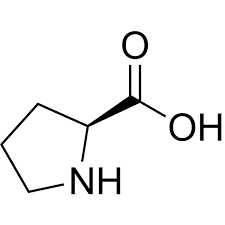
Which amino acid is known as an imino acid?
Proline.
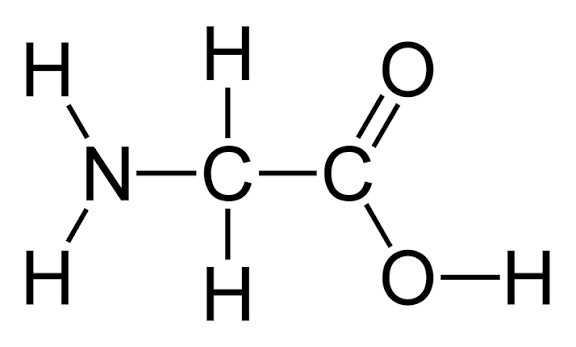
Which amino acid has a hydrogen atom as its side chain?
Glycine.
Which amino acids have planar aromatic side chains?
Phenylalanine, tryptophan, tyrosine, and histidine.
Which amino acids are positively charged at physiological pH?
Lysine and arginine.
Which amino acid can participate in acid-base chemistry and may be positively charged at physiological pH?
Histidine.
Which amino acids are negatively charged at physiological pH?
Aspartate and glutamate.
Why are peptide bonds planar?
Because of resonance
secondary structure
three-dimensional structure formed by hydrogen bonds between main chain N–H and C=O groups of amino acids nearby in the linear sequence