Cells and Tissues of the Immune System
 Call Kai
 Learn
Learn Practice Test
 Spaced Repetition
 Match
Match Flashcards
 Knowt Play
1/45

There's no tags or description
Looks like no tags are added yet.
Name | Mastery | Learn | Test | Matching | Spaced | Call with Kai | Chat |
|---|
No analytics yet
Send a link to your students to track their progress
46 Terms
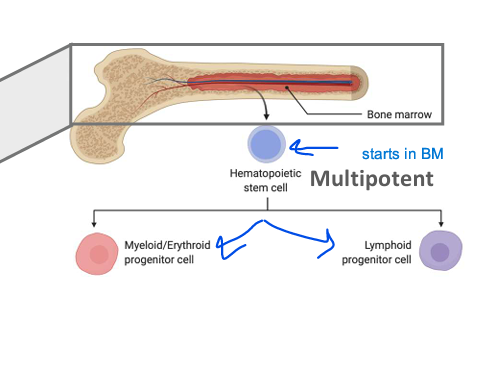
Hematopoiesis is the creation of ___.
Process starts in the BM as a Multipotent cell called: ___ stem cell. Where it can follow 2 different lineages: ___/Erythroid progenitor cell or ___ progenitor cell.
cells; hematopoietic; Myeloid; Lymphoid
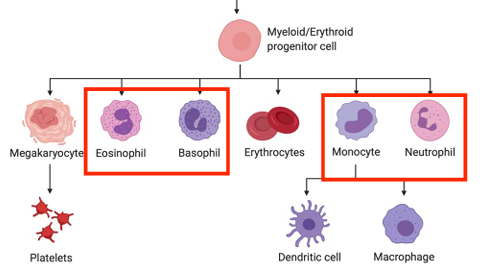
Immunology focuses on these cells in the Myeloid lineage:
-eosinophil
-basophil
-monocyte
-neutrophil
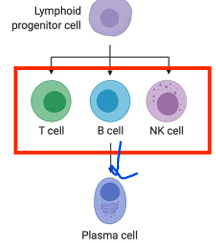
Immunology focuses on these cells in the Lymphoid lineage:
-T cell
-B cell
-NK cell
Lymphocytes are __-40% of peripheral WBCs.
Major types include: __ lymphs (T + B cells) and large lymph (__ cells).
You cannot differentiate between T and B cells by eyes, you would need ___ testing.
20; small; NK; further
To differentiate cells, we need ___ (Cluster of Differentiation) Markers.
Each cell has a very ___ set of these markers! It is used to determine what it is to track numbers or treatment, etc.
CD; specific
B Cells make up half of circulating lymphs, ___-20%.
Markers include:
-IgM and ___
-Fc receptor for ___ heavy chain
-___ for complement (CD35)
-___ molecules
-CD___
IgD; IgG; receptor; MHCII; 19

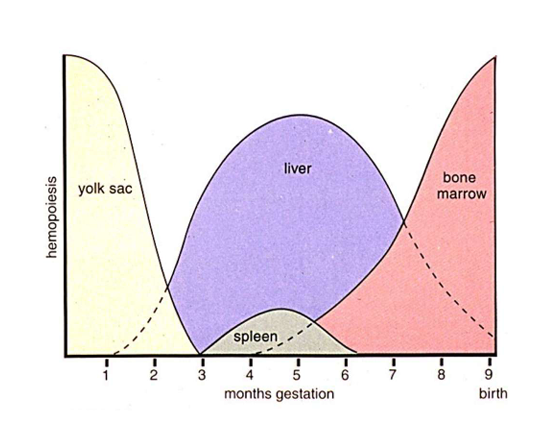
B Cell Maturation starts in the ___ ___ → (starts ~2 mon) liver + spleen → (start ~5 mon) ___ marrow
The two stages of differentiation are: Antigen Independent and ___
yolk sac; bone; dependent
In the B Cell Maturation process, a stem cell becomes a ___-B Cell that is ___ to BM stromal cell.
Pro; connected
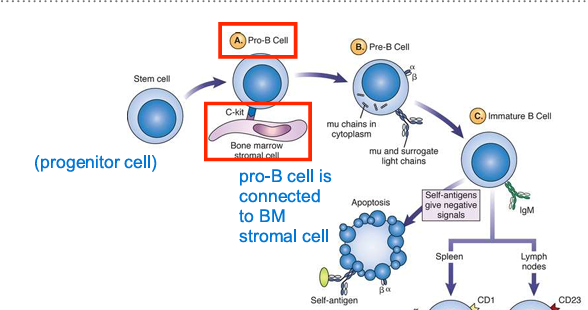
Pro-B cells become ___-B cells when ___ (μ) chains start to accumulate in cytoplasm.
Pre; mu

Once μ chains become very accumulated in Pre-B cells, they become ___ and are now present on the cell surface! This cell is now called an ___ B cell.
IgM; immature
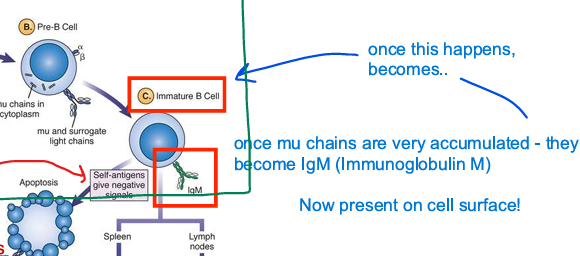
Immature B cells must undergo ___ selection, a process where self-antigens are presented to the B cell to see if they self-react. If they react, they will be forced to go through ___.
negative; apoptosis
If a immature B cell passes negative selection (they do not react), they leave the BM to the ___ ___ or spleen to finish maturation.
Lymph nodes
Which steps of the B cell maturation cycle take place in the bone marrow?
Stem, Pro, Pre, Immature, and neg selection
After an immature B cell leaves the BM, it gains IgM AND ___ - and is now considered ___.
IgD; mature
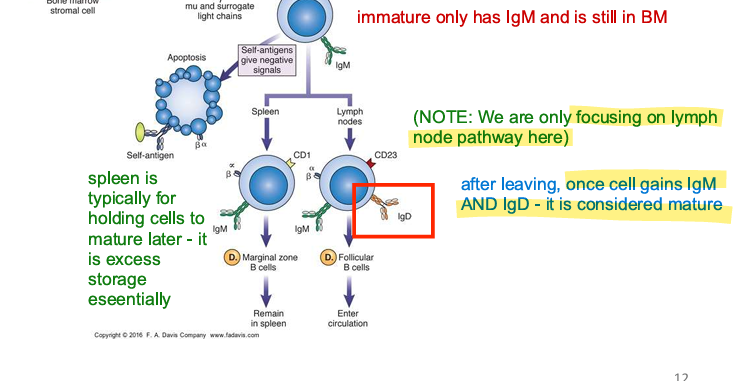
List the steps of B cell maturation from stem cell → mature B cell
Stem, Pro, Pre, Immature, Neg Selection, Mature Cell
Mature B cells hang in ___ and secondary lymphoid waiting for an ___ to respond to.
spleen; antigen

When an antigen is presented to a Mature B cell and ___ to IgD and/or IgM, a response is triggered and ___ the B cell.
binds; activates

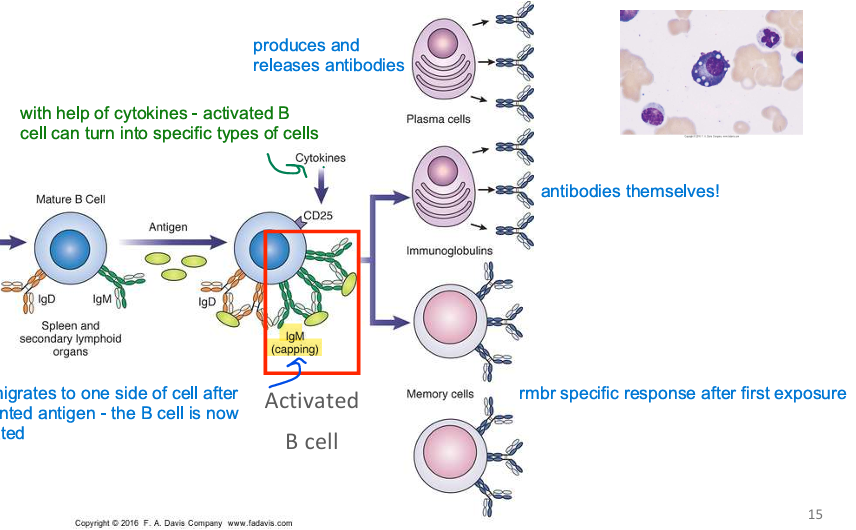
After an antigen binds to a mature B cell’s IgD and/or IgM, IgM ___ occurs and the B cell is now activated.
This is when IgM ___ to one side of the cell after presented an antigen.
capping; migrates
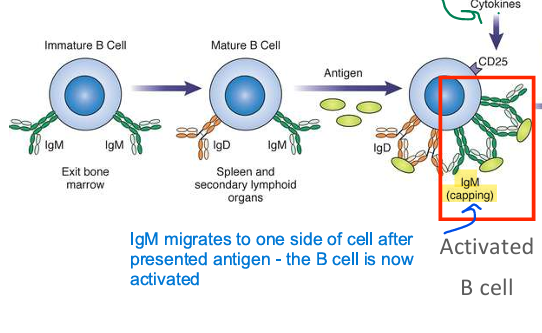
A mature B cell can turn into specific types of cells with the help of ___. This includes ___ cells (makes antibodies), ___ (antibodies themselves), and ___ cells after first exposure.
cytokines; plasma; immunoglobulins; memory
T cells make up ___-80% of circulating lymphocytes.
List the 4 important CD Markers:
60; CD2; CD3; CD4; CD8
Which CD markers do all T cells have?
CD2 and CD3
The CD marker for T Helper cells is ___.
CD4
The CD marker for Cytotoxic T Cells is ___.
CD8
T Cell differentiation starts with an ___ T-cell leaving the BM and entering the ___ to mature.
immature; Thymus
A double negative (DN) cell is an immature T cell who lacks both ___ and ___ (is unemployed).
A double positive (DP) has ___.
CD4; CD8; both
Immature T cell will first become a ___ cell, as it develops it will form both CD4 and CD8 to become a __ cell.
DN; DP
DP cells must undergo ___ selection - a mechanism that tests both CD markers react to ___I or II markers, making sure the cell ___ to what it’s supposed to react to.
positive; MHC; reacts
In T Cell Differentiation, the process from immature T cell to positive selection takes place in the Thymus ___.
cortex

In T Cell differentiation, Positive selection requires the “goldilocks” condition (needs to be just right).
Too strong of a bind between CD4/CD8 to MHC I or II= ___. Leading to ___.
Too weak of a bind between CD4/CD8 to MHC I or II= no ___. Leading to apoptosis.
Intermediate binding between CD4/CD8 to MHC I or II= just right. Passing positive selection and becoming a ___-positive cell (either T helper CD4 or Cytotoxic CD8).
Whichever marker is more ideal stays, the other gets ___ off! Only ONE can win!
autoimmune; apoptosis; reaction; single; cleaved
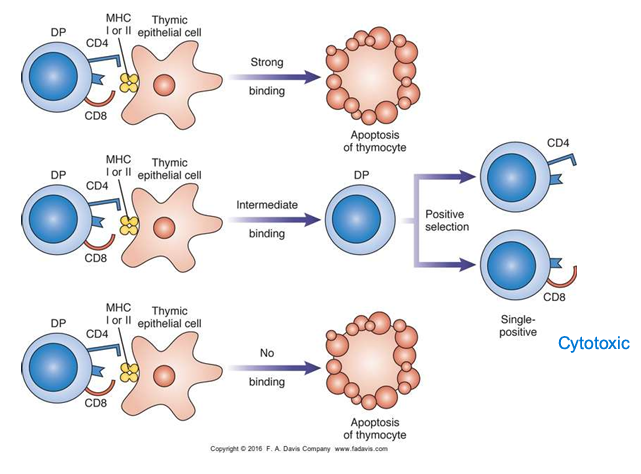
After development of a single pos cell, it moves to the ___ of Thymus to undergo ___ selection. If it passes, it will exit the Thymus and enter the body as a ___ T cell CD4 or CD8.
medulla; negative; mature
The T Cell Differentiation whole maturation takes about ___ weeks and only about ___% of T cells survive and exit the thymus (due to pos/neg selection).
3; 1
Pos selection - tests cells ability to react with what it is ___ to (cannot be too strong or too weak - must be ___)
Neg selection - tests cells against ___-antigens to make sure they do ___ react against self.
supposed; intermediate; self; not
T Cell subpopulations includes CD4+ Helper T Cells (Th1 + Th2) and CD8+ Cytotoxic T Cells.
T Helpers ___ other cells (such as B cells). Cytotoxic T cells destroy ___ infected or ___ cells.
helps; virally; tumor
Natural Killer (NK) Cells are ___ lymphocytes that make up ___-10% of circulating lymphs.
It’s specific marker is CD__: Fc receptor for ___.
It plays a role in ___-dependent cell mediated cytolysis. It also lyses virus infected or tumor cells without needing ___ immunization (innate).
Large; 5; 16; IgG; antibody; prior
Receptors on the NK cell recognize the ___ and release ___ granzymes, signaling the cell to die.
antibody; perforin
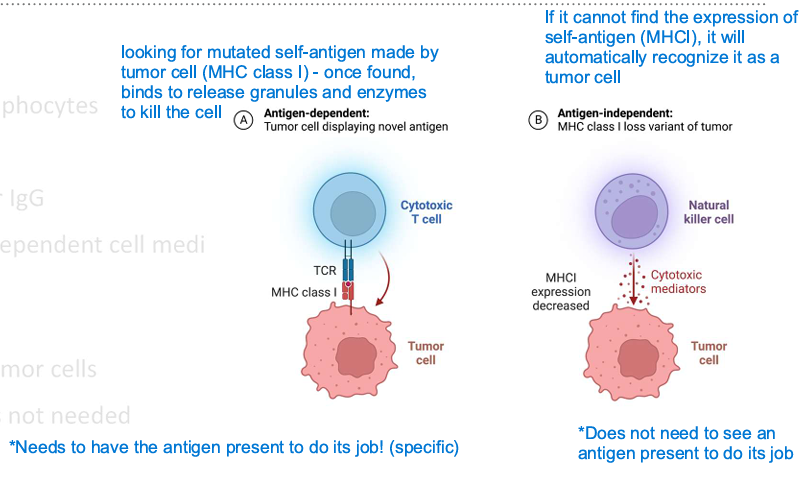
NK Cells can also kill in two different ways: Antigen-dependent and Antigen-Independent.
Antigen-dependent NK Cells require an ___ present on the infected cell to bind and kill the cell by releasing granules and enzymes.
Antigen-independent NK cells will kill a cell that does not have the ___-antigen (MHCI) present since it will automatically recognize it as a tumor cell. (NOTE: every cell in body has a MHC1 cell!)
antigen; self
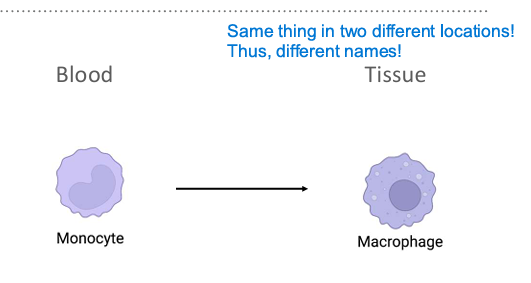
Monocytes/Macrophages make up ___-10% of circulating nucleated cells. Their two main functions are ___ and antigen presentation (MHC___).
Monocytes and Macrophages are the same thing but it two different locations. Monocytes = blood and Macrophages = ___.
4; phagocytosis; II; tissue
Neutrophils make up most of the body’s circulating nucleated cells around ___-70%. It is considered the ___ effective cell at Phagocytosis.
It also plays a role in acute inflammation, but it is very ___-lived. (few hours)
50; most; short
Eosinophils make up ___-3% of circulating nucleated cells and protect against ___ infections. It also ___ allergic responses.
1; parasitic; dampens
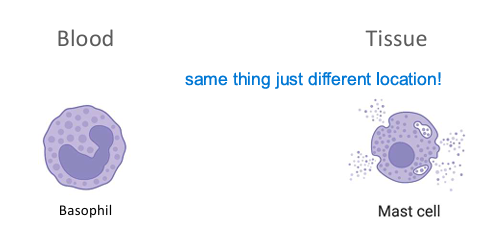
Basophils/Mast Cells make up ___% of circulating nucleated cells.
Mast cells are basophils that are found in the thymus, spleen, lung, GI tract, and bone marrow.
Markers include the Fc receptor for ___ heavy chain. They are also involved in ___ reactions and their granules affect ___.
IgE; Hypersensitivity; vasodilation
Primary Lymphoid Organs are the major sites of lymphopoiesis, an area for cells to ___. It includes the fetal ___, ___ ___, and ___.
liver; bone marrow; thymus
Secondary Lymphoid Organs creates an environment for ____, by trapping antigens, providing space for lymphocyte-____ interactions, and ___ the immune response products.
It includes the ___ nodes, ___, and ___.
interaction; antigen; exporting
Lymph; spleen; MALT
The spleen is an encapsulated organ that ___ blood - the total volume goes through ___x daily! It removes old/damaged cells and invading organisms.
Components:
Red pulp = destroys damaged ___.
White pulp = contains ___ and ____ (where antigen-lymphocyte reaction occurs)
filters; 4; RBCs; lymphocytes; macrophages
Lymph nodes are encapsulated organs strategically located along the lymphatic vessels where all lymph cells ___.
It filters lymph fluid and ___ invading organisms.
travel; traps
Mucosal Associated Lymphoid Tissue (MALT) is non-encapsulated. It includes your ___, adenoids, Peyer’s patches.
Considered first line of defense for ports of entry that are ___ or ingested (respiratory, gastrointestinal, urogenital tracts).
tonsils; inhaled
Cells ___ and are NOT stationary. Migration happens via circulatory and ___ systems.
Lymphs can circulate among secondary organs and ___ to the blood, increasing the likelihood that they will encounter ___ organisms.
migrate; lymphatic; invading