Chapter 1: The Study of Human Anatomy
 Call Kai
 Learn
Learn Practice Test
 Spaced Repetition
 Match
Match Flashcards
 Knowt Play
1/56

There's no tags or description
Looks like no tags are added yet.
Name | Mastery | Learn | Test | Matching | Spaced | Call with Kai | Chat |
|---|
No analytics yet
Send a link to your students to track their progress
57 Terms
Anatomy
study of the structural basis of body function.
Physiology
study of the functional relevance of a structure.
Functional morphology (3F’s)
“Form Follows Function”
Gross Anatomy (Cadaver Anatomy)
The word “anatomy” means to cut, and, for many centuries, the only way to visualize what lay beneath the skin was to perform cadaver dissections.
Inspection
Methods of Anatomical Study. Looking at surface appearance
Palpation
Methods of Anatomical Study. Feeling a structure
Auscultation
Methods of Anatomical Study. Listening to normal sounds
Percussion
Methods of Anatomical Study. Tapping and listening
Dissection
Methods of Anatomical Study. Cutting and separating of tissues
Radiology
branch of medicine concerned with imaging.
Invasive medical imaging
inserted into the body
non-invasive medical imaging
no penetration of the body
Radiography
Techniques of Radiology. X-ray or radiograph. Contrast medium – for visualization of hollow organs. Angiography – blood vessels
Computed Tomography (CT scan)
Techniques of Radiology. Cross-section X-rays (look at it from the direction of feet to head). Equivalent radiation doses of 100-200 simple chest X-rays
Magnetic Resonance Imaging (MRI)
Techniques of Radiology. Soft tissue visualization. Uses magnets, not radiation.
Positron Emission Tomography (PET)
Techniques of Radiology. Gamma ray detection. Nuclear medicine (use of radioisotopes). Used for finding active cell division/active sites in the body.
Sonography
Techniques of Radiology. reflection of ultrasound waves. Sonogram – obstetrics, emergency medicine, other diagnostic procedures. Echocardiography – beating heart.
Integumentary system
Principal organs: skin, hair, nails, cutaneous glands. Principal functions: protection, water retention, thermoregulation, vitamin D synthesis, cutaneous sensation, nonverbal communication.
skeletal system
Principal organs: bones, cartilages, ligaments. Principal functions: support, movement, protective enclosure of viscera, blood formation, mineral storage, electrolyte and acid-base balance.
muscular system
Principal organs: skeletal muscles. Principal functions: movement, stability, communication, control of body openings, heat production.
lymphatic system
Principal organs: lymph nodes, lymphatic vessels, thymus, spleen, tonsils. Principal functions: recovery of excess tissue fluid, detection of pathogens, production of immune cells, defense against disease.
respiratory system
Principal organs: nose, pharynx, larynx, trachea, bronchi, lungs. Principal functions: absorption of oxygen, discharge of carbon dioxide, acid-base balance, speech
digestive system
Principal organs: teeth, tongue, salivary glands, esophagus, stomach, small and large intestines, liver, gallbladder, pancreas. Principal functions: nutrient breakdown and absorption. liver functions include metabolism of carbohydrates, li[ids, proteins, vitamins, and minerals; synthesis of plasma protein; disposal of drugs, toxins, and hormones; and cleansing of blood.
nervous system
Principal organs: brain, spinal cord, nerves, ganglia. Principal functions: rapid internal communication, coordination, motor control, and sensation.
endocrine system
Principal organs: pituitary gland, pineal gland, thyroid gland, parathyroid glands, thymus, adrenal glands, pancreas, testes, ovaries. Principal functions: hormone production; internal chemical communication and coordination.
urinary system
principal organs: kidneys, ureters, urinary bladder, urethra. prinicpal functions: elimination of wastes; regulation of blood volume and pressure; stimulation of red blood cell formation; control of fluid, electrolyte, and acid-base balance; detoxification
male reproductive system
principal organs: testes, epididymites, spermatic ducts, seminal vesicles, prostate gland, bulbourethral glands, penis principal functions: production and delivery of sperm; secretion of sex hormones
female reproductive system
principal organs: ovaries, uterine tubes, uterus, vagina, mammary glands principal functions: production of eggs; site of fertilization and fetal development; fetal nourishment; birth; lactation; secretion of sex hormones.
Anatomical Position
Standing erect with feet flat, ankles together. Arms at the sides (supinated). Palms, face, and eyes facing forward. Provides a constant reference of body position. Note your reference vantage point for identifying left and right structures
prone
plane of reference. face down
supine
planes of reference. face up
frontal plane
planes of reference. Vertically cut in half. front and back half. anterior/posterior portions
sagittal plane
planes of reference. cut in half left and right sides. Median (midsagittal) plane – equal halves. Parasagittal – unequal right/left portions.
transverse plane
planes of reference. cut in half below the waist and above the waist. superior/inferior portions
anterior
toward the front of the body
posterior
toward the back of the body
ventral
toward the anterior side
dorsal
toward the posterior side
superior
above
inferior
below
medial
toward the midline of the body
lateral
away from the midline of the body
proximal
closer to the point of attachment or origin
distal
farther from the point of attachment or origin
superficial
closer to the body surface
deep
farther from the body surface
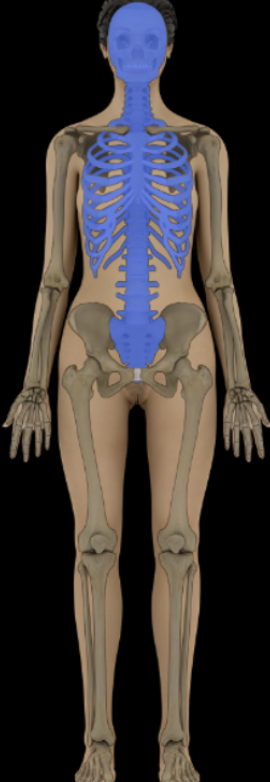
Axial Region of the Body
Head. Neck (cervical region). Trunk. Thoracic region. Lungs, Heart, Mediastinum. Abdominal region. Four quadrants. Nine regions. Lots and lots of organs

Appendicular Region of the Body
Shoulder Girdle & Upper limbs
• Scapula
• Clavicle
• Arm (brachial region)
• Forearm (antebrachial region)
• Wrist (carpal region)
• Hand (manual region)
• Fingers (digits)
• Pelvic Girdle & Lower limbs
• Pelvic Bones – Ileum, Ischium, Pubis
• Thigh (femoral region)
• Leg (crural region)
• Ankle (tarsal region)
• Foot (pedal region)
• Toes (digits)
Cranial cavity
Enclosed by cranium (braincase). Contains brain.
Vertebral canal
Enclosed by vertebral column (backbone). Contains spinal cord.
Thoracic cavity
Superior to the diaphragm
Mediastinum
lung and heart cavity
Pericardium
Pericardial cavity, a small, fluid-filled space located between the two layers of the serous pericardium surrounding the heart. Pericardial fluid.
Pleura
Pleural cavity, two fluid-filled spaces located inside the chest that surround the left and right lungs. Pleural fluid.
Abdominal cavity
Superior portion. Contains most of the digestive organs. Spleen, kidneys, and ureters.
Pelvic cavity
Inferior portion. Distal large intestine, urinary bladder, urethra, and reproductive organs
Peritoneum
Peritoneal cavity, a fluid-filled potential space inside the abdomen located between the parietal peritoneum (which lines the abdominal wall) and the visceral peritoneum (which covers abdominal organs). Retroperitoneal position–outside of peritoneum. Intraperitoneal –surrounded by peritoneum. Peritoneal fluid.