LO1-2 Drivers of Globalization
 Call Kai
 Learn
Learn Practice Test
 Spaced Repetition
 Match
Match Flashcards
 Knowt Play
1/53

There's no tags or description
Looks like no tags are added yet.
Name | Mastery | Learn | Test | Matching | Spaced | Call with Kai | Chat |
|---|
No analytics yet
Send a link to your students to track their progress
54 Terms
What are the two macro factors driving globalization?
The decline in barriers to trade and investment, and technological change.
What happened to trade barriers in the 1920s and 1930s?
Countries raised tariffs to protect domestic industries, leading to retaliatory trade policies and contributing to the Great Depression.
What is international trade?
When a firm exports goods or services to consumers in another country.
What is foreign direct investment (FDI)?
When a firm invests resources in business activities outside its home country.
What was the goal of Western nations after World War II?
To reduce barriers to the free flow of goods, services, and capital among nations.
What agreement was created to achieve this goal?
The General Agreement on Tariffs and Trade (GATT).
When did the first GATT negotiations go into effect?
1948.
What was the most recent GATT negotiation round called, and when was it completed?
The Uruguay Round, finalized in 1993.
What did the Uruguay Round accomplish?
It reduced trade barriers further, extended GATT to services, strengthened intellectual property protection, and created the World Trade Organization (WTO).
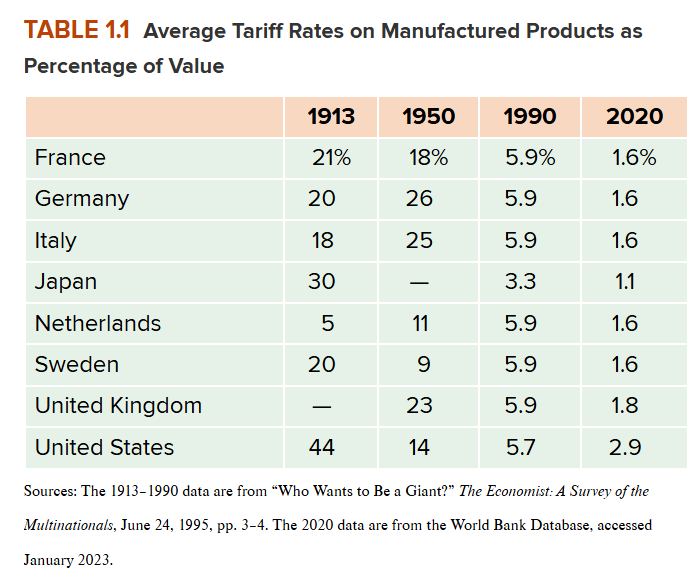
What does Table 1.1 show?
Average tariff rates on manufactured goods have fallen sharply since 1950 — now under 3%.
Besides GATT and WTO, what else reduced trade barriers?
Bilateral and regional trade agreements (EU, NAFTA/USMCA, U.S.–South Korea FTA).
Bilateral agreements: = between two countries (e.g., U.S.–South Korea Free Trade Agreement)
Regional agreements: = between multiple countries in a region (e.g., European Union, NAFTA/USMCA)
How many trade agreements existed in the early 1990s versus today?
Fewer than 50 in the early 1990s; around 300 today.

What does Figure 1.1 show?
Between 1960 and 2022, world GDP grew 9.5×, while merchandise trade grew 24.6×.
What was the value of world trade in goods and services in 2022?
Goods: $25 trillion; Services: $7 trillion.
Why did trade and output decline in 2020?
Due to the COVID‑19 pandemic.
How did trade recover after 2020?
Trade flows rebounded strongly in 2021 and 2022.
What percentage of FDI law changes between 2003–2020 made investment easier?
About 80%.
How did global FDI values change from 1990 to 2022?
1990: $244 billion → 2019: $1.5 trillion → 2020: $780 billion → 2021: $1.71 trillion → 2022: $1.3 trillion.
shows how global foreign direct investment (FDI) — money that companies invest directly in businesses or assets in other countries — has changed over time.
What does faster trade growth than GDP imply?
Firms are spreading production globally (like Boeing).
Economies are more interconnected.
The world is wealthier.
Trade is the engine driving global growth.
What does globalization of markets and production lead to?
It increases world trade, foreign direct investment, and imports, exposing home markets to foreign competition.
How does globalization affect competition?
It intensifies competition across industries as firms from different countries enter each other’s markets.
Give examples of globalization-driven competition.
In China: U.S. firms like Apple, GM, and Starbucks expanded.
In the U.S.: Japanese automakers took market share from GM and Ford.
In Europe: Philips lost ground to Sony, Panasonic, Samsung, and LG.
What is the overall effect of global integration?
It creates a single, interconnected marketplace with fierce competition in manufacturing and services.
Why can declining trade barriers not be taken for granted?
Because demands for protection from foreign competitors still exist in many countries.
What happened after the 2008–2009 global financial crisis?
Calls for higher trade barriers increased to protect domestic jobs.
How did Donald Trump’s presidency reflect protectionist trends?
He advocated higher trade barriers and launched a trade war in 2018, imposing tariffs on steel, aluminum, and Chinese imports.
How did China respond to U.S. tariffs?
By imposing tariffs on American goods entering China.
What could rising trade barriers lead to?
A slowdown in the globalization of both markets and production.
How did the COVID-19 pandemic affect globalization?
It disrupted global supply chains and made companies reconsider their globalization strategies.
What new trend emerged after COVID-19?
Some firms began moving production closer to home to reduce risks from future disruptions.
How much did world trade decline in 2020 due to COVID-19?
Around 8%, followed by a strong rebound in 2021.
What is the overall impact of these events on globalization?
Trade wars and pandemics have slowed globalization, but global trade remains resilient and continues to recover.
What made globalization possible in theory
The lowering of trade barriers.
What made globalization a tangible reality?
Technological change.
What major technological areas drive globalization?
Communication, information processing, and transportation technologies.
What is the most important innovation since WWII?
The microprocessor.
How did the microprocessor enable globalization?
It made high‑power, low‑cost computing possible and supports modern telecommunications.
What technologies rely on microprocessors?
Satellites, optical fiber, wireless networks, the Internet, and the Internet of Things (IoT).
What does Moore’s Law state?
Microprocessor power doubles and cost halves every 18 months.
How many Internet users were there in 1990 vs. 2022?
1990: <1 million; 2022: ~5.5 billion (69% of global population).
Why is the Internet the backbone of the global economy?
It enables global communication, e‑commerce, and coordination of worldwide production.
What were North American and global e‑commerce sales in 2022?
North America: $1 trillion; Global: $5.7 trillion
How does the Internet act as an “equalizer”?
It removes constraints of location, scale, and time zones, letting buyers and sellers connect anywhere.
How does the Internet help global production?
It allows firms to coordinate globally dispersed suppliers in real time.
What transportation innovations matter most for globalization?
Commercial jet aircraft, superfreighters, and containerization.
How did jet travel affect globalization?
It drastically reduced travel time, effectively “shrinking” the world.
What is containerization?
A system using standardized containers to move goods easily between ships, trucks, and trains.
How did containerization change shipping?
It cut labor, time, and cost dramatically — making global shipping cheap and efficient
How does tech enable global production systems?
Lower communication and transport costs make it economical to spread production worldwide.
How does Dell use technology for global production?
It uses the Internet to coordinate suppliers, holds only 3 days of inventory, and outsources customer service to India.
How does tech globalize markets?
Low‑cost communication and transportation create global marketplaces and reduce cultural distance
How do global media contribute to globalization?
Networks like CNN, HBO, BBC, Al Jazeera, and streaming platforms spread culture worldwide.
What is evidence of global consumer culture?
McDonald’s in Tokyo, iPads in Rio, Gap jeans in Paris — same products everywhere.
What caution does the text give about globalization?
National differences in culture, preferences, and business practices still matter; firms must not ignore them.