MAE488 Exam 1
 Call Kai
 Learn
Learn Practice Test
 Spaced Repetition
 Match
Match Flashcards
 Knowt Play
1/144

There's no tags or description
Looks like no tags are added yet.
Name | Mastery | Learn | Test | Matching | Spaced | Call with Kai | Chat |
|---|
No analytics yet
Send a link to your students to track their progress
145 Terms
What is a system?
An element or a combination of elements intended to act together which is designed to accomplish an objective.
What is an input?
An external cause or causes.
What is an output?
An effect or effects that results from one or more input.
What is an input-output relationship?
A description of how the input affects the output (usually called the mathematical model or just model).
What is the state of an element?
The particular condition that it is in at a specific time.
The state of an element or system is the particular condition that it is in at ALL times, true or false?
False
What is a static element?
An element where the current output or state depends only on the current input. A static system contains only static elements. A static element doesn't change with time.
What is a dynamic element?
An element where the current output or state depends only on past and current input. A dynamic system contains at least one dynamic element.
What is a causal element?
An element (or system) where the current output does not depend on future input. A causal system contains only causal elements. Can be physically realized.
What is a non-causal element?
An element where the current output depends on future input. A non-causal system contains at least one non-causal element. Can only exist mathematically.
The current output of a static system depends only on _____ input.
Current
The current output of a dynamic system depends only on ____ input.
Past, current
The current output of a causal system does NOT depend on ____.
Future
A dynamic system is causal ,true or false?
True
A causal system can be physically realized, true or false?
True
What is a linear element?
An element that obeys the superposition principle.
What are the two properties of the superposition principle?
1. The additive property
2. The homogeneous property
What is the additive property? Hint: this will look like an equation.
f(x+y) = f(x) + f(y)
What is the homogeneous property? Hint: this will look like an equation.
f(ax) = af(x)∀a
If two inputs are added together to create a new input, and the system satisfies the additive property, then the output of the system will be the ___ of the outputs.
sum
The _____ can be used to linearize a function.
Taylor series expansion.
What is modelling?
The process of simplifying a system and applying the appropriate fundamental principles to create a useful mathematical model of the system.
What makes an ODE homogeneous?
If after rearranging properly (dependent variable is output, right hand side is the input), the right side is equal to 0.
What makes an ODE linear?
If after rearranging properly, the left hand side contains only linear terms (no nonlinear functions and no products of the dependent variable and/or derivatives with itself).
What makes an ODE variable coefficient?
If the coefficient of the dependent variable are a function of the independent variable.
If an ODE is not variable coefficient, what is it?
Constant coefficient ODE.
What is the order of an ODE?
The order of the highest derivative of the dependent variable.
What is the order of a system of ODEs?
The sum of the orders of the highest derivative of the dependent variable in each equation.
From a systems point of view, the solution of an ODE is the output of the corresponding system, true or false?
True
What is the characteristic root?
s = -a
What is the characteristic equation?
s + a = 0
Complex roots always occur as what?
Complex conjugate pairs.
The product of a complex number and its complex conjugate is what?
A real number.
What is the impulse input signal?
c𝛿(t)
What is the step input signal?
cu(t) = {0,t<0; c,t>0
What is the ramp input signal?
r(t)=ct
What is the parabolic input signal?
p(t)=ct^2
What is the sinusoid input signal?
csin(ω𝑡 + 𝜙)
What is the derivative of a parabolic signal?
A ramp signal.
What is the integral of a ramp signal?
A parabolic signal.
What is the unit step function and what is it used for?
u(t) = {0, t<0; 1, t>0
Used to "zero" a function for all time <0.
What is the Laplace equivalent of differentiation in the time domain?
Multiplication by s in the Laplace domain.
What is the Laplace equivalent of integration in the time domain?
Division by s in the Laplace domain.
When is the final value theorem valid?
Both x(t) and dx/dt have Laplace transforms.
x(t) approaches a constant value as t--> infinity.
What does the FVT tell us?
The final (steady-state) value.
Does L{x(t)y(t)} = X(s)Y(s)?
NO.
What are the 3 steps of solving an ODE with the Laplace transform?
1. Take the Laplace transform of both sides of the ODE
2. Solve for the dependent variable as a function of s (e.g., X(s))
3. Take the inverse Laplace transform of the result to obtain the solution (e.g., x(t))
If the inverse Laplace transform of a general first order system is X(s), what is the step response?
x(t)
Most s domain functions can be represented as a ____ function of s?
Rational function.
What is the general form of PFE?
X(s) = N(s)/D(s)
What is D(s)?
The characteristic polynomial.
What is D(s) = 0?
The characteristic equation.
What roots are required for PFE?
Real or pairs of complex conjugates.
What is multiplicity?
Repeated roots.
What is the free response of an inverse Laplace transform?
AKA initial condition response. Part of the response that is due to the initial condition. If the initial conditions are zero, there is no free response.
If initial conditions are zero, is there a free response/initial condition response?
No
What is the forced response of an inverse Laplace transform?
The part of the response due to the forcing function (input). If the input is zero, there is no forced response.
When is there no forced response?
When the input is zero.
What is the steady-state response of an inverse Laplace transform?
The part of the response that remains with time.
Can a steady-state response be zero?
Yes
What is the transient response of an inverse Laplace transform?
The part of the response that decays to zero with time.
Can the transient response be zero?
Yes
What is the complete response?
The sum of the free and forced response or the sum of the steady-state and transient response.
What is the time constant, τ?
1/a, a>0
The measure of the speed of decay of an exponentially decaying signal.
Given the solution of a general first order system, what is the expression for free response?
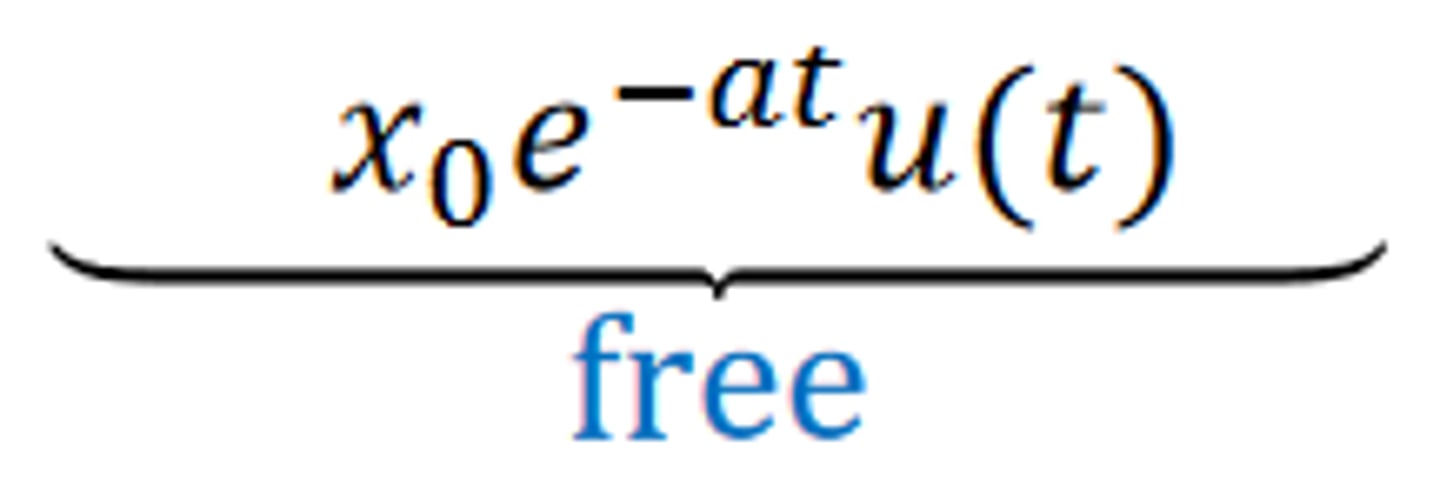
Given the solution of a general first order system, what is the expression for forced response?
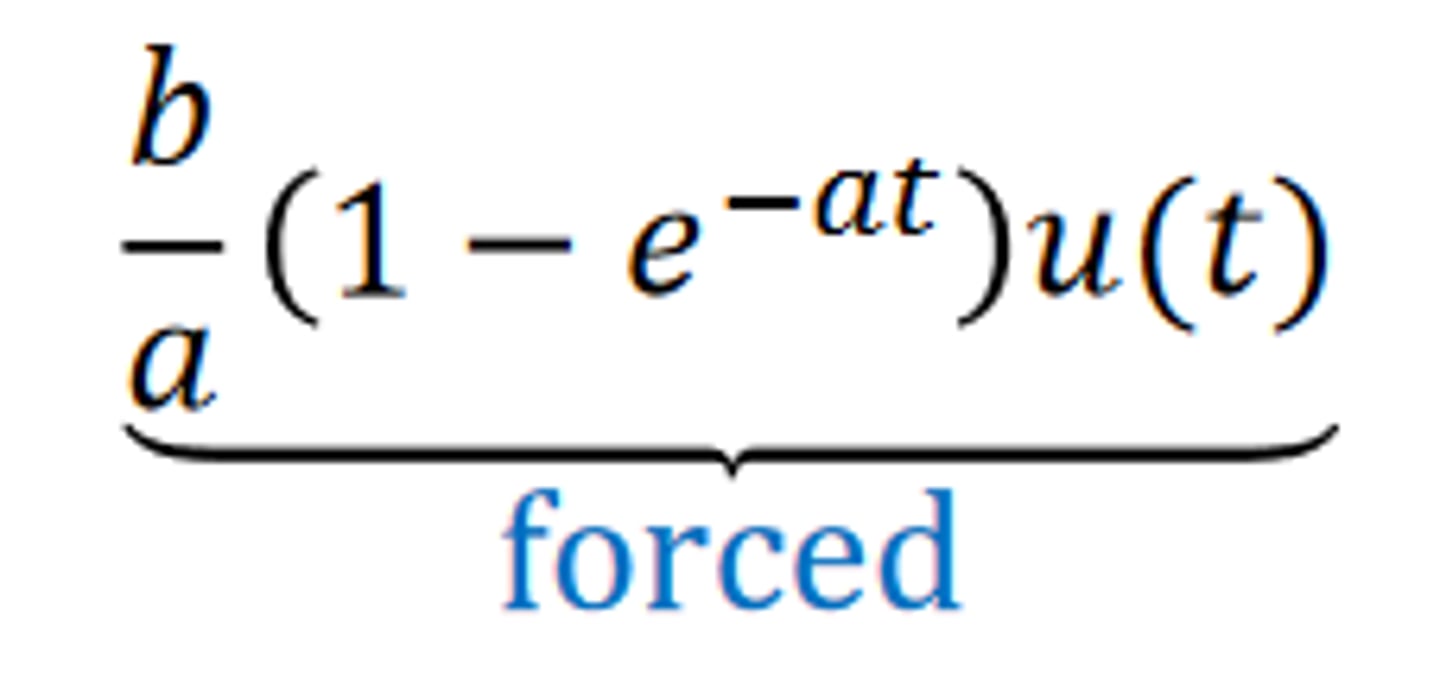
Given the solution of a general first order system, what is the expression for steady-state response?
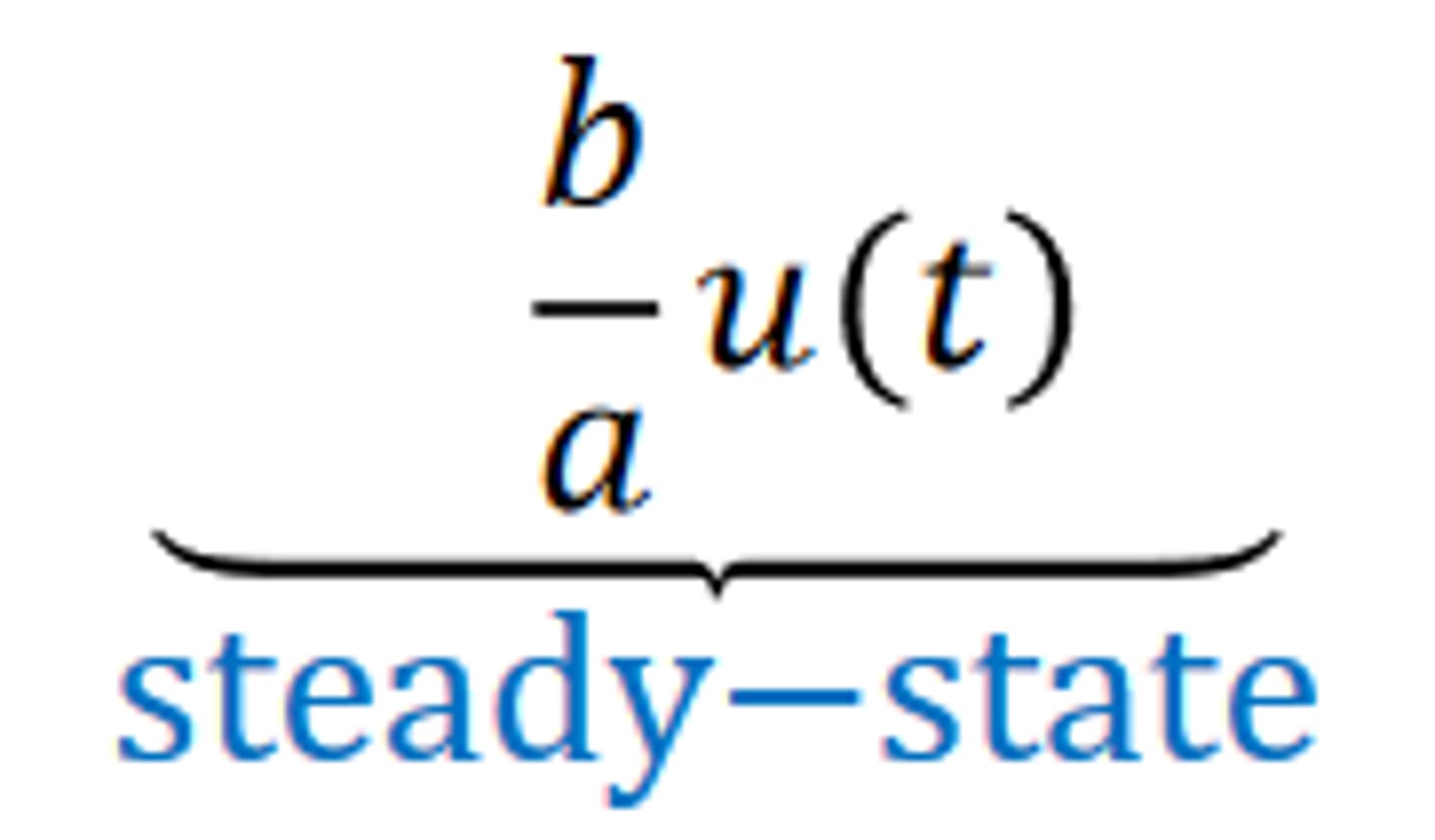
Given the solution of a general first order system, what is the expression for transient response?
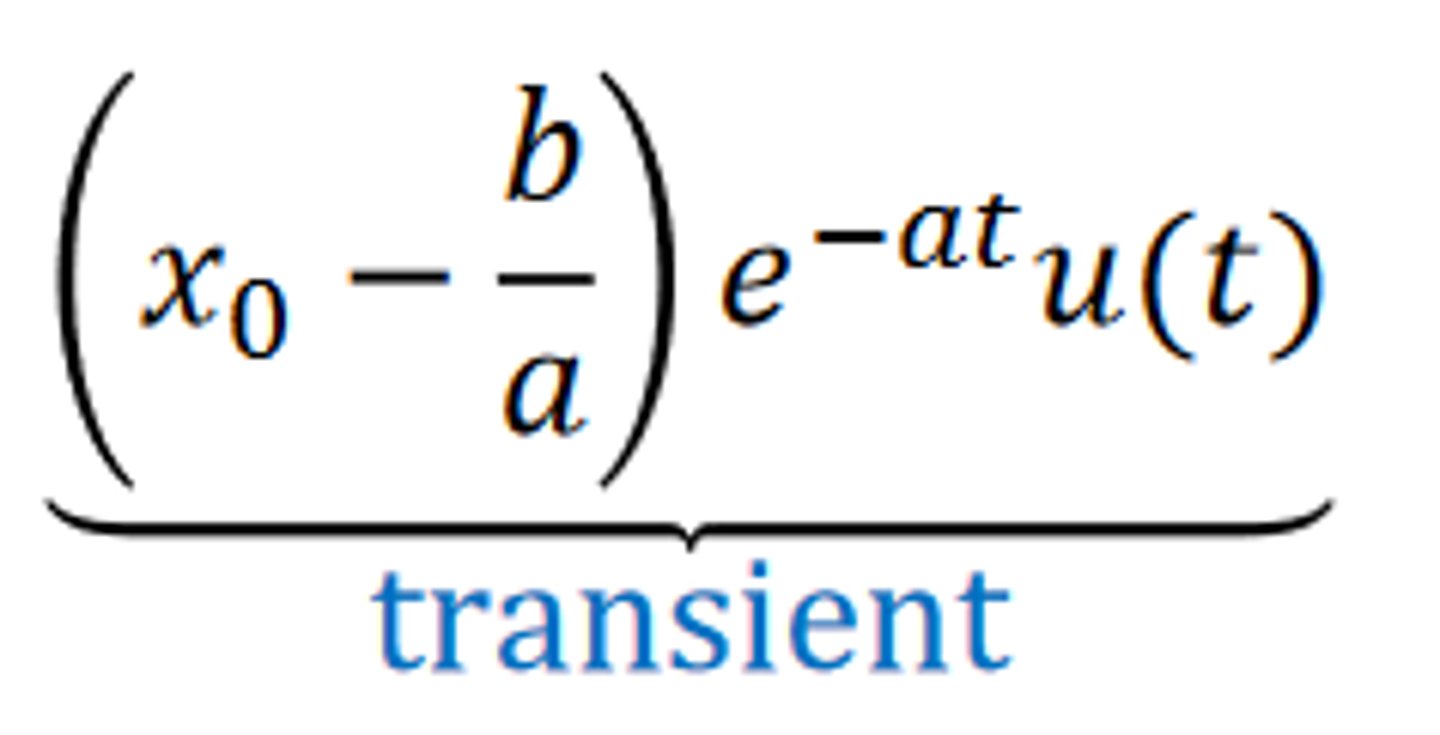
For what value
In one time constant, how much has a signal decayed?
63%
What is the natural frequency of the system?
ω = sqrt(k/m) rad/s or 1/s
What is the damped natural frequency?
The frequency of oscillation of the free response.
β=ω_d=sqrt((k/m)-(c/2m)^2)
What is the effect of the damping coefficient, c?
To reduce the frequency of oscillation from the natural frequency.
What happens if c=0?
The system doesn't have any damping and ω_d=ω_n.
What happens if c is greater or equal to 2sqrt(mk)?
ω_d=0 or imaginary, in which case the roots of the characteristic equation will be real and the system will not oscillate.
What is the ODE and characteristic equation of a general 2nd order homogeneous ODE which corresponds to a mass-spring-damper system with mass m, damping coefficient c, and spring constant k, and no forcing function?
mẍ + cẋ + kx = 0: ODE
ms^2+cs+k = 0: characteristic eqn
Consider the step response of a 2nd order system with complex conjugate roots. If the damping ratio increases, what happens to the time constant?
Time constant decreases (τ = 1/ζω_n)
What is the value of c for which ω_d=0?
c = 2sqrt(mk), both roots are real and equal
c = 2sqrt(mk) is the dividing line for what?
Between an oscillatory response and an non-oscillatory response.
What is the critical damping value?
c = 2sqrt(mk)
What is the damping ratio, zeta?
The ratio of the actual value of c to the critical damping value.
ζ = c/2sqrt(mk)
What is T(s)=X(s)/F(s)=1/(s+a)?
The transfer function of a non homogeneous first order ODE assuming zero initial conditions.
What is the standard 2nd order transfer function expression?
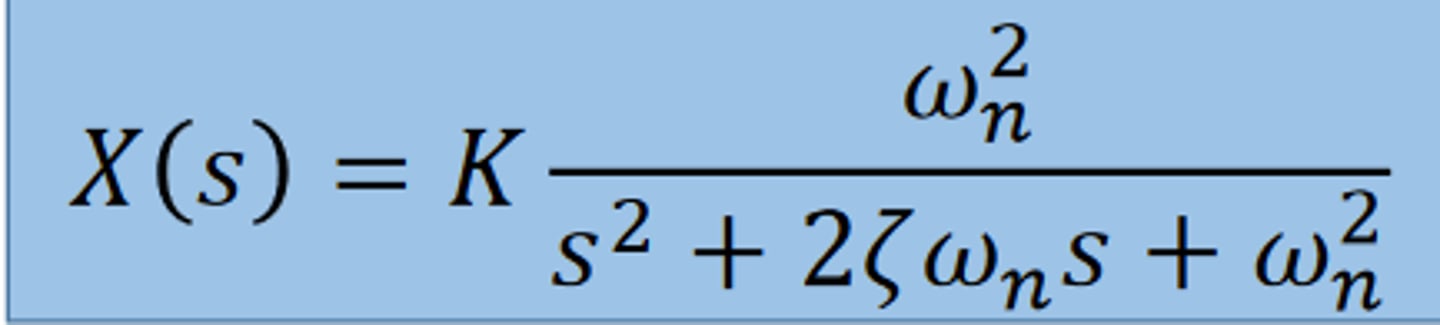
What is the characteristic polynomial of a transfer function?
F(s) or denominator
The transfer function is independent of the initial conditions and the input, true or false?
True
The transfer function can be used to calculate the free response, true or false?
False
What is the impulse function?
Similar to a pulse function but represents an input that is applied and then removed after a very short time.
The derivative of a parabolic input is a. The derivative of a is b. What are a and b?
The derivative of a parabolic input is a ramp input. The derivative of a ramp input is a step input.
What is the derivative of a step input?
The unit impulse function or Dirac delta function is the derivative of the unit step function. δ(t) = d/dt[u_s(t)].
What are the properties of the unit impulse?
1. δ(0) --> infinity
2. δ(t) = 0, t does not equal 0
3. The integral of -infinity to infinity δ(t)dt= 1 = L{δ(t)}.
What is the Dirac delta function?
Unit impulse function.
A transfer function is the Laplace transform of the input divided by the Laplace transform of the output, true or false?
False
What does it mean if a system has numerator dynamics?
It has derivatives of the input. ex. X(s)/G(s) = as+6/(3s^2+18s+24) where a does not equal 0.
What is equilibrium?
A state that is not changing.
What is a stable system?
A system that eventually returns to equilibrium if disturbed.
What is a globally stable system?
A system stable for any condition.
What is a locally stable system?
A system stable only for some initial conditions.
What is a marginally stable system?
A system that will oscillate about an equilibrium point.
What is global stability a characteristic of?
A characteristic of the system, not the initial conditions or the input.
Is global stability a characteristic of the initial conditions?
No