Working Memory Model
 Call Kai
 Learn
Learn Practice Test
 Spaced Repetition
 Match
Match Flashcards
 Knowt Play
1/12

There's no tags or description
Looks like no tags are added yet.
Name | Mastery | Learn | Test | Matching | Spaced | Call with Kai | Chat |
|---|
No analytics yet
Send a link to your students to track their progress
13 Terms
What is the context of the WMM?
STM more useful than MSM suggested
Rehearsal is not the only way that info get to LTM
MSM’s STM cannot example dual task performance
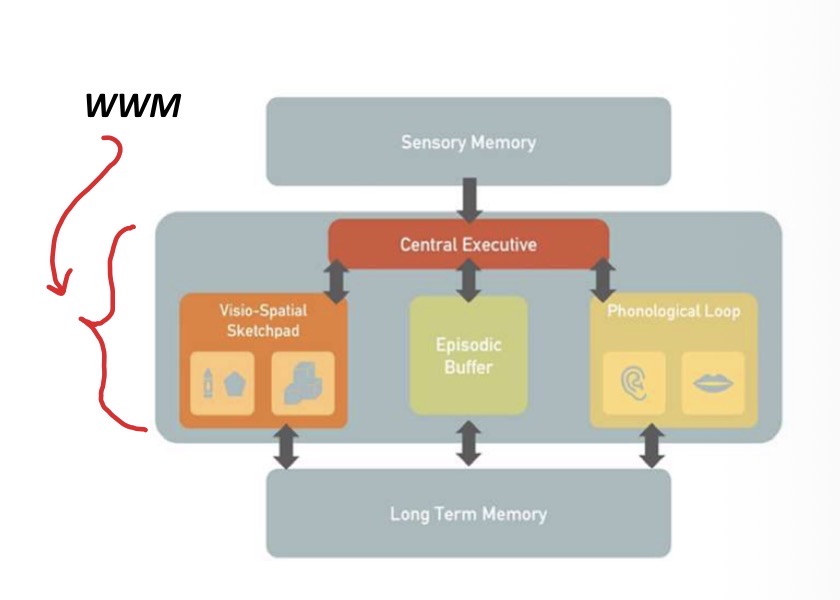
What is the WMM?
a multi-component, flexible system
A dynamic & active processor of different types of info
Short term storage of info (like STM)
Processes info which we are consciously aware of
What does the WMM comprise of?
central executive
Visio-spatial sketchpad
Episodic buffer
Phonological loop
Describe the central executive
Controls attention and the subsystems
Receives info from SM and allocates it to the appropriate subsystem
Processes info in any modality
Limited capacity = 3-5 item
Describe the Visio-spatial sketchpad
Inner eye
Stores and processes visual and spatial info
Sets up and manipulates mental image - elephant & ice hockey
Has 2 components
Visual cache - passive store of form and colour
Inner scribe - an active store - concerned with the spatial arrangement of objects
Describe the episodic buffer
Added in 2000
Integrates and manipulates info from CE, VSS, PL & LTM
Allows us to 'work' on information
Limited capacity = ~ 4 items
Who created the WMM?
Baddeley & Hitch (1974)
Draw a diagram of the WMM
Describe the phonological loop
Stores and processes speech and language based information
Limited capacity - how much you can say in 2s
2 components
Phonological store - inner ear
Stores words recently heard
Articulatory process - inner voice
Subvocal repetition - maintenance rehearsal
How does Baddeley’s Dual Task Effect support WMM?
P: asked Ps to perform 2 tasks at the same time - 2 visual tasks, 1 visual and 1 verbal task
E: visual and verbal performed much enter at both tasks
T:
no competition win the subsystems when performing a verbal and visual task together
Shows there must be a separate subsystem that processes visual input & verbal processing
How does a case study support WMM?
P: Case Study of KF
E:
forgot more auditory info than visual info
Auditory forgetting was worse for verbal material e.g. letters/digits - but not for meaningful sounds
T:
suggests PL was damaged but VVS was intact
Findings strongly supports the existence of separate visual & acoustic memory stores
But case studies cannot be generalised to the population
How does the central executive refute the WMM?
P: argued concept of CE is too vague and doesn’t really explain anything
E:
Seems to be the same as ‘attention’
Case study EVR with cerebral tumour removed - performed well on reasoning tests but had poor decision making skills
Shows parts of CE intact and other parts not wholly intact
T:
shows there’s more likely several components to CE
Probably more complex than Baddeley suggested
How the WMM actively processing info refute the model?
P: active processing component is responsible for higher level cognitive functions e.g. problem-solving
E:
working memory’s strength as an active processor is inextricably linked to its vulnerability to overload
Can result in slower processing and breakdown in performance
T: explains why tasks requiring attention to multiple pieces of info can be challenging and prone too errors