L3 (Galbraith): Pharmaceutics parenterals
 Call Kai
 Learn
Learn Practice Test
 Spaced Repetition
 Match
Match Flashcards
 Knowt Play
1/64

There's no tags or description
Looks like no tags are added yet.
Name | Mastery | Learn | Test | Matching | Spaced | Call with Kai | Chat |
|---|
No analytics yet
Send a link to your students to track their progress
65 Terms
Obj. 1
Explain the use of a laminar flow hood as the primary engineering control (PEC).
🔹Q: What is Laminar Flow Hood?
a PEC (Primary Engineering Control) used in sterile compounding to provide a clean ISO 5 environment for preparing STERILE products.
Obj. 1
🔹Q: What is the purpose of a laminar flow hood?
To ⬇reduce contamination during sterile compounding by providing continuous HEPA-filtered airflow over the work area.
Obj. 1
🔹Q: What does “laminar airflow” mean?
Air moved in smooth, parallel, unidirectional streams to sweep particles AWAY from the sterile compounding area.
Obj. 1
🔹Q: What type of air filtration is used in laminar flow hoods?
HEPA (High-Efficiency Particulate Air) filtration.
Obj. 1
🔹Q: What ISO classification environment does a PEC provide?
ISO Class 5 air quality.
Obj. 1
🔹Q: What is PEC short for?
Primary Engineering Control.
Obj. 1
🔹Q: Why must airflow in the hood remain UNOBSTRUCTED?
Blocking airflow can DISRUPT the sterile air pattern & ⬆increase 🦠contamination risk
Obj. 2
Define terms: Storage Time, Beyond Use Date (BUD), and Expiration.
🔹Q: What is Storage Time?
The amt. of time a compounded preparation can be STORED under specified conditions BEFORE administration or disposal.
Obj. 2
🔹Q: What is BUD (Beyond Use Date)?
The date or time after which a COMPOUNDED sterile preparation (CSP) should NOT be used.
assigned based on stability & sterility consideration.
Obj. 2
🔹Q: What is Expiration Date?
MANUFACTURER-assigned date indication how long a Commercially manufactured product is expected to remain stable & effective under proper storage conditions.
Obj. 3
Define the terms: sterile, pyrogen free, and endotoxin level.
🔹Q: What does Sterile mean?
COMPLETELY FREE of viable microorganisms.
Obj. 3
🔹Q: Why is sterility important for parenteral products?
Parenteral products bypass the body’s normal protective barriers, so contamination with microorganisms can cause serious infection.
Obj. 3
🔹Q: What does Pyrogen-free mean?
FREE of FEVER-producing substances.
Obj. 3
🔹Q: What are Endotoxins?
Pyrogenic substances derived from the outer membrane of Gram (-) bacterial.
Obj. 3
🔹Q: What is Endotoxin Level?
The amt. of BACTERIAL ENDOTOXINS present in a preparation.
Obj. 3
🔹Q: Can a product be STERILE but still contain PYROGENS / ENDOTOXINS?
Yes.
A product may have NO living microorganism, but still contain FEVER-causing endotoxins.
Obj. 3
🧠Sterile, Pyrogen-free, & Endotoxin
Sterile = NO microbes
Pyrogen-free = NO FEVER-causing materials
Endotoxin = Bacterial fever toxin
Obj. 4
Explain the difference between sterile and nonsterile isopropyl alcohol (IPA).
🔹Q: What is isopropyl alcohol (IPA) used for in sterile compounding?
Disinfectant/sanitizing agent to ⬇reduce microbial 🦠contamination during sterile compounding.
Obj. 4
🔹Q: What is sterile IPA?
Sterile IPA is isopropyl alcohol that has been sterilized and is free of viable microorganisms.
It is used inside ISO 5 sterile compounding areas.
Obj. 4
🔹Q: What is NON-sterile IPA?
Nonsterile IPA is REGULAR isopropyl alcohol that is not guaranteed to be free of microorganisms.
Obj. 4
🔹Q: Where should STERILE IPA be used?
Inside critical sterile compounding areas such as:
ISO 5 PECs
laminar flow hoods
direct compounding areas
Obj. 4
🔹Q: Where is NON-sterile IPA commonly used?
Nonsterile IPA may be used for cleaning NONCRITICAL outer surfaces or general areas outside the sterile critical compounding zone.
Obj. 5
Contrast the physical characteristics of drugs administered intravenously, intramuscularly, subcutaneously, intradermal, intrathecal, and intraperitoneally.
🔹Q: What are important physical characteristics of IV drugs?
IV drugs:
must be sterile
must be pyrogen-free
are usually isotonic
should have appropriate pH
are typically aqueous solutions
can be given in large volume
Obj. 5
🔹Q: Why must IV drugs be isotonic and carefully pH-controlled?
Because irritating or highly hypertonic/hypotonic solutions can damage blood vessels and blood cells.
Obj. 5
🔹Q: What are important physical characteristics of IM drugs?
IM drugs:
may be aqueous OR oily
can be suspensions
tolerate moderate irritation
have moderate injection volumes
Obj. 5
🔹Q: Why can oily solutions be given IM but NOT IV?
➡IV: Oil injected IV could cause emboli.
➡IM: muscle tissue can tolerate depot/oily preparations.
Obj. 5
🔹Q: What are important physical characteristics of SubQ drugs?
SubQ drugs:
should be nonirritating
are usually aqueous
are given in SMALL volumes
should be near isotonic
Obj. 5
🔹Q: Why must SubQ drugs be minimally irritating?
Because irritation can cause pain and tissue damage in subcutaneous tissue.
Obj. 5
🔹Q: What are important physical characteristics of intradermal drugs (ID)?
ID drugs:
are administered in VERY SMALL volumes
must be nonirritating
are usually aqueous solutions
Obj. 5
🔹Q: What are intradermal injections commonly used for?
Skin testing & Diagnostic tests.

Obj. 5
🔹Q: What are important physical characteristics of intrathecal drugs (IT)?
Intrathecal drugs:
must be sterile
must be preservative-free
must be pyrogen-free
require STRICT isotonicity and pH control

Obj. 5
🔹Q: Why are preservatives AVOIDED in intrathecal injections?
B/c preservatives can be neurotoxic to the CNS.

Obj. 5
🔹Q: What are important physical characteristics of intraperitoneal drugs (IP)?
IP drugs:
must be sterile
must be nonirritating
are usually isotonic aqueous solutions
Obj. 5
🔹Q: Which route has the strictest sterility and preservative requirements?
Intrathecal (IT) administration.
Obj. 5
🔹Q: Which parenteral route commonly uses oily depot formulations?
IM
Obj. 5
🔹Q: Which routes usually require SMALL injection volumes?
SQ
ID
Obj. 5
🧠All Parenteral routes:
IV = bloodstream → very strict
IM = muscle depot → oils OK
SubQ = gentle/small volume
ID = tiny skin injections
IT = CNS → preservative-free
IP = abdominal cavity → sterile/isotonic
Obj. 6
Name a contraindication for intravenous, intramuscular, subcutaneous, intradermal, intrathecal, and intraperitoneal routes of administration.
🔹Q:
What is a contraindication for intravenous (IV) administration?
Why are oily preparations contraindicated IV?
OILY solutions/suspensions → may cause emboli.
They can obstruct blood vessels & cause embolism (blockage).
Obj. 6
🔹Q:
What is a contraindication for intramuscular (IM) administration?
What is a contraindication for subcutaneous (SubQ) administration?
What is a contraindication for intradermal (ID) administration?
IM injections: severe bleeding disorders or anticoagulation → hematoma risk.
Irritating or highly concentrated solutions → can damage subcutaneous tissue.
Large-volume injections → dermis can only tolerate very small volumes.

Obj. 6
🔹Q:
What is a contraindication for intrathecal (IT) administration?
Why are preservatives contraindicated intrathecally?
Preservative → Neurotoxic
They may damage the CNS.

Obj. 6
🔹Q:
What is a contraindication for intraperitoneal (IP) administration?
Irritating & non-sterile solutions → Damage peritoneum & cause infection
Obj. 6
🔹Q:
Which route absolutely requires preservative-free products?
Which route cannot receive oily formulations?
Which routes require minimally irritating preparations?
Intrathecal (IT)
Intravenous (IV)
SC, ID, IP
Obj. 6
🧠Contraindications of all Parenterals:
IV = no oils
IM = avoid bleeding disorders
SubQ = avoid irritants
ID = tiny volumes only
IT = no preservatives
IP = sterile/nonirritating only
Obj. 7
Identify the pH range and osmolarity acceptable for intravenous administration.
🔹Q:
What is the normal physiological pH of 🩸BLOOD?
What pH range is generally acceptable for IV administration?
Why is pH important for IV products?
~7.35-7.45
~7.35-7.45 (IV = blood)
Extremely acidic or basic IV solutions may:
irritate veins
damage tissues
cause pain
cause phlebitis
Obj. 7
🔹Q:
What is the NORMAL 💧osmolarity of body fluids?
What osmolarity is ideal for IV administration?
What does isotonic mean?
What problems can occur with HYPERtonic IV solutions?
What problems can occur with HYPOtonic IV solutions?
280-300 mOsm/L
280-200 mOsm/L (IV = body fluid)
Isotonic = approximately the same osmolarity as body fluids.
Hypertonic solutions may:
pull water out of cells (shrink)
irritate veins
damage tissues
Hypotonic solutions = may cause cells to swell and potentially rupture.
Obj. 7
🔥Acceptable IV pH + Osmolarity?
IV drugs should be close to normal blood conditions:
pH near 7.4 (IV = 🩸blood)
osmolarity near 300 mOsmol/L (IV = 💧body fluid)
Obj. 8
Contrast diluents: Normal Saline, Water for Injection, Bacteriostatic solutions, and dextrose in water.
🔹Q: NORMAL SALINE
What is Normal Saline?
What are characteristics of Normal Saline?
Normal saline is a sterile isotonic solution containing 0.9% NaCl in 💧water.
Characteristics of Normal Saline:
Isotonic
Contains NaCl
Common IV diluent
Compatible with many IV drugs
Obj. 8
🔹Q: WFI
What is Water for Injection (WFI)?
Is Water for Injection isotonic?
Can Water for Injection (WFI) be injected alone IV in large amounts?
Water for Injection (WFI) is sterile purified water used for preparation of parenteral products.
No. WFI contains no solutes & is HYPOtonic.
No, b/c it is HYPOtonic → may cause hemolysis.
Obj. 8
🔹Q: BACTERIOSTATIC SOLUTIONS
What are bacteriostatic solutions?
What is the purpose of bacteriostatic solutions?
Why are bacteriostatic solutions contraindicated intrathecally?
Sterile solutions containing antimicrobial preservatives that inhibit bacterial growth.
To allow MULTIPLE-DOSE use by preventing bacterial growth after opening.
It contains PRESERVATIVES → neurotoxic in intrathecal injections (IT)
Obj. 8
🔹Q: D5W
What is dextrose in water (D5W)?
What are characteristics of D5W?
A sterile IV solution containing dextrose dissolved in water.
Characteristics of D5W:
Provides calories/carbohydrate
Initially isotonic
Common IV diluent
Obj. 8
🔥Normal Saline, Water for Injection, Bacteriostatic Solution, D5W.
Diluent | Key Feature |
Normal Saline | Isotonic salt solution |
Water for Injection | Sterile water, hypotonic |
Bacteriostatic Solution | Contains preservative |
D5W | Dextrose-containing IV solution |
Obj. 8
🔥Q:
Which diluent contains preservatives?
Which diluent is HYPOtonic and should NOT be injected alone in large amounts?
Which diluent provides glucose/calories?
Bacteriostatic solutions.
WFI (Water for Injections).
D5W (Dextrose in Water).

Obj. 9
Distinguish between USP 797 new Categories 1, 2, and 3 and their BUD limits.
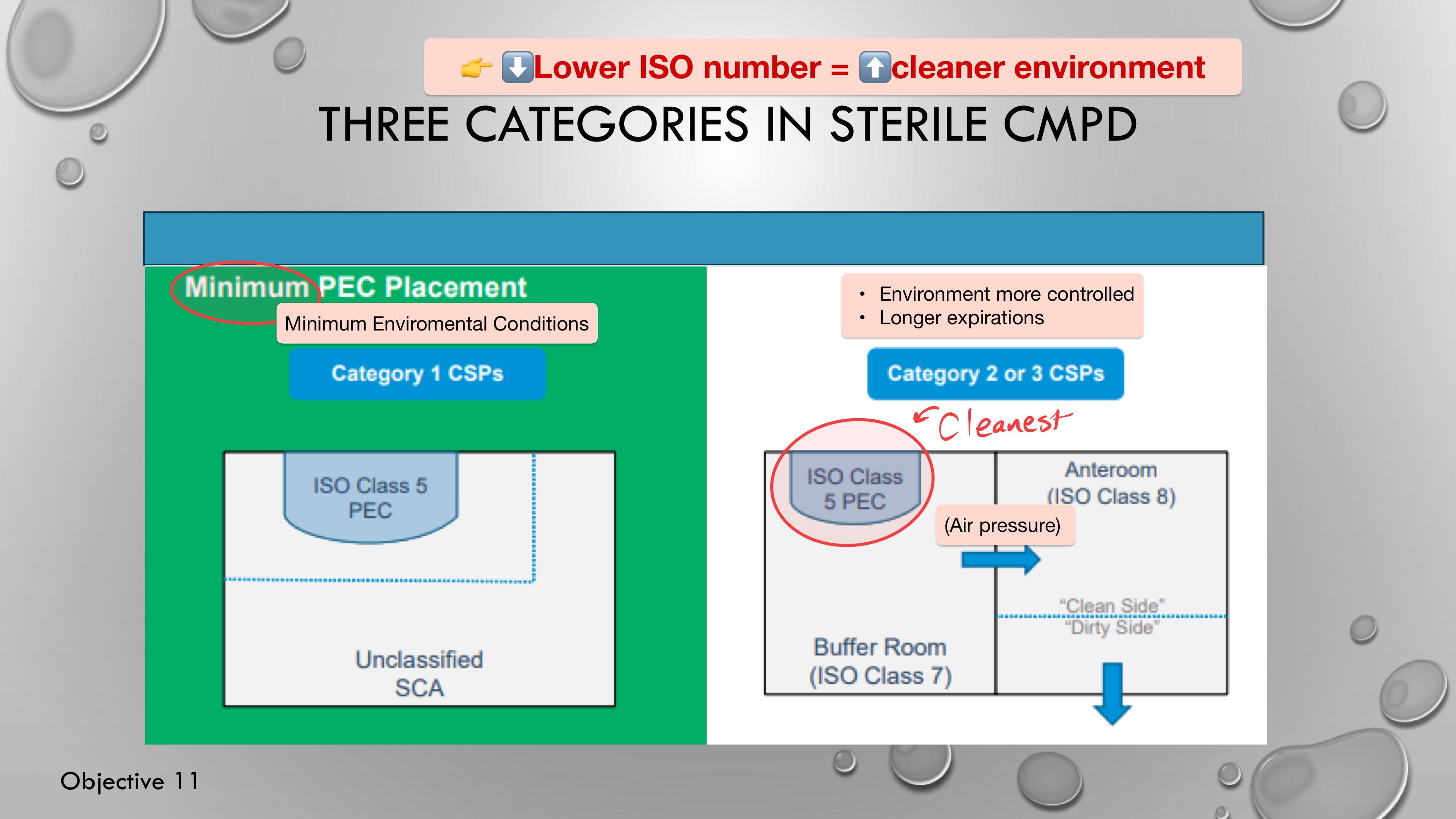
🔹Q: CATEGORY 1 CSPs (compounded sterile preparations)
What are Category 1 CSPs?
What are the BUD limits for Category 1 CSPs?
Prepared in a segregated compounding area with SHORTER BUDs.
Controlled room temperature: ≤12 hours; Refrigerated: ≤24 hours

Obj. 9
🔹Q: CATEGORY 2 CSPs (compounded sterile preparations)
What are Category 2 CSPs?
What are the BUD limits for Category 2 CSPs?
Compounded in a cleanroom suite with STRICTER environmental controls and LONGER BUDs than Category 1 CSPs.
Room temperature: 4 days; Refrigerated: 10 days; Frozen: 45 days

Obj. 9
🔹Q: CATEGORY 3 CSPs (compounded sterile preparations)
What are Category 3 CSPs?
What are the BUD limits for Category 3 CSPs?
CSPs prepared with the ⬆HIGHEST environmental and quality control standards and therefore qualify for the LONGEST BUDs.
Room temperature: 60 days; Refrigerated: 90 days; Frozen: 120 days
Obj. 9
🔥Q:
Which USP <797> category has the shortest BUDs?
Which USP <797> category has the longest BUDs?
Category 1.
Category 3.
Obj. 9
🔥USP <797> Categories
BUDs:
Category 1 = shortest
Category 2 = medium
Category 3 = longest BUDs
Obj. 10
Perform allegation with a large volume parenteral prescription.
🔹Q:
What is alligation?
Why is alligation used in parenteral compounding?
Alligation is a calculation method used to determine how much of two different concentrations are needed to prepare a desired final concentration.
To prepare IV solutions or large volume parenterals (LVPs) with the CORRECT concentration.
Q: What is the basic alligation setup?
➡Basic Alligation Setup
Higher concentration
↘ desired concentration
↗
Lower concentration
Subtract diagonally to determine parts needed.

Example Problem
Q: Example: How would you prepare 1 L of 5% dextrose using 50% dextrose and sterile water?
➡Set up alligation:
50%
\
5%
0% /
👉Differences:
50 − 5 = 45 parts 💧water
5 − 0 = 5 parts of 🍬50% dextrose
👉Ratio:
5 parts D50W
45 parts water
⭐️Total = 50 parts
Q: In the D5W example, what fraction is D50W?
5/50 =0.1 → 10% of final volume.
Q: In the D5W example, how much D50W is needed for 1 L?
1000mL x 0.1 = 100mL
Need:
100 mL D50W
In the D5W example, how much sterile water is needed?
1000 - 100 = 900mL
Need:
900 mL sterile water
Q: Final answer for preparing 1 L of D5W from D50W?
Mix:
100 mL of 50% dextrose
900 mL sterile water
to obtain:
1000 mL of 5% dextrose solution.
Q: What is a large volume parenteral (LVP)?
An injectable solution typically >100 mL used for IV infusion.