Nucleic acids 3.1.5
 Call Kai
 Learn
Learn Practice Test
 Spaced Repetition
 Match
Match Flashcards
 Knowt Play
1/7

Earn XP
Description and Tags
Name | Mastery | Learn | Test | Matching | Spaced | Call with Kai | Chat |
|---|
No analytics yet
Send a link to your students to track their progress
8 Terms
Nucleotide sructure
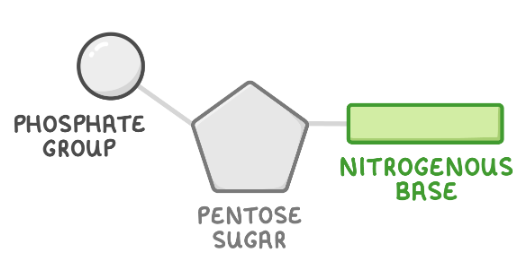
DNA - structure
Deoxyribonucleic acid is a type of nucleic acid that contains the instructions needed to make proteins. Contains bases adenine, thymine, guanine and cytosine, a phosphate group and deoxyribose (a pentose sugar).
A and G are purines. T and C are pyrimidines. A and T pair with 2 hydrogen bonds. C and G pair with 3 hydrogen bonds.
Watson and Crick discovered DNA structure: 2 polynucleotide strands in a double helix (sugar phosphate backbone) with complementary base pairing with weak hydrogen bonds.
RNA
Ribonucleic acid is a type of nucleic acid that uses information from DNA to synthesise proteins. Contains bases guanine, cytosine, adenine and uracil, a phosphate group and ribose pentose sugar.
RNA is a single stranded helix made of 1 polynucleotide strand, which is much shorter than DNA.
DNA replication
Semi-conservative replication produces DNA molecules consisting of 1 original DNA strand and one new strand.
DNA helicase breaks hydrogen bonds between complementary bases. This unwinds and unzips the double helix.
Each strand acts as a template for free nucleotides to attach to (complementary bases).
DNA polymerase joins free nucleotides together via a condensation reaction (5’ to 3’) forming phosphodiester bonds between the sugar-phosphate backbone of the new DNA strand
DNA replication discovery
Meselson and Stahl proposed 2 main models: conservative and semi-conservative. They carried out an experiment to test which.
Bacteria were grown in a medium containing 15N so all the nitrogen in the bases was the heavy isotope of N.
The bacteria was transferred to a medium with 14N for one round of replication, so the lighter N was incorporated into any new DNA strand.
The DNA was extracted and centrifuged.
Steps 2 and 3 were repeated and the distribution of heavy and light N were tracked.
The heavier bands sink lower in the test tube and lighter go to the top. This experiment proved semi-conservative replication.
ATP
Adenosine triphosphate is the energy currency of the cell containing adenine (a nitrogenous base), ribose (a pentose sugar) and 3 phosphate groups.
ATP can be used for movement, active transport, synthesis of large molecules, etc. The inorganic phosphate released during the hydrolysis of ATP can phosphorylate other compounds, often making them more reactive.
The hydrolysis of ATP releases energy.
ATP + H2O —(ATP Hydrolase)—> ADP + Pi
The condensation of ATP releases water.
ADP + Pi —(ATP Synthase)—> ATP + H2O
Water
Is polar which allows hydrogen bonds to form between water molecules.
Is a metabolite - involved in condensation and hydrolysis reactions.
High specific heat capacity - lots of energy is required to heat it so maintains body temperature.
High latent heat of vaporisation - provides a large cooling effect with little water loss through evaporation.
Cohesion between water molecules - allows columns of water for transport (xylem) and surface tension.
Inorganic ions
Iron ions are a component in haemoglobin.
Sodium ions are used in co-transport or glucose and amino acids.
Phosphate ions are components of DNA and ATP.
Hydrogen ions affect the pH.