Secondary active transport, diffusion potential and osmosis
 Call Kai
 Learn
Learn Practice Test
 Spaced Repetition
 Match
Match Flashcards
 Knowt Play
1/47

There's no tags or description
Looks like no tags are added yet.
Name | Mastery | Learn | Test | Matching | Spaced | Call with Kai | Chat |
|---|
No analytics yet
Send a link to your students to track their progress
48 Terms
Na+ -K+ATPase transporter is it considered simple or active transport?
Primary active trasport
Na+ -K+ATPase transporter
How much Na+ and K+ is transported using it and where are they transported? Do they move with concentration gradient?
3Na+ ions are transported against concentration gradient moving to the ECF (out of cell)
2K+ ions are transported agains concentration gradient moving to the ICF (into cell)
How is the potential energy difference created in the cell due to the Na+ K+ ATPase transporter?
More positive charges (Na+) are pumped out a cell compared to the number of positive charges (K+) pumped into a cell. This creates a charge separation and a potential difference across the plasma membrane.
Secondary Active transport
Secondary active transport refers the coupling of a Na+ gradient (or other ion) to another solute to drive the movement of the second solute across the membrane.
Is the Na K+ ATPase transporter electrogenic?
Yes
The Na⁺/K⁺ ATPase is electrogenic because it transports 3 Na⁺ out of the cell for every 2 K⁺ transported into the cell, resulting in a net movement of 1 positive charge out of the cell per ATP.
After NA K ATPase which solute is normally used again to move down its electrochemical gradient at a new transport membrane protein, while assisting the movement of another solute?
Also write whether the solute will move downhill with concentration gradient or uphill agains concentration gradient
One of the solutes, often Na+, moves down its electrochemical gradient (downhill) . In contrast, the other solute moves against its electrochemical gradient (uphill).
Which Ion normally moves down its electrochemical gradient during secondary active transport?
Na+
the Na K+ ATPase creates a electrochemical concentration gradient making [Na+] higher out of the cell than inside. To move back into the cell Na+ uses other transporters to move back in, no energy input required as it moves downhill into the cell again. This in turn moves other solutes out of the cell.
Why is the downhill movement of Na+ important?
The downhill movement of Na+ provides energy for the uphill movement of the other solute. In other words, the downhill gradient of Na+ (driving force) is coupled to the movement of another molecule (e.g. glucose) against its electrochemical gradient.
In secondary transports is ATP used directly?
No, its used indirectly
The energy supplied by ATP is not used directly in this process. Instead, it is supplied indirectly by the Na+ concentration gradient already established across the cell membrane by primary active transport.
Two forms of secondary active transport
Symport (co-transport)
Antiport (counter-transport)
Symport (co-transport)
means that all solutes are transported in the same direction across the cell membrane

Antiport (counter-transport)
Means that solutes move in opposite directions across the cell membrane

For Antiport what should you think of for an example
Think of NA+ moving downhill into cell and allowing another cell to leave the cell
Symport/Antiport
What happens if you are missing one of you solutes for your transporter?
If either solute is missing, the co-transporter cannot function because it cannot rotate. Thus, both solutes are required, and one cannot be transported without the other.
Diffusion potential
The potential difference generated when charged solute pass through the membrane downhill its concentration gradient.

True or False
A diffusion potential can only be generated if the membrane is permeable to the ion
True
The sign (+ or -) of the diffusion potential depends on ……
the charge of the diffusing ion
At electrochemical equilibrium, the concentration driving force is ____ by the electrical charge. The chemical and electrical driving forces acting on an ion are ___ and ___.
balanced
equal and opposite
True or False
Leak channels are protein channels in the cell membrane that allow specific ions to passively move across the membrane.
True
The __ ___ ___ is one of the major components that maintains the membrane potential in animal cells.
K+ leak channel
Due to the Na+ K+ ATPase transporter where do you find higher [ ] for Na+ and K+?
NA+ higherr out of cell (ECF)
K+ higher inside cell (ICF)
How does the K+ leak channel help move from inside the cell to outside
The generation of this K+ gradient (K+ moving to lower concentrated areas) allows K+ ions to move back across the membrane by a K+ leak channel. K+ is moving down its electrochemical gradient.
When equilibrium is achieved between the electrical and chemical gradient of K+ it is known as the __ ___ ___, and there is a relative negative charge on the inside of the cell.
resting membrane potential
The ___ ___ describes the balance of electrochemical forces.
Nernst equation
The Nernst equation converts a concentration difference for an __ into a __.
ion
voltage
True or False
The Nernst Equation assumes that the membrane is permeable to that ion
True
Water flow across the membrane is facilitated by movement through channels known as ____
aquaporins
What drives the movement of water through the Aquaporins?
The movement of water through aquaporins is driven by osmosis.
Osmosis
Osmosis is the flow of water across a semipermeable membrane due to differences in solute concentrations
What is the driving force for Osmosis?
Osmotic Pressure
Osmotic pressure
Osmotic pressure is the minimum pressure needed to stop the net water flow across a semipermeable membrane
How can you determine the exact osmotic pressure?
This pressure can be determined when solutions are closed to the atmosphere and pressure is applied to a piston to stop the flow of water.
Easy memory trick to remember movement of water in Osmosis
Water Follows Solute
Water moves from Low Solute —→ High Solute
Water will go where ever the higest solute concentration is
True or False
Water flows from an area of low osmotic pressure to high osmotic pressure?
True
Hypotonic Solution
A solution that has less solute compared with the solution it's being compared to.
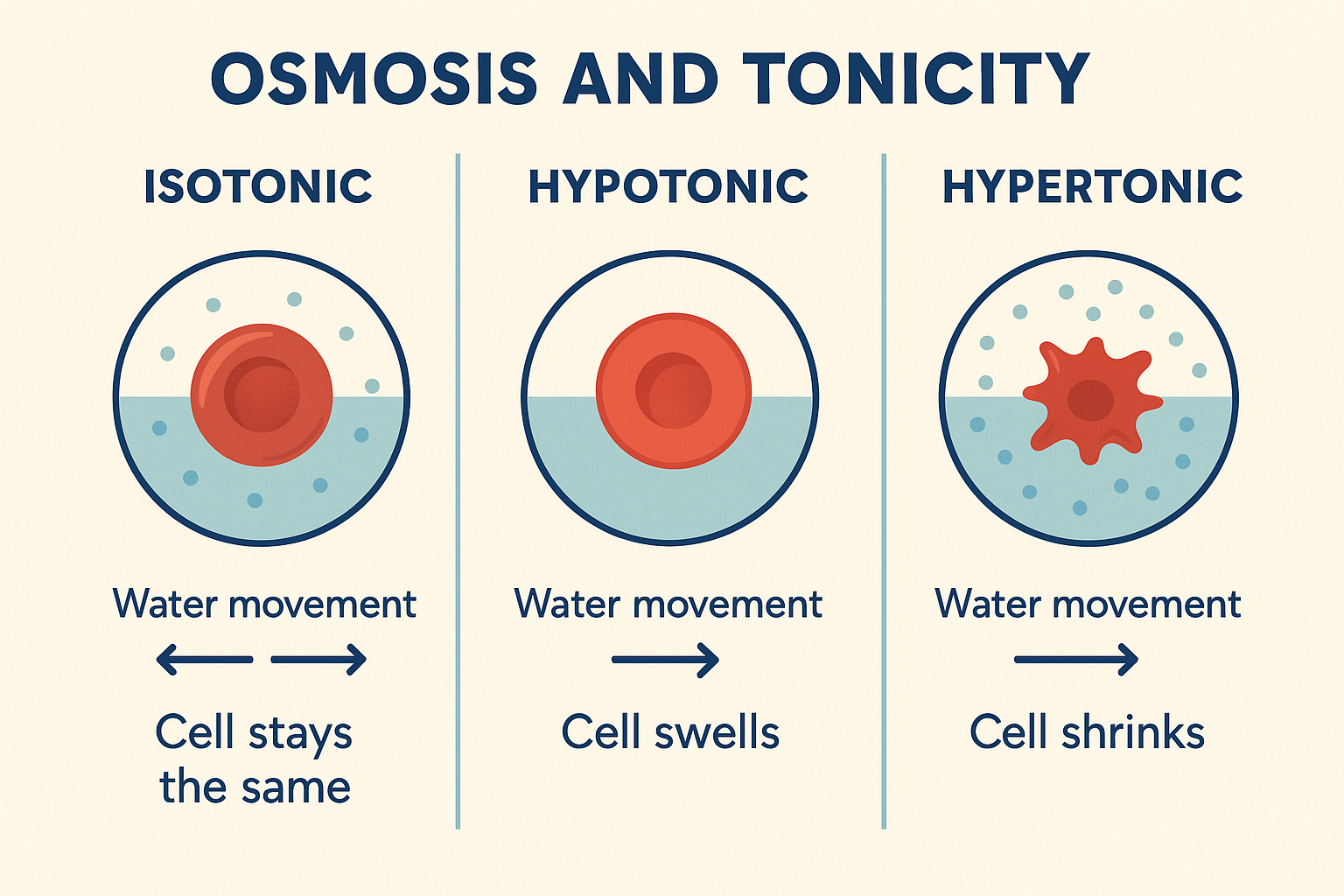
Hypertonic
Hypertonic means the solution has a higher concentration of solute compared with the solution you're comparing it to.
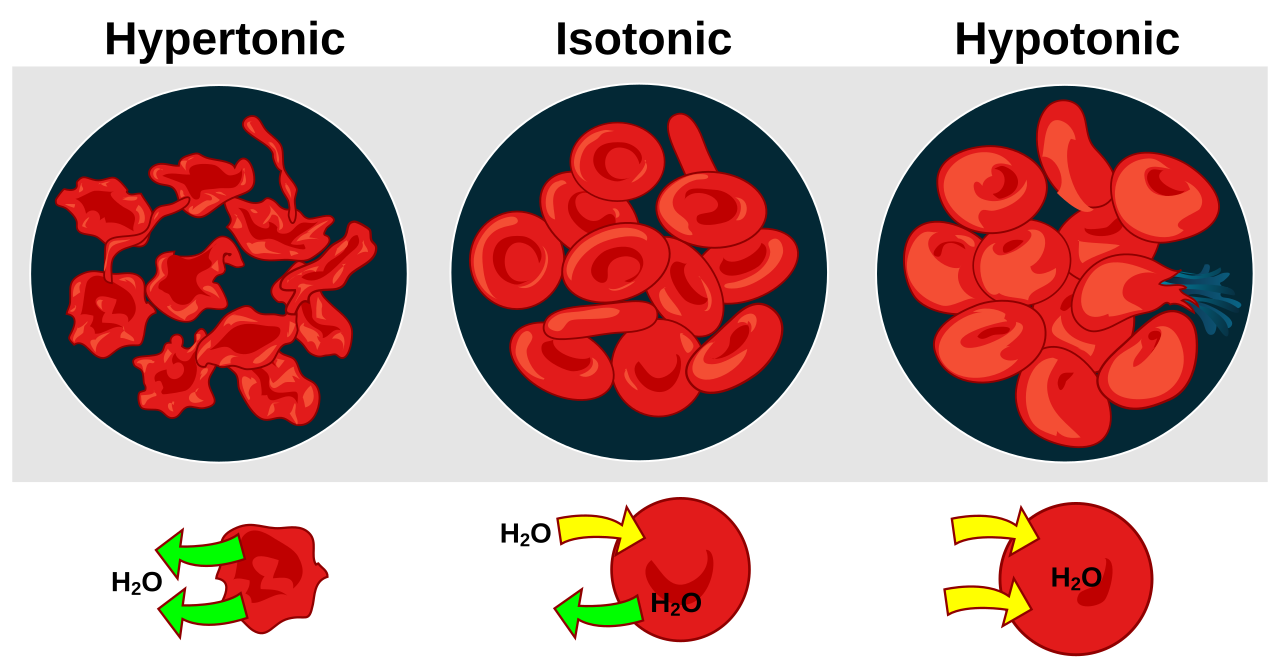
State which is Hypertonic and Hypotonic
Low osmotic pressure =
High osmotic pressure =
Hypotonic
Hypertonic
Think about it. Pressure increases when molecules move back and forth so if you have more materials you should expect the pressure to be higher than if the amount of materials were lower
Colloid osmotic (oncotic) pressure
Colloid osmotic (oncotic) pressure is a type of osmotic pressure induced by the plasma proteins (mainly albumin) in blood vessel plasma.
___ in blood and plasma is the main contributor to osmotic pressure.
Albumin
Albumin is made by the ___
liver
____ ____ and ___ ____ ____ drive fluid across capillary membranes, which serve as the sights for the exchange of gases, nutrients, and waste products.
Hydrostatic pressure
colloid osmotic pressure
True or False
The capillary bed is the sight of gas, nutrient, and waste product exchange?
True
Hydrostatic pressure is the force that ___ fluid out of the ____ and into the (interstitial fluid/extracellular fluid)
pushes
capillaries
interstitial fluid
Plasma Colloid osmotic pressure is the force the ___ fluid back into the ____ from the ___ ___.
pulls
capillaries
interstitial fluid
How does Edema happen?
If too much fluid is pushed out by the hydrostatic pressure and not pulled back in by the colloidal osmotic pressure, fluid can build up in the interstitial tissues, leading to edema.
Therapeutic benefits of Manuka honey
Offers antibacterial activity and provides a protective covering.
Maintains the moisture in the wound and lowers pH to promote healing.
High osmotic potential promotes autolytic debridement
Autolytic debridement
Autolytic debridement is the lysis, or breakdown, of damaged tissue at a wound site by enzymes that digest specific components of body tissues or cells, e.g. proteins, fibrin and collagen.
Explain how Manuka honey helps with would healing?
The outflow of lymph fluid helps to remove devitalized tissues from the wound bed. The low water and high solute concentration of honey pulls this fluid upward (osmosis) and helps remove devitalized cells and tissue from deep within the wound bed.