Bioplastics - definition, production & applications

0.0(0)
Studied by 0 people
call kaiCall Kai
learnLearn
examPractice Test
spaced repetitionSpaced Repetition
heart puzzleMatch
flashcardsFlashcards
GameKnowt Play
Card Sorting

1/16

encourage image

There's no tags or description

Looks like no tags are added yet.

Last updated 10:15 AM on 5/29/26
Name
Mastery
Learn
Test
Matching
Spaced
Call with Kai

No analytics yet

Send a link to your students to track their progress

17 Terms

1
New cards

What makes a plastic a bioplastic?

  • based on renewable raw materials (matières 1res)

AND/OR

  • biodegradable plastics

2
New cards

What’s the definition of biodegradable?

Materials that can be broken down naturally by microorganisms into natural simpler substances

3
New cards

Among all the plastics types, which ones are bioplastics?

Even plastics based on 100% of raw oil but biodegradable are considered as bioplastics
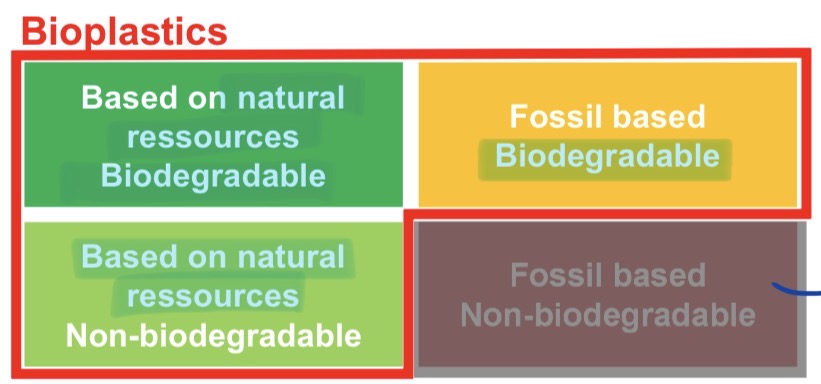
<p><em>Even plastics based on 100% of raw oil but biodegradable are considered as bioplastics</em></p>
4
New cards

Why using bioplastics?

to shorten the carbon cycle → prevent animals to eat them…

5
New cards

Explain both carbon cycles of bioplastics and conventional plastics

<p></p>
6
New cards

How long does bioplastics’ carbon cycle last compared to conventional plastics?

  • bioplastics → ~ 10 years

  • fossil plastics → ~ 1 million years

7
New cards

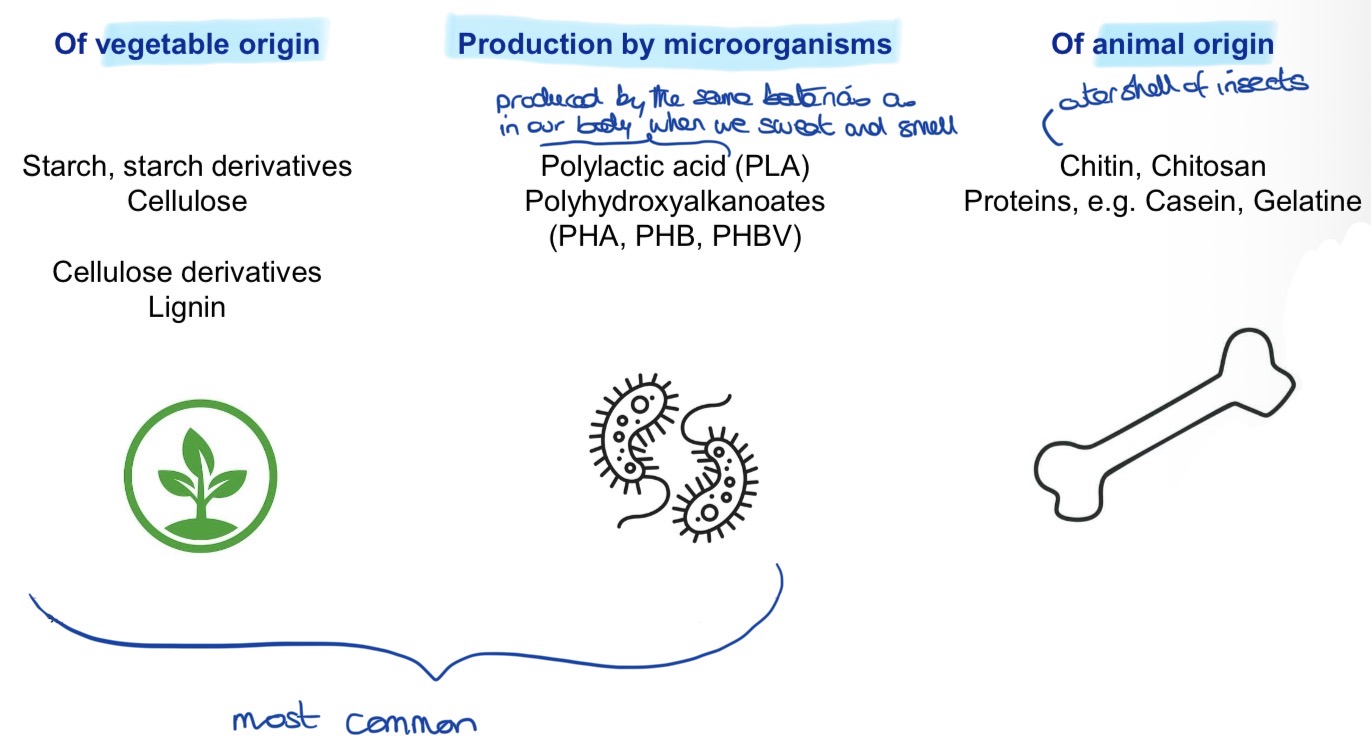
What are the 3 different sources of bioplastics’ raw materials?

Which ones are the most common?

(Where do the monomers can come from)

knowt flashcard image
8
New cards

What are the 3 different ways of producing bioplastics?

Note: each process doesn’t correspond to one source of raw materials, they can be applied to various raw materials, regardless their origin
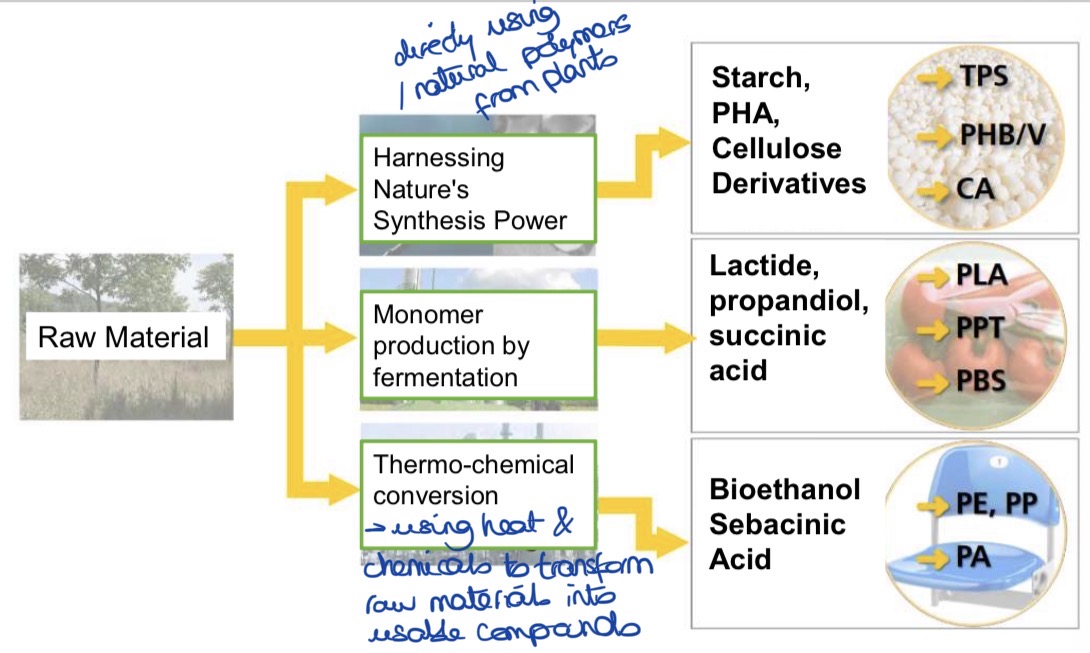
<p>Note: each process doesn’t correspond to one source of raw materials, they can be applied to various raw materials, regardless their origin</p>
9
New cards

Why do some companies use bioplastics although it’s expensive?

  • good image

  • Forced by the law (regulations about carbon footprint)

10
New cards

List all the bioplastics you know

  • CA cellulose acetate

  • PBAT polybutylene advocate terephthalate

  • PBS polybutylene succitane

  • PHA polyhydroxyalkanoates

  • PLA polyactide / polylactic acid

  • TPS thermoplastic starch

11
New cards

Properties & applications of polylactide / polylactic acid PLA

+ polymerised from lactic acid (derived from corn, rice, potatoes, tapioca)

+ excellent chemical resistance Low water

+ easy to process

- very brittle at low temperature (low temperature resistance)

  • injection moulding (moulage par injection)

  • Blown & flat films (food packaging, biodegradable bags)

  • Fibres (textiles)

  • Coating (inner layer of paper cups)

<p>+ polymerised from <u>lactic acid</u> (derived from corn, rice, potatoes, tapioca)</p><p>+ excellent chemical resistance Low water</p><p>+ easy to process</p><p>- very brittle at low temperature (low temperature resistance)</p><p></p><ul><li><p>injection moulding (moulage par injection)</p></li><li><p>Blown &amp; flat films (food packaging, biodegradable bags)</p></li><li><p>Fibres (textiles)</p></li><li><p>Coating (inner layer of paper cups)</p></li></ul><p></p>
12
New cards

Properties & applications of thermoplastic starch TPS

+ chemically and thermally modified (enhanced properties)

+ fast & good biodegradability (water soluble)

+ very elastic

- poor hydrolysis resistance (degrades when exposed to moisture = humidité)

  • blown & flat films

  • Foam trays (plateau en “mousse” des paquets de fruits)

  • Coatings (add barrier properties

13
New cards

Properties & applications of cellulose acetate CA

+ basic properties similar to polystyrene PS

+ very glossy/shiny & only slightly opaque

+ excellent chemical resistance Low water

- can only be melted and processed if modified (external plasticisers)

- expensive

  • injection moulding

  • Films

  • Packaging

  • Cosmetic articles

  • Foam

<p>+ basic properties similar to polystyrene PS </p><p>+ very glossy/shiny &amp; only slightly opaque </p><p>+ excellent chemical resistance Low water</p><p>- can only be melted and processed if modified (external plasticisers)</p><p>- expensive </p><p></p><ul><li><p>injection moulding</p></li><li><p>Films </p></li><li><p>Packaging</p></li><li><p>Cosmetic articles </p></li><li><p>Foam </p></li></ul><p></p>
14
New cards

Properties & applications of polyhydroxyalkanoates PHA

+ polyester produced from sugar or starch by fermentation

+ good sealing properties (étanchéité)

+ excellent biodegradability

+ highly flexible (PHV) to very rigid (PHB)

- after crystallisation → very brittle

  • injection moulding

  • Blown films

  • Horticulture

  • Catering (restauration)

15
New cards

Properties & applications of polybutylene succinate PBS

+ up to 40% bio based

+ similar to PBT (good insulation capacity)

+ flexible

+ very stable

+ biodegradable

  • Injection moulting copolymer

  • Blown & flat films (Packaging, sealing layers, mulch films = in agriculture, laid on the soil)

16
New cards

Properties & applications of polybutylene adipate terephthalate PBAT

+ soft material, similar to LD-PE

+ excellent compatibility with PLA (stick together very well)

- fossil based but biodegradable

  • shrink & packaging films

  • Blown films

  • Paper costing (barrier properties → bags, compost bags, mulch films)

<p>+ soft material, similar to LD-PE </p><p>+ excellent compatibility with PLA (stick together very well)</p><p>- fossil based but biodegradable </p><p></p><ul><li><p>shrink &amp; packaging films </p></li><li><p>Blown films</p></li><li><p>Paper costing (barrier properties → bags, compost bags, mulch films)</p></li></ul><p></p>
17
New cards

What’s the problem with some plastic films used for food packaging?

Some of these films are made with multiple layers of different plastics (up to 6…), each having a specific purpose.

However, as they’re stuck (collés) together, we can’t separate them and thus, they’re not recyclable (unless the energy from burning them is used for something)