Chronic Pain and Concurrent Opioid Use Disorder
 Call Kai
 Learn
Learn Practice Test
 Spaced Repetition
 Match
Match Flashcards
 Knowt Play
1/26

There's no tags or description
Looks like no tags are added yet.
Name | Mastery | Learn | Test | Matching | Spaced | Call with Kai | Chat |
|---|
No analytics yet
Send a link to your students to track their progress
27 Terms
Key points for treatment of Opioid use disorder
Stabilize with opioid agonist therapy (suboxone, methadone, sublacade, etc.)
Limit carries (limit how much opioid is given at a time - 1 week dosages for ex.)
Frequent urine drug testing
If patient has concurrent chronic pain and opioid use disorder, which do you treat first?
Treat OUD first, then chronic pain
Results of treating opioid use disorder
Reduce opioid hyperalgesia
Reduce tolerance
Reduce withdrawal hyperalgesia
Key treatment points of chronic pain disease
Non-pharmacological treatment (exercise, physiotherapy, psychology)
Non-opioid therapy (Gabapentin, NSAIDs)
Carries: enough until they see the doc next
Less frequent urine drug testing
Chronic pain in canada
1/5 canadians live with chronic pain, with 1/3 of Canadians over the age of 65 living with chronic pain
31-55% of people with substance abuse disorder report chronic pain
Impact of chronic pain in Albert
Est. 940 000 people have chronic pain in AB, costing the AB healthcare system 1.2-1.7 billion (6-8% of provincial health expenditure)
Loss of alberta productivity due to chronic pain
3.4 to 4.7 billion dollars a year
How many people use opioids in alberta, and how many are considered problematic users
596 000 people use opioids as pain relievers, and 58 000 of them are considered problematic users
Chronic Pain WHO identification
Chronic pain is identified as its own disease, with a primary and secondary subset
What is primary chronic pain
Pain persists after the body has completely healed or no identifiable causes
Examples of primary chronic pain
Fibromyalgia, pelvic pain, musculoskeletal pain, lower back pain
What is secondary chronic pain
Pain occurring with an underlying disease or issue
Examples of chronic secondary pain
Cancer pain, post-surgical pain, rheumatoid arthritis
Course of back pain
Majority of people with backpain will have resolved pain in 2 weeks
90% of back pains will resolve in 6 months
But 20-40% of people will have a flareup within the year
Use of using a baseline urine drug screen for chronic pain
Can display if patient has:
Substance use disorder
Chronic pain issue
Somewhere in between
Measures risk, monitors compliance
Use of monitoring patients on opioids with urine drug screens
Helps prevent the use of illicit opioids, and establishes a good patient doctor relationship
Benefit of using buprenorphine in elderly patients with chronic pain
Drug does not go through the kidneys (important in people with reduced kidney function)
If UDS baseline shows substance in it, what could this mean
Patient may be receiving opioids from illicit sources - could be opioid overuse disorder
If UDS monitoring shows no substance (even if given opioids) what could this mean
Patient is either not asking medication, or is using too much
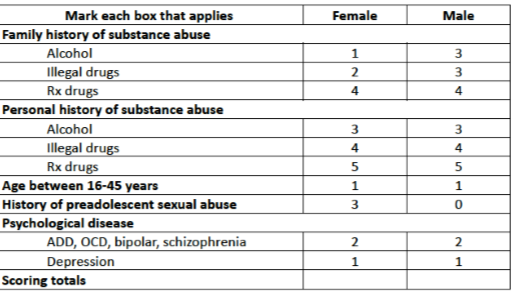
Use of opioid risk tool
Administered to patients prior to beginning opioid therapy for pain management. Indicates risk of future opioid abuse
Why is cancer pain becoming more prevalent in medicine
Growing number of patients are surviving a cancer diagnosis with improved surgery, chemo, radiation
Why is morphine doses usually given at 90 mg or less for chronic pain
As opioid dose increases >100 mg, hyperalgesia worsens
Is hyperalgesia in opioid use related more to dose or propensity for OUD
Propensity for oud.
Patients with chronic pain who are at risk for OUD more likely to report increased pain sensitivity regardless of whether they were on no, low, or high doses
What is the main goal of chronic paon treatment
Goal is to improve function! NOT decrease pain.
Steps of chronic pain treatment:
Physical therapy
Psychological therapy
Safe drug prescriptions: NSAIDs, Steroids, SNRIs

Treatment of Fibromyalgia
Exercise, antidepressants, gabapentinoids
Use of opioids and cannabinoids in Fibromyalgia treatment
No convincing evidence of benefit, and should be avoided due to potential harms