Understanding Professionalism in Physical Therapy Practice
 Call Kai
 Learn
Learn Practice Test
 Spaced Repetition
 Match
Match Flashcards
 Knowt Play
1/97

There's no tags or description
Looks like no tags are added yet.
Name | Mastery | Learn | Test | Matching | Spaced | Call with Kai | Chat |
|---|
No analytics yet
Send a link to your students to track their progress
98 Terms
Tertiary Care
Highly Specialized medical services, e.g. heart/liver/lung transplants/major surgical procedures.
Secondary Care
Specialized care including inpatient hospitalization, ambulatory care, same-day surgery (e.g. Hernia repair).
Primary Care
Basic/entry point level of health care, includes outpatient services.
Acute Care/Inpatient
Care for patients that are medically unstable.
Acute Rehab Hospital
Rehab intensive care with an average stay of 4-5 days.
Sub-Acute Care
Intermediate level of care with an average stay of 15 days.
Long Term Acute Care
Care for medically complex patients requiring specialized 24 hr care.
Skilled Nursing Facility
Facility for patients with permanent disability or nonreversible pathology, average stay of 25 days or more.
Nursing Home
Facility for patients requiring daily and 24/7 skilled nursing care.
Home Health
Care for patients who cannot leave their home or are unsafe in the community.
Hospice
Palliative, end of life care where PT and OT are optional.
Custodial Care
Care for people unable to care for themselves, may be medical or nonmedical.
Outpatient Care
Less costly than inpatient care, patients have potential for improvement.
PTA Participation
A PTA can participate in discharge planning for a patient.
Documentable Progress
A patient must be making documentable progress to continue PT services.
Direct Access PT
A patient may access physical therapy directly depending on the state.
Outpatient Services Requirement
A patient must receive a set number of hours or units per week to continue outpatient services.
Outpatient services
A patient must receive a set number of hours or units per week to continue outpatient services.
General Supervision
Applies to the PTA under general supervision of the PT; PT must be available to the PTA by telecommunication.
PTA assessment
PT assesses PTAs provision of services on an ongoing basis.
Offsite supervision
If PT is supervising the PTA in an offsite setting, PT must be available by telecommunication at all times.
Regular meetings
Regularly scheduled meetings between PT and PTA to determine the needs of the patient and PTA.
Supervisory visits
Supervisory patient/client visits shall be made by the PT when PTA requests reexamination, change in POC, conclusion of care, or there has been a change in patient status.
Monthly supervision
Supervisory visits should occur once per month or more depending on patient needs.
Direct Supervision
Applies to student PTs and PTAs under direct supervision of the PT and student PTAs under direct supervision of the PTA; PT or PTA is physically present and immediately available, telecommunication is not acceptable.
Direct Personal Supervision
Applies to PT aides and technicians under direct personal supervision of the PT or PTA; PT or PTA is physically and immediately available and supervises tasks related to patient care and services.
Role of the PTA
A PTA is a graduate of an accredited PTA program with licensure in the state of practice; the PT is responsible for actions of the PTA in all settings.
PTA responsibilities
The PTA modifies elements of intervention for patient progress, safety, and comfort, and collects selected examination and outcome data.
Role of the PT Aide
Support personnel who perform tasks assigned to them by the PT or PTA that do not require clinical decision making, under direct personal supervision.
State supervision ratios
Many states have ratios of aides/student/PTAs to PT for supervision; this varies by state and is found in state legislature.
Dry needling
An intervention performed by physical therapist only.
Selective sharp debridement
An intervention performed by physical therapist only, specifically for wound care.
Grade V mobilizations/manipulation
An intervention performed by physical therapist only.
PTA supervision during PT absence
The PTA can supervise PT aides in the clinic while the PT is absent.
PT availability during vacation
The PT must be available by telecommunication during all business hours while on vacation.
Post-vacation meeting
Upon returning to the clinic, the PT and PTA should have a scheduled meeting to discuss the patients seen by the PTA.
POC changes by PTA
The PTA cannot add exercises to the POC in the absence of the PT without calling the PT to discuss.
PTA
Physical Therapy Assistant
POC
Plan of Care
Health Condition
Umbrella term for diseases/disorder/injury/trauma/other circumstances such as aging, stress, congenital anomaly, genetic predisposition, information on etiology/pathogenesis
Body Function
Functions of the body + psychological functions
Body Structures
Anatomical parts of the body (organs/limbs and their components)
Impairments
Problems in body function/structure/significant deviation/loss
ICF Model
International Classification of Functioning, Disability and Health
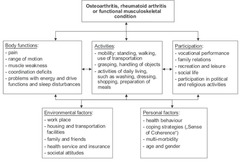
Activity
Execution of a task/action by an individual
Participation
Involvement in life situation
Activity Limitations
Difficulties an individual may have in executing activities
Participation Restrictions
Problems an individual may experience in involvement in life situation or role
Contextual Factors
Entire background of an individual's life and living situation
Environmental Factors
Physical/social/attitudinal environment in which people live and conduct their lives, including social attitudes/architectural characteristics, legal and social structures
Personal Factors
Particular background of an individual's life, gender, age, coping styles, social background, education, profession, past/current experience, overall behavior/character/other factors that influence how disability is experienced by an individual
Performance
What an individual does in his/her current environment
Capacity
An individual's ability to execute a task/action HIGHEST PROBABLE FUNCTIONING in a given domain at a given moment
Documentation
Complete, accurate, timely documentation is essential for patient safety, compliance with STATE + FEDERAL regulations, accurate communication between health care providers, appropriate utilization with for third-party payers, and historical record for potential legal situations
Medical Records
Records to be placed in safe & secure place for a certain number of years (7 yrs)
Outcome Measures
Documentation is enhanced by using measurements with demonstrated reliability and validity
Guidelines for Documentation
Comply with all applicable state/federal/regulatory agency laws & regulations
Medically approved symbols/abbreviations
Can be used in documentation.
Mistakes in medical records
Must be crossed out with a single line through the error then initialed/dated by PT/PTA.
White out material
Should never be used to correct text in a medical record.
Informed consent for treatment
Must be given only by a competent adult.
Consent for non-competent adults/minors
Must be given by a parent/legal guardian in written form.
Documentation of treatment
Each episode of treatment must be documented.
Patient's response to treatment
Must be documented after each treatment session.
Patient identifier on documentation
Patient name and other unique identifier should be on each page.
Date each entry
Payers require length of time per visit, e.g., Medicare/Medicaid.
Sign each entry
Must include first and last names and professional designation.
Significant events documentation
Record significant events such as phone conversations with physician/nurse.
Treatment rendered documentation
Must be in OBJECTIVE, MEASURABLE, FUNCTIONAL TERMS (e.g., ROM, strength, sitting tolerance).
Discharge plan
Must be completed when goals/outcomes are reached.
Electronic documentation
Must have security and confidentiality practices in place; e-signatures are acceptable.
Charting error correction
Clearly indicate that a change was made without deletion of the original medical record.
Health Insurance Portability and Accountability Act (HIPAA)
Immediate purpose is to disclose minimum necessary information about personal health.
Patient confidentiality
Must be maintained in all oral, written, and electronic forms.
Patient's right to access medical records
Patients have the right to request their records and to request amendments.
Provider response time for records
Providers have 30-60 days to respond to requests.
Exceptions to HIPAA
In emergencies, treatment may commence if delay will prevent timely care.
Individuals with Disabilities Education Act (IDEA)
Ensures children with disabilities receive appropriate and free public education.
Early Intervention Programs (EIP)
Programs that serve children with developmental delays.
Individualized Education Plans (IEPs)
Plans created for children, allowing them the option of not attending planning meetings.
Americans with Disabilities Act (ADA)
Prevents discrimination against people with disabilities (physical/mental health).
ADA Requirements
Requires employees (15 or more) to accommodate needs of people with disabilities for economic independence in public/private sector.
EEOC Regulations
Abides by Equal Employment Opportunity Commission (EEOC) regulations.
Reasonable Accommodation
Reasonable accommodation to workplace by removing barriers unless would cause 'undue hardship' - an action requiring significant difficulty/expense.
Example of Undue Hardship
Installing an elevator for an individual to access upper floors might be an undue hardship for a smaller business.
PT Role
Consultant to employers to help them meet their responsibilities, and to individuals with disabilities to help them achieve their rehabilitation potential and rights under law.
Mandatory Reporting
PTs and PTAs are MANDATORY REPORTERS for all categories of abuse in all 50 states.
Reporter Immunity
As a reporter, the PT or PTA is immune to criminal or civil liability.
Consequences of Not Reporting
NOT REPORTING is considered a crime and can result in a loss of license or other penalties.
Reporting Procedure
Call the state specific hotline, report findings, and follow any/all facility procedures.
Do Not Confront Offenders
Do not confront possible offenders yourself.
Relay Information
Relay information to the PT and facility.
Elder Abuse Reporting Scenario
While treating an elderly female patient 6 weeks post THR, the patient reports to a PTA that her children are neglectful and sometimes abusive when she requires help at home and she rolls up her sleeve to reveal bruising.
First Action for PTA
Alert the PT of the situation and allow the PT to decide the next step.
Alternative Action for PTA
Wait until witnessing interactions of the patient and her children in order to establish reasonable suspicion.
Contacting Family
Contact the patient's family and discuss her statements in a private conversation.
Reporting to Authorities
Contact an elderly abuse hotline or report to the appropriate authority.
Assess and Document Findings
Assess and document all findings.