ISEN302 EXAM 1
 Call Kai
 Learn
Learn Practice Test
 Spaced Repetition
 Match
Match Flashcards
 Knowt Play
1/34

There's no tags or description
Looks like no tags are added yet.
Name | Mastery | Learn | Test | Matching | Spaced | Call with Kai | Chat |
|---|
No analytics yet
Send a link to your students to track their progress
35 Terms
Engineering Economics
Centers on the “Time Value of Money” based on interest rates and time periods, and how the value changes as time passes.
Ethics
The concept of distinguishing between right and wrong in decision making.
Integrity
The foundation for long-term career success.
Key Elements of Money
Time, Value, Interest Rate
Time Value of Money
The value of a given sum of money depends on interest rate, the amount of money and the point in time when the money is received or paid.
Discounted Cash Flow
A valuation method that estimates the value of an investment using its expected future cash flows.
4 Rules of Discounted Cash Flow
1. Money has a time value.
2. Quantities of money cannot be added or subtracted unless they occur at the same point in time.
3. To move money forward one time unit, multiply by 1 plus the discount or interest rate.
4. To move money backward one time unit, divide by 1 plus the discount or interest rate.
Fixed Cost
Constant, unchanging, regardless of the level of output or activity. (Property taxes, insurance, Management & administrative salaries, License fees, Rent or lease)
Variable Cost
Vary with output or activity level. (Direct labor cost - # of workers & # of hours, Direct materials)
Marginal Cost
Variable cost for producing 1 more unit. (Used as basis for last-minute pricing)
Average Cost
total cost / # units. (Basis for normal pricing)
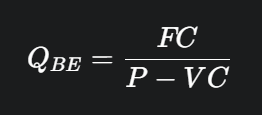
Breakeven Point
The point where your output = to your input, or where your profit is = 0.
Sunk Cost
Money already spent due to past decision, therefore not used in decision making.
Opportunity Cost
Cost of the foregone opportunity, often hidden or implied.
Recurring Cost
Repetitive to produce similar goods & services. (Office space rental, Material cost for a product)
Non-recurring costs
Not repetitive; one time. (Purchase cost for real estate, Construction costs of the plant)
Incremental Cost
Difference in costs between two alternatives.
Cash Cost
Money from one owner to another: cash flow. (This month’s car loan payment, Money paid or received)
Book Cost
Transaction cost as recorded in an accounting book. (Depreciation cost calculated this year for an existing asset, per accounting department, Book value of your office equipment)
Life Cycle Cost
All costs over its entire life of a product, structure, system, or service.
Life Cycle Costing
Design products, projects, & services recognizing all costs & benefits over the entire life cycle.
Design Changes and Cost Impacts
Design changes implemented later in the cycle the more difficult and costly it becomes; when designers try to save money early in the design stage the result is often poor design and change orders during construction
Internal Cost
(materials, labor, overhead, etc.) used to calculate product/service cost.
External Cost
Not directly incurred by the firm and not easily predictable. (ex. Effects on wildlife & environment)
Benefits
Often more difficult to estimate than costs, optimism is common and is usually overestimated. (Sales of products, Revenues, Cost reduction from reduced material or labor costs, Reduced risk)
Cost Estimating Model (Per Unit Model)
ex. Construction cost per square foot (building), Capital cost of power plant per kW of capacity, Revenue / maintenance cost per mile (hwy).
Cost Estimating Model (Segmenting Model)
Estimate is decomposed into individual components, Estimates are made at component level, Individual estimates are aggregated back together.
Nominal Interest Rate
Also known as Annual Percentage Rate, is the annual interest rate (r) without considering the effect of any compounding.
Effective Interest Rate
The annual interest rate taking into account the effect of compounding during the year. [ i = (1+r/m)^n - 1 ]
Annuities
End-of-period cash flow.
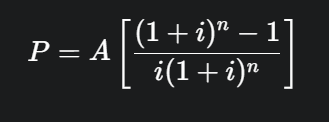
Arithmetic Gradient Repeated Cash Flow
When a cash flow is not a constant amount “A”, but is a uniformly increasing series “G”. It is expressed as (A/G, i%, n) or (G/A, i %, n).
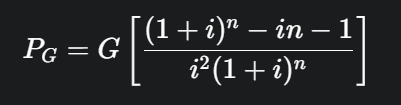
Geometric Gradient Repeated Cash Flow
When the period to period cash flow change is a uniform rate “g” (% increase)
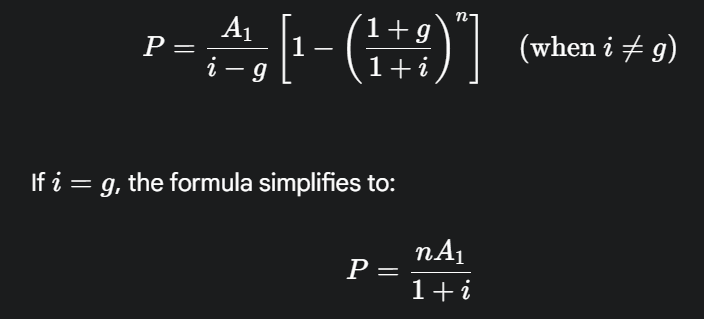
Capital Recovery Factor
Ratio used to determine the present value of a series of equal annual cash payments.
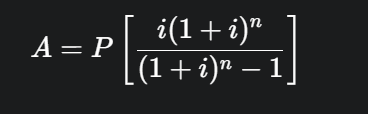
Uniform Series Sinking Fund Factor
Ratio used to determine the future value of a series of equal annual cash payments.
Present and Future Money
F = P(1+i)^n