PTA 222 Clinical orthopedics
 Call Kai
 Learn
Learn Practice Test
 Spaced Repetition
 Match
Match Flashcards
 Knowt Play
1/340

Earn XP
Description and Tags
Name | Mastery | Learn | Test | Matching | Spaced | Call with Kai | Chat |
|---|
No analytics yet
Send a link to your students to track their progress
341 Terms
Length Tension Relationship
Active insufficiency
the muscle is incapable of shortening to necessary extent to allow full range of motion at all joints crossed.
Length Tension Relationship
Passive insufficiency
the muscle cannot stretch to the necessary extent for full range of motion in the opposite direction of all joints crosse
What are the types of muscle contractions
Isometric
Isotonic
-Eccentric
-Concentric
Kinematic Chain
Closed Chain (CKC)
distal segment of kinematic chain meets considerable resistance
Kinematic Chain
Open Chain (OKC)
activities that involve the distal segment moving freely through space to isolate movement of a joint
Joint Position
Open Pack Position
Position of least joint congruity
“Loose-packed” or “resting” position
Slack of major ligaments
Minimal surface congruity
Minimal joint surface contact
Maximal joint volume
Minimal joint stability
Joint Position
Closed Pack Position
Position of maximum joint congruity
Maximal tautness of ligaments
Maximal surface congruity
Minimal joint volume
Maximal stability of the joint
Arthrokinematic motion
Occurs where
at bone ends, without regard to body movement
Arthrokinematic motion
what movement
accessory movements
Arthrokinematic motion
motions to specific to what
not what
What kinds are there
also known as what
motions specific to articulating joint surfaces
not volitional
Glide (slide), spin, and roll
Joint play
Arthrokinematic motion
Glide/Slide
One portion of the articular surface comes into contact with a series of locations on the corresponding surface
Arthrokinematic motion
Spin
Portion of one joint spins (clockwise or counterclock wise) around the stationary longitudinal axis
Arthrokinematic motion
Roll
Multiple points of contact on one joint surface come into contact with multiple points on the corresponding joint surface
What are the classifications of fractures
Open, closed, complete, incomplete, displaced, non displaced
Types of fracture
Spiral, comminuted, Avulsion
What does precaution mean
its like a yellow light
You proceed with caution
What does contraindication mean
Red light
Stop immediately
Special Tests
Precautions/Contraindications
Previous or chronic injury to the area
Fracture of the area
Surgery of the area
Acute injury to the area
Imaging
Conventional Radiography
Descending density
Light to darkest
Metal
Bone
Soft tissue
Water/body fluid
Fat
Air
Imaging
Arthrography
Study of structures within encapsulated joint
Imaging
Myelography
Spinal cord, nerve roots, dura mater, spinal canal
Imaging
Angiography
Vascular system
Imaging
Computed Tomography (CT)
Axial Plane Image
Greater Contrast to detail soft tissue than x-ray
Imaging
Mahnetic Resonance Imaging (MRI)
Thin Slices without radiation
Also details soft tissue greater than x-ray
Which type of imaging shows vascular structures
Angiography
What is the Load Deformation Curve
a graph that plots applied force (load) against a change in shape (deformation), biomechanics to show how body tissues like tendons and ligaments react to stress
Tissues and Tissue Repair
Strain
overstretching/overuse of musculotendinous unit, slight trauma or repetitive trauma
Tissues and Tissue Repair
Sprain
Severe stress/stretch/tear of ligament
Tissues and Tissue Repair
Dislocation
displacement of boney partners in result, loss of anatomical relationship associated with secondary trauma to surrounding soft tissue
Tissues and Tissue Repair
Subluxation
incomplete/partial dislocation of bony partners in joint associated with secondary trauma to surrounding soft tissue
Tissues and Tissue Repair
Hemarthrosis
bleeding in joint, usually due to trauma
Tissues and Tissue Repair
Contusion
bruising from direct blow, capillary rupture, bleeding, edema and inflammatory response
Tissues and Tissue Repair
Contracture
adaptive shortening of skin, fascia, muscle or joint capsule that prevents normal mobility and flexibility
Tissues and Tissue Repair
Adhesion
abnormal adherence of collagen fibers to surrounding structures during immobilization/trauma/surgery
Tissues and Tissue Repair
Bursitis
Inflammation of bursa
Tissues and Tissue Repair
Synovitis
inflammation of synovial membrane resulting in excess synovial fluid in joint or tendon sheath
Tissues and Tissue Repair
Dysfunction
Loss of normal function of tissue
Tissues and Tissue Repair
Reflex Muscle Guarding
prolonged contraction of a muscule in response to painful stimulus
Tissues and Tissue Repair
Intrinsic Spam
prolonged contraction of a muscle in response to local circulatory and metabolic changes
What is the difference between muscle, tendon and ligament?
Muscle has a lot of blood vessels and connect to bone, tendons have a limited blood supply and connect muscle to bone, ligaments have a small amount of blood supply and connect bone to bone
Stages of Soft Tissue Healing
Acute
Coagulation and inflammation
Begins at initial onset of injury
Stages of Soft Tissue Healing
Subacute
Migratory and proliferative
Beings within days and include major processes of healing
Stages of Soft Tissue Healing
Chronic
Maturation and remodeling
May last for up to a year
Responsible for scar tissue formation and development of new tissue
Acute
Day 1-6
Defensive events
Vasoconstriction 5-10 minutes
Acute
Day 1-6
Inflammatory response
Vasodilation
-stimulates pain receptors, clot formation, plasma synthesis, healing proteins
Acute
Day 1-6
what happens typically day 4-6
Complete removal of debris marks end of inflammatory process
Is swelling and inflammation good or bad?
They are neither good or bad, it just depends on factors like how long it has been going on, if its short term then it could be good because it means the body is healing and it’ll go away on its own. If it happens for a long time, then that means something is wrong and requires more attention
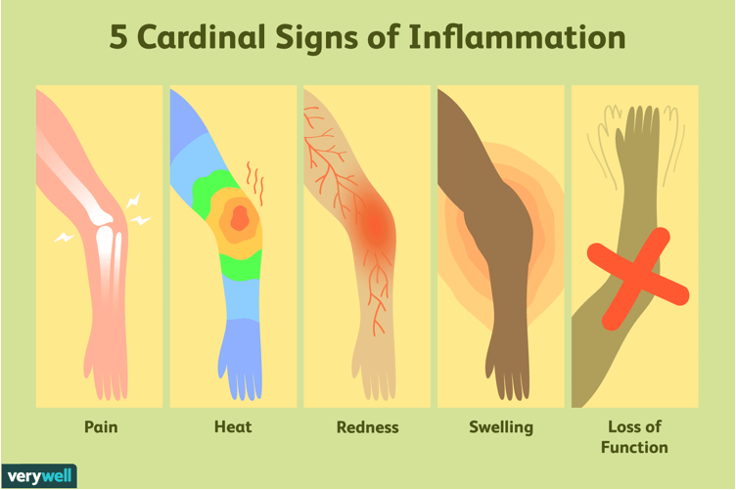
Acute
signs and symptoms
Swelling, Redness, Loss of function, Increased Warmth, Pain at rest/with active motion, empty end feel, muscle inhibition and guarding
Acute
Physical Therapy Goals
Protection to allow healing
Control pain and inflammation
Control and then eliminate edema
Restore pain free ROM
Prevent muscle atrophy
Minimize effects of immobilization / participation restriction
Scar Management
Maintain general fitness
Patient Education & independence with home exercise
Acute
Physical Therapy Interventions
Grade I mobilization
Compression/Elevation
Modalities
PROM, then AROM in pain free ranges
Gentle massage
Isometrics
Exercise with muscle in shortened position or in joint resting position
Acute
Physical therapy interventions
-Effects of manual treatment
pain reduction (endorphin release and large fiber joint afferents), decreased intra articular pressure, increase joint mobility, remodel connective tissue, increased tendon glide, increase joint lubrication
Subacute
Criteria to advance
adequate pain control and tissue healing, near normal ROM, tolerance for strengthening
Subacute
Overlaps what
the inflammation phase
Subacute
what happens with blood vessels and tissues
Capillary growth, granulation tissue formation, fibroblast proliferation with collagen synthesis, increased macrophage and mast cell activity
Subacute
Develops what
Wound’s Tensile Strength (Low)
Subacute
Develops Wound’s Tensile Strength (Low)
What tissue type
and how
Connective tissue (collagen type I & III)
Fibrinogen -> Fibrin -> honeycomb matrix
-Glue that provides protection and prevents infection
Subacute
Signs and Symptoms
Decreased what
Decreased pain and swelling
-Residual effusion may still be present
Subacute
Signs and Symptoms
Increase of what
Increase in pain free AROM and PROM
-Pain occurs with tissue resistance as opposed to at rest
Subacute
Signs and Symptoms
What is the criteria to progress interventions
decreased swelling, pain that isn’t constant or exacerbated by ROM
Subacute
Physical Therapy Goals
What movement will help what
Gentle movement will help guide collage fiber replacement
Subacute
Physical Therapy Goals
Gentle movement will help guide collage fiber replacement
still protecting what
Still protecting the collagen formation and direct formation to II lines
Subacute
Physical Therapy Goals
Full pain free ROM
Restore normal joint osteo and arthro kinematics
Improve muscle strength
Improve neuromuscular control
Restore muscle force couple relationships
Subacute
Physical Therapy Goals
overly aggressive can cause what
delay/disruption, but patient should return to normal activities that don’t acerbate symptoms or cause risk in re injury
Subacute
Physical Therapy Interventions
Submax Isometrics
Early range/resting joint position then progressed to multi-angle
Contraction is below perception of pain
Subacute
Physical Therapy Interventions
Submax Isometrics
what is it and how can it be progressed and modified
Light resistance, concentric exercise
-Control motion, proper joint mechanics in single plane
-Can progress to combined motion / diagonal planes
Subactue
Physical Therapy Interventions
what do you constant check and what is this used for
Monitor symptoms
Exercise for muscular endurance (high reps, light weight)
-Slow twitch are first to atrophy
Subactue
Physical Therapy Interventions
what does it help fix
Address muscle length and strength imbalances including postural stability issue
Chronic
Criteria to advance
no complaints of pain, full pain free ROM, good flexibility and balance, strength of 75-80% compared to uninvolved side
Chronic
what transfers into what in this part
Conversion of initial healing to scar tissue
Chronic
how long can this last and what becomes stronger
Can last up to 1 year with goals of tissue remodeling and increasing tensile strength
Chronic
day 21-60
predominance of fibroblasts that are easily remodeled
-This is 1-2 MONTHS
Chronic
1 month to 1 year
What tissue is formed into what and where is it located
Contracted tissue = scar formation
Inferior to original tissue, if left immobilized the scar will be less than 20% of its original size
-Can impact function
Chronic
Physical therapy goals
improve muscle strength to normal levels, return neuromuscular control, complete full return to functional activities
Chronic
what happens with pain at this stage
Pain may be present at end ranges when tissue is stressed or due to soreness from resistive exercises
Chronic
what happens with exercise at this stage
Exercise is progressed from isolated, unidirectional simple movements to complex patterns and multidirectional movement with muscular coordination
Chronic
what happens with collagen
Collagen strength will develop in the direction that forces occur
-Inappropriate stresses will affect strength and lead to adhesion, contracture, tissue dysfunction, laxity, fibrosis, structural failure
Chronic Inflammation
Reasons why it may occur
overuse/repetitive strain
new trauma
reinjury
length-strength imbalances
tissue weakness or too much tension on wound site
return to activity to soon
hypertrophic scarring, poor blood supply
Musculotendonious Injury
Direct
Result of contact
Musculotendonious Injury
Indirect
Result of physical impact without contact
Musculotendonious Injury
Overuse
Continuous impact on bone/tendon
Musculotendonious Injury
Grade 1 (First degree strain (mild) )
tear of few muscle fibers with minor swelling and tenderness, minimal loss of strength and motion, monitor for exacerbation
Musculotendonious Injury
Grade ll Second degree strain (moderate)
• greater damage to muscle, loss of strength, pain on activity that prevents participation, 3-28 days of rehab
Musculotendonious Injury
Grade lll Third degree strain (severe)
•tear across entire muscle belly, severe pain and loss of function, can be no pain if there is a full tear, surgery may be necessary, healing up to 3 months nonoperatively
Musculotendonious Injury
Tendonitis
inflammation of tendon, overuse; painful with loss of motion, calcium may be deposited along tendon
Musculotendonious Injury
Tendinosis
chronic alternation of the tendon with tissue degeneration, cell atrophy, tendon thickening and pain
Musculotendonious Injury
Paratendonitis/tenosynovitis
repetitive friction over sheath
Ligamentous injury
Grade l sprain
stretching of ligament but no fiber damage, minimal loss of structural integrity, no abnormal motion, little swelling, local tenderness, minimal bruising
Ligamentous injury
Grade ll sprain
stretching of ligament, tearing of some fibers, significant structural weakness, some abnormal motion, solid end feel, bruising/swelling, hemarthrosis/effusion
Ligamentous injury
Grade lll sprain
complete or almost complete ligament disruption, full tear; loss of structural integrity, marked abnormal motion, significant bruising and hemarthorsis
Articular Cartilage Injury
Type l
superficial, microscopic damage to chondrocytes and extracellular membrane (ECM)
Articular Cartilage Injury
Type ll
partial thickness, disruption of articular cartilage surface
Articular Cartilage Injury
Type lll
full thickness, disruption of articular cartilage with penetration to subchondral bone
Fibrocartilage Healing
what is it composed of
Type l collagen
Fibrocartilage Healing
Type l collagen
hyaline cartilage/articular cartilage is Type II Collagen
Fibrocartilage Healing
Nourishment is what and what is it typically, what is usually preformed
Nourishment is diffused through synovial fluid
Typically avascular - low potential for regeneration
Often surgery is performed
Bony Healing
Hematoma Formation (Inflammatory) Phase
Tissue volume is filled with matrix including blood clot/ hematoma
Release of product, increase in blood flow, invasion of nuetorphils & monocytes, local fibrin clot degradation
Bony Healing
Soft Callus Formation (Repair) Phase
Formation of what, what is new
Formation of connective tissues, including cartilage, new capillaries
Bony Healing
Soft Callus Formation (Repair) Phase
what happens 7-10 and week 2
Day 7-10 periosteum undergoes intramembranous bone formation response
Week 2 cartilage overlies fracture site
Prepares for ossification
Bony Healing
Hard Callus Formation (Modeling) Phase
Osteoclastic and Chondroclastic Resorption
Replaces with lamellar bone via osteoblasts
-called CLINICAL UNION
Bony Healing
Hard Callus Formation (Modeling) Phase
random what, what can be reduced
Random alignment / weak
Splinting can be reduced though still needs protection