Parts of a Removable Partial Denture
 Call Kai
 Learn
Learn Practice Test
 Spaced Repetition
 Match
Match Flashcards
 Knowt Play
1/16

There's no tags or description
Looks like no tags are added yet.
Name | Mastery | Learn | Test | Matching | Spaced | Call with Kai | Chat |
|---|
No analytics yet
Send a link to your students to track their progress
17 Terms
Unification
Rigidity
Principal functions of major connector
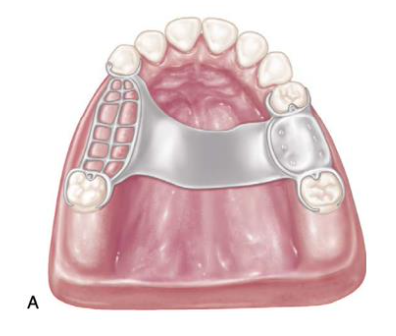
Single palatal strap
Maxillary Major Connector — broad, thin; for bounded spaces

Anteroposterior palatal strap
Maxillary Major Connector — two straps for rigidity

Palatal plate
Maxillary Major Connector — complete coverage; maximum support
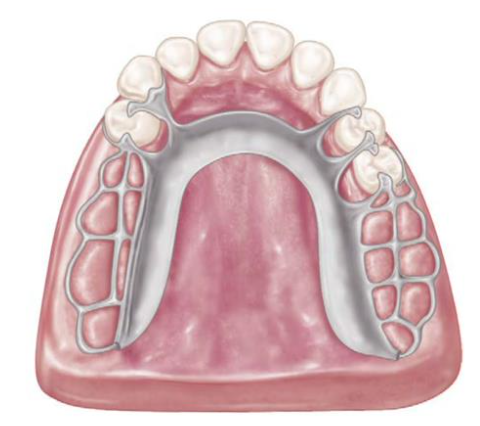
U-shaped (horseshoe)
Maxillary Major Connector — around a torus or anterior spaces

Lingual bar
Mandibular Major Connector — half-pear shaped; needs ≥7–8 mm of vertical space

Lingual plate (linguoplate)
Mandibular Major Connector — thin apron over the cingula when height is limited

Sublingual bar
Mandibular Major Connector — set lower and lingually where the vestibule is shallow

Labial/cingulum bar
Mandibular Major Connector — for severely lingually inclined teeth
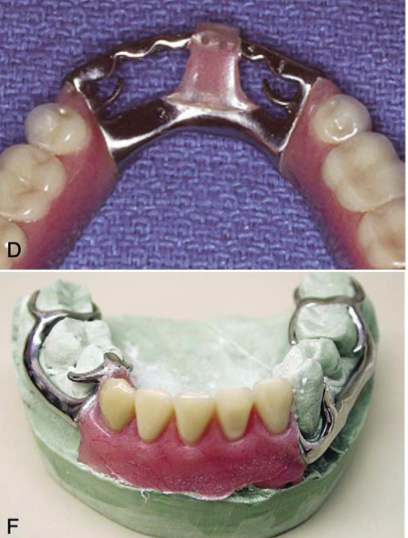
Double lingual (Kennedy) bar
Mandibular Major Connector — a lingual bar plus a cingulum bar
Direct retainer
Provides retention against dislodging forces
Engages an undercut on the abutment tooth

Rest
Directs force along the long axis and stops the denture settling
Occlusal rest
Rest — spoon-shaped; ~1/3 the mesiodistal width
Cingulum rest
Rest — on the cingulum of a canine/anterior tooth
Incisal rest
Rest — a rounded notch at the incisal edge
Shortened dental arch (SDA)
Patients can function with as few as 20 occluding teeth
• Patient's choice
• No budget
• Significant difference in chewing and comfort
anterior teeth + 4-6 occlusal units
opposing premolars = 1 occlusal unit
opposing molars = 2 occlusal units
Shortened dental arch (SDA) requires ?