LAB 2
 Call Kai
 Learn
Learn Practice Test
 Spaced Repetition
 Match
Match Flashcards
 Knowt Play
1/45

There's no tags or description
Looks like no tags are added yet.
Name | Mastery | Learn | Test | Matching | Spaced | Call with Kai | Chat |
|---|
No analytics yet
Send a link to your students to track their progress
46 Terms

metaphase
Metaphase
Chromosomes align in the center at the metaphase plate
-enzyme separate the chromatids from each other
Late prophase
Nuclear envelope breaks down, which allows the mitotic spindle microtubules to attach to kinetochores, a specialized protein at the centromere
•Spindle poles are at opposite ends
•The kinetochore microtubules pull chromosomes to the center

Late prophase
Anaphase
Centromeres split, and motor proteins in the kinetochores pull the chromosomes toward the pole it faces
•Chromosomes take on a “V” shape while moving towards the poles

Anaphase
Telophase & Cytokinesis
Telophase (prophase in reverse)
•Begins when chromosomes stop moving
•Chromosomes uncoil forming chromatin
•Nuclear envelope and nucleolus reappear
•Spindle breaks down
•Cell will have a nucleus identical to its parent
Cytokinesis (not part of mitosis)
•Division of cytoplasm through contractile ring of actin

Telophase & Cytokinesis
Early Prophase
Nucleolus disappears
•Chromatin condenses, forming chromosomes. 2 sister chromatids are held together at the centromere
•Centrosomes separate and mitotic spindle forms (microtubules)

Early Prophase
Interphase
Nucleolus and nuclear envelope are visible
•DNA is duplicated and is in the form of chromatin
•Centrioles replicate.
2 centrioles = centrosome

Interphase
The cell cycle: Interphase + Mitosis

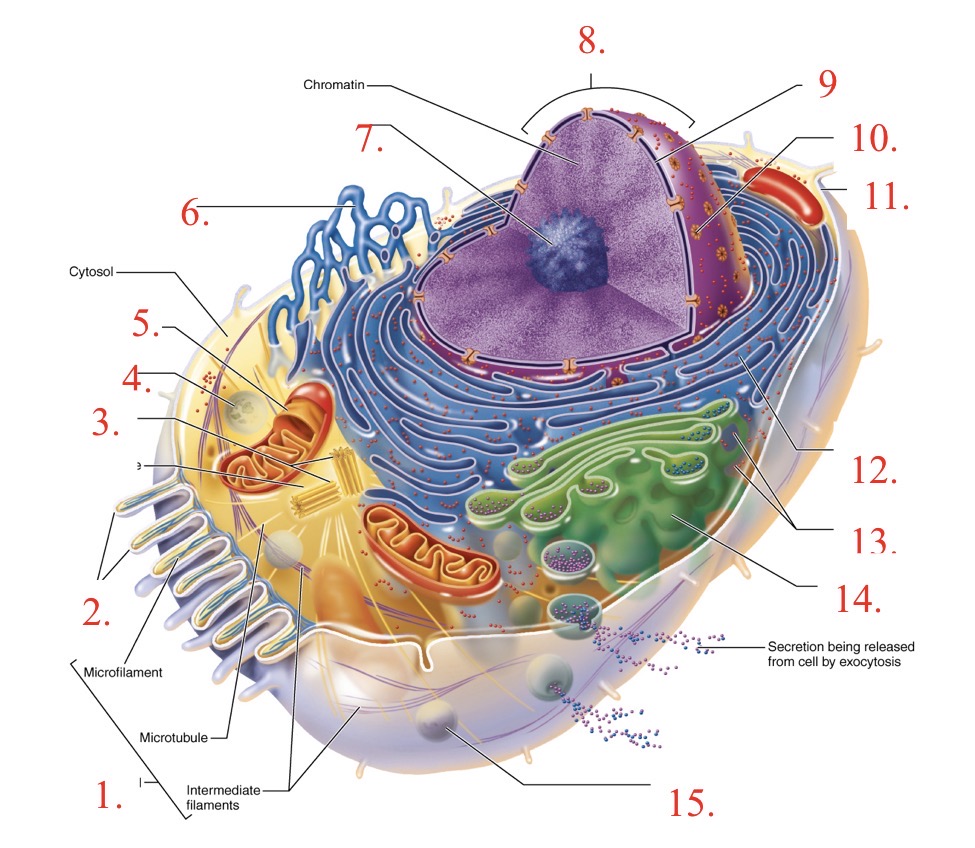
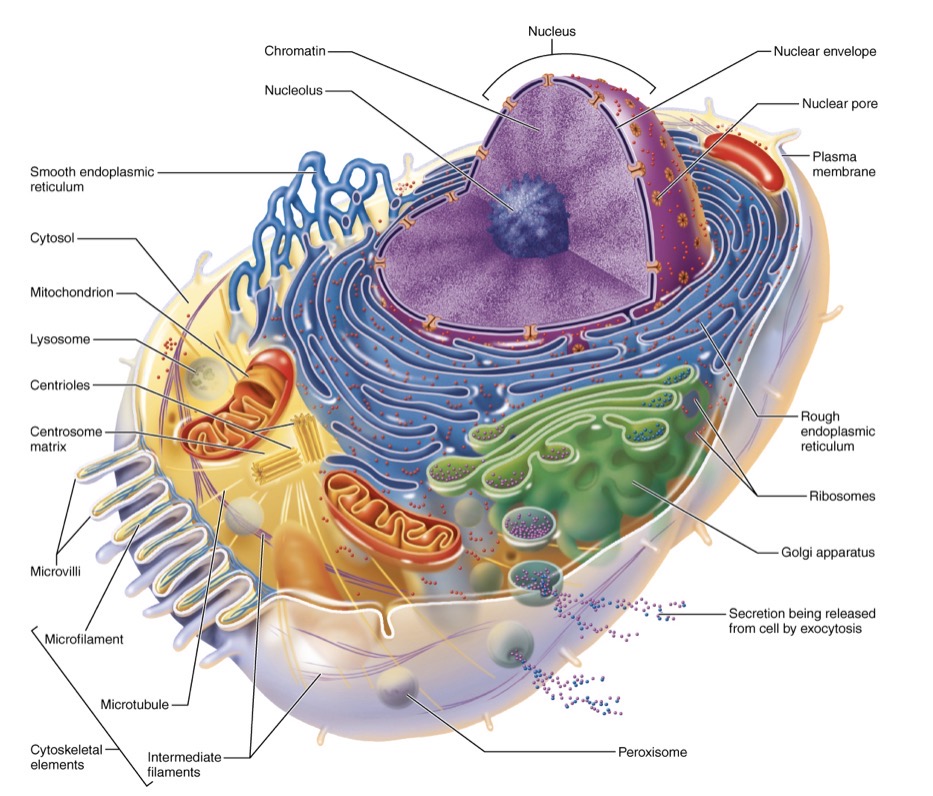
Site of protein synthesis?
Ribosomes
Site of lipid synthesis?
Smooth endoplasmic reticulum
Main site of ATP synthesis?
Mitochondria
Encloses the chromatin?
Nucleus
Packages proteins for transportation?
Golgi apparatus
Sac of digestive enzymes?
Lysosomes
Helps direct mitotic spindle formation?
Centrioles
Intracellular network of rod-like structures?
Cytoskeleton
what attaches to ribosomes ?
Rough endoplasmic reticulum
What detoxifies chemicals in body?
Peroxisomes : sacs containing oxidase enzymes that detoxify alcohol, free radicals, and other harmful chemicals

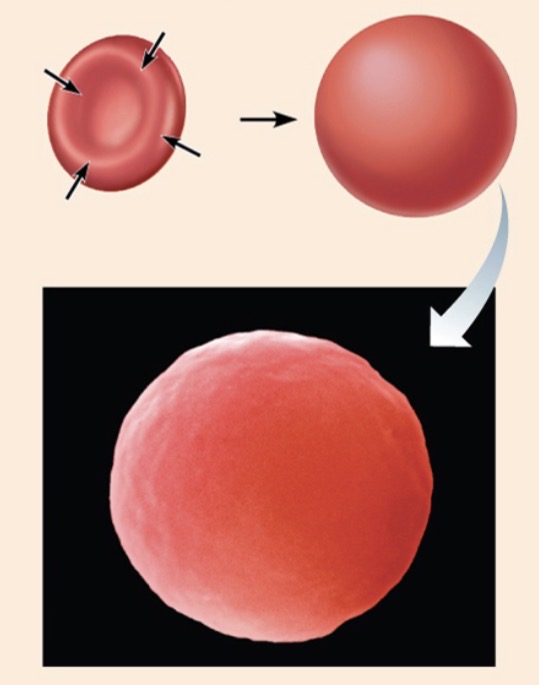
In general what will happen?
All sacs placed in distilled water will gain mass except for the sac in the beaker with 40% glucose outside (which stays the same)

Water moves into sac because it has a higher solute concentration. Sac gains mass and swells

Sac will stay the same. There is no concentration gradient so no net osmosis

Water moves into sac because there is higher solute there. Sac gains mass.

Sac gains the most mass. Strong gradient so lost of water enters




Phagocytosis (Cell eating)

Pinocytosis (Cell drinking)

Receptor-mediated endocytosis ( molecule specific eating)
Vesicular transport (requires ATP)
Endocytosis
Exocytosis
Endocytosis types
•Phagocytosis (cell eating)
•Pinocytosis (cell drinking)
•Receptor-mediated (molecule specific eating)
Exocytosis
•Secretory vesicles inside the cell move to the plasma membrane, fuse with it & then release its contents outside
•Hormones
•Neurotransmitters
•Mucus
•Ejection of wastes
Simple diffusion
The plasma membrane is a lipid bilayer, which means that only molecules that can dissolve through lipids can pass through the plasma membrane via diffusion
•Examples are O2 and CO2
Facilitated diffusion
If a molecule is not lipid soluble, carrier proteins on the plasma membrane can assist and act as a gate to allow it to pass through and enter the cell
•Example is glucose
Molecules moving down its concentration gradient(high to low)
passive process
Osmosis
movement of water down its concentration gradient
Passive transport
does not use ATP and can be either unassisted (freely moving) via
simple diffusion OR
with help of a protein carrier via facilitated diffusion
Active transport
requires ATP for molecules to move against their concentration gradient
Details of the Plasma Membrane


