Advanced Adult Health: Cardiovascular, Vascular, Hematologic, and Gastrointestinal Disorders Flashcards
 Call Kai
 Learn
Learn Practice Test
 Spaced Repetition
 Match
Match Flashcards
 Knowt Play
1/24

Earn XP
Description and Tags
Comprehensive practice flashcards in fill-in-the-blank format covering DIC, PAD, Aortic Aneurysms and Dissection, ACS/CABG, Mechanical Circulatory Support (IABP/VAD), Shock, Cardiac Tamponade, Gastrointestinal Bleeding, Liver Disorders, Obesity, and Bariatric Surgery.
Name | Mastery | Learn | Test | Matching | Spaced | Call with Kai | Chat |
|---|
No analytics yet
Send a link to your students to track their progress
25 Terms
Excess thrombin converts fibrinogen to __________ and promotes platelet aggregation in Disseminated Intravascular Coagulation (DIC).
fibrin
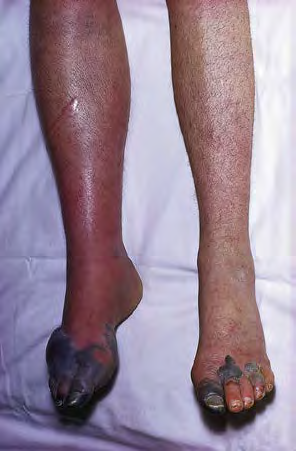
Chronic DIC is treated with __________ because it does not respond to oral anticoagulants.
Heparin

Ankle-Brachial Index (ABI) is calculated using the formula: ABI=__________Ankle systolic blood pressure.
Higher brachial systolic blood pressure

An Ankle-Brachial Index (ABI) result of 0.40 or lower indicates __________ Peripheral Artery Disease (PAD).
Severe PAD
The classic symptom of lower extremity Peripheral Artery Disease (PAD) is intermittent claudication, caused by lactic-acid accumulation from __________ metabolism.
anaerobic
The emergency cues for acute arterial ischemia are known as the six Ps: Pain, Pallor, Pulselessness, Paresthesia, Paralysis, and __________.
Poikilothermia

An arterial aneurysm described as a circumferential, relatively uniform dilation is classified as a __________ aneurysm.
Fusiform aneurysm

Type A aortic dissection affects the ascending aorta/aortic arch and usually requires a __________ emergency.
Surgical

During Coronary Artery Bypass Graft (CABG) surgery, the Left Internal Mammary Artery (LIMA) is most commonly used to bypass the __________ artery because it supplies blood to the largest part of the heart muscle.
Left Anterior Descending (LAD)
In an Intra-aortic Balloon Pump (IABP), pneumatic inflation begins at the start of __________ and deflates just before systole.
diastole

Moderate to severe aortic insufficiency is considered a __________ for Intra-aortic Balloon Pump (IABP) therapy.
Contraindication

To prevent arterial trauma or displacement during IABP therapy, the nurse must keep the head of the bed no higher than __________ degrees.
45

A Left Ventricular Assist Device (LVAD) shunts blood from the left ventricle and pumps it directly into the __________.
aorta
The classic Beck's triad seen in cardiac tamponade consists of hypotension, muffled heart tones, and __________.
distended neck veins
Pulsus paradoxus is defined as an abnormally large fall in systolic blood pressure greater than __________ mm Hg during inspiration.
10
In the initial stage of shock, cellular hypoperfusion shifts metabolism from aerobic to __________ metabolism, causing lactic acid buildup.
anaerobic
In the Sepsis Hour-1 bundle, rapid administration of __________ mL/kg crystalloid is initiated for hypotension or lactate ≥4mmol/L.
30
Candidates for bariatric surgery typically have a BMI of ≥40kg/m2 or a BMI of ≥35kg/m2 with at least one weight-related __________.
comorbidity
Roux-en-Y gastric bypass is classified as a combination of restrictive and __________ surgical procedures.
malabsorptive
Diagnosis of metabolic syndrome requires meeting at least __________ of the 5 diagnostic criteria.
3
Esophageal varices are complex, enlarged veins at the lower end of the esophagus caused by __________ hypertension.
portal
In managing hepatic encephalopathy, lactulose works by trapping __________ in the gut so it can be expelled via the colon.
ammonia
A red, velvety precancerous patch on the mouth mucosa or tongue is referred to as __________.
Erythroplakia
Black, tarry, foul-smelling stools caused by the digestion of blood from an upper GI source are termed __________.
melena
When caring for a patient with a balloon tamponade tube (such as a Sengstaken-Blakemore tube), a pair of __________ must always be kept at the bedside for emergency airway obstruction.
scissors