[CHEMICAL REACTIONS] Chemical Kinetics and Thermodynamics
 Call Kai
 Learn
Learn Practice Test
 Spaced Repetition
 Match
Match Flashcards
 Knowt Play
1/30

Earn XP
Description and Tags
Proverbs 16:3
Name | Mastery | Learn | Test | Matching | Spaced | Call with Kai | Chat |
|---|
No analytics yet
Send a link to your students to track their progress
31 Terms
TRUE
[Chemical Kinetics and Thermodynamics]
TRUE OR FALSE:
There is an intrinsic connection between the energy of chemical substances and their behavior toward chemical reaction.
Stability
[Chemical Kinetics and Thermodynamics]
_______is a property that bridges the properties and changes of a system.
Stability
[Chemical Kinetics and Thermodynamics]
In thermodynamics,_______ refers to the tendency of a system to remain in a state of low energy and high entropy.
Gibb's free energy (G)
[Chemical Kinetics and Thermodynamics]
Total amount of energy possessed by a substance
Enthalpy (H)
[Chemical Kinetics and Thermodynamics]
Total heat content of a substance
Entropy (S)
[Chemical Kinetics and Thermodynamics]
Degree of disorder in the substance
TRUE
[Chemical Kinetics and Thermodynamics]
TRUE OR FALSE:
In most cases, the changes of ΔG and ΔH (increase or decrease) are the same.
Zeroth Law of Thermodynamics
[Law of Thermodynamics]
If two bodies are each in thermal equilibrium with some third body, then they are also in equilibrium with each other
A=B=C
a. Zeroth Law of Thermodynamics
b. First Law of Thermodynamics
c. Second Law of Thermodynamics
d. Third Law of Thermodynamics
First Law of Thermodynamics
[Law of Thermodynamics]
Energy cannot be created nor destroyed, but only converted from one form to another.
The thermodynamic calculations of energy will differ depending on the system:
Open: Matter (Exchange), Energy (Exchange)
Closed: Matter (No exchange), Energy (Exchange (as heat))
Adiabatic: Matter (No exchange), Energy (Exchange (not heat))
Isolated: Matter (No exchange), Energy (No exchange)
a. Zeroth Law of Thermodynamics
b. First Law of Thermodynamics
c. Second Law of Thermodynamics
d. Third Law of Thermodynamics
Open System
Closed System
Adiabatic System
Isolated System
[Law of Thermodynamics]
In First Law of Thermodynamics the thermodynamic calculations of energy will differ depending on the system:
_____: Matter (Exchange), Energy (Exchange)
_____: Matter (No exchange), Energy (Exchange (as heat)
_____: Matter (No exchange), Energy (Exchange (not heat)
_____: Matter (No exchange), Energy (No exchange)
Open System
[Law of Thermodynamics]
Matter (Exchange), Energy (Exchange)
a. Open System
b. Closed System
c. Adiabatic System
d. Isolated System
Closed System
[Law of Thermodynamics]
Matter (No exchange), Energy (Exchange (as heat)
a. Open System
b. Closed System
c. Adiabatic System
d. Isolated System
Adiabatic System
[Law of Thermodynamics]
Matter (No exchange), Energy (Exchange (not heat)
a. Open System
b. Closed System
c. Adiabatic System
d. Isolated System
Isolated System
[Law of Thermodynamics]
Matter (No exchange), Energy (No exchange)
a. Open System
b. Closed System
c. Adiabatic System
d. Isolated System
Second Law of Thermodynamics
[Law of Thermodynamics]
Entropy always increases over time
a. Zeroth Law of Thermodynamics
b. First Law of Thermodynamics
c. Second Law of Thermodynamics
d. Third Law of Thermodynamics
Third Law of Thermodynamics
[Law of Thermodynamics]
Entropy of a system (e.g. crystalline solid) is zero only when the temperature approaches absolute zero
a. Zeroth Law of Thermodynamics
b. First Law of Thermodynamics
c. Second Law of Thermodynamics
d. Third Law of Thermodynamics
[Chemical Kinetics and Thermodynamics]
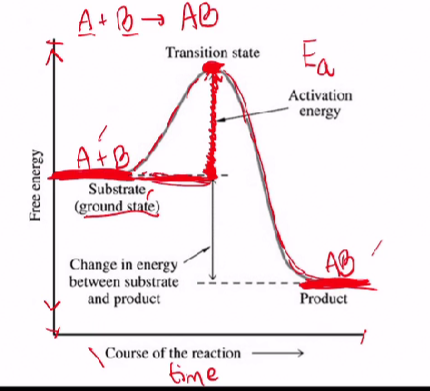
Figure 4. Standard energy diagran with labels
TRUE
[Chemical Kinetics and Thermodynamics]
TRUE OR FALSE:
All reactions demand a certain rise from the ground state to transition state
Transition state
[Chemical Kinetics and Thermodynamics]
The temporary state where the reactant/substrate transitions into the product
Activation energy (Ea)
[Chemical Kinetics and Thermodynamics]
The energy that must be raised from the reactant to the transition state
TRUE
[Chemical Kinetics and Thermodynamics]
TRUE OR FALSE:
The ACTIVATION ENERGY(Ea) is inversely related to the RATE (SPEED) of reaction.
TRUE
[Chemical Kinetics and Thermodynamics]
TRUE OR FALSE:
Decrease OR FALSE:
Higher Activation energy (Ea) → Increase Rate (speed) of reaction.
TRUE
[Chemical Kinetics and Thermodynamics]
TRUE OR FALSE:
Higher Activation energy (Ea) slows a reaction
Exergonic (Exothermic)
[Chemical Kinetics and Thermodynamics]
Lowered (-) ΔG / ΔH
a. Exergonic (Exothermic)
b. Endergonic (Endothermic)
![<p>[Chemical Kinetics and Thermodynamics]</p><p>Lowered (-) <span>ΔG / ΔH</span></p><p><span>a. Exergonic (Exothermic)</span></p><p><span>b. Endergonic (Endothermic)</span></p>](https://assets.knowt.com/user-attachments/8d30af6f-7d41-4313-9d77-ab0c10306626.png)
Endergonic (Endothermic)
[Chemical Kinetics and Thermodynamics]
Raised (+) ΔG / ΔH
a. Exergonic (Exothermic)
b. Endergonic (Endothermic)
![<p>[Chemical Kinetics and Thermodynamics]</p><p>Raised (+) ΔG / ΔH</p><p>a. Exergonic (Exothermic)</p><p>b. Endergonic (Endothermic)</p>](https://assets.knowt.com/user-attachments/e0354553-1532-4fad-bc4e-23fc438ba923.png)
spontaneous
[Chemical Kinetics and Thermodynamics]
Exergonic (Exothermic)
a. spontaneous
b. nonspontaneous
nonspontaneous
[Chemical Kinetics and Thermodynamics]
Endergonic (Endothermic)
a. spontaneous
b. nonspontaneous
- ΔG / ΔH = exergonic/exothermic = spontaneous
+ ΔG / ΔH = endergonic/endothermic = nonspontaneous
[Chemical Kinetics and Thermodynamics]
Combining all these ideas of ΔG / ΔH
more stable
In most cases, the assumption is that when reactions result to lower energy/enthalpy (negative ΔG / ΔH) the product becomes _____?
a. more stable
b. less stable
TRUE
TRUE OR FALSE:
Many compounds aspire stability, and thus, lowering of energy is the natural thing to happen (i.e. spontaneous)
Catalyst
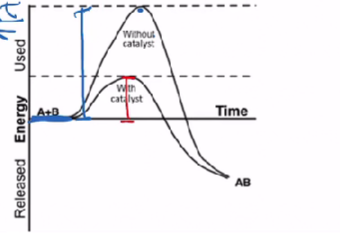
This is a substance that speeds up the rate of an ongoing reaction by reducing the activation energy