oat chem unit 9
 Call Kai
 Learn
Learn Practice Test
 Spaced Repetition
 Match
Match Flashcards
 Knowt Play
1/17

Earn XP
Description and Tags
half life of my face is face years in jail
Name | Mastery | Learn | Test | Matching | Spaced | Call with Kai | Chat |
|---|
No analytics yet
Send a link to your students to track their progress
18 Terms
kinetics
determines how fast a reaction will happen without depending on spontaneity.
reaction rate
Δ[A] / ΔT
[A] = concentration of A
T = time
Time will be multiplied by the stoichiometric coefficient
reaction rate example

rate laws
Rate = k[A]m[B]n
k = rate constant
[A] & [B] = concentration of reactants
n and m = reaction orders
Products do not appear in rate law
k, m, and n must be determined experimentally
Overall reaction order = m+n
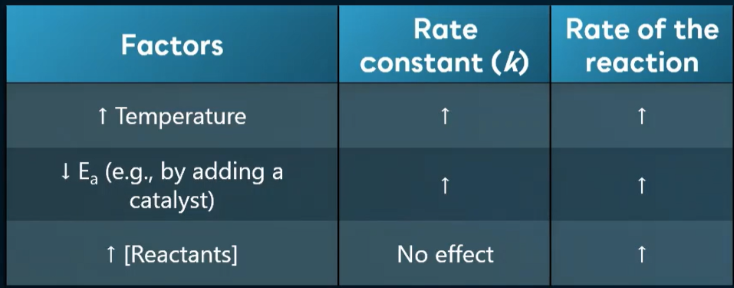
Temperature, catalyst, and concentration effects on rate and rate constant
zero order reaction
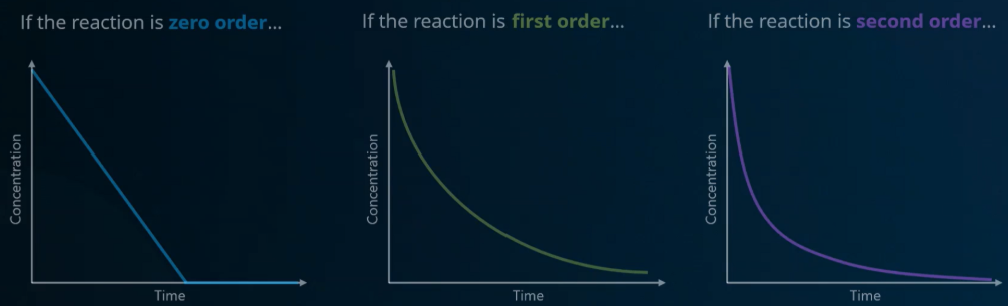
Rate of the reaction does not depend on the concentration of the reactants.
Rate = k[A]0 = k(1) = k
Unit: k = M/s
![<ul><li><p><span style="background-color: transparent;">Rate of the reaction does not depend on the concentration of the reactants.</span></p></li><li><p><span style="background-color: transparent;">Rate = k[A]<sup>0</sup> = k(1) = k</span></p></li><li><p><span style="background-color: transparent;">Unit: k = M/s</span></p></li></ul><p></p>](https://assets.knowt.com/user-attachments/178c81d5-7d5f-4049-9433-ea985d7b37f6.png)
first order reaction
The rate of the reaction is proportional to the concentration of the reactant.
Rate = k[A]1 = k[A]
Unit: k = 1/s
![<ul><li><p><span style="background-color: transparent;">The rate of the reaction is proportional to the concentration of the reactant.</span></p></li><li><p><span style="background-color: transparent;">Rate = k[A]<sup>1</sup> = k[A]</span></p></li><li><p><span style="background-color: transparent;">Unit: k = 1/s</span></p></li></ul><p></p>](https://assets.knowt.com/user-attachments/fe38322c-5ab1-4008-8bc7-9d894a72b1bc.png)
second order reaction
For A → B: The rate of the reaction is proportional to the square of the concentration of reactant A.
Rate = k[A]2
For A + B → C + D: The rate of reaction is proportional to both reactant A and B
Rate = k[A][B] or k[A]2 or k[B]2
Units = 1/Ms
![<ul><li><p><span style="background-color: transparent;">For A → B: The rate of the reaction is proportional to the square of the concentration of reactant A.</span></p><ul><li><p><span style="background-color: transparent;">Rate = k[A]<sup>2</sup></span></p></li></ul></li><li><p><span style="background-color: transparent;">For A + B → C + D: The rate of reaction is proportional to both reactant A and B</span></p><ul><li><p><span style="background-color: transparent;">Rate = k[A][B] or k[A]<sup>2</sup> or k[B]<sup>2</sup></span></p></li></ul></li><li><p><span style="background-color: transparent;">Units = 1/Ms</span></p></li></ul><p></p>](https://assets.knowt.com/user-attachments/4cdc198c-8594-48f9-84b1-f2b47ab076a0.png)
concentration vs time
determining rate law from experimental data
To determine the rate order of A, use two trials in which [B] is equal.
Divide concentrations of A (0.4 / 0.2 = 2)
Divide initial rates (4.0E-5 / 1.0E-5 = 4)
Rate = k[A]x[B]y ← solve for x
When A is doubled, the rate is quadrupled → 2x = 4 → x = 2
Reaction order with respect to A: k = [A]2
Do the same for B
![<ul><li><p><span style="background-color: transparent;">To determine the rate order of A, use two trials in which [B] is equal.</span></p></li><li><p><span style="background-color: transparent;">Divide concentrations of A (0.4 / 0.2 = 2)</span></p></li><li><p><span style="background-color: transparent;">Divide initial rates (4.0E-5 / 1.0E-5 = 4)</span></p></li><li><p><span style="background-color: transparent;">Rate = k[A]<sup>x</sup>[B]<sup>y</sup> ← solve for x</span></p></li><li><p><span style="background-color: transparent;">When A is doubled, the rate is quadrupled → 2<sup>x</sup> = 4 → x = 2</span></p></li><li><p><span style="background-color: transparent;">Reaction order with respect to A: k = [A]<sup>2</sup></span></p></li><li><p><span style="background-color: transparent;">Do the same for B</span></p></li></ul><p></p>](https://assets.knowt.com/user-attachments/320f32aa-a8db-4c5c-8376-7785dd27824a.png)
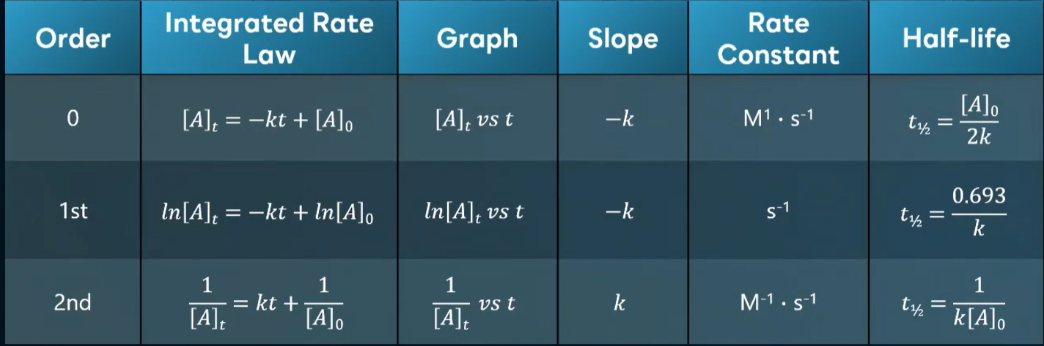
integrated rate law
Determines the amount of reactant/product present over a period of time.
rate determining step
the slowest step of the reaction which determines the rate.
This is the step with the highest activation energy.
Determines the overall rate law.
intermediate
Formed during the reaction but are not part of the reactants or products.
catalyst
Lowers the activation energy, which increases the reaction rate. They are not consumed during the reaction (shows up in both reactants and products)
collision theory
For a chemical reaction to occur, three conditions must be met:
Molecules must collide
Molecules must have proper orientation when they collide
Molecules must have sufficient energy to overcome the Ea barrier.
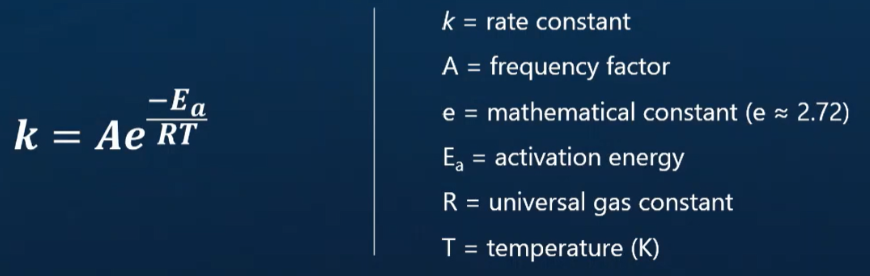
arrhenius equation
half life
time it takes to convert half of a reactant to product
Zero order: lower concentration = lower half life
First order: half life is independent of concentration
Second order: lower concentration = higher half life
the
a determiner placed before nouns (and noun phrases) to indicate that the listener or reader already knows, identifies, or is already familiar with the specific person, place, thing, or concept being discussed