Comprehensive Guide to Accounting and Taxation Principles
 Call Kai
 Learn
Learn Practice Test
 Spaced Repetition
 Match
Match Flashcards
 Knowt Play
1/150

There's no tags or description
Looks like no tags are added yet.
Name | Mastery | Learn | Test | Matching | Spaced | Call with Kai | Chat |
|---|
No analytics yet
Send a link to your students to track their progress
151 Terms
International Accounting Standards Board (IASB)
Private-sector body that develops and issues International Financial Reporting Standards (IFRS).
Basic Principle of a Sound Tax System
Fiscal Adequacy: Source of revenue should be sufficient to meet the demands of public expenditures.
Exemption of the Government
Government can but does not tax itself as this will not raise additional funds.
Non-appropriation of Public Funds
Prohibition of using public funds for the benefit of a church or religion.
Flat or fixed rate tax
Tax that subjects all taxpayers with the same rate.
Pension
Specified income payable at stated intervals for a fixed or contingent period.
Tax Deductions
Compensation for damages; forgiveness of debt; bad debt recovery
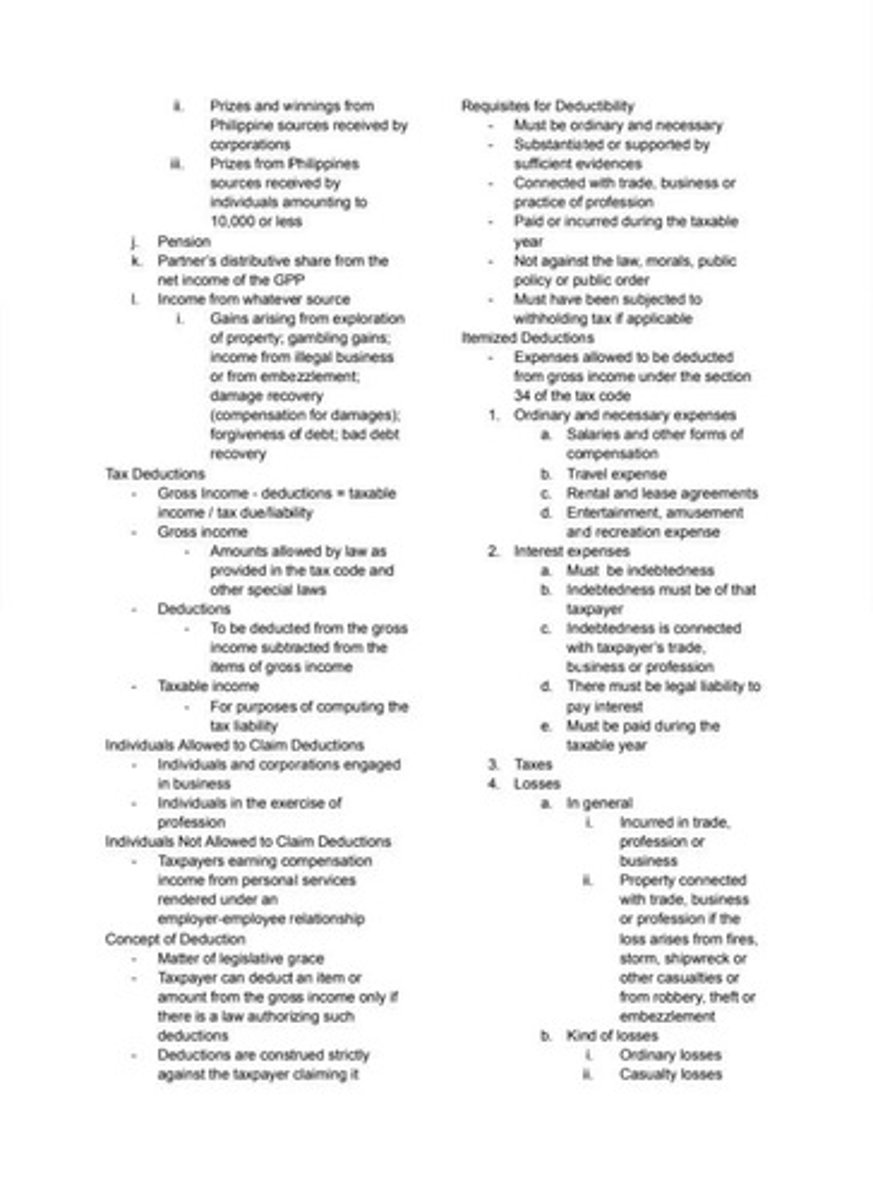
Individuals Not Allowed to Claim Deductions
Taxpayers earning compensation income from personal services rendered under an employer-employee relationship
Accrued Expense
Unrecorded expenses that have been incurred and for which cash has not been paid.
Fixed Asset/Property, Plant and Equipment
Physical resources that are owned and used by a business and are permanent or have a long life.
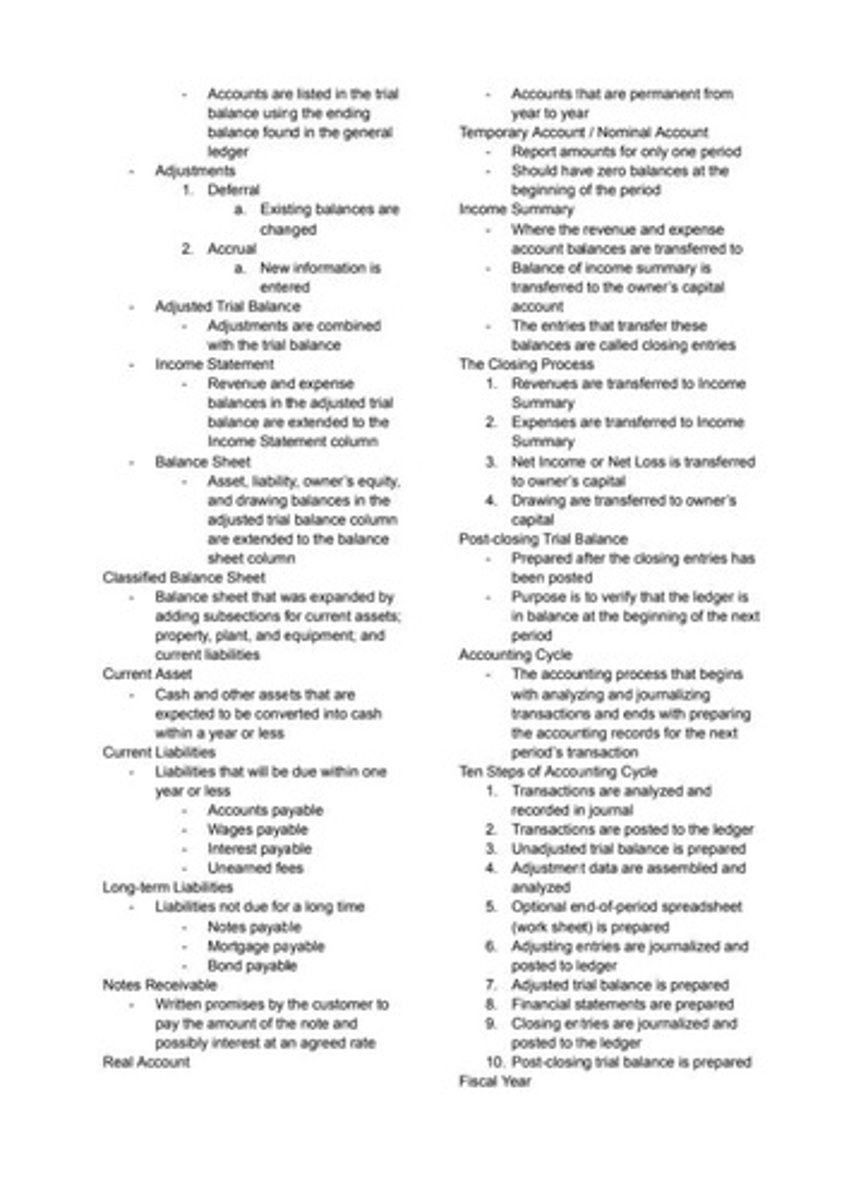
Classified Balance Sheet
Balance sheet that was expanded by adding subsections for current assets; property, plant, and equipment; and current liabilities.
Current Asset
Cash and other assets that are expected to be converted into cash within a year or less.
Current Liabilities
Liabilities that will be due within one year or less.
Long-term Liabilities
Liabilities not due for a long time.
Real Account
Where the revenue and expense account balances are transferred to.
The Closing Process
1. Revenues are transferred to Income Summary; 2. Expenses are transferred to Income Summary; 3. Net Income or Net Loss is transferred to owner's capital; 4. Drawing are transferred to owner's capital.
Post-closing Trial Balance
Prepared after the closing entries have been posted.
Accounting Cycle
The accounting process that begins with analyzing and journalizing transactions and ends with preparing the accounting records for the next period's transaction.
Fiscal Year
Annual accounting period adopted by a business.
Business
Integrated set of activities capable of being conducted and managed for providing goods or services to customers.
Types of Businesses
1. Service Business - Provides Service; 2. Merchandising Business - Provides product; 3. Manufacturing Business - Creates product.
Financial Accounting
Provides external users with information.
Luca Pacioli
Father of Accounting.
Generally Accepted Accounting Principles (GAAP)
Financial accountants follow GAAP in preparing reports.
Financial and Sustainability Reporting Standards Council (FSRSC)
Tasked with promulgating generally accepted accounting principles in the Philippines.
Business Entity Concept
Activities of businesses are recorded separately from the activities of its owners, creditors, or other businesses.
Partnership
Owned by two or more individuals; 1% entities in the Philippines.
Corporation
Organized under state or federal statutes as a separate legal taxable entity; generates 90% of business revenue.
Going Concern Concept
A company that has the resources to continue making enough money to stay afloat for the foreseeable future.
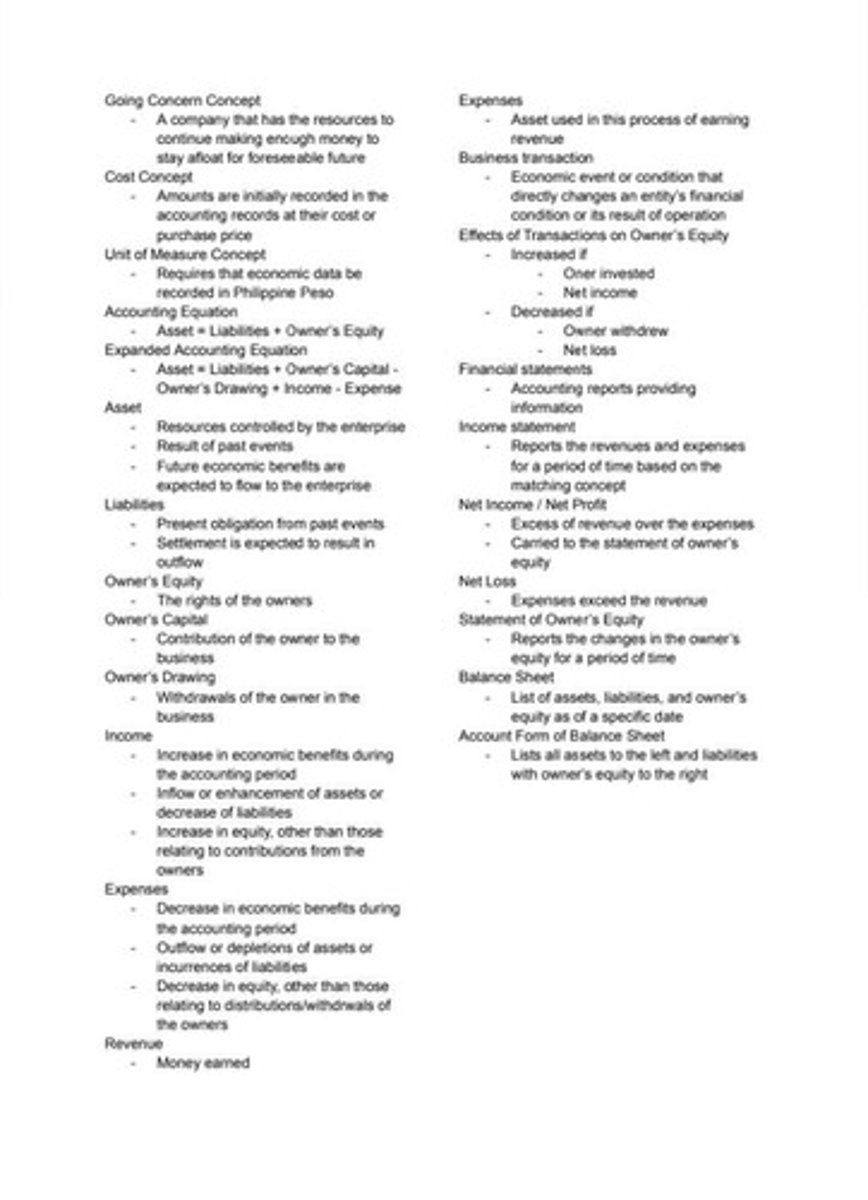
Cost Concept
Amounts are initially recorded in the accounting records at their cost or purchase price.
Unit of Measure Concept
Requires that economic data be recorded in Philippine Peso.
Accounting Equation
Assets = Liabilities + Owner's Equity.
Liabilities
Present obligation from past events; settlement is expected to result in outflow.
Owner's Capital
Contribution of the owner to the business.
Owner's Drawing
Withdrawals of the owner in the business.
Income
Increase in economic benefits during the accounting period.
Revenue
Money earned.
Business Transaction
Economic event or condition that directly changes an entity's financial condition or its result of operation.
Financial Statements
Accounting reports providing information.
Net Income / Net Profit
Excess of revenue over the expenses; carried to the statement of owner's equity.
Net Loss
Expenses exceed the revenue.
Balance Sheet
List of assets, liabilities, and owner's equity as of a specific date.
Taxation
An inherent power of the state to enforce a proportional contribution from its subjects for public purpose.
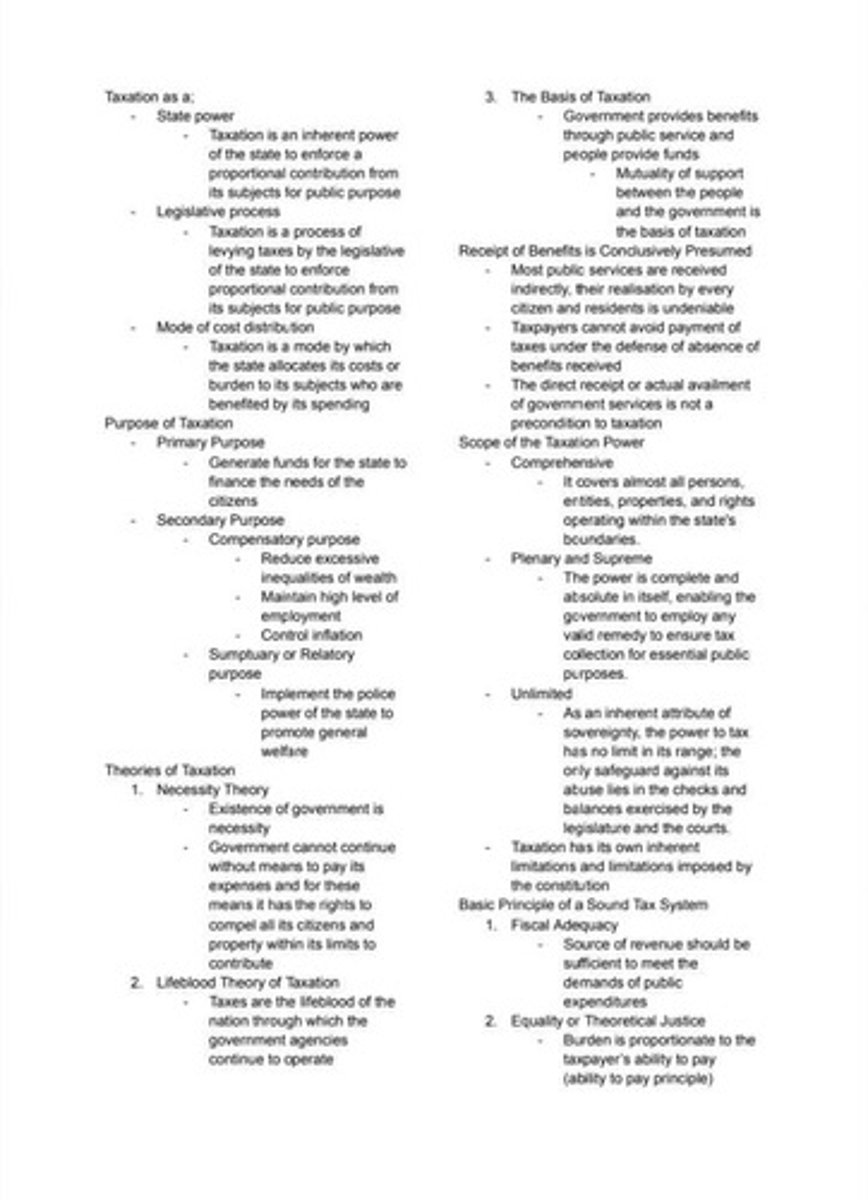
Purpose of Taxation
Primary Purpose: Generate funds for the state to finance the needs of the citizens.
Necessity Theory
Existence of government is necessity; government cannot continue without means to pay its expenses.
Lifeblood Theory of Taxation
Taxes are the lifeblood of the nation through which government agencies continue to operate.
Administrative Feasibility
Laws should be capable of convenient, just and effective administration.
Territoriality of Taxation
Tax can be only imposed within the territory of the state.
Public Purpose
Tax is intended for common good; taxation must be exercised for public purpose.
Non-delegation of the Taxing Power
Legislative taxing power is vested exclusively in congress and is non-delegable.
Due Process of Law
A constitutional limitation ensuring fair legal proceedings.
Uniformity Rule in Taxation
Taxation must be uniform across similar entities.
Stages of Taxation Power
Includes Levying or Imposition, Assessment and Collection, and Payment.
Direct Double Taxation
Occurs when all elements of double taxation exist for both impositions.
Indirect Double Taxation
Occurs when at least one of the secondary elements of double taxation is not common.
Tax Avoidance
Act or trick that reduces or totally escapes taxes by any legally permissible means.
Tax Exemption
Immunity, privilege or freedom from being subject to a tax which others are subject to.
Specific Tax
Tax of a fixed amount imposed on a per unit basis.
Ad Valorem Tax
Tax based on the value of the property.
Excise Tax
Tax imposed on specific goods, often to regulate behavior.
Community Tax
Tax on persons who are residents of a particular place.
Property Tax
Tax on properties.
Real or personal
Refers to types of property or assets.
Real estate tax
Tax imposed on real property.
Income tax
Tax on annual income, gains or profits.
Estate tax
Tax on gratuitous transfer of properties by a decedent upon death.
Direct tax
Tax collected from the person who is intended to pay the same or tax which is non-transferable.
Proportional tax
Tax that emphasizes equality as it subjects all taxpayers to the same rate.
Percentage tax
Tax that is calculated as a percentage of the value.
Progressive or Graduated tax
Tax that imposes increasing rates as the tax base increases.
Regressive tax
Tax that imposes decreasing tax rates as the tax base increases.
Local tax
Tax imposed by the municipal or local government.
Professional tax
Business taxes, fees and charges.
Tax laws
Laws that provide for the assessment and collection of taxes.
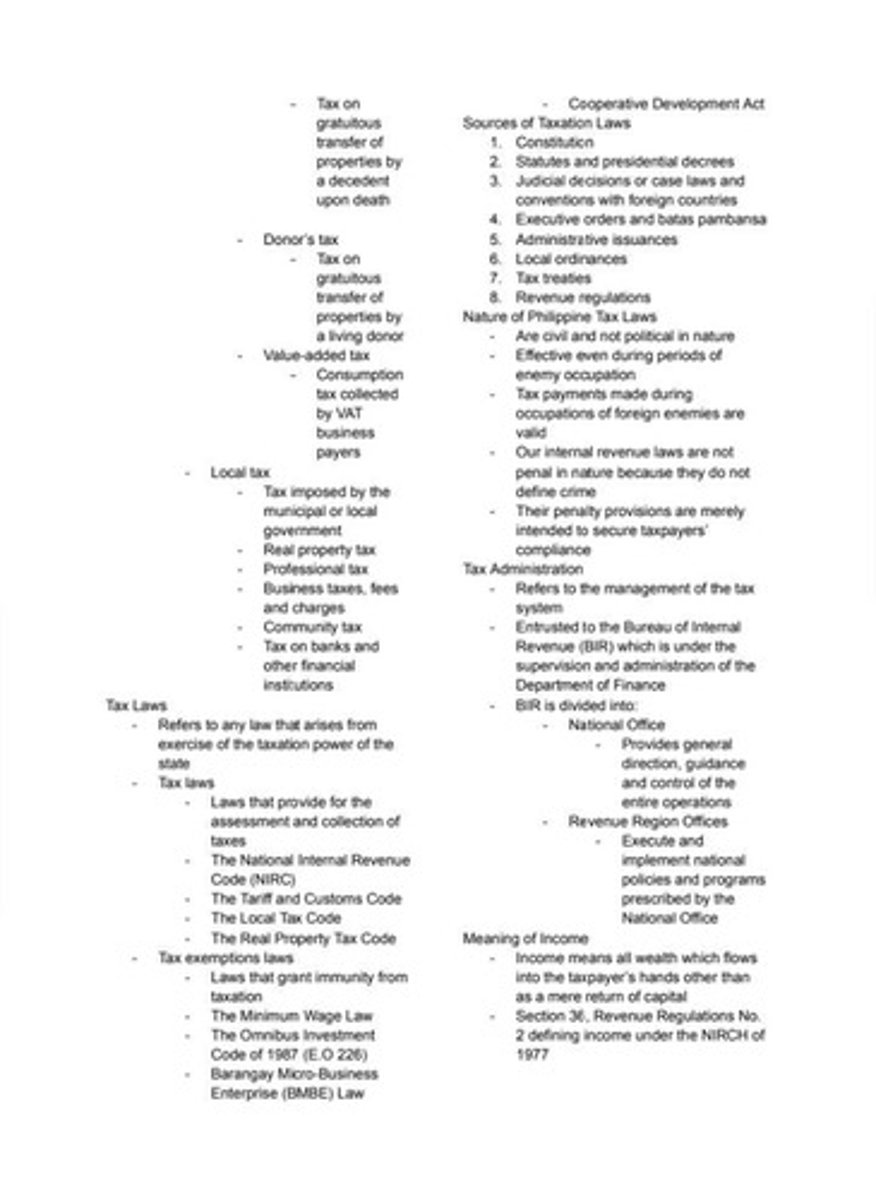
Tax exemptions laws
Laws that grant immunity from taxation.
Sources of Taxation Laws
1. Constitution 2. Statutes and presidential decrees 3. Judicial decisions or case laws and conventions with foreign countries 4. Executive orders and batas pambansa 5. Administrative issuances 6. Local ordinances 7. Tax treaties 8. Revenue regulations.
Nature of Philippine Tax Laws
Are civil and not political in nature.
Tax Administration
Refers to the management of the tax system.
Bureau of Internal Revenue (BIR)
The agency entrusted with tax administration under the Department of Finance.
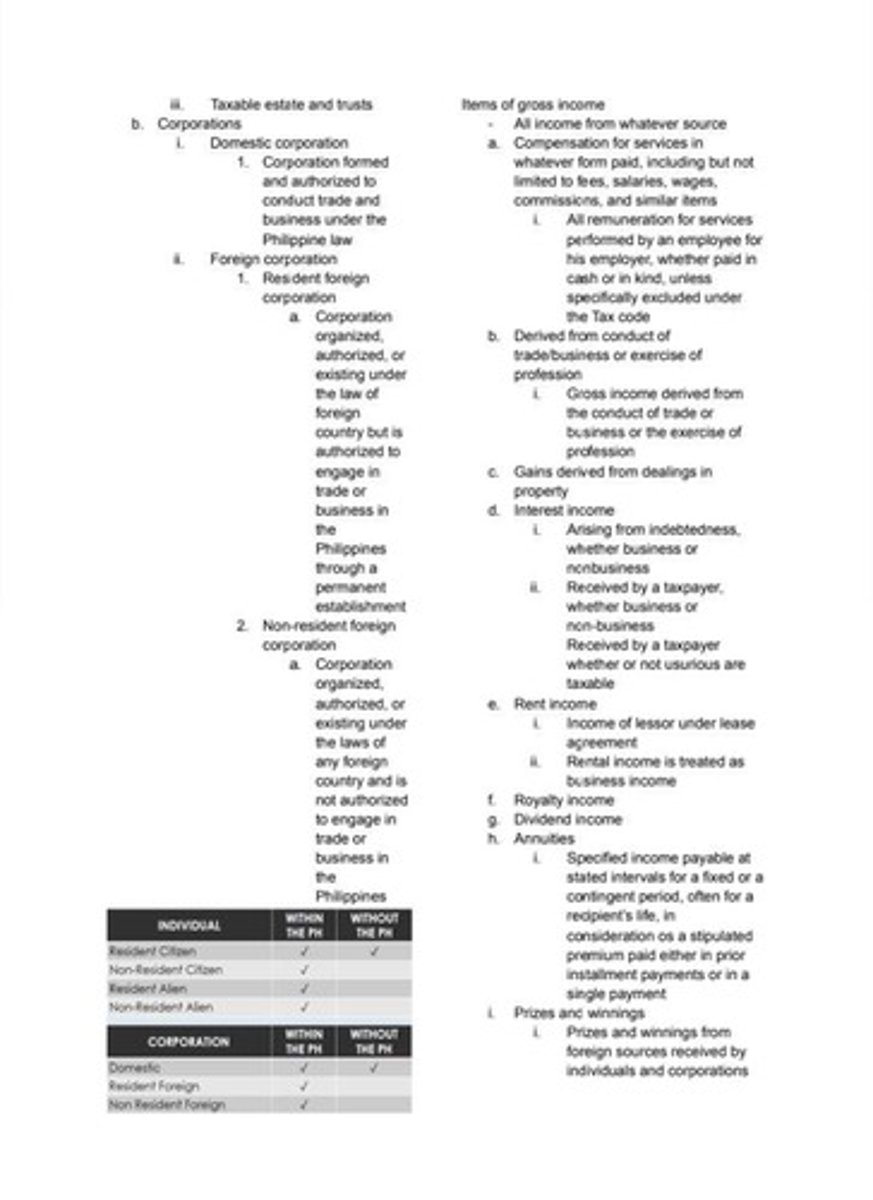
Domestic corporation
Corporation formed and authorized to conduct trade and business under Philippine law.
Resident foreign corporation
Corporation organized under the law of a foreign country but authorized to engage in trade or business in the Philippines.
Non-resident foreign corporation
Corporation organized under the laws of any foreign country and not authorized to engage in trade or business in the Philippines.
Items of gross income
All income from whatever source.
Compensation for services
Includes fees, salaries, wages, commissions, and similar items.
Interest income
Income arising from indebtedness, whether business or non-business.
Prizes and winnings
Prizes and winnings from foreign sources received by individuals and corporations.
Gains arising from exploration of property
Income from illegal business or from embezzlement; damage recovery
Taxable Income
Gross Income - deductions = taxable income / tax due/liability
Gross Income
Amounts allowed by law as provided in the tax code and other special laws
Deductions
To be deducted from the gross income subtracted from the items of gross income
Individuals Allowed to Claim Deductions
Individuals and corporations engaged in business; individuals in the exercise of profession
Requisites for Deductibility
Must be ordinary and necessary; substantiated or supported by sufficient evidences; connected with trade, business or practice of profession; paid or incurred during the taxable year; not against the law, morals, public policy or public order; must have been subjected to withholding tax if applicable
Ordinary and necessary expenses
Salaries and other forms of compensation; travel expense; rental and lease agreements; entertainment, amusement and recreation expense
Taxes
Various taxes that can be deducted
Losses
Incurred in trade, profession or business; property connected with trade, business or profession if the loss arises from fires, storm, shipwreck or other casualties or from robbery, theft or embezzlement
Kind of losses
Ordinary losses; casualty losses; net operating loss carry-over; capital losses and income by the code or other special laws
Bad debts
Deductible only if it is a valid business-related debt, not between related parties, proven worthless and uncollectible, and properly written off in the taxpayer's books by year-end
Charitable and other contributions
Donations to the government or political subdivisions including fully owned government corporations
Research and development
Expenses related to research and development can be deducted
Pension trusts
Contributions to pension trusts can be deducted