Chapter 10 - Infection Prevention and Control
 Call Kai
 Learn
Learn Practice Test
 Spaced Repetition
 Match
Match Flashcards
 Knowt Play
1/33

There's no tags or description
Looks like no tags are added yet.
Name | Mastery | Learn | Test | Matching | Spaced | Call with Kai | Chat |
|---|
No analytics yet
Send a link to your students to track their progress
34 Terms
Infection prevention and control (IPC)
Comprehensive and systematic program — reduce risk of transmitting infectious agents
Infection occurs when: Portal of entry
IPC breaks chain of infection
Clinician → patient
Patient → Clinician
Patient → patient
Goal of IPC
Prevent healthcare associated infections (HAIs) in patients
Prevent Occupational injuries and illnesses in healthcare personnel
Infection control assessment
What procedures will be performed?
Periodontal instrumentation, radiographs, air polishing…
What exposure risks are associated with those procedures?
Blood, saliva, sharps injury…
What IPC measures are indicated?
PPE, barriers, hand hygiene…
Procedure → Risk → Protection
Model of IPC vs Dental hygiene care model
IPC model
Tasks and procedures to protect both patient and provider
DH care model
Patient’s health needs
→ Don’t rely on patient’s health history to determine infection risk
(Asymptomatic, patient doesn’t know etc)
COVID, Hep B, C, Influenza
Use standard precautions for EVERYONE
Government Agencies and Organizations
Centers for Disease Control and Prevention (CDC)
Health and human services department (HHS)
Promote health, qol, infection guidelines n rec
Not regulatory agency (NO ENFORCE) only recommendations
Occupational Safety and Health Adminstration (OSHA)
US Department of Labor
Enforce/ Regulates workplace safety regulations
Employers in private sector are responsible for health and safety of employees
National Institute for Occupational Safety and Health (NIOSH)
Conducts research and makes recommendations to prevent occupational injuries
Approves respirators
US Food and Drug Administration (FDA)
Regulates medical products and devices
Evaluates safety and effectiveness
US Environmental Protection Agency (EPA)
Regulates environment, hazardous waste, chemicals and disinfectants
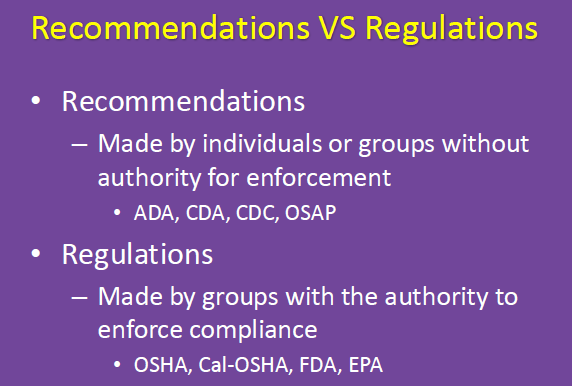
Other organizations (non regulatory)
American National Standards Institute (ANSI)
Standards for protective clothing
Eyewear
Association for the Advancement of Medical Instrumentation (AAMI)
Standards for sterilization
Healthcare facilities
American Dental Association (ADA)
Develops dental standards and terminology
Organization for Safety, Asepsis and Prevention (OSAP)
Provides infection prevention resources
Government Agency summary
Organization | Think |
|---|---|
CDC | Guidelines/recommendations |
OSHA | Workplace safety/regulations |
NIOSH | Occupational safety research + respirators |
EPA | Environment + disinfectants |
FDA | Medical products/devices |
ANSI | Standards |
AAMI | Instrument sterilization/processing |
ADA | Dentistry standards |
OSAP | Dental infection-prevention resources |
Standard of Care
Minimum acceptable level of care
Can be influenced by
Infection control regulations
Evidence based guidelines
Government agencies
Licensing boards
Dental practitioners
Expert opinions
Types of pathogenic microorganisms dhcp
Cytomegalovirus (CMV)
HBV
HCV
Herpes
Simplex virus type 1 and 2
HIV
TB
Staphylococci
Streptococci
Influenza
Coronavirus
Infection through
→ Direct contact w/ blood, oral fluids
→ Indirect contact w/ contaminated objects
→ Droplets
→ Inhalation of aerosols
From
→ Pathogenic organism
→ Reservoir source
→ Mode of transmittion
→ Portal entry
→ Susceptible host
Chain of Infection
Link where disease transmission occurs
Infectious Agent
Bacteria, virus, fungi
Reservoir
People, instruments, equipment, water
Portal of Exit
Secretions, blood, skin, mucous membranes
Transmission
Direct contact, indirect, fomites, vector, airborne
Portal of Entry
Mucous membrane, GI Tract, broken skin, eyes
Susceptible Host
Immunosuppressed, elderly
CDC 4 principles of infection control
Principle 1
Take action to stay healthy
Immunization, hand hygiene, medical evaluation, postexposure management, education, training
Principle 2
Avoid contact w/ blood and other infectious substances
PPE, gloves, face mask, eyewear, gowns, safe handling of sharp instruments and objects & high speed evacs
Principle 3
Make patient care items safe
Cleaning, sterilization, disinfection, containment and disposal of single use items
Principle 4
Limit spread of blood/ infectious substances
Protective covers/barriers, cleaning and disinfecting, waste management of sharps/non sharp and hazardous waste

P1: work restrictions
Work restrictions
diptheria, mmr = don’t work
hep a = no direct contact
upper resp infection = avoid autoimmune contact
herpes/ shingles = continue work, but cover lesions
hepb = continue work no restrictions except no oral surgery
hcp/hiv = not restricted
P1: Immunization recs for Healthcare personnel (HCP)
CDC Advisory council on immunzation practices (ACIP)
→ Rec for all HCP
HepB (most important)
Employer must offer, if employee declines → must sign osha declination waiver
Influenza
MMR
Varicella
Tdap
→ HCP should consult w/ provider to determine immunization/ risk
→ Children should receive DPT (diptheria, pertusis, tetanus)
→ Adults receive Td (tetanus diptheria) booster every 10 yrs
→ TdaP rec for all adults (Replace Td)
→ 65+ get pneumococcal vaccine
How is Hepatitis B vaccine tested?
3 part series
HepB vaccine dose 0,1,6 months
Hepatitis B surface antibody (Anti-HBs) given 1-2 months after third dose
If failed then
Additional dose → Get an anti-HBs titer
Fail = nonresponder or test for hepatitis B surface antigen (HBsAg)
HBsAg active infection or carrier status
HBsAg = Antigen
Anti-HBs = Antibody against antigen
P2: Standard precautions
Used for ALL Patients regardless of infection status, symptoms, appearance etc
SP applies to
Blood
Bodily fluids / secretions
Excretions
Nonintact skin
Mucous membrane
Health history alone does NOT determine infection risk
P2: Transmission based precautions
Used in addition to standard precautions
Contact
Direct or indirect contact
Person or environment
Droplet
Respiratory droplets
Airborne
Infectious particles suspended in air
Precautions may include
Patient isolation
Adequate room ventilation
Respiratory protection N95
Tuberculosis (TB) — active
Patient should wear surgical mask when coughing/ sneezing
Defer dental treatment for treatment
Emergency dental → transfer to TB facility equipped w/ engineering controls
Tests
Tuberculin skin test (TST) / Mantoux test
P2: Engineering controls
Most effective workplace control
Devices/ equipment that remove hazard
Examples (Refer to photo)
Safety needles
Retractable needles
Needle-shielding devices
Safety IV devices
Sharps containers
Devices that contain/remove sharps

P2: Work practice controls
How the person performs the task
Examples (Refer to photo)
Never recap needles by hand
Avoid hand contact w/ sharps
Proper patient positioning
1 handed scoop method for anesthetic needles
High speed evacuator and ultrasonic disinfector

P2: Administrative controls
Policies and organizational actions
Rotating duties
Taking breaks
Employee education and training

P2: Personal protective equipment (PPE)
Protective clothing, eyewear, airway, attire
Based on exposure risk
Procedures like scaling/root planning will produce more risk than xrays
Protects from
Blood, splatter, saliva, bodily fluids, aerosols
→ Engineering and work practice controls are preferred, PPE is not your ONLY line of defense
Eye and face protection
Goggles, safety glasses w/ side shields, face shields
Protects from splatter, droplets etc
Masks (Surgical not respirators)
Protects mouth/ nose from splatters/droplets
American Society for Testing and Materials (ASTM)
Level 1 = lowest barrier performance
For procedures w/ no/ minimal blood splatter (not used for DH)
Level 2 = intermediate
Level 3 = highest
Surgical mask ≠ respirator
Respirators & Respiratory protection
N95 (NIOSH approved)
Used for aerosol generating procedures (handpieces, airwater syringes, air polishing, ultrasonic)
Respiratory protection program
Fit testing
Medical evaluation
Education
Training
Protective clothing
Gowns, lab coats, uniform
Cover forearmsand below knees
Scrubs are not protective clothing
Gloves
Medical examination gloves (nitrile)
Ambidextrous, nonsurgical, nonsterile
For contacting blood, saliva, OPIM
Sterile surgical gloves
Sterile, for surgical procedures
Heavy duty utility gloves
Puncture resistant for sharps injury
Used for cleaning contaminated instruments/ equipment
Hand hygiene
Type | Main purpose |
|---|---|
Routine handwash | Remove soil and transient microorganisms |
Antiseptic handwash | Remove transient + reduce resident flora |
Antiseptic handrub | Not visibly soiled |
Surgical hand antisepsis | Remove transient + resident flora |
Transient flora
Patients, contaminated surfaces, environment
Easy to remove
Wash hands
Resident flora
Organisms that live on/ in the body
Hard to remove
need antiseptic agents
Types of procedures
Routine dental procedures (Screening, examination, nonsurgical)
Soap + water
Not soiled
Alcohol based rub
Surgical procedures (biopsy, extraction)
Hand antisepsis
Other precautions
Don’t wear rings
Keep nails short/ no fake nails
Prevent dermatitis
Powder free gloves
Hand lotion
Cool water
Principle 3: Make patient care items safe
Cleaned, sterilized, disinfect, dispose single use
Sterilization
Destruction of all living organisms including bacterial spores
Instrument classification
Critical
Penetrates soft tissue/ bone
Sterilization
periodontal scalers, dental instruments
Semicritical
Contacts mucous membrane or nonintact skin
Sterilization or high level disinfectant (if no heat)
Dental mirrors, handpieces
Noncritical
Contacts intact skin
Clean/ disinfect/ barrier w/ EPA intermediate level disinfectant
Xrays, blood pressure cuff, facebow

Sterilization process
Transport
Container w/ solid sides and bottom
Biohazard label
Separate dirty from sterile instruments
Cleaning
Clean before sterilization (debris intefere w/ sterilization)
Use automatic cleaning methods
Ultrasonic cleaning baths
Instrument washers/ disinfectors
Manual cleaning
Use utility gloves/ eye, mask, gown
Packaging
Inspect, dry, package, place in sterilizer
Don’t overload or overlap
Sterilization
Autocalve (steam + pressure)
Distilled water → Air evac via dynamic (preferred) air removal or gravity displacement
4-6 mins + 20 min drying
Unsaturated chemical vapor
Use chemical vapor instead of steam
Reduces humidity and rust/corrosion
Dry heat
Uses high heat 350F
Damages heat sensitive items
Storage
Must be 1 directional workflow to reduce contamination

Sterility assurance
Chemical indicators
Doesn’t prove sterilization was successful
Tells you if conditions were reached
Biological indicators (BIs)
Spore test
geobacillus stearothermophilus
bacillus pumilus
Highest level of sterility assurance
Test weekly
Dental water quality
Safe drinking — Managed by EPA
Must be ≤ 500 CFU/mL for drinking water
CFU = colony forming units
Have a separate water reservoir
Biofilm can still develop inside of dental unit waterlines even if you’re using distilled/ sterile water
Chemical treatment/ products
Remove biofilm via shock treatment
always follow manufacturer’s instructions for use (IFU)
2 types of treatment
Treatment cartridges (release active ingredients to disinfect)
Filter devices (removes solids)
Filters help remove microorganisms as it exits the waterline. Does NOT remove biolfilm
Surgical procedures
Only use sterile solutions (coolants/ irrigants)
Sterile tubing/ bulbs
Principle 4: Limit spread of blood/ infectious substances
PPE, cleaning, disinfecting, limit touching while wearing medical gloves, manage waste
Environment surface disinfection
Housekeeping surfaces
Floors, walls, sinks
Lower risk of disease transmission
Clean/ disinfect if visibly contaminated
Clinical contact surfaces
Surfaces contaminated with droplets, oral fluids etc
Must be barrier protected/ cleaned/ disinfect between each patient
No barriers = use low level disinfectant or intermediate level w/ tuberculocidal claim
Exposure management
Occupational exposure is preventable
Qualified healthcare provider (QHCP) - evaluates and treat infectious disease
Postexposure management program
Must be in every dental facility
Post exposure management
Step 1 - Immediate first aid
Wash the area
don’t use antiseptic or milk the wound
Step 2 - Report the incident
Report to designated person
Person completes form (source patient, nature of exposure)
Step 3 - Discuss w/ source patient
Step 4 - Referral
Refer to QHCP to treat exposed person
Step 5 - Medical evaluation and follow up
Test for disease and followup depending on results (type of exposure, amount of fluid, infectious status, susceptibility)
HBV - vaccinate if unvac, treatment within 24 hrs, if vac but no response, no action needed
HCV - no vaccine
HIV - Give HIV PEP within 2 hrs