Bio chap 9
 Call Kai
 Learn
Learn Practice Test
 Spaced Repetition
 Match
Match Flashcards
 Knowt Play
1/106

There's no tags or description
Looks like no tags are added yet.
Name | Mastery | Learn | Test | Matching | Spaced | Call with Kai |
|---|
No analytics yet
Send a link to your students to track their progress
107 Terms
Exergonic
Releasing energy
Endergonic
Taking in energy
First law of thermodynamics
Energy can’t be created or destroyed
Catabolic pathway
The breakdown of organic molecules
Fermentation
Partial degradation of sugars that occur without oxygen
Aerobic respiration
Consumes organic molecules and oxygen an yields ATP
Anaerobic respiration
Consumes compounds other than oxygen
Cellular respiration
Includes aerobic and anaerobic respiration, but is often used to refer to aerobic respiration
Cellular respiration equation
C6H12O6 + 6 O2 → 6 CO2 + 6 H2O + Energy (ATP + heat)
Oxidative phosphorylation
Electron transport and chemiosmosis
Where do we get the most ATP?
Oxidative phosphorylation
Redox reaction
The transfer of electrons during chemical reactions releases energy stored in organic molecules
What is used to synthesize ATP?
Redox reaction
OIL RIG
Oxygen
Is
Lost
Reduction
Is
Gain
An electron loses potential energy when
It shifts from a less electronegative atom toward a more electronegative one
Redox reaction
Transfer of electrons between reactions
Oxidation
The loss of electrons
Reduction
The addition of electrons to a substance
Reducing agent
The electron donor that reduces the electron acceptor
Oxidizing agent
The electron acceptor that oxidizes the electron donor
Oxygen atoms are very electronegative
True
The partial gain of electrons by O atoms and partial loss of electrons by bonding partners constitute
a redox reaction
NAD+ is a coenzyme that
function as an electrons carrier
What process(es) is NAD+ important to?
Producing energy, specifically in fermentation
Each NADH represents
Stored energy that is tapped to synthesize ATP
Dehydrogenase
removes hydrogen from the substrate
Kinase
Transfers phosphate
Isomerase
Rearranges molecules
For NAD+ to change to NADH,
A dehydrogenase must occur
Electron transport chain
Consists of a series of molecules built into the inner membrane of mitochondria
Used by cellular respiration to break the fall of electrons to O2 into several energy-releasing steps
ETC
If NADH transferred electrons directly to oxygen,
energy would be released in one explosive reacction
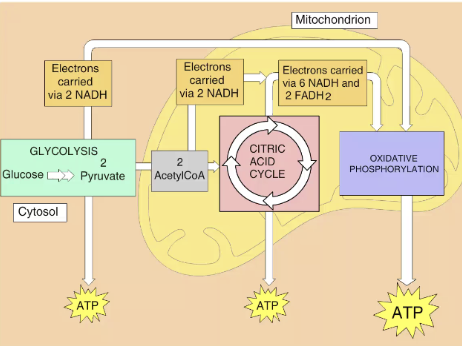
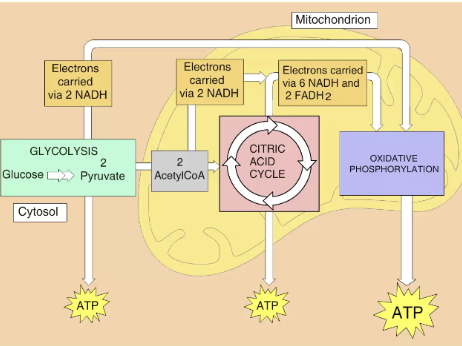
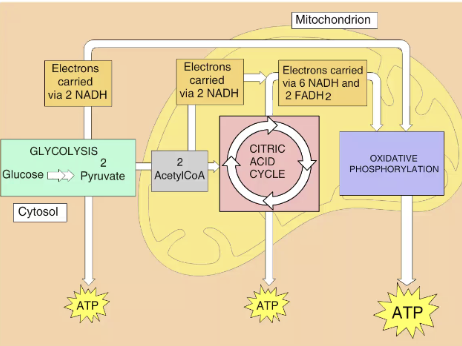
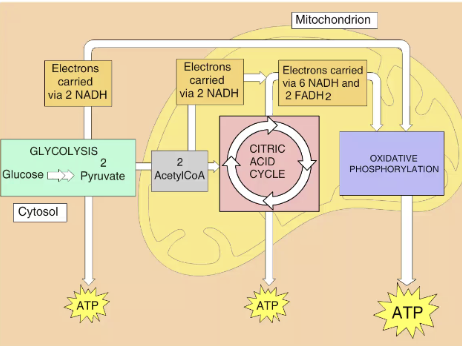
Three stages of cellular respiration
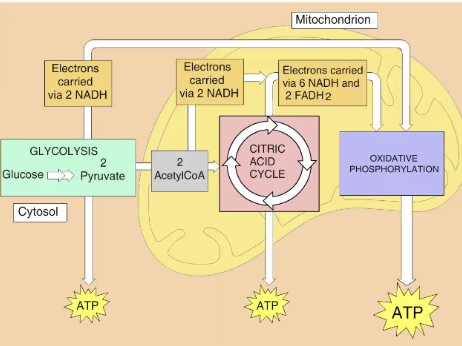
Glycolysis
Citric acid cycle
Oxidative phosphorylation
Glycolysis
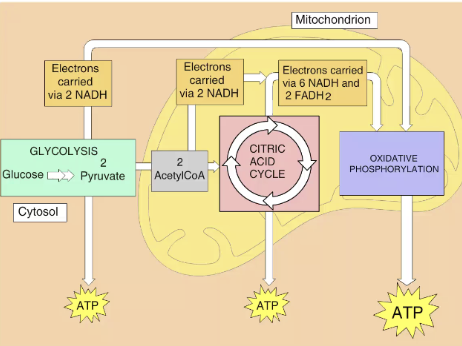
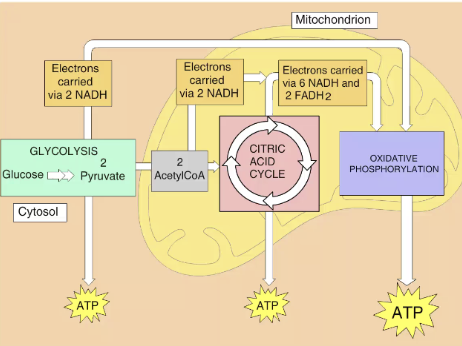
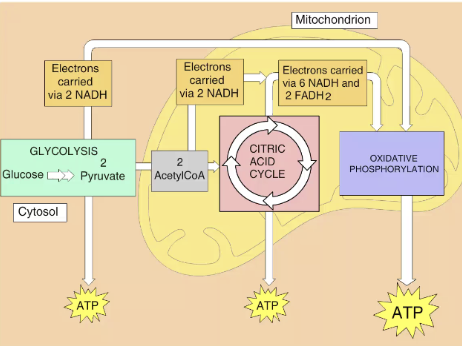
Breaks down glucose into two molecules of pyruvate
Citric acid cycle
Completes the breakdown of glucose to CO2 with pyruvate
Oxidative phosphorylation
During this stage, the electron transport chain and chemiosmosis facilitate the synthesis of most of the cell’s ATP
The process that generates almost 90% of ATP
Oxidative phosphorylation
Substrate-level phosphorylation
Some ATP is also formed in glycolysis and the citric acid cycle by this process
When does substrate level phosphorylation occur?
When an enzyme transfers a phosphate groups directly from a substance to ADP
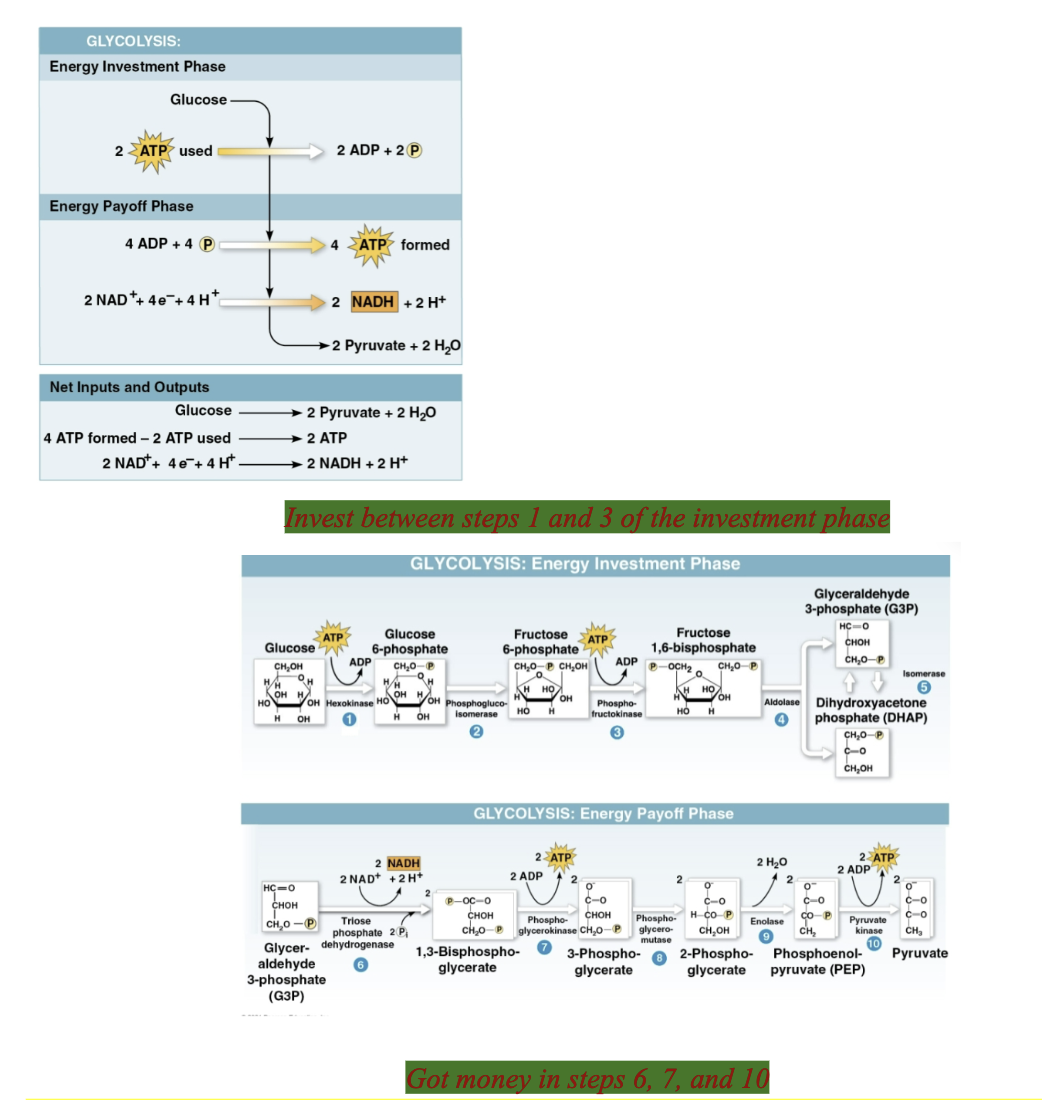
Glycolysis phase name
Energy investment phase
Glycolysis reactants
Glucose and 2 ATP
Glycolysis products
2 NADH, 2 pyruvate, and 2 net ATP (energy payoff phase)
The three rate limiting steps in glycolysis
Pyruvate, phosphofructokinase, and hexokinase
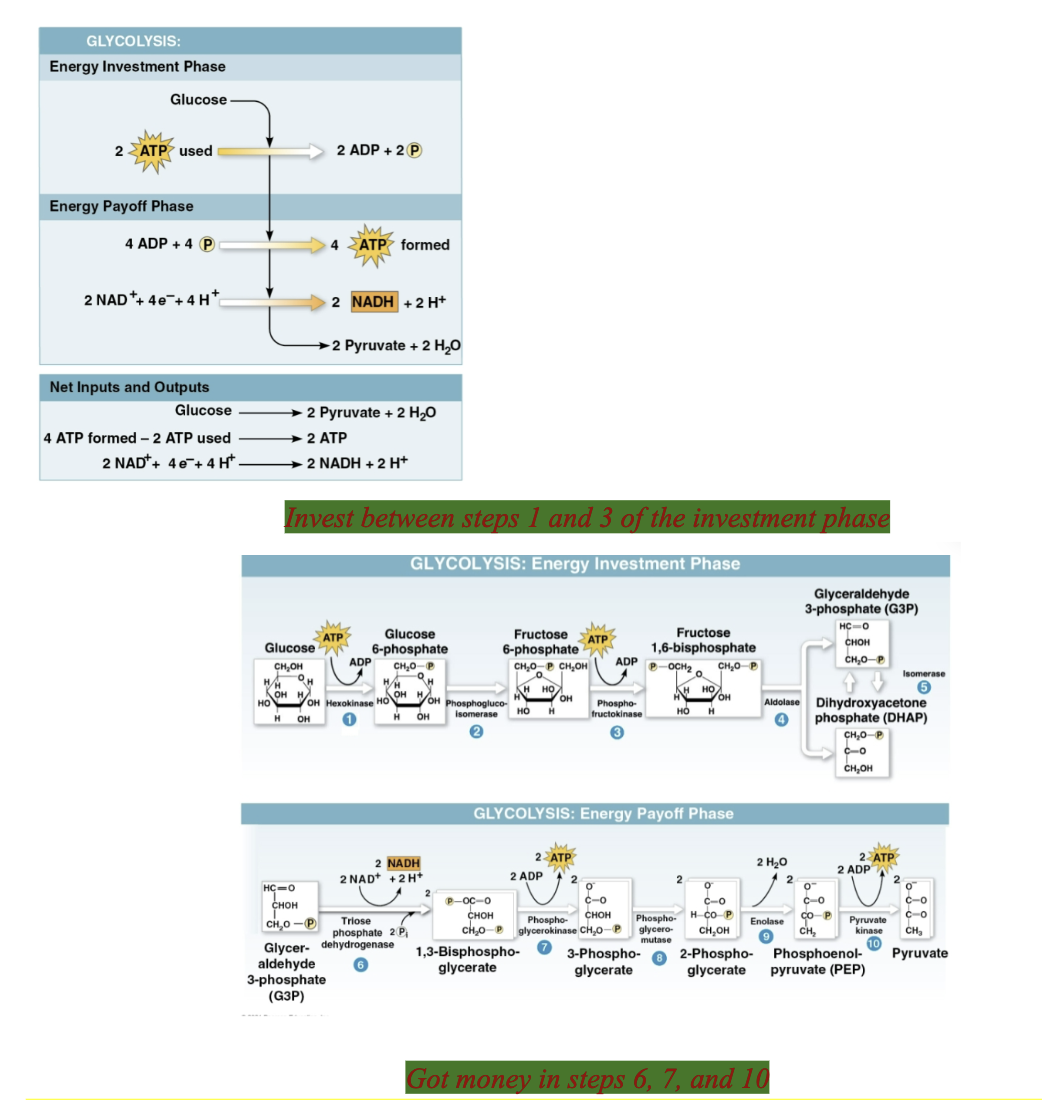
Glycolysis step 1
(hexokinase) costs 1 ATP to convert glucose into glucose 6-phosphate
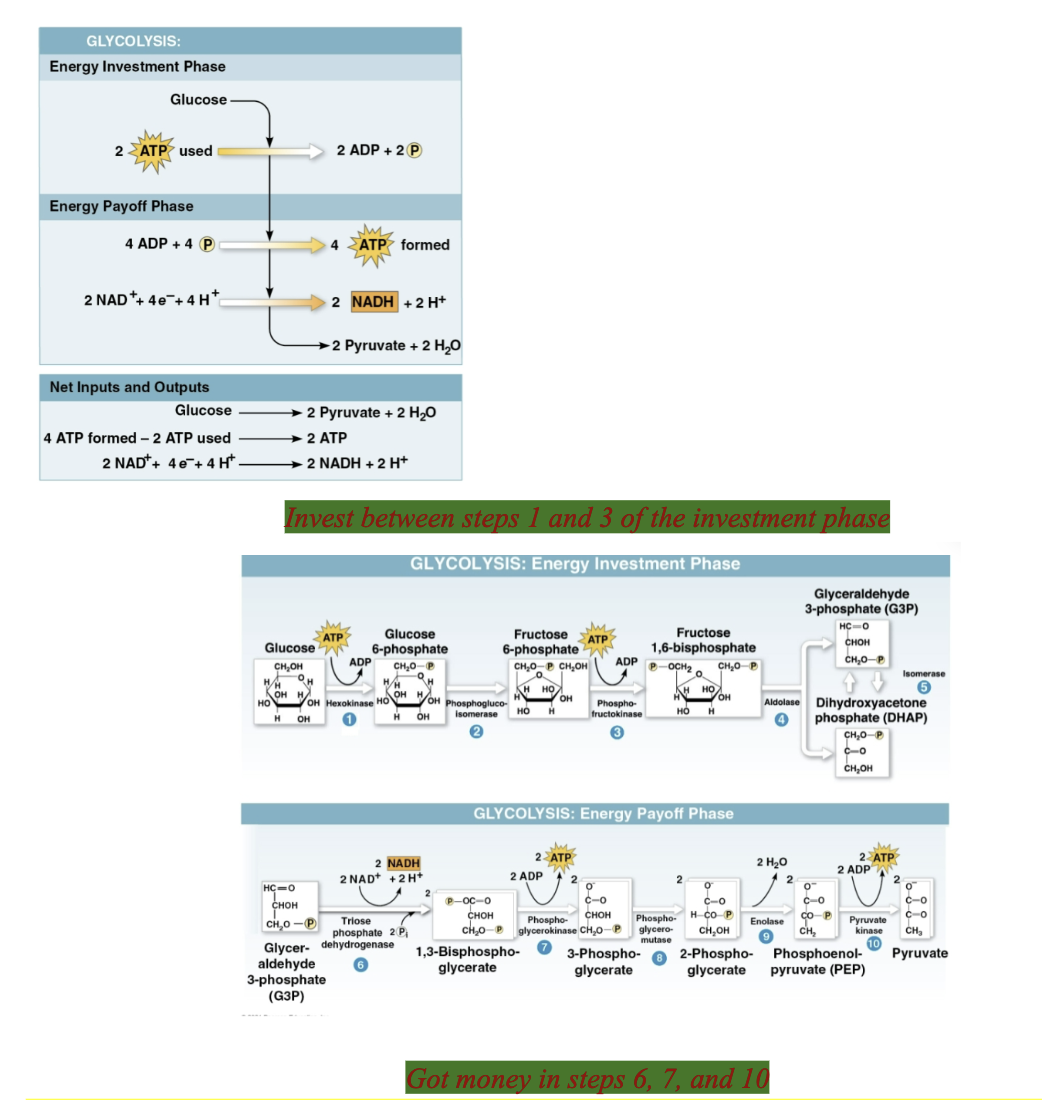
Glycolysis step 2
Isomerization
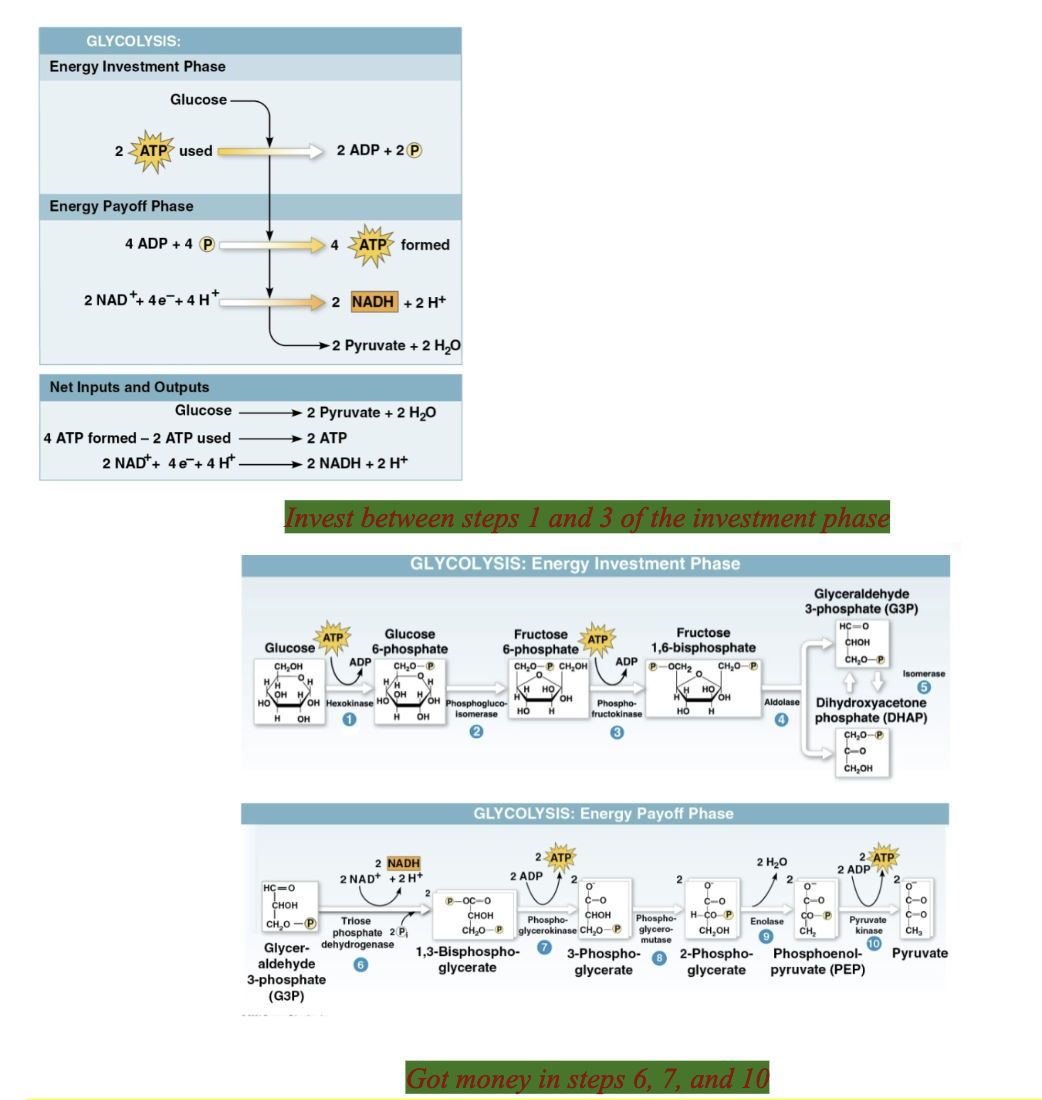
Glycolysis step 3
(phosphofructokinase) Costs 1 ATP to convert fructose 6-phosphate into fructose
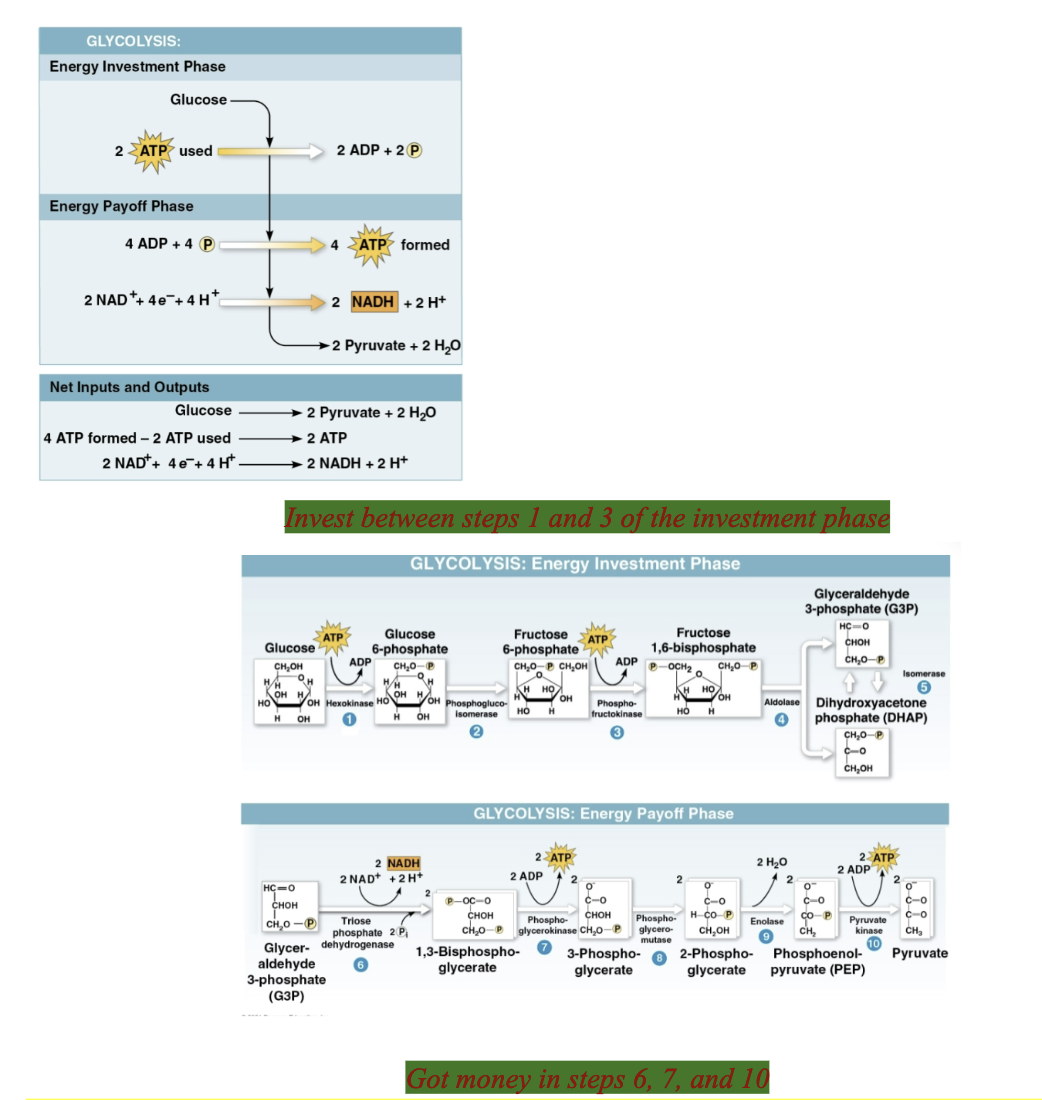
Glycolysis step 4
Split
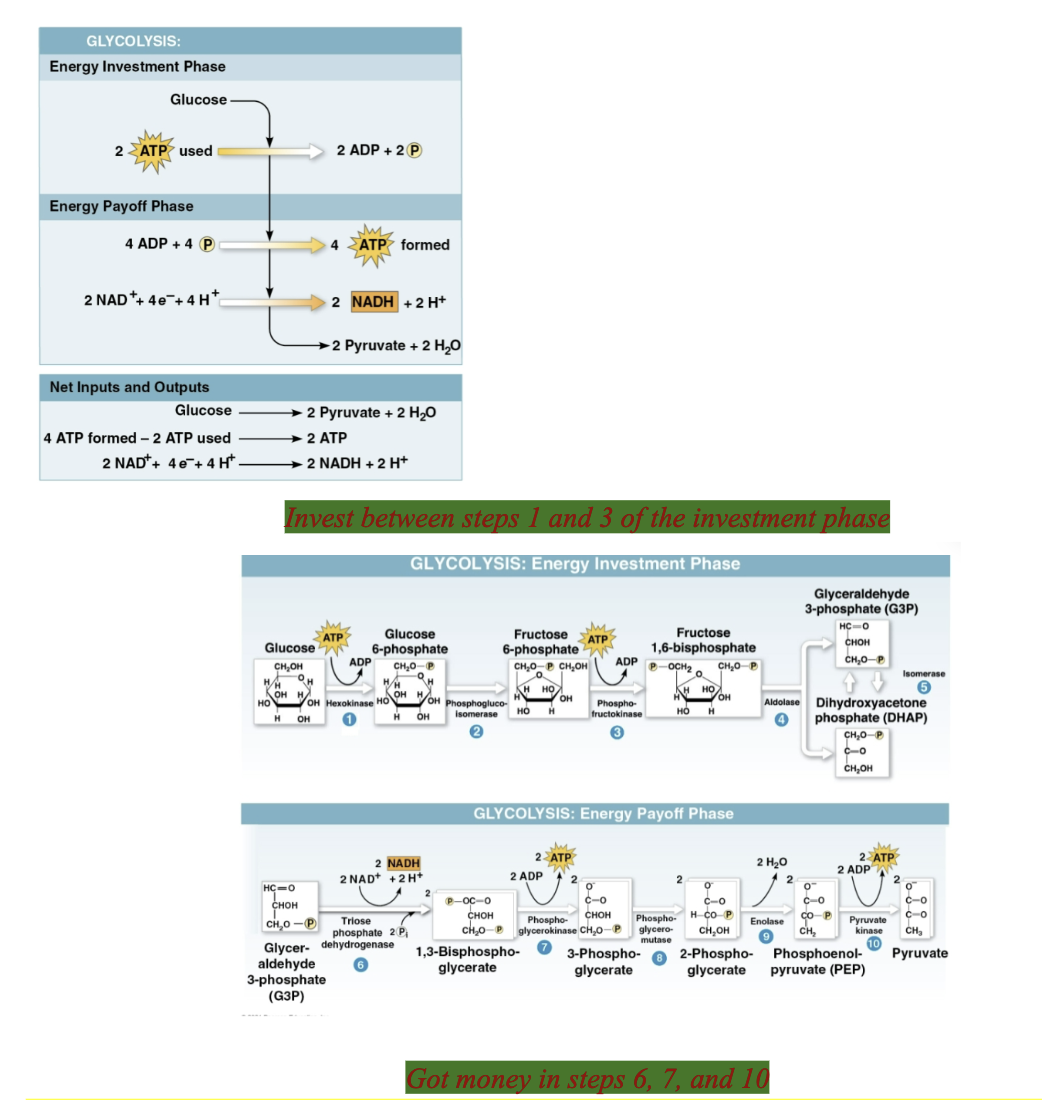
Glycolysis step 5
Conversion
Glycolysis step 6
(dehydrogenase) makes 2 NADH
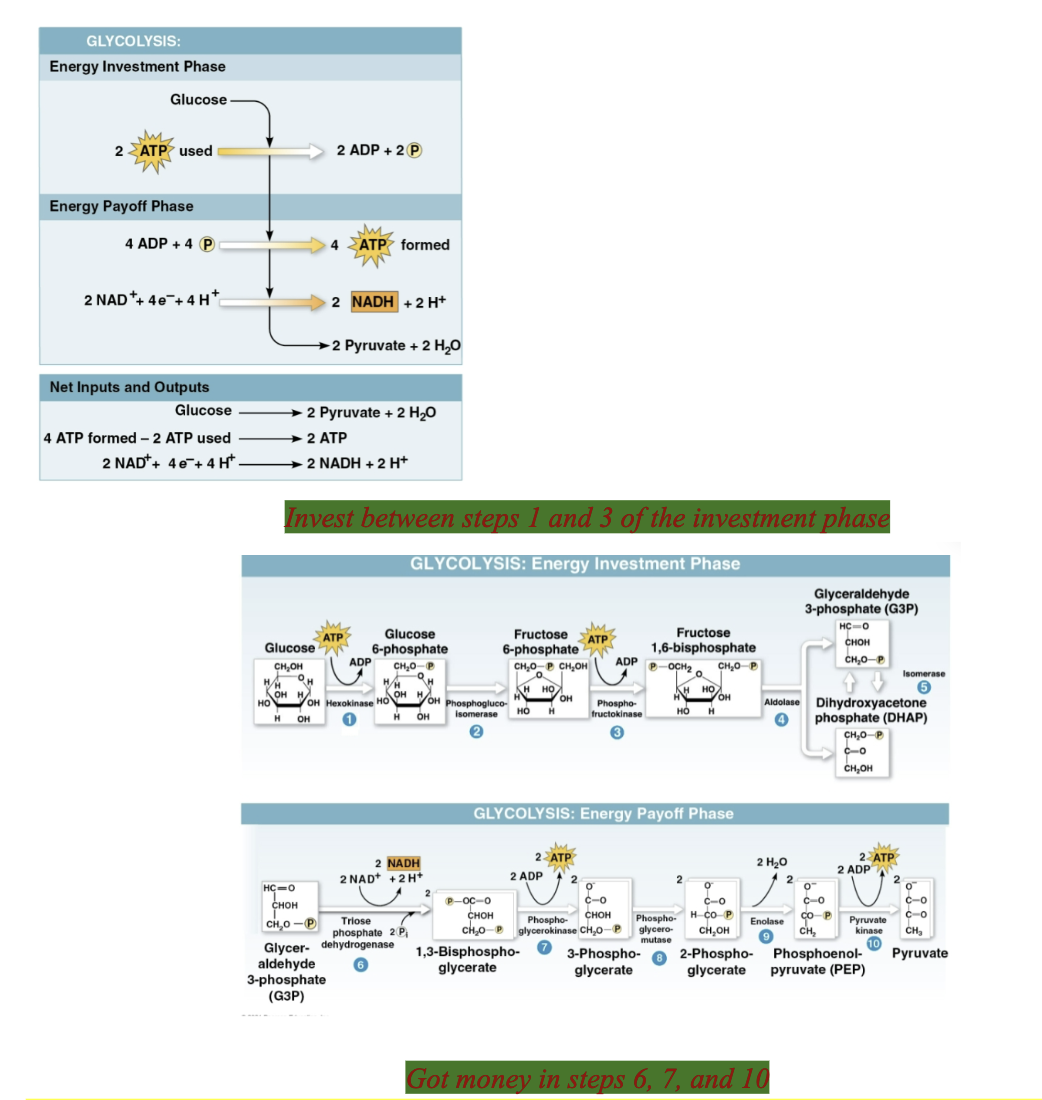
Glycolysis step 7
(phosphoglycerate kinase) Debt settled, 2 ATP made
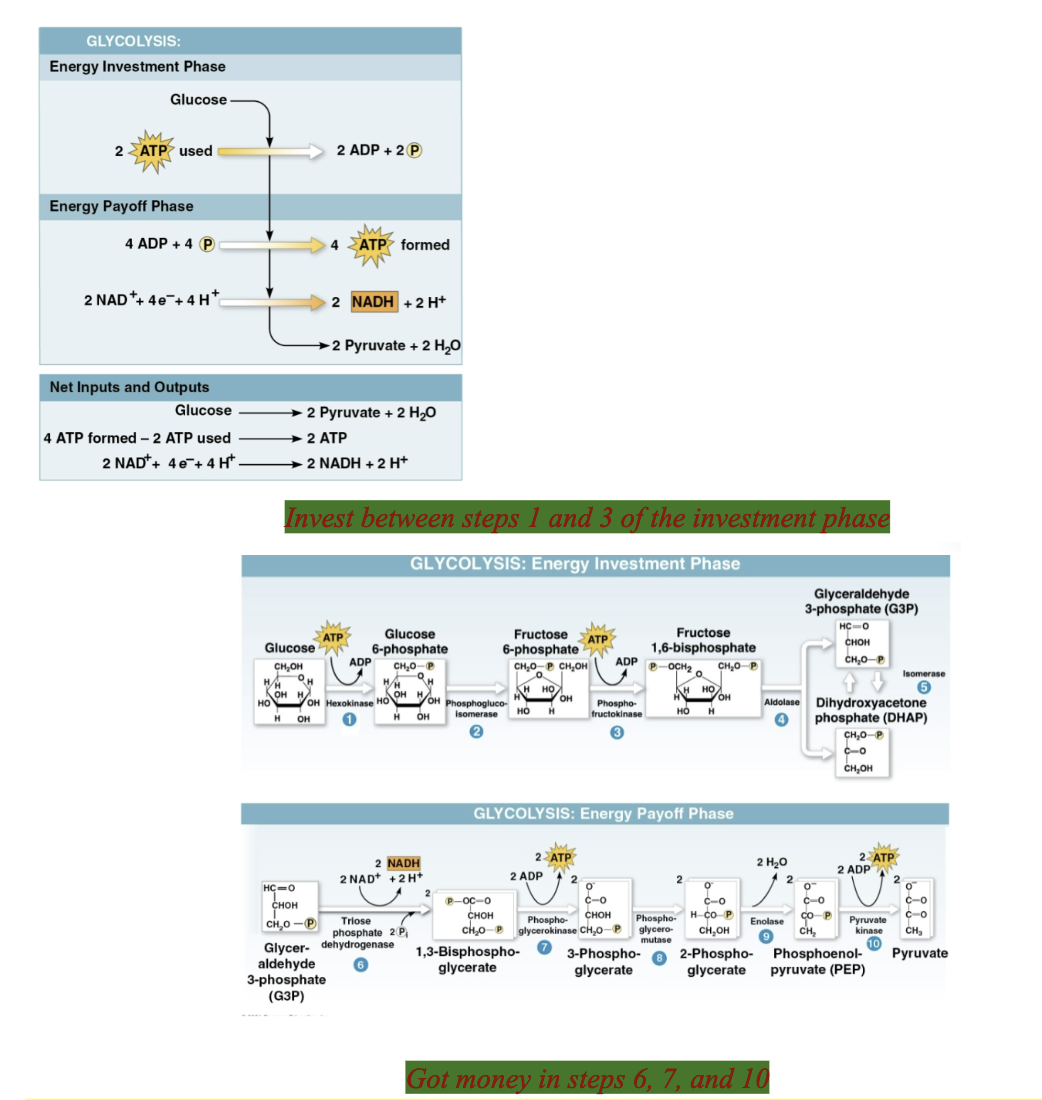
Glycolysis step 8
Shuffle
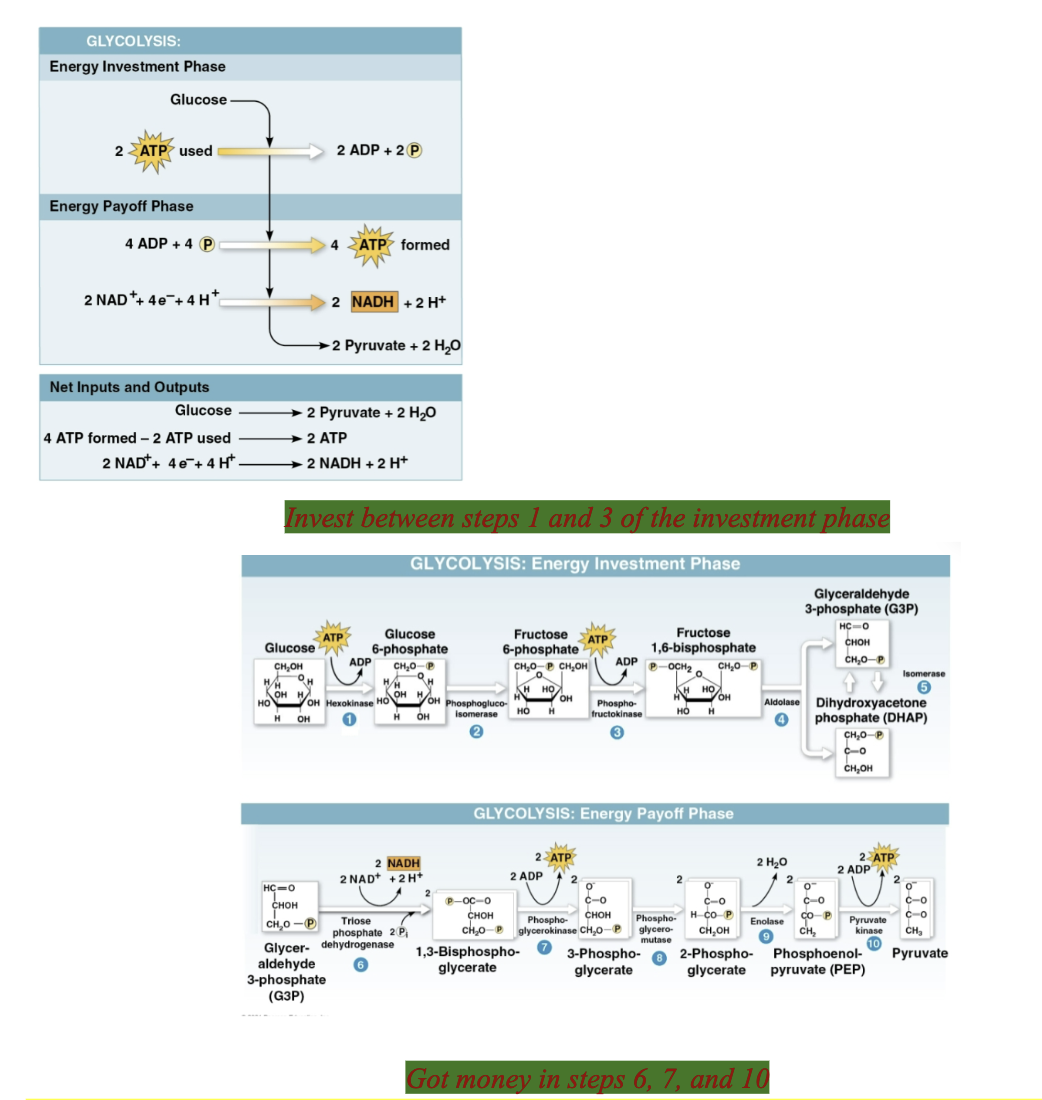
Glycolysis step 9
2 water made
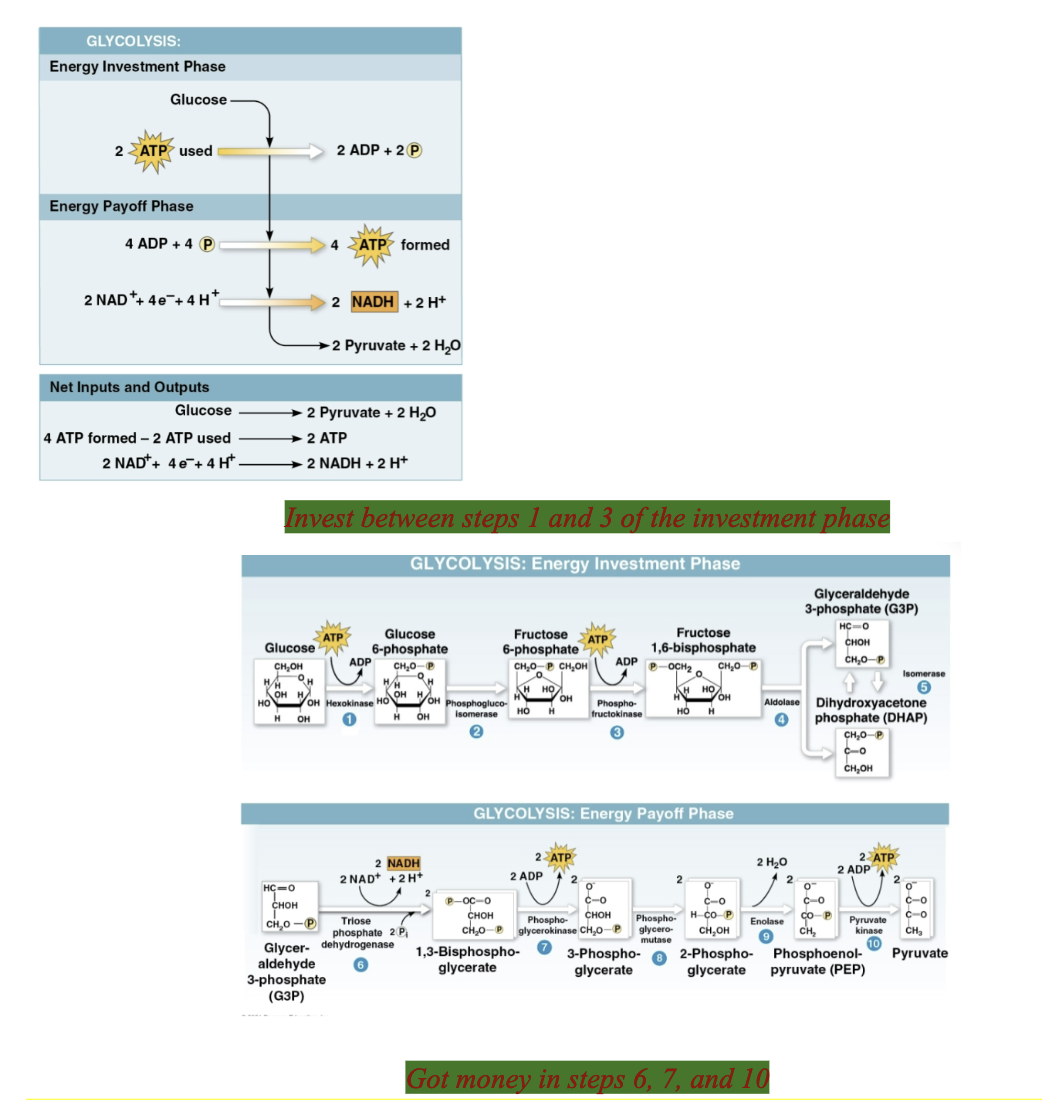
Glycolysis step 10
(pyruvate kinase) 2 ATP made
What happens to pyruvate before entering citric acid cycle?
It is converted to acetyl-CoA
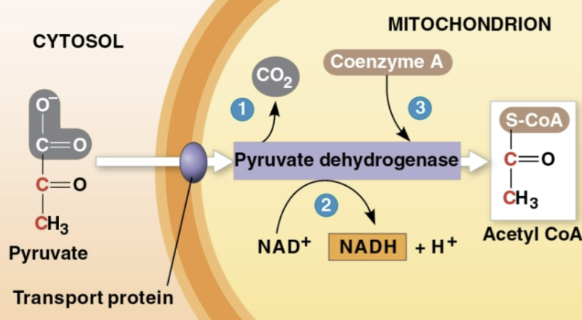
Step 1 of oxidation of pyruvate
Oxidation of pyruvate’s carboxyl group, releasing the first CO2 of cellular respiration
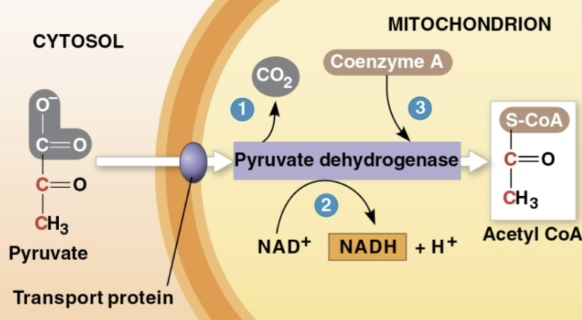
Step 2 of oxidation of pyruvate
Reduction of NAD+ to NADH
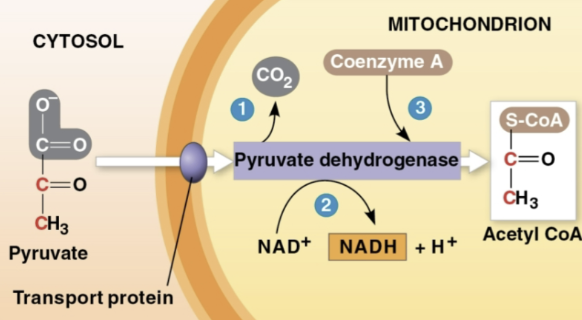
Step 3 of oxidation of pyruvate
A combination of the remaining two-carbon fragment with coenzyme A to form acetyl-CoA
What starts citric acid cycle?
Acetyl-CoA
How many times does citric acid cycle occur?
Twice
What is citric acid cycle also known as?
Krebs cycle
Reactions of oxidation of pyruvate
1 pyruvate, 1 NAD+, 1 coenzyme A
Products of oxidation of pyruvare
1 acetyl-CoA, 1 CO2, 1 NADH, and 1 H+
Reactants of citric acid cycle
2 acetyl-CoA
Products of citric acid cycle
6 NADH, 2 FADH2, 2 ATP, 4 CO2 by product, and 2 water
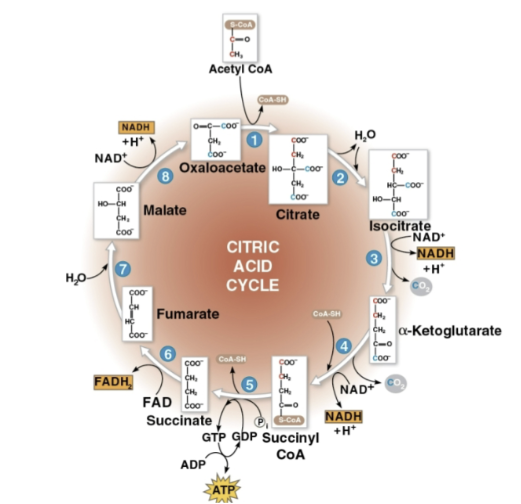
Step 1 of citric acid cycle
Acetyl-CoA joins with oxaloacetate, releasing the CoA groups and forming a six carbon molecule called citrate
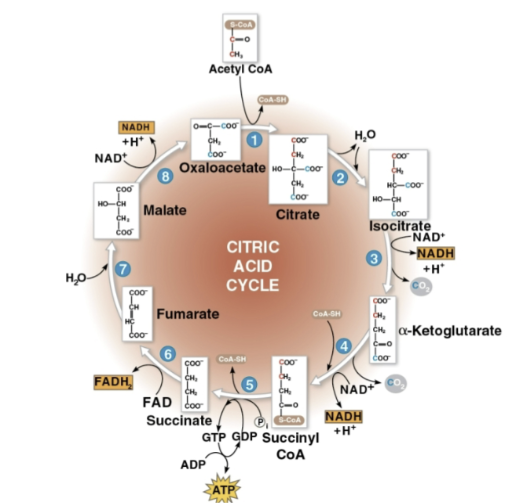
Step 2 of citric acid cycle
Citrate is converted into isocitrate by removing then adding a water molecule
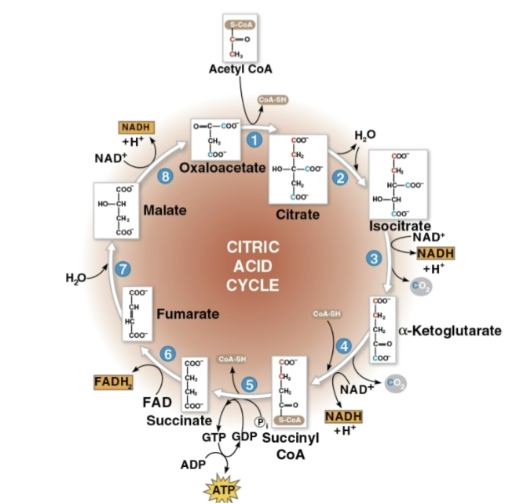
Step 3 of citric acid cycle
Isocitrate is oxidized and releases a molecule of CO, leaving behind a ketoglutarate
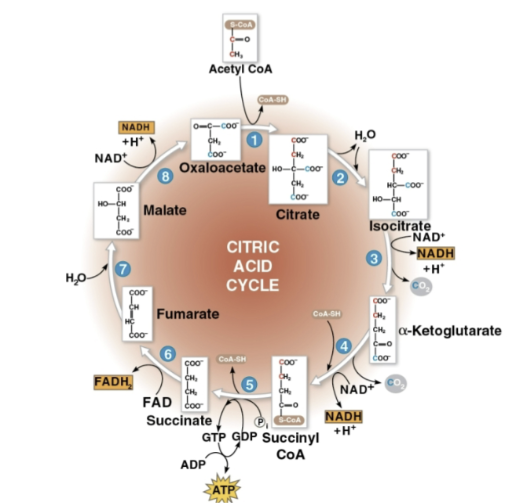
Step 4 of citric acid cycle
a-ketoglutarate is oxidized reducing NAD+ to NADH and releasing CO2
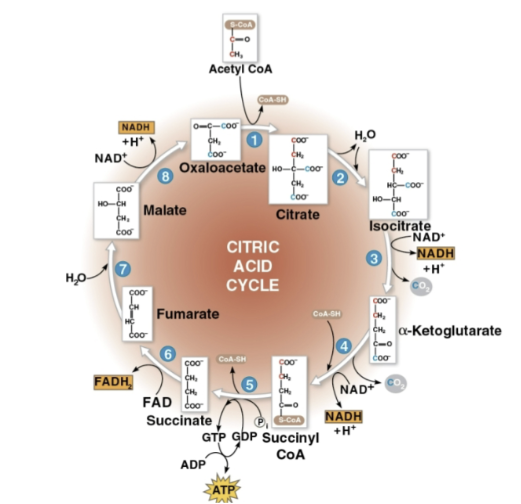
Step 5 of citric acid cycle
Succinate made and CO2 is released, NADH is made, ATP
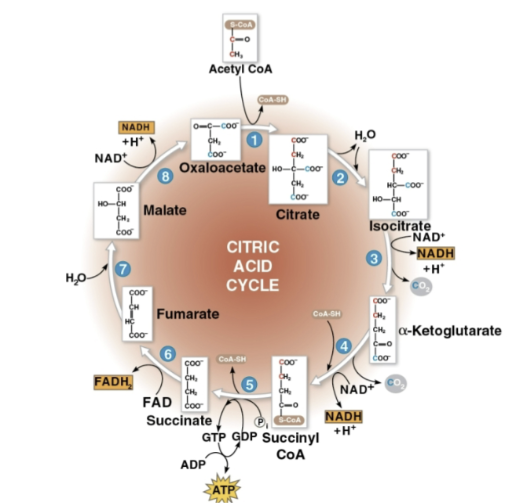
Step 6 of citric acid cycle
Succinate is oxidized, forming fumarate, and two hydrogen atoms are transferred to FAD, making FADH2,
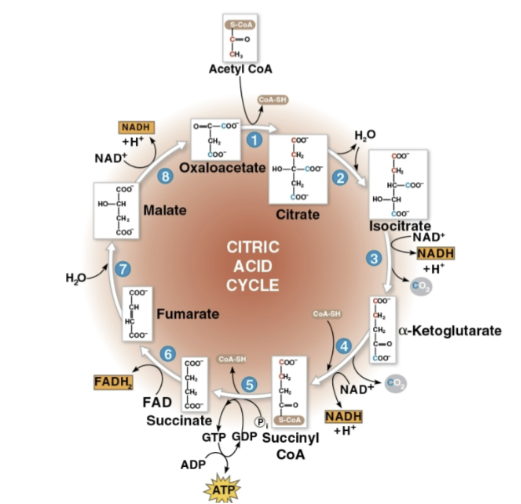
Step 7 of citric acid cycle
Water is added to fumarate, converting it into malate
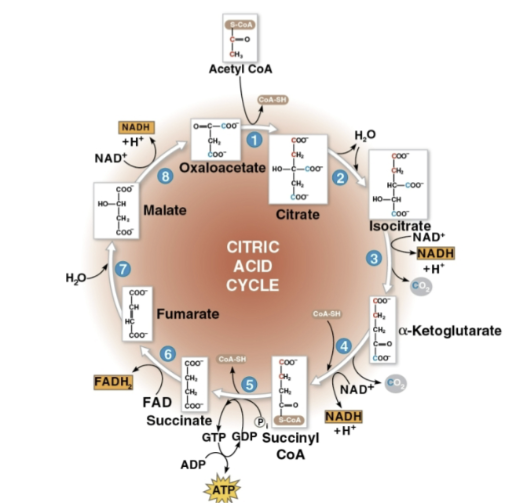
Step 8 of citric acid cycle
Oxaloacetate is regenerated by oxidation of malate and NAD+ is reduced to NADH
Per glucose, what was made in citric cycle?
6 NADH, 2 FADH2, 2 ATP, 4 CO2
What does chemiosmosis couple up with in ATP synthesis
ETC
What does NADH and FADH2 donating electrons to the ETC do?
Powers ATP synthesis via oxidative phosphorylation
Where is the ETC in prokaryotes?
Embedded in plasma membrane
Chemiosmosis
The diffusion of ions through a semipermeable membrane, like osmosis, from greater ion concentration into less ion concentration until the internal and external concentrations are equal
Is ATP produced in oxidative phosphorylation
Yes
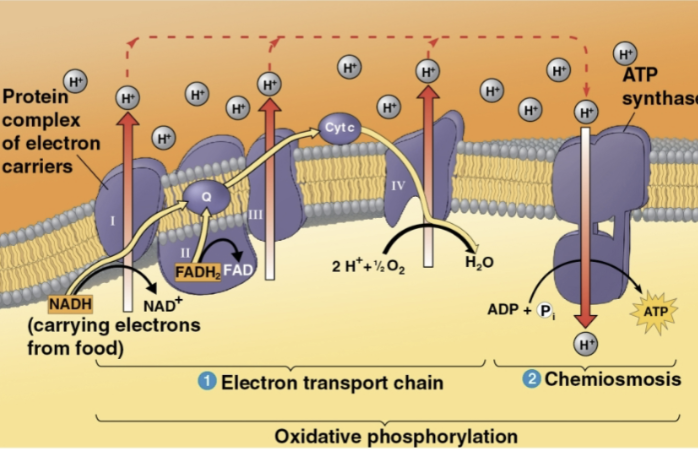
Step 1 of oxidative phosphorylation
Delivery of electrons by NADH and FADH2
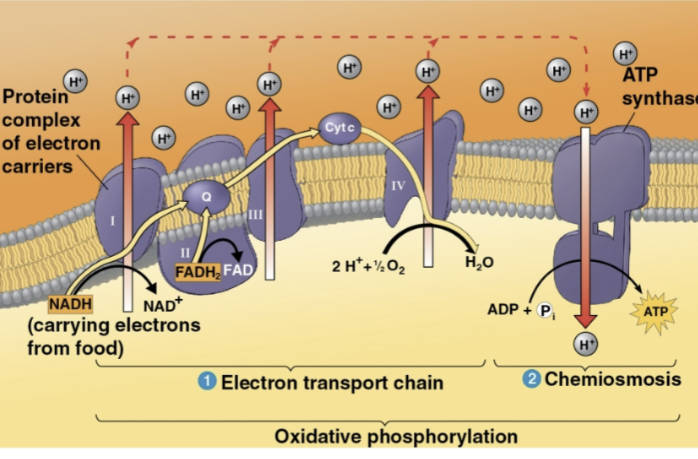
Step 2 of oxidative phosphorylation
Electron transfer and proton pumping
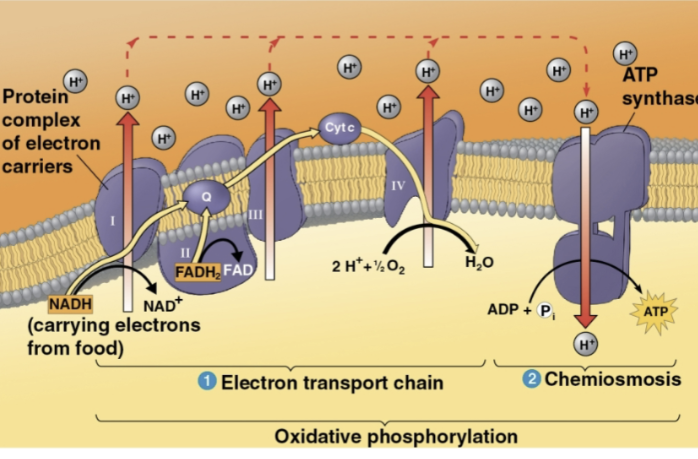
Step 3 of oxidative phosphorylation
Splitting of oxygen to form water
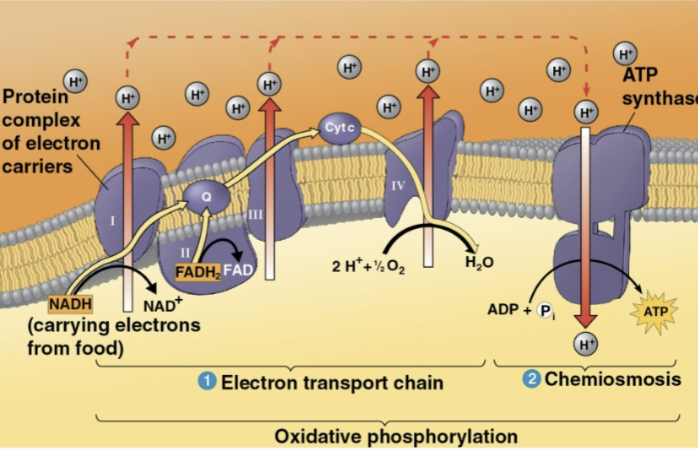
Step 4 of oxidative phosphorylation
Gradient-driven synthesis of ATP
Energy coupling mechanisms of chemiosmosis
The use of energy in H+ gradient to drive cellular work
What is the energy released as electrons that are passed down the electron transport chain used for?
To pump H+ from the mitochondrial matrix into the intermembrane space
In chemiosmosis, how does H+ move after being pumped into the intermembrane space?
Moves down its concentration gradient back across the membrane, passing through the protein complex ATP synthase
Step 1 of ETC
NADH donates
Step 2 of ETC
FADH2 donates
Step 3-5 of ETC
Pump H+
Step 6 of ETC
Oxygen accepts
Step 7 of ETC
Water made
Step 8 of ETC
H+ flows back
Step 9 of ETC
ATP synthase spins
Step 10 of ETC
ATP payday
The three reasons why the exact number of ATP produced is not know
1. Photophosphorylation and the redox reactions are not directly coupled; the ratio of NADH to ATP molecules is not a whole number
2. ATP yield varies depending on whether electrons are
passed to NAD+ or FAD
3. The proton-motive force is also used to drive other
kinds of work
What does the ETC need to operate?
Oxygen
Oxidizing agent in glycolysis
NAD+
Fementation
Extension of glycolysis that oxidizes NADH by transforming electrons to pyruvate or its derivatices
Two common types of fermentation
Alcohol and lactic acid fermentation
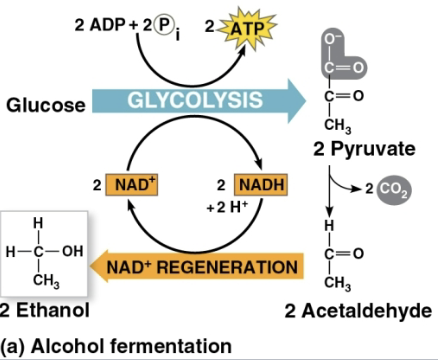
Pyruvate in alcohol fermentation
Pyruvate is converted to ethanol by
The release of CO2 from pyruvate
Production of NAD+ and ethanol
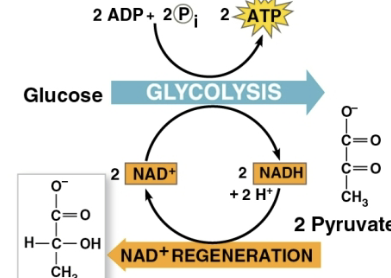
Pyruvate in lactic acid fermentation
Pyruvate is reduced directly by NADH to form lactate and NAD+