Lecture 3: Infectious Diseases and Pathology I
 Call Kai
 Learn
Learn Practice Test
 Spaced Repetition
 Match
Match Flashcards
 Knowt Play
1/227

There's no tags or description
Looks like no tags are added yet.
Name | Mastery | Learn | Test | Matching | Spaced | Call with Kai | Chat |
|---|
No analytics yet
Send a link to your students to track their progress
228 Terms
Microbial pathogenesis is the process by which microbes cause disease in a host.
What is microbial pathogenesis?
Bacteria, viruses, fungi, parasites, and prions
Which microorganisms are key in microbial pathogenesis? (5)
Pathogens must evade host defenses to cause infection
What must pathogens do to cause infection in a host?
Infectivity = ability to establish infection
Virulence = severity of disease.
What is the difference between infectivity and virulence?
It plays a critical role in determining infection outcome.
What role does the host immune response play in microbial pathogenesis?
No, some infections result in asymptomatic carriers.
Do all infections lead to disease?
Replication and transmission.
What does pathogen survival depend on? (2)
Entry, establishment, multiplication, immune evasion, and damage to the host
What are the main steps of pathogenesis? (5)
pathogenesis describes the interactions between microorganisms and their hosts that lead to disease.
What does microbial pathogenesis describe?
They must overcome host defenses, often causing tissue damage.
What must pathogens overcome to cause disease, and what can result?
No, some result in asymptomatic carriers who can still spread the disease.
Do all encounters with pathogens lead to symptomatic infection?
1. Entry: Pathogens must gain access to host tissues (e.g., skin, mucosal surfaces).
2. Adhesion: Pathogens attach to host cells using specific adhesins.
3. Invasion: Microbes penetrate host defenses to enter cells or tissues.
4. Multiplication: Pathogens replicate within the host.
5. Evasion: Immune evasion through strategies like antigenic variation.
6. Damage: Toxins or immune responses cause direct or indirect damage to host tissues.
7. Transmission: Pathogens exit the host to infect new individuals.
What are the steps of infection in pathogenesis? (7)
Prokaryotic, single-celled organisms
classified by shape and Gram stain.
What are bacteria, and how are they classified?
Acellular microorganisms that require a host cell for replication.
What are viruses, and what do they require for replication?
Eukaryotic organisms, including yeasts and molds
They can cause superficial or systemic infections.
What are fungi, and what types of infections can they cause?
Include protozoa and helminths; often have complex life cycles with multiple hosts.
What are parasites, and what is unique about their life cycles?
Infectious proteins that cause neurodegenerative diseases.
What are prions, and what type of diseases do they cause?
Tuberculosis, pneumonia.
Give examples of bacterial diseases. (2)
Influenza, HIV.
Give examples of viral diseases. (2)
Malaria, schistosomiasis.
Give examples of parasitic diseases. (2)
capsule, pili, flagella
What bacterial structures aid in adhesion and motility? (3)
endotoxins (LPS) and exotoxins (e.g., diphtheria toxin).
What are two major categories of bacterial virulence factors?
They cause direct cell damage.
How do bacterial toxins affect host cells?
Enhances survival and resistance to host defenses and antibiotics.
How does biofilm formation benefit bacteria?
Inflammatory responses.
What host response is triggered by bacterial components?
By surviving inside host cells and avoiding immune detection.
How do intracellular bacteria like Mycobacterium tuberculosis evade the immune system?
Staphylococcus aureus—causes abscesses and systemic infections.
Give an example of a bacterial pathogen and diseases it causes.
Antibiotic resistance.
What is a growing challenge in bacterial pathogenesis?
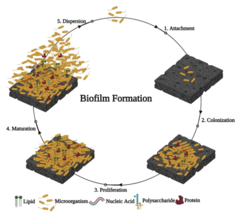
Bacteria attach to a surface (biotic or abiotic) using pili, flagella, or surface proteins; attachment is generally reversible.
What happens during the attachment stage of biofilm formation?

Bacteria form microcolonies, secrete EPS (extracellular polymeric substance), and establish irreversible attachment; quorum sensing begins.
What occurs during the colonization stage of biofilm formation?

Cell-to-cell communication to coordinate behavior and gene expression; begins during colonization.
What is quorum sensing, and when does it begin in biofilm formation?

Rapid bacterial population growth; microcolonies expand; quorum sensing regulates growth and structure.
What happens during the proliferation stage of biofilm formation?

Full Development stage of complex, multi-layered structures with nutrient/oxygen gradients; high resistance to immune response and antimicrobials.
What characterizes the maturation stage of biofilm formation?
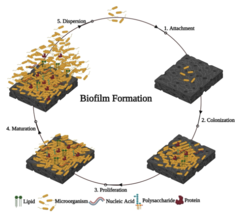
Bacteria are released from the biofilm to colonize new surfaces, often in response to environmental signals, nutrient depletion, or physical forces.
What occurs during the dispersion stage of biofilm formation?
Host cells.
What do viruses depend on for replication?

Attachment, penetration, replication, assembly, and release.
What are the main steps of viral replication? (5)

Some viruses remain dormant and can reactivate later (e.g., Herpesvirus).
What is viral latency, and give an example.

Through antigenic drift and shift (e.g., Influenza virus) allows escape from immune detection.
How do viruses evade immune detection? (2)

HIV, hepatitis B can persist for years.
Which chronic infections can persist for years? (2)
HPV (Human Papillomavirus) causes cervical cancer.
Which virus is oncogenic and what disease does it cause?
It may cause tissue damage.
How can the immune response contribute to viral pathogenesis?
Vaccination
What is critical for preventing viral infections?
Eukaryotic organisms; some act as opportunistic pathogens.
What type of organisms are fungi, and what is their role in disease?
Candida albicans—causes opportunistic infections in immunocompromised patients.
Give an example of an opportunistic fungal pathogen and the infections it causes.
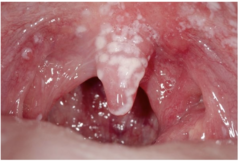
Skin and mucosal surfaces (e.g., athlete's foot, candidiasis).
What are superficial fungal infections, and give examples.
In immunocompromised hosts (e.g., cryptococcosis).
In whom do systemic fungal infections typically occur, and give an example.

By altering their cell wall components.
How do fungi evade immune detection?
It can lead to respiratory infections such as histoplasmosis.
How can inhalation of fungal spores cause disease?
Antifungal resistance.
What emerging issue complicates fungal treatment?
It often requires cultures or tissue biopsy.
Why is diagnosing fungal infections challenging?
Single-celled organisms; cause diseases such as malaria and giardiasis.
What are protozoa, and give examples of diseases they cause.
Multicellular parasites, including nematodes and flatworms.
What are helminths, and what groups do they include?
They involve multiple hosts, including humans, vectors, and environmental reservoirs.
Why do many parasites have complex life cycles?
Through antigenic variation and immune suppression.
How do parasites evade the immune system? (2)
They are chronic, long-lasting, and often cause severe complications.
What is a common feature of many parasitic infections?
Plasmodium falciparum; malaria is a leading cause of death worldwide.
Which parasite causes malaria, and why is it significant?
Because of different life cycle stages.
Why can parasitic diagnosis be difficult?
The parasite's life cycle.
What does effective treatment of parasitic infections depend on?
Misfolded proteins that cause neurodegenerative diseases.
What are prions?

Creutzfeldt-Jakob disease (CJD) and mad cow disease (Bovine Spongiform Encephalopathy, BSE)
Name two diseases caused by prions
They induce normal proteins to misfold, leading to brain degeneration.
How do prions cause disease?
They contain no genetic material.
How are prions unique compared to other pathogens?
They have long incubation periods, but the disease is fatal once symptoms begin.
What is notable about the incubation period of prion diseases?
Through contaminated tissue, surgical instruments, and possibly the food chain.
How are prion diseases transmitted? (3)
Currently, no effective treatments exist.
Preventing transmission and understanding pathogenesis.
Are there any effective treatments for prion diseases and what are the main focuses of prion research
A diverse community of microorganisms living on or in humans.
What is the human microbiome
Supports digestion, immune regulation, and protection from pathogens.
Why is the microbiome critical for health? (3)
It varies by body site: skin, gut, respiratory tract, urogenital tract.
How does microbiome composition vary in the body?
Diet, environment, and genetics.
What factors influence microbiome diversity? (3)
An imbalance of the microbiome that can lead to disease.
What is dysbiosis?
Inflammatory bowel disease, obesity, diabetes.
Name some diseases linked to microbiome imbalance. (3)
Probiotics and fecal transplants
What are some microbiome-based therapies being researched? (2)
It breaks down complex carbohydrates and fibers.
What is one major role of the gut microbiome in digestion?
Vitamin K and B vitamins.
Which essential vitamins are synthesized by the gut microbiome? (2)
it metabolizes drugs and detoxifies harmful compounds.
How does the gut microbiome interact with drugs and harmful compounds?
It regulates immune responses and promotes immune tolerance.
How does the gut microbiome influence the immune system
The connection through which the gut microbiome influences mental health and behavior.
What is the gut-brain axis?
Irritable bowel syndrome (IBS), obesity, and metabolic syndrome.
Which diseases are linked to gut microbiome dysbiosis? (3)
High-fiber diets promote beneficial microbes.
How does diet impact the gut microbiome?
Fecal microbiota transplantation (FMT).
What therapy involving gut microbiota shows promise for treating Clostridium difficile infections?

Protects against pathogenic invasion.
What is the main protective function of the skin microbiome?
Staphylococcus epidermidis and Propionibacterium acnes.
Name two dominant species of the skin microbiome.
It helps prevent colonization by harmful microbes and supports tissue repair.
How does the skin microbiome contribute to wound healing?
Eczema and acne.
Which skin diseases are linked to microbiome imbalances? (2)
Temperature, moisture, and hygiene products.
What environmental factors influence the skin microbiome? (3)
It trains immune cells to tolerate harmless microbes.
How does the skin microbiome interact with the immune system?
Antibiotics and skincare products.
What can disrupt the skin microbiome? (2)
Probiotics and topical microbiome treatments.
What are potential therapeutic applications of the skin microbiome? (2)
Live beneficial bacteria applied to the skin to restore microbial balance, compete with harmful bacteria, reduce inflammation, and promote skin health.
What are probiotics in the context of skin treatments?
Probiotic creams containing Lactobacillus or Bifidobacterium species for eczema, acne, and rosacea.
Give an example of a probiotic used in topical skin treatments.
Substances, often fibers or plant-derived compounds, that feed beneficial microbes already on the skin to support healthy bacterial growth and suppress harmful bacteria.
What are prebiotics in skincare?
Skincare products containing inulin or oligosaccharides to improve the skin barrier and manage sensitive skin.
Give an example of a prebiotic used in topical skin treatments.
By-products of probiotic bacteria (e.g., peptides, enzymes, organic acids) that promote a healthy skin barrier and modulate inflammation without involving live organisms.
What are postbiotics in skincare?
Products containing bacterial metabolites like short-chain fatty acids that soothe inflammation and enhance skin hydration.
Give an example of a postbiotic used in skincare.
Skincare formulated to be gentle on the skin's natural microbiome, avoiding harsh chemicals and maintaining a healthy microbial environment.
What is microbiome-friendly skincare?
pH-balanced cleansers and moisturizers designed to preserve the skin's microbial diversity.
Give an example of microbiome-friendly skincare.
By addressing imbalances in Cutibacterium acnes and reducing inflammation.
How is the microbiome targeted in acne treatment?
By restoring microbial diversity, particularly controlling Staphylococcus aureus overgrowth.
How can microbiome treatments help in eczema (atopic dermatitis)?
Modulating the skin microbiome to reduce inflammation.
What role does the microbiome play in rosacea treatment?
By calming the immune response through microbiome-targeted therapies.
How can microbiome modulation assist in psoriasis?