Wx Theory Part 1
 View linked note
 Call Kai
 Learn
Learn Practice Test
 Spaced Repetition
 Match
Match Flashcards
 Knowt Play
1/20

There's no tags or description
Looks like no tags are added yet.
Name | Mastery | Learn | Test | Matching | Spaced | Call with Kai |
|---|
No analytics yet
Send a link to your students to track their progress
21 Terms
What is the primary cause of weather (wx)?
Uneven heating and cooling of the Earth’s surface.
What are the main components of the atmosphere by percentage?
78% Nitrogen, 21% Oxygen, 1% other gases.
What is the range of water vapor in the atmosphere?
Varies from 0% to 4% by volume.
Name the layers of the atmosphere from bottom to top.
Troposphere, Tropopause, Stratosphere, Mesosphere, Thermosphere.
What is the altitude range of the Troposphere over the poles and equator?
Up to 20,000 feet over the poles
up to 56,000 feet over the equator.
Where does the majority of weather phenomena occur?
In the Troposphere.
What is the temperature lapse rate in the Troposphere?
Decreases approximately 2°C per 1,000 feet gained.
jet streams and clear air turbulence are located most commonly where?
in the tropopause
stratosphere altitude is
from the tropopause to ~160,000’
where does very little wx/turbulence occur? can clouds be here?
stratosphere
yes, some types of clouds extend into it. Ice clouds can be here
How is temperature in the troposphere vs tropopause vs strasophere?
troposphere: temp lapse rate (decreases as alt increases)
tropopause: abrupt change
stratosphere: increases w/ altitude increase
What is atmospheric pressure?
The weight of all the air molecules above you.
At sea level, what is the standard atmospheric pressure and temp?
29.92 in-Hg
15°C
what is convection
As warm air rises it eventually cools off, sinks, and warms up, rises, etc
results from uneven heating of air by contrasting surface temps
pressure gradient forces
The force created by pressure differences that drive the wind
moves from high to low pressure perpendicular to isobars
what are isobars and how do we read pressure gradients?
isobars connect area of equal pressure
if they are closer together = faster pressure changes = stronger wind/wx
How does the Coriolis force affect air movement in the northern and southern hemispheres?
In the northern hemisphere, air deflects to the right
In the southern hemisphere, air deflects to the left.
how does pressure gradience force, Coriolis force, and wind move along isobars w/o surface friction?
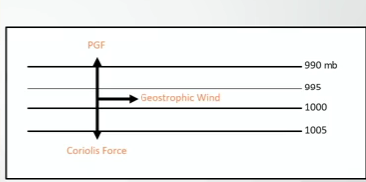
PGF - high to low and perpendicular
Coriolis - opposite of PGF
wind - 90* to the right of both
What is the role of friction in wind movement?
Friction slows wind down and allows deflection across isobars towards lower pressure.
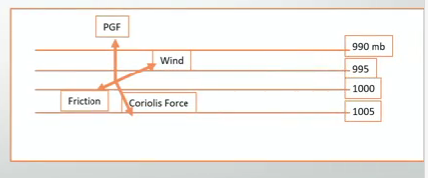
how does pressure gradience force, Coriolis force, and wind move along isobars w/ surface friction?
PGF - does not change, high to low and perpendicular
coriolis - reduced and deflected
results in wind - reduces and deflected towards lower pressure
What is the pressure lapse rate in the troposphere?
Decreases approximately 1 inch of mercury per 1,000 feet of altitude gained.