Wx Theory Part 1
All wx is the result of uneven heating/cooling of the Earth’s surface
Composition of the Atmosphere
78% Nitrogen
21% Oxygen
1% other gases
Water vapor in the Atmosphere
varies from 0% to 4% by volume
Layers of the atmosphere (bottom —> up)
Troposphere
Tropopause
Stratosphere
Mesosphere
Thermosphere
Troposphere
from sea level up to 20,000’ over the poles + up to 56,000’ over the equator
Majority of the wx, clouds, storms occur here
Temperature lapse rate:
decreases ~2*C per 1,000’ gained
Pressure lapse rate:
decreases ~1” Hg per 1,000’ gained
Tropopause
altitude: varies w/ latitude and season — elliptical shape
boundary of the troposphere
traps moisture and associated wx in the troposphere
commonly associated w/ the location of the jet stream and possible clear air turbulence
abrupt change in temp
Stratosphere
altitude: from tropopause to ~160,000’
little wx exists here
air remains stable although certain types of clouds extend into this layer
Temp: increases w/ height
non turbulent
may have ice clouds
Atmospheric Pressure
Atmospheric pressure: the weight of all the air molecules above you
the unequal heating of Earth’s surface causes changes in air pressure
pressure differs w/ altitude, temperature, and density of the air
measured in in-Hg
@ sea level:
standard pressure: 29.92” Hg
standard temp: 15*C
pressure lapse rate:
decreases 1” Hg per 1,000’ PA gained
Convection
results from uneven heating of air by contrasting surface temps
warm air becomes less dense + rises
cold are becomes more dense + falls
As warm air rises it eventually cools off, sinks, and warms up, rises, etc
Pressure Gradients
pressure gradients
the force created by pressure differences that drive the wind
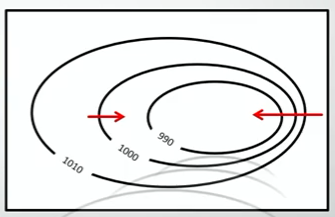
this force travels from high pressure to low pressure perpendicular to isobars
isobars - lines that connect areas of equal pressure
the closer the isobars = the stronger the pressure gradient = the higher the flow = the stronger the wind
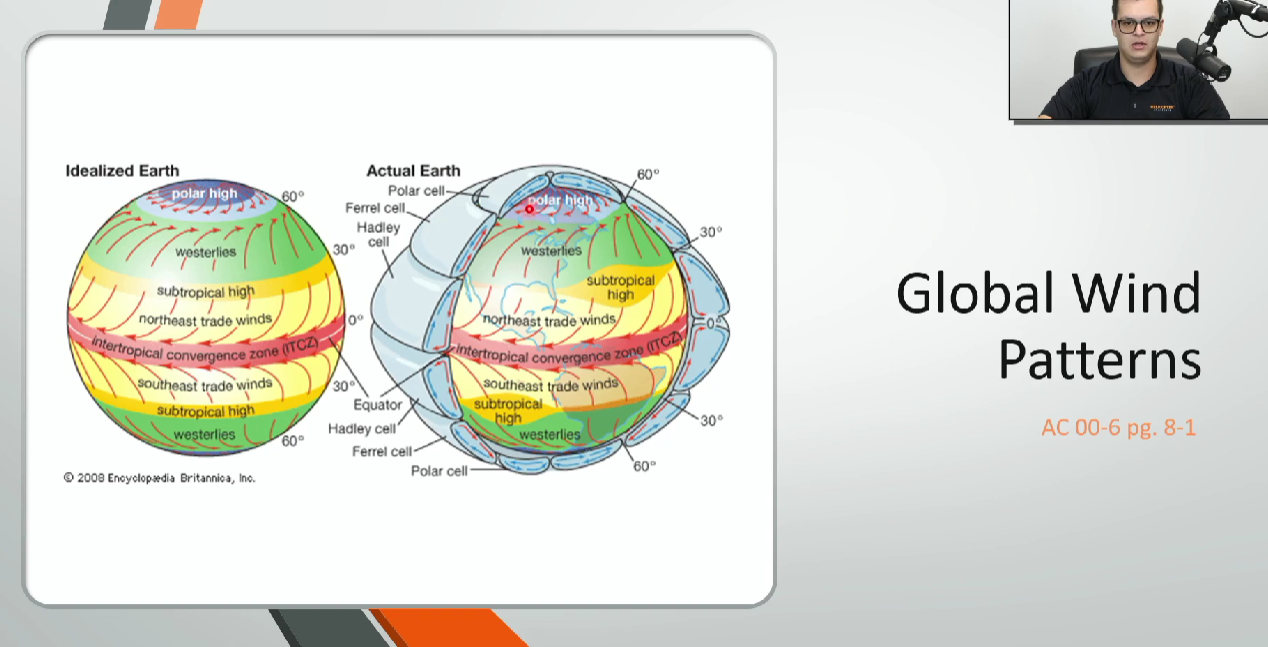
Coriolis Force
created by the rotation of the Earth
affects bodies that move over the great distances such as air masses
northern hemisphere — air deflects to the right
southern hemisphere — air deflects to the left
three-cell circulation pattern created from Coriolis:
Hadley
Ferrel
Polar
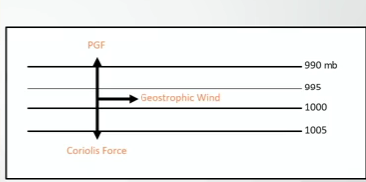
Pressure gradient flow perpendicular to the isobars, Coriolis deflects the wind 90* to the right
pressure gradient forces balances Coriolis force
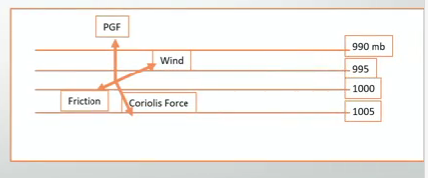
Friction
friction between surface and the wind — slows wind down
surface friction allows the wind and reduces Coriolis force, but does not affect pressure gradient force
winds near the surface are deflects across the isobars towards lower pressure