Ch 2: Ethical and Legal Issues in Selling
 Call Kai
 Learn
Learn Practice Test
 Spaced Repetition
 Match
Match Flashcards
 Knowt Play
1/28

There's no tags or description
Looks like no tags are added yet.
Name | Mastery | Learn | Test | Matching | Spaced | Call with Kai | Chat |
|---|
No analytics yet
Send a link to your students to track their progress
29 Terms
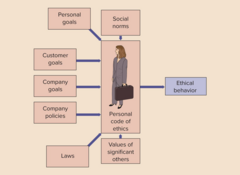
Ethics
Principles governing the behavior of an individual or a group.
Manipulation
Unethically eliminating or unfairly reducing a buyer's choices.
Persuasion
Influencing a buyer's decision while leaving the final choice to the buyer.
Moral Decoupling
Separating moral judgment from a specific behavior to rationalize unethical actions.
Bribes vs. Kickbacks
Bribes influence purchase decisions; kickbacks are payments based on order amounts.
Backdoor Selling
Bypassing a buyer's purchasing agent to contact decision-makers directly.
Poaching
The unethical practice of stealing potential customers from colleagues.
Statutory Law
Legislation passed by state legislatures or Congress, such as the UCC.
Offer
Occurs when a salesperson quotes specific terms to a buyer.
FOB Destination vs. FOB Factory
Destination: seller’s responsibility until received by buyer. Factory: buyer’s respnsibility as soon as its shipped.
Expressed vs. Implied Warranty
Expressed is explicitly stated orally/written; implied is automatically required by law.
Sales Puffery
Exaggerated statements about product performance that are not legally binding.
Business Defamation
Making unfair or untrue statements about a competitor or their products.
Tying Agreement
Requiring a buyer to purchase one product to obtain another.
Conspiracy vs. Collusion
Conspiracy occurs before contacting buyers; collusion occurs while a buyer decides.
Spiffs (Push Money)
Special incentives given to reseller salespeople to push specific products.
Lubrication vs. Subordination
Lubrication involves small customary payments; subordination involves large illegal bribes.
Cultural Relativism
The view that no single culture's ethical standards are superior to another's.
Ethical Imperialism
Applying home country ethical standards universally across all foreign markets.
Foreign Corrupt Practices Act (FCPA)
U.S. law prohibiting companies from paying bribes to foreign officials.
Resiprosity
Special relationship in which two companies agree to buy products from each other
Contract to sell
occurs when a salesperson makes an offer and receives an unqualified acceptance from the buyer
When are written agreements usually required?
sales over $500
The Foreign Corrupt Practices Act (FCPA) permits
small lubrication payments when they are customary in a culture.
The Robinson-Patman act only applies to…
interstate commerce
According to UCC, orders become contracts to sell when…
they are signed by an authorized representative of the salesperson's company.
In the context of the Uniform Commercial Code (UCC), an invitation to negotiate
can be in the form of a sales presentation
______________ involves paying large sums of money to higher-ranking officials to get them to do something illegal or to ignore an illegal act.
subordination
Statutory laws
are based on legislation passed either by state legislatures or by Congress.