CCMA Course- Vaccinations and Immunizations
 Call Kai
 Learn
Learn Practice Test
 Spaced Repetition
 Match
Match Flashcards
 Knowt Play
1/34

There's no tags or description
Looks like no tags are added yet.
Name | Mastery | Learn | Test | Matching | Spaced | Call with Kai | Chat |
|---|
No analytics yet
Send a link to your students to track their progress
35 Terms
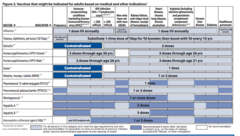
Vaccine schedule
Contraindications to vaccines
the addition of preservatives or stabilizers that may be the cause of allergy sensitivity such as gelatin, eggs, or other types of plant derivatives used in processing the vaccines. Read the package inserts very carefully and screen the patient before administering the immunizing agents to verify the prior history of sensitivity or allergic reaction.
Only accept written documentation as proof of vaccination for all vaccines except:
Influenza and pneumococcal polysaccharide vaccines
What can be given to kids after a vaccination to reduce discomfort?
-An age appropriate dose of a non-aspirin containing pain reliever
SDV
never use any vaccine left in a single dose vial after you have administered it. Dispose of it properly.
MFSs
manufacturer filled syringes are prepared with a single dose of vaccine and are sealed under sterile conditions by the manufacturer
Used only for one patient and one injection
Multidose vial
contains more than one dose of vaccine. Contains an antimicrobial preservative to help prevent the growth of microorganisms... can be used in more than one patient.
Oral applicator
contains only one dose of oral vaccine.... no preservative
Only rotavirus is administered this way
BUD
beyond use date. BUD replaces the manufacturers expiration date and information on how to determine the BUD is influded in vaccine pack
Power/pellet form vaccine
reconstitution
-Lyophilized vaccine and diluent come together from the manufacturer. Vaccine should be reconstituted using only diluent supplied for that vaccine.
What syringe size to administer injectable vaccines?
1 mL to 3 mL
What size needle can be used for most vaccines
fine gauge (22 to 25)
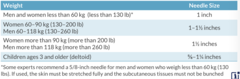
Needle length
Labeling syringes
Label syringe immediately prior to administration so you know which one to administer
Which vaccine is injected last
the most painful one
Painful vaccines
measles, mumps, rubella, PCV13, HPV
Breastfeeding during vaccination of children 2 and under
Or bottle-feeding
highly recommended
Sucrose or glucose for vaccine administration
yes
Topical anesthetics
block transmission of pain signals from the skin. Use only for recommended ages and types of patients
Oral
PO
Intranasal
NAS
Subcutaneous injection
SC
administered into the fatty tissue found below the dermis and above muscle tissue
recommended site for infants under 12 months is fatty tissue over anterolateral thigh, or fatty tissue over the triceps
For adults; triceps of upper arm
Intramuscular
IM
Administered into muscle tissue below the skin and subcutaneous tissue
-For infants less than 3 yo, use vastus lateralis in the thigh
-For 3 and up, use deltoid muscle in upper arm
Intradermal injection
ID
Administration of rotavirus
-administer liquid slowly against side of infants cheek
-allow child to swallow
FluMist
only vaccine administered by intranasal route in the US
What vaccines are administered subcutaneously
MMR, IPV, VAR, PPSV23
To administer subcutaenous
cleanse skin with alcohol swab
Pinch needle and underlying fatty tissue
Insert needle at 45 degree angle and inject vaccine
To administer intramuscular
Skin should be spread and tissues not bunched
For pediatric or geriatric patients, skin can be bunched up
Insert needle at 90 degree angle and inject the vaccine, withdraw the needle
Vaccines by intramuscular injection
HepB, DTaP, DT< Hib, PCV13, IIV, HepA, 9vHPV, MenACWY, Tdap, Td, MenB, IPV, PPSV23, RZV
Which vaccine can be administered by either subcutaneous or intramuscular injection?
Polio and pneumococcal polysaccharide
Administering multiple injections
Separate injections by 1 inch or more to isolate if reaction takes place.
Combination vaccines
simultaneous administration of antigens from several pathogens
can reduce number of injections required.
Most combination vaccines are administered via what route
intramuscular
What to document for vaccine administration
-Vaccine and date it was administered
-Vaccine manufacturer
-Vaccine lot number
-Name and title of person who administered the vaccine and address of the facility where the permanent medical record is kept
-Edition date of the vaccine information statement, located on back
-Date the VIS was given to patient, parent, or guardian
-Route, Dosage and Site of adminstration