ch 8-1 moon and mercury pt 1
 Call Kai
 Learn
Learn Practice Test
 Spaced Repetition
 Match
Match Flashcards
 Knowt Play
1/42

There's no tags or description
Looks like no tags are added yet.
Name | Mastery | Learn | Test | Matching | Spaced | Call with Kai | Chat |
|---|
No analytics yet
Send a link to your students to track their progress
43 Terms
how has the distance between Earth and the moon been measured to accuracy of a few centimeters?
lasers
which major planets has the most eccentric orbit?
Mercury
most elliptical
all 4 planets can never be further than ____ from the sun as seen from the Earth
28°
how is mercury viewed from Earth?
never far from the sun
difficult to see despite being the 4th brightest object in the sky
how much does Earth rotate every hour?
15°
see mercury for a total of 2 hours on any given night
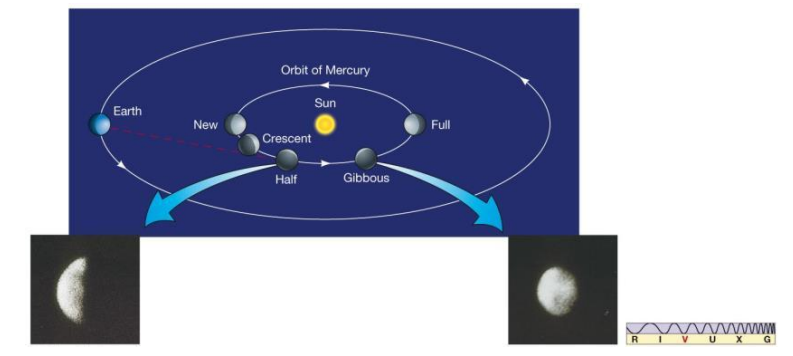
when can phases of Mercury be seen the best?
at its maximum elongation
when Mercury is at its greatest apparent distance from the sun (can get the best image of the planet)
what is the radius and mass of the moon?
radius: 1738 km (smaller core similar to Earth’s mantle)
mass: 7.3 × 10²² kg (1.2% of Earths)
angular diameter: 3.5
what is the radius and mass of Mercury
radius: 2440 km (slightly larger than the moon ¼ Earth)
mass: 3.3 × 10²³ kg
angular diameter: 13”
what is the moon’s density?
3300 kg/m3
contains fewer heavy elements than Earth
what is Mercury’s density?
5400 kg/m3
sightly less than Earth
interior must contain a lot of high-density material and Fe
what is Earths density?
5500 kg/m3
what is the moons escape velocity?
2.4 km/s
what is Mercuy’s escape velocity?
4.2 km/s
what is Earth’s escape velocity?
11.2 km/s
to get past pull of Earth’s gravitational pull
what does Mercury’s iron core must contain?
a much larger fraction of the planets mass than our planets core
what is escape velocity?
measure of strength of an objects gravity-speed needed for any object to escape forever from its surface
this speed increases with increased mass size or decreased radius of the parent object
object mass and radius
minimum speed a object has to travel to free itself from gravitational pull from
what are the maria on the Moon?
Large, dark, flat regions formed by ancient lava flows.
Why are maria darker than the rest of the Moon?
They are made of basaltic lava, which is darker than the surrounding highlands.
Why are the Moon's dark regions called maria?
Early observers thought they were oceans and named them "maria," the Latin word for seas.
what are the light areas of the moon?
Terrae
lunar highlands
now know to be elevated several km above the Maria
what does the moon have any of?
craters (from meteorite impacts, asteroid, and comets)
how are age estimates of craters based on?
superpositions
younger craters occur on top of older ones
sharper the rim the younger the crater
does the far side of the moon have craters and marias?
has some craters but no maria
what is the far side of the moon?
side we never see, very little maria
what is the near side of the moon?
the side that faces us → many maria → maria might be effect by Earth’s presence some how
how does the moon rotate?
once on its axis in exactly the same tie it takes to complete one orbit around the Earth
since mercury cannot be imaged well, where did the bets pictures of it come from?
Messenger
mercury surface images
resembles moons highlands but craters less densely packed
no signs of clouds, rivers, dust storms, or other aspects of weather, recent or ancient
extensive smooth plains, widespread lava flows filled depressions
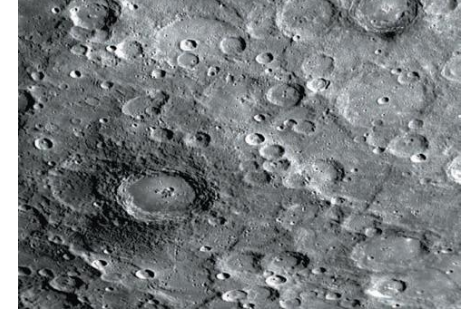
in addition to craters what does mercury also have?
extensive smooth plains
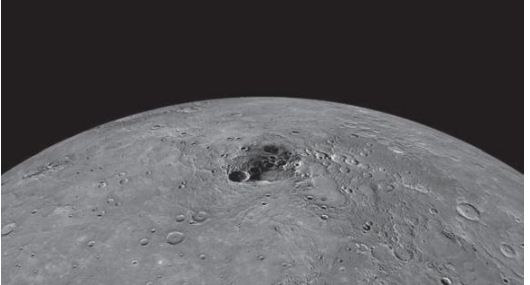
what are intercrater plains
oldest parts of Mercury’s surface 4B years ago
what does it mean that the moon is tidally locked to Earth?
its rotation rate is the same as the time it takes to make one revolution, so the same side of the moon always faces Earth
what is the reason for tidal locking?
gravitational interaction between the Earth and the moon
gravitational pull of moon causes Earth’s oceans to bulge
gravitation pull from Earth causes bulges on the moon
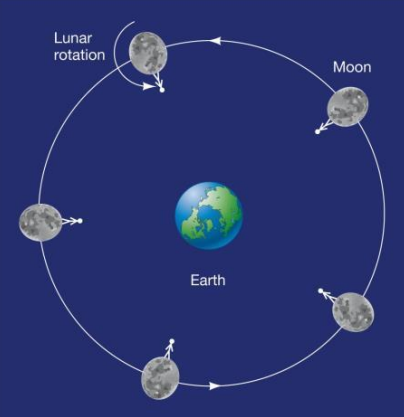
Why are the rotations of the Moon and Mercury unusual?
Because their spins are strongly influenced by the gravitational effects of their nearby parent bodies (Earth for the Moon and the Sun for Mercury).
What strongly influences the rotation of the Moon and Mercury?
Their close proximity to Earth and the Sun, respectively, resulting in strong tidal gravitational effects on their spins.
what is synchronous orbit?
state of an object when its period of rotation is exactly equal to its average orbital period
why was mercury though long though to be tidally locked to the sun?
Early observations repeatedly showed the same surface features, leading astronomers to believe Mercury always kept the same side facing the Sun.
What did later observations reveal about Mercury's rotation?
Mercury is not tidally locked; it has a 3:2 spin-orbit resonance, rotating 3 times for every 2 orbits around the Sun.
eccentric around the sun
takes 59 days (previously thought to be 88)
2/3 or orbital period (exactly 3 rotations for every 2 revolutions)
why does air stick around?
gravity pulls on all molecules and atoms keeping them from drifting into space
what factor of Earth’s atmosphere makes life possible?
Nitrogen and Oxygen
why do air molecules have high speeds?
due to thermal motion
how does thermal motion work?
heat works against gravity to keep atmosphere off the surface
all gas molecules are in constant random motion
cooler gas → slower molecules move
warmer gas → faster molecules move, pressure works to oppose gravity
what happens if the average molecular speed is well below the escape velocity?
few molecules will escape?
when do escapes become more probable?
for lighter molecules (higher speed for same kinetic energy) more likely to escape
at higher temperatures (increase velocity → more likely to escape)
for smaller planets (escape velocity is less)
compare escape velocity with the planets molecular speed of molecules