Exam 3 CCJ 230
 Call Kai
 Learn
Learn Practice Test
 Spaced Repetition
 Match
Match Flashcards
 Knowt Play
1/45

There's no tags or description
Looks like no tags are added yet.
Name | Mastery | Learn | Test | Matching | Spaced | Call with Kai |
|---|
No analytics yet
Send a link to your students to track their progress
46 Terms
sociological theories
social arrangements and inequality can produce crime
social structure
how society is organized. The social and economic conditions affect behavior and attitudes, as well as arrangements, as causes of crime. social ecology- the study of humans in their environment
social process
sociological pathology
crime is a symptom of social “Sickness”. Emile Durkheim
simple societies
modern industrial ones results in two structural conditions, egoism and anomie
Egoism
lack of social integration
anomie
lack of moral regulation, normlessness
social disorganization
structure of cities, neighborhoods, communities. Crime is caused by breakdown of social bonds and social control and confusion about how to behave
Park and burgess
Mapping concentric zones
Shaw and McKay
Delinquency with inner-city changing racial groups.
social disorganization: the revival
crime is higher when there is low participation in voluntary organizations, few community ties, low levels of collective efficacy, high degrees of residential mobility, population density, single parent homes, dilapidated housing, more poverty.
social disorganization and social economy strengths and limitations
structural analysis, addressing its methodological issues, although some remain, says place and people both make a difference, social disorganization is “natural to modern society, " and race issues.
Anomie and strain theory
frustration resulting from failing to achieve goals; strain → anger→ crime (tension between culture and structure)
Robert Merton
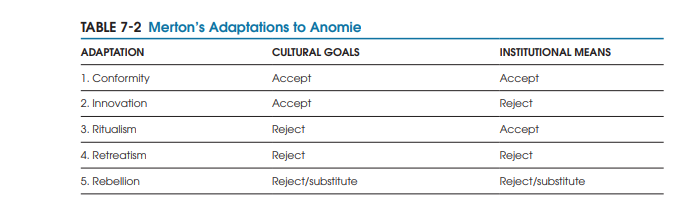
social structure and anomie- adaptations typology. Societies have cultural goals and prescribed means to achieve goals. Ex→ capitalistic societies, goal is weath “Get rich or die trying”
Robert Merton’s adaptation typology part of strain theory
Conformity→ accept institutionalized means, accept cultural goals
Innovation→ reject institutionalised means, accept cultural goals
Ritualism→ accept institutionalized means, reject cultural means
Retreatism→ Reject institutionalized means, reject cultural means
Rebellion→new means, new goals
Issue with merton’s strain theory
economic motivation assumption
Agnew and general strain theory
considers economic and non-economic strain. Strain is caused by removing positive stimuli and introducing negative stimuli. increases the likelihood of criminal coping.
general strain theory and terrorism
terrorists often justify their movements in strain.
Subcultural theories
there are subcultural environments through which adolescents adopt pro-deviant norms. influenced by merton and addresses his limitations. subcultures rooted in economic and other types of strain
Strengths and weaknesses of subcultural theory
addresses how social group norms affect crime(Gangs, juveniles, etc.) Doesn’t account for upper or middle-class crime or how people adopt pro-deviant norms.
sociological theories: focus on process
learning, control, lifecourse all contribute to social process
socialiization
learning of social norms, values, and attitudes. can learn to reject both mainstream social norms and delinquent ones over your lifetime
social learning theories
Behavior and attitudes are learned through interactions with others. criminality as the result of socialization process, influenced by consensus theory. people can be socialized into deviance.
What is the agent of socialization that criminologists focus on?
before school age- Parents, once in school- Peers
Edwin Sutherland
arguably the most famous criminologist and learning theory: differential association. Why do people in high crime neighborhoods turn to crime and others no? association with deviant peers found to increase likelihood of delinquency. extended to white collar crime.
Differential association
criminal behavior is learned, through process of communication, principally in intimate personal groups, (1) techniques and (2) deviant attitudes, (un)favorability of laws, favorability of violating law def.s > unfavorability of violating law def.s, variation, same learning process as in other areas, motivations not sufficient enough to explain crime.
Learning theories
addressing sutherland: how do people adopt deviant attitudes through differential association. differential id theory, social learning theory, differential reinforcement theory
Differential ID theory
you look to reference groups (someone you look up to)
Social learning theory
Aggressive tendencies learned through conditioning and modeling
Diff reinforcement theory
criminal behavior learned when reinforcements from others
applications of learning theories
jail and prisons, boston marathon bombers.
criminogenic media
media that is hypothesised to be a direct cause of crime. Hypothesis that individuals especially young people may imitate crimes they see in media. no causal link found between violent media and violent behavior. Media may inspire offenders.
Learning theory strengths and weaknesses
great empirical support, “watershed in criminology”, casualty criticism: peers→crime or crime→peers, not all crime influenced by peer groups, difficulty to study and measure acceptance of unfavorable def.s, difficult to study and measure acceptance of unfavorable def.s, where did the values come from in the first place.
Travis Hirschi
social bond theory, social institutions keep us from breaking laws: attachment,belief, commitment, involvement.
control theory
asks why do people not become criminals? assumes human nature=selfish, antisocial, capable of crime. Society controls our behavior. 2 types of control: social (External), self-control (Internal).
self-control theory
In childhood, individuals develop self-control, which keeps people from engaging in crime/deviant/risky behaviors
control theories strengths and limitations
great acclaim, empirical support, overstating the issue, casualty: some weak relationships, focus on minor deviance, chicken or the egg: social bonds/control
life course perspectives
emphasises progression through a series of age-linked social roles embedded in social institutions. includes biological aging, social age grading, historical events
socialization and social ties
help society restrain from chaotic aspirations that would lead to a more deviant society.
social integration
the amount of social ties a person has. a person with weak social ties have less support
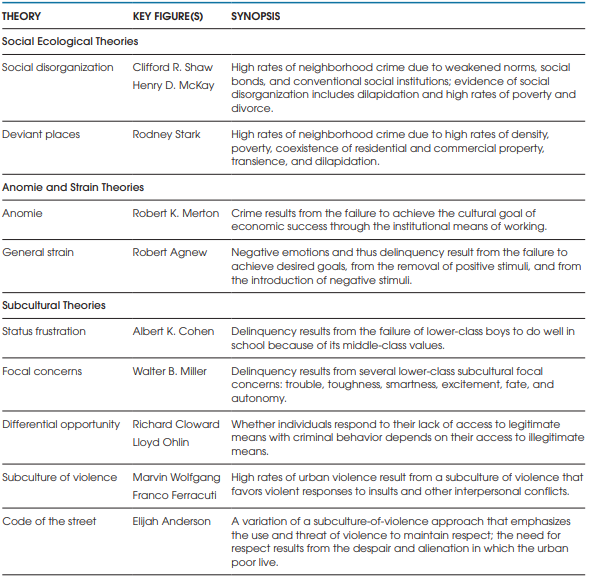
social ecological theories, anomie strain theories, subcultural theories
good chart
Social pathology
crime originates from a social sickness, coined by emile durkheim
theories of neutralization
the reasons criminals come up with to deal with the shame and guilt of crime
relative deprivation
a perceived discrepancy between what an individual or group has and what they believe they should have, leading to feelings of discontent and potential criminal behavior.
broken windows theory
a criminological theory that suggests visible signs of disorder and neglect cause an increase in crime. It emphasizes maintaining urban environments to prevent crime.
subculture of violence
explains the high level of violence in certain communities, where violent behavior is normalized and accepted as part of the culture.

