Mirrors 101
 Studied by 0 people
 Call with Kai
 Learn
Learn Practice Test
 Spaced Repetition
 Match
Match Flashcards
 Knowt Play
1/16

There's no tags or description
Looks like no tags are added yet.
Name | Mastery | Learn | Test | Matching | Spaced | Call with Kai |
|---|
No study sessions yet.
17 Terms
glancing angle
The glancing angle
Is the angle between an incoming ray or outgoing ray and the mirror surface rather than the normal of the mirror surface.
Why is the glancing angle important
In optics and X-ray physics, the glancing angle determines how much of the wave interacts with the surface and affects phenomena like total internal reflection and diffraction.
Formula for calculating number of
Images formed by two inclined mirrors
N=\left(\frac{360}{\theta}\right)-1
Concave mirrors
These type of curved mirrors produces both inverted and erect images, but the erect images are usually larger than the size of the original object.
Convex morrow
A type of curved mirror that produces diminished and upright images always
Good to know

Relationship between radius of curvature (R) and the focal length (f)
f=\frac{R}{2} The formula relating radius of curvature and the focal length
Concave mirrors magic
They can form real or virtual images depending on the object’s position, these images are formed on a screen when they’re real but cannot be formed on a screen when virtual
Convex mirrors magic
Convex mirrors always produce virtual images which are upright and diminished , and are formed behind the mirror.
Knowing the nature of a mirror
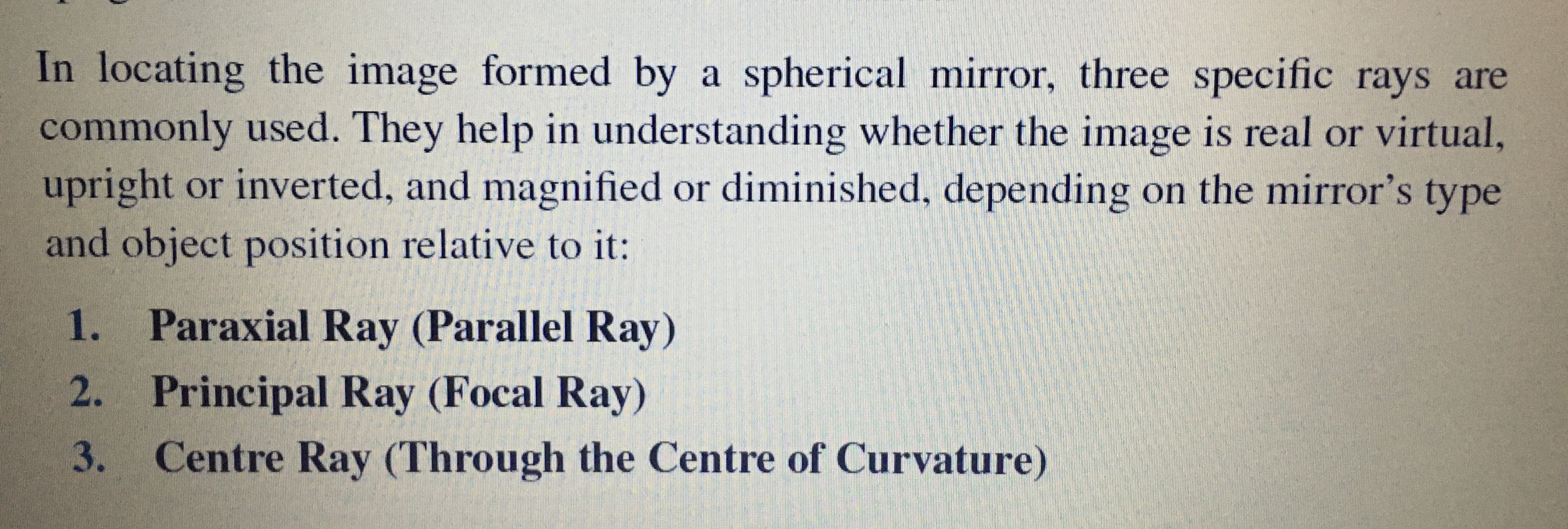
Mirror formula
This formula relates the object distance (u), image distance (v), and the focal length (f).
\frac{1}{f}=\frac{1}{u}+\frac{1}{v}
Magnification formulam=\frac{h_{i}}{h_{o}}=\frac{v}{u}
This formula relates the image distance (h_{i} ) and the object distance (h_{o} ) by the formula
Real images
These images are formed as a result of the actual intersection of two or more rays from an object. Real images are formed on a screen.
Virtual images
These images are formed by the appa