bio 2.0 chp 11 - unit 3
 Call Kai
 Learn
Learn Practice Test
 Spaced Repetition
 Match
Match Flashcards
 Knowt Play
1/54

There's no tags or description
Looks like no tags are added yet.
Name | Mastery | Learn | Test | Matching | Spaced | Call with Kai | Chat |
|---|
No analytics yet
Send a link to your students to track their progress
55 Terms
the purpose of cell division is to promote:
cell growth, replacement, renewal, reproduction
true/false:
before cell division starts, the DNA of the cell must replicate and copy itself
true
What is the name for prokaryotic cell division?
binary fission
the eukaryotic DNA are ___ whereas prokaryotic DNA are ___
large and linear; small and circular
A pair of chromosomes with the same genes in the same order, but
may have different alleles for some of the genes are termed as:
homologous chromosomes
sister chromatids formed as a result of DNA replication have:
same genes at a locus
the eukaryotic DNA replication occurs at ____ during ___ phase
nucleus, S
What is the order of the eukaryotic cell cycle?
G1, S, G2, Mitosis, Cytokinesis
true/false:
the eukaryotic M phase comprises mitosis and cytokinesis
true
if a cell is mutated and doesn’t undergo interphase, can it still proceed towards cell division?
No, because interphase (G1 → S phase → G2 ) is required for cells to make necessary proteins for DNA replication (during G1),
complete DNA replication (during S phase) and make
necessary proteins before cell division M phase starts (during
G2)
the cells that are not actively dividing are at:
G0 phase
what does it mean to say that DNA replication is semi-conservative?
each parental strand acts as a template to produce daughter DNA molecules that have one parental strand and one new strand
DNA replication starts at:
ori R
during the DNA replication process of a double stranded DNA:
each of the parental DNA strands serves as a template to form a newly synthesized daughter DNA strand
the DNA replication process occurring at the replication fork involves:
synthesis of both leading and lagging strands where each proceeds in 5’ to 3’ direction
what is the correct order of enzymes and proteins that participate in the DNA replication process?
helicase, SSBP, primases, DNA polymerases, DNA ligases
What are the functions of HELICASE?
breaks hydrogen bonds between nitrogenous bases
unwinds parental double helix at replication fork
What are the functions of SSBPs?
bind to single-stranded regions of parental strands and prevent them from coming back together
What are the functions of topoisomerases?
work upstream of replication fork
relieve stress caused by unwinding double helix
What are the functions of RNA primase?
synthesizes short pieces of RNA complementary to a region of the DNA parental strand
What are the functions of DNA polymerase?
synthesizes a new DNA strand by reading the DNA template
adds corresponding nucleotide to 3’OH end of RNA primer or growing strand
What is the function of DNA ligase?
covalently corrects segments of DNA (phosphodiester bonds formed)
connects Okazaki fragments in lagging strand
From where is the energy for polymerization derived in DNA replication?
the pyrophosphate hydrolysis of incoming nucleotide
Say, a cell is exposed to a drug that mutates the gene encoding
actin filaments (reminder: actin filaments and motor proteins, myosin,
help in contractile ring contraction, needed for cytokinesis in animal
cells). What would be the effect on cell division?
cells with multiple nuclei will form/multinucleate
Say, for a blood cell undergoing cell division, to begin with, there
are two copies of the beta-subunit gene in its DNA (AA). How many
gene copies will be present at the end of G1; end of G2; end of M (cell division) in each daughter cell
2, 4, 2
What is the DNA content of the beginning of the G1 PHASE?
2ng
What is the DNA content of the end of S phase?
4ng
What is the DNA content of the End of M PHASE (mitosis and cytokinesis)?
2ng
true/false:
If a parent cell has 2n=4, then each daughter cell formed as a
result of mitosis and cytokinesis will have a total of 4 chromosomes
true
true/false:
one parent cell after completion of mitosis and cytokinesis produces 4 daughter cells
false
in animal cells, miotic spindles (microtubules) are formed from centrosomes during ____
prophase
chromosomes align along a single plane in the middle of the dividing cell during ___
metaphase
sister chromatids split at the centromere and move to the opposite poles of the dividing cell during ____
anaphase
a dividing human skin cell (2n=46) has a total of ___ chromosomes at the G1 phase of mitosis
46
A dividing human skin cell (2n=46) arrested at the anaphase of
mitosis has ___chromatids separated at each pole of the cell with a
total of ___chromatids in a cell.
46, 92
A parent human skin cell (2n=46) undergoing mitosis and
cytokinesis will result in the formation of ___daughter cells and a total
of ___chromosomes in each daughter cell.
2, 46
Say a dividing human cell is exposed to a drug that inhibits the
enzyme “Separase”. The enzyme “Separase” helps in centromere
splitting during sister chromatid separation. At what stage will the cell
cycle get arrested (stopped) as an effect of drug treatment?
metaphase
What is the first thing to occur in DNA replication?
the strands of DNA double helix are separated by helicase
On which strand are new nucleotides being added continuously in the same direction as the replication fork is opening?
leading strand
true/false:
When DNA polymerase reaches a primer from prior DNA synthesis, the primer is removed and replaced with DNA nucleotides.
true
RNA primase lays down an RNA primer to start DNA replication. If a mutation occurs that blocks the function of RNA primase, which synthesis of which strand is affected, and why?
Both strands are affected because all DNA polymerase can only add new nucleotides to a 3′-OH present at the end of the RNA primer.
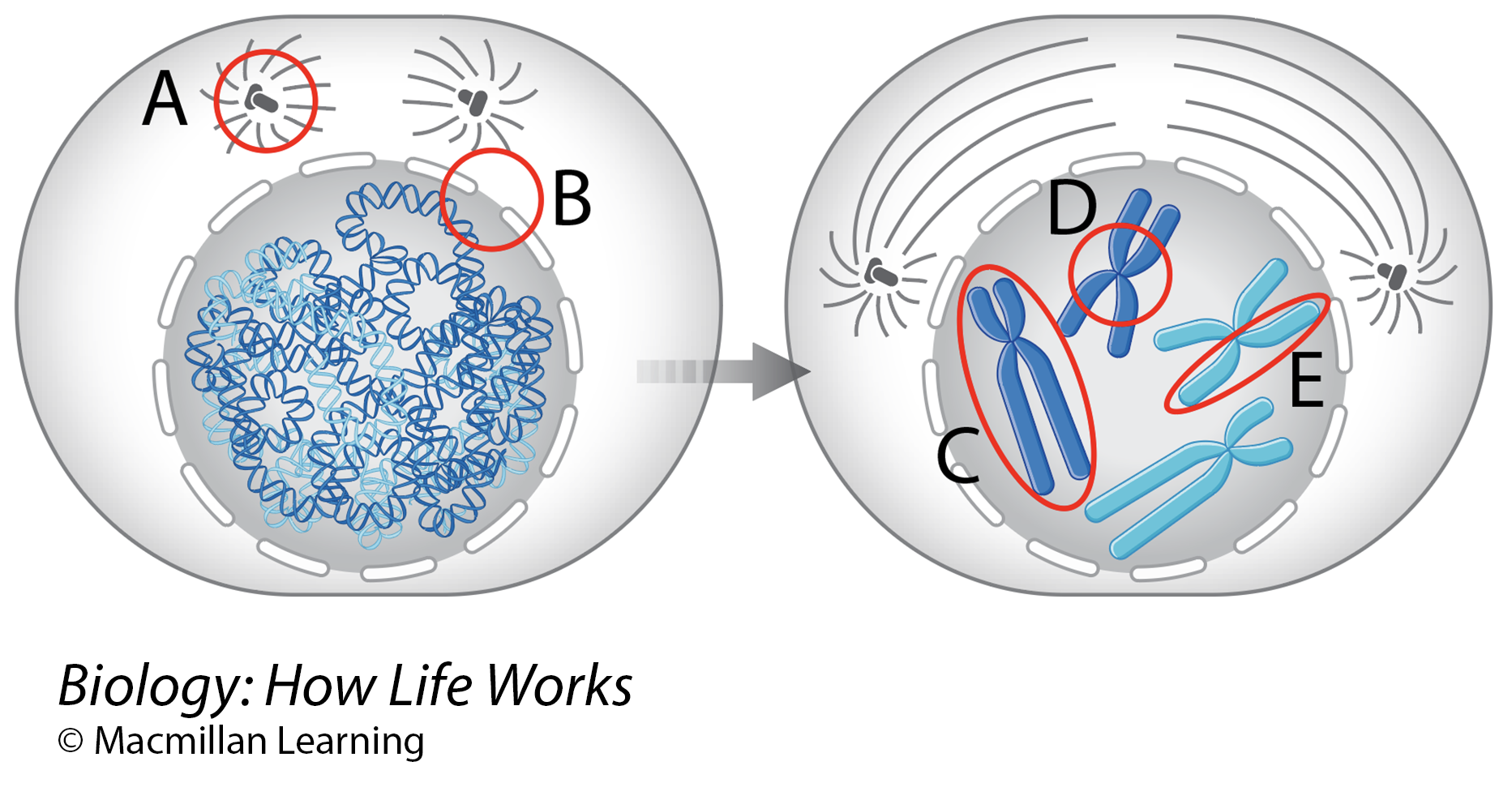
In the figure, which lettered item is a centromere?
D
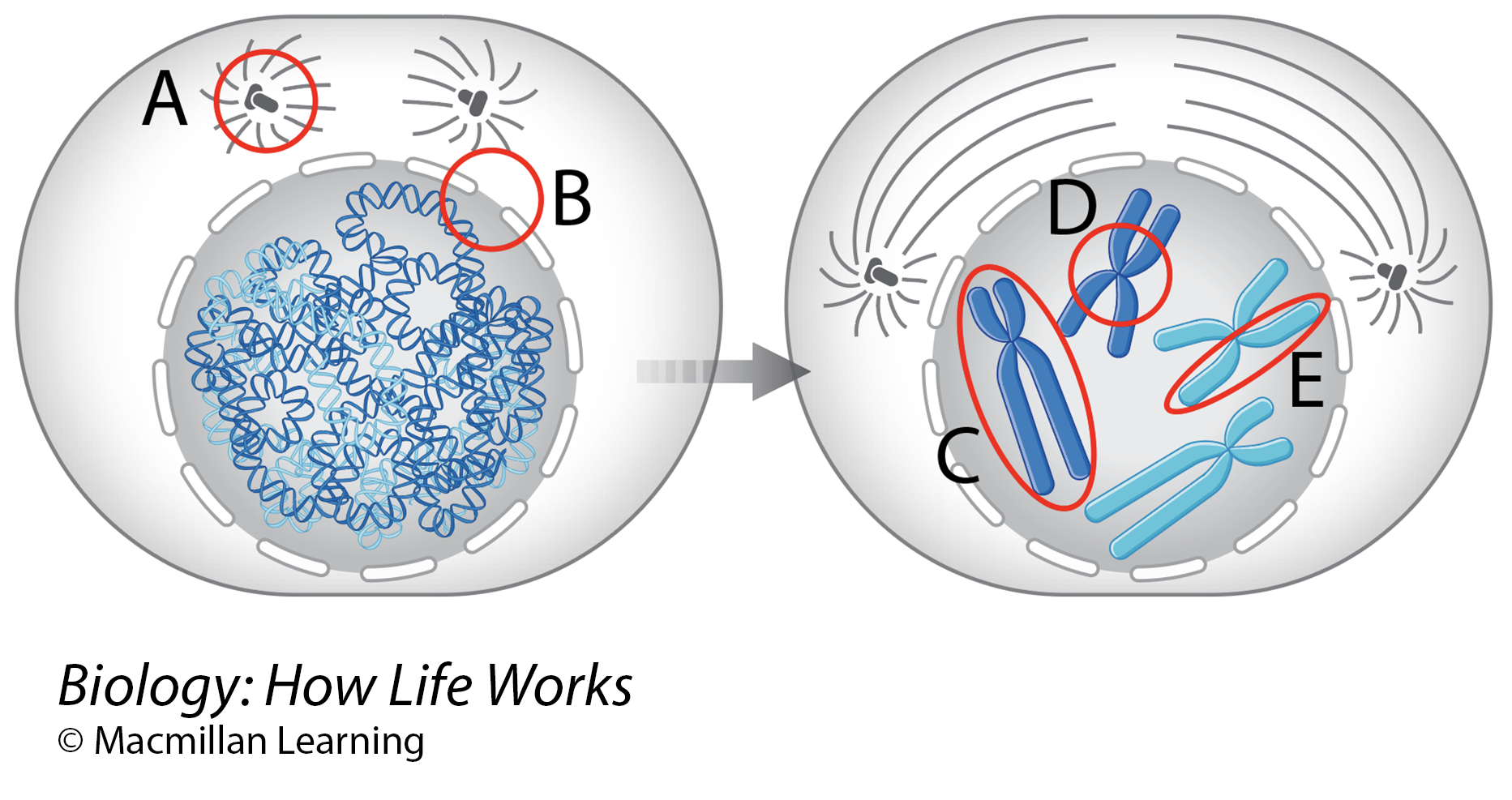
In the figure, which lettered item is a centrosome?
A
The contractile ring that leads to cytokinesis in animal cells has been shown to be made primarily of actin filaments (microfilaments).
Which motor protein would you predict is involved in the contraction of the ring?
myosin
Under experimental conditions, we can delete the gene for the motor protein involved in the contraction of the contractile ring during animal cell cytokinesis.
Which of the results might you predict?
Additional rounds of the cell cycle continue producing a multinucleate cell.
The process of cytokinesis involves components of the cytoskeleton. It is most similar to what other cytoskeletal function?
muscle contraction
A researcher is studying phases of the cell cycle in a population of cells during which there is an increase in the DNA content. This stage is most likely:
S phase
Why are primers needed for DNA replication?
DNA polymerase can only add nucleotides to an existing chain.
When we say that DNA replication is semiconservative, we mean that:
when DNA is replicated, each new double helix contains one parental strand and one newly synthesized daughter strand
Mitotic cell division is considered asexual because:
the daughter cells receive DNA from one parent cell, and the daughter cells are genetically identical.
A homologous chromosome pair is best described as two chromosomes that have:
the same genes in the same order but possibly with different alleles of some of the genes.
Taxol is an anticancer drug that prevents uncontrolled cell proliferation by blocking the lengthening and shortening of microtubules, which causes arrest of the cell cycle. If dividing cells are treated with Taxol, what will occur?
The cells will be unable to form a mitotic spindle.
Sister chromatids are best described as two DNA molecules that have:
the same genes in the same order with the same alleles.
Many molecular biology lab techniques rely on the fact that even small stretches of complementary nucleic acid sequences have a strong tendency to come together to form the H-bonded base pairing that we recognize as characteristic of the DNA double helix. Which of the answer choices prevents this strong tendency to reassociate from disrupting DNA replication?
single-strand binding protein
When a nucleotide is added to a growing nucleic acid strand during DNA replication, the incoming monomer is _____, and the energy required to drive the polymerization is derived from _____.
a nucleoside triphosphate; cleaving a pyrophosphate