NS 1400 Test 1
 Call Kai
 Learn
Learn Practice Test
 Spaced Repetition
 Match
Match Flashcards
 Knowt Play
1/154

There's no tags or description
Looks like no tags are added yet.
Name | Mastery | Learn | Test | Matching | Spaced | Call with Kai | Chat |
|---|
No analytics yet
Send a link to your students to track their progress
155 Terms
What is health?
a state of complete physical, mental, and social well-being and not merely the absence of disease or infirmity
"Range of behavioral, biological, socio-economic and environmental factors that influence the health status of individuals or populations"
Determinants of health
Multifactorial - social, economic, psychological and physiological factors
Impacts of the determinants of health
Produces an impact on 1) individual level pathology (the study of the causes and effects of disease or injury) and 2) patterned health differences in populations
Yield health disparities
Determinants work through ________________________ ______________ _________________
discernable causal pathways --> this allows for prevention and amelioration of disease
Biological determinants of health (1)
Innate - Effects or characteristics of the body that are innate in origin or have an innate component that may directly and measurably determine health and/or disability
GENETICS - Effects or characteristics of the body that are genetic in origin or have a heritable component that may directly and measurably determine health and/or disability.
Biological determinants of health (2)
Body Structure - Effects or characteristics of body structure that may be protective or risk factor determinants of health; they may be causally related or strongly associated with the propensity for health or for disease, disability, or injury
ANATOMY - Effects or characteristics of body anatomy that may be protective or risk factor determinants of health; they may be causally related or strongly associated with the propensity for health or for disease, disability, or injury.
Biological determinants of health (3)
Body Functioning - Effects or characteristics of body functioning that may be protective or risk factor determinants of health; they may be causally related or strongly associated with the propensity for health or for disease, disability, or injury
PHYSIOLOGY - Effects or characteristics of physiology that may be protective or risk factor determinants of health; they may be causally related or strongly associated with the propensity for health or for disease, disability, or injury.
Genetic subclass
Single-gene
•Caused by defect in one specific gene
•Known as Mendelian disorders
•Rare -only 18,000 known single gene disorders
Chromosomal
•Defect due to an excess or lack of the genes contained in a whole chromosome or chromosome segment.
•Chromosomal disorders include: Down syndrome, Klinefelter syndrome, and Turner syndrome.
Multifactorial
•Result from interactions of several genes and the environment
•Polygenic
•Most common
•cancer, coronary heart disease, hypertension, and stroke.
Mitochondrial DNA-linked
•Defect arise from mutations in mitochondrial DNA.
•>60 hereditary disorders
•Maternal transmission
Anatomical subclass
Height - Anthropometric measure used to assess a person's relationship to the accepted standards for growth and development.
Weight - Anthropometric measure used to assess a person's relationship to the accepted standards for growth and development.
Waist-hip ratio - Anthropometric measure used to approximate abdominal fat; regarded as a better predictor of health risk than body mass index (BMI).
Bone density - Measure of bone mass in relation to bone volume used to determine risk of developing osteoporosis.
Physiological subclass
Risk Factor - Organ System
Blood Pressure - Cardiovascular
Nutritional Status - Digestive
Pulmonary Function - Respiratory
Sensory Function - Nervous
Movement and Balance - Musculoskeletal Nervous Strength - Musculoskeletal
Fitness - Cardiovascular Respiratory
Biochemical Measures - Endocrine, Urinary, Immune
What is disease?
A harmful deviation from the normal structural or functional state of an organism, generally associated with certain signs and symptoms
What influences food choices?
- Taste
- Smell
- Texture
- Hunger/Satiety levels
- Experience
- Family
- Culture
- Cost
- Access and Availability
- Sustainability/Climate
Social =
Personal factors, behaviors, & environments
How many Americans are health illiterate?
9/10
What is economics?
A social science which is concerned with the study of the allocation of scarce resources among competing ends
What is opportunity cost?
The forgone benefit that would have been derived by an option not chosen
What non-biological factors influence health?
Occupation
Education
Income
Price of health goods
Prices of non-health goods that affect health status (food, housing)
In terms of non-biological factors that influence health, there are many disparities in _________________, __________________, and. ________________
occupation, education, and income
Life insurance companies, to be profitable (or more precisely, to set premiums accurately)....
they need to know what type of person is more likely to die at different ages
Keys and co-authors find that the measure with the best correlation between subcutaneous fat and weight & height measures was something called the 1. _______________ ____________ which they re- name as the ________________ ______________ ________________ (_______)
1. Quetelet Index
2. Body mass index (BMI)
How do you calculate BMI?
BMI = weight / height^2
Overweight: _____________________
Obese: ____________________
1. BMI between 25.0 and 29.9
2. BMI 30 or greater
Advantages of BMI
• Relatively easy to do
• Relatively inexpensive
• Non-invasive
• And can be readily understood
Criticisms of BMI
-Much of the original work on BMI and mortality relied on somewhat idiosyncratic (individual) samples that were predominantly male and Caucasian
-It does not distinguish between muscle mass and fat
-Correlation between % body fat and BMI is not perfect
-In some populations, correlation with certain diseases begins at lower BMI levels (eg in south Asian populations, risk of diabetes rises once BMI is above 23)
-It is possible to use more accurate means of measuring body fat; eg bioelectrical impedance analysis (muscle is a conductor; fat is an insulator)
-Does not account for impact of lean muscle mass to total body weight
-Nor does it account for body fat distribution
NHANES
National Health and Nutrition Examination Survey
Globally _______ of adults are obese
13%
Globally ______ of adults are considered overweight and obese
39%
At a basic level, obesity arises because of:
• Increased caloric intake that results in the accumulation of fat
• Reduced physical activity
• If energy (caloric) intake exceeds energy consumption, the body stores the excess
Obesogenic
an environment that enables weight gain and/or is not conducive to weight loss
Why would you say we live in an obesogenic environment?
• Rise in the availability of sugar sweetened beverages
• Changes in the relative prices of foods, with obesogenic foods becoming relatively less expensive
• Increased ease of access to unhealthy foods co-existing with food deserts
What individual behavior changes cause obesity?
• Reductions in physical activity
• Changes in time use, specifically reductions in time spent preparing healthier meals from scratch
What health consequences is obesity associated with?
- Cardiovascular diseases
- Diabetes
- Some musculoskeletal disorders such as osteoarthritis
- Some cancers
- Mood disorders (depression, anxiety); substance abuse
What are the economic costs of obesity?
- Direct medical costs
- Economic productivity costs
- Externalities in terms of higher medical premiums
Characteristics of disease
-Disease is a condition of the body, its parts, organs, or systems or an alteration thereof
-Results from infection, parasites, nutritional, environmental, genetic, or other causes
-Has a characteristic, identifiable, marked group of signs or symptoms
-Deviates from normal structure or function
What is obesity?
A complex disease characterized by a disproportionate body weight for height owing to an excessive accumulation of adipose tissue.
What is the ICD (International classification of disease) code for obesity?
Endocrine, nutritional, and metabolic diseases
What are the biomechanical health risks of obesity?
- Obstructive sleep apnea
- Obesity-hypoventilation syndrome
- Asthma/Reactive Airways Disease
- Osteoarthritis
- Urinary stress incontinence
- Gastroesophageal Reflux Disease
- Immobility/Disability
Obesity health risks diagram
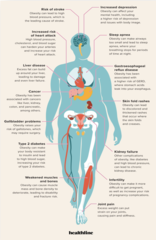
What are the cardiometabolic health risks of obesity?
- Prediabetes
- Type 2 Diabetes
- Dyslipidemia
- Hypertension
- Non-Alcoholic Fatty Liver Disease
- Polycystic Ovary Syndrome
- Female infertility
- Male hypogonadism
What is required for the diagnosis of obesity?
An assessment of body composition (total body adiposity)
How to measure body fat?
- Hydrostatic Weighing (gold standard)
• Limited to fat and fat-free mass (fat is less dense)
- Dual X-Ray Absorptiometry (DEXA - new gold standard)
• Discriminates across more compartments
• Fat, lean mass, and bone
• Can inform on fat distribution
- Air Displacement Plethysmography (Bod Pod)
More feasible options include:
- Bioelectric Impedance (flow of electrical current)
- Skin-fold Thickness, BMI, waist circumference, waist:hip ratio
Effectiveness of tools to determine body composition

Body mass index
-Relative measure of total body weight to height
-Approximation, at best of total adiposity
-Shown to moderately correlate with direct measurements of body fat
-But does predict cardiometabolic and biomechanical risk
Underweight BMI
Normal BMI
18.5-24.9
Overweight BMI
25-29.9
Obese class I BMI
30-34.9
Obese class II BMI
35-39.9
Obese class III BMI
≥40
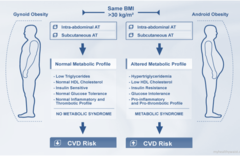
Android Obesity
Excess central adiposity
-associated with greater risk of health complications
What are some of health complications associated with android obesity?
-Hypertension
-Dyslipidemia
-Insulin resistance
-Diabetes
Gynoid obesity
Excess adiposity below the waist
-relatively benign
Waist-to-hip ratio
Better predictor of cardio-vascular disease (CVD) risk factors and events than BMI
White adipose tissue is classified into what two compartments based on location?
-Subcutaneous adipose tissue
-Visceral adipose tissue
_______________________ ________________ ______________ is the larger storage compartment
-Under the dermis of the skin
-Stores >80% of total body fat
Subcutaneous adipose tissue
__________________ ________________ __________________ surrounds the internal organs
-Intra-abdominal, perirenal and pericardial adipose tissue
Visceral adipose tissue
____________________ _______________________ correlates most closely with obesity-related health risks
Visceral accumulation
Anatomic differences in fat deposition
What is physiology?
A branch of biology concerned with the functioning of living organisms, and their constituent tissues or cells
First law of thermodynamics states that _____________ ______ ____________.
Energy is conserved
Once growth is completed, any excess energy not needed to maintain body temperature, cellular work, and body movement is stored and converted to _______
fat (65% of excess calories)- adipose tissue is easiest way to store energy
Obesity is characterized by an excessive accumulation of _______________
adiposity
What contributes to the positive energy balance that causes obesity (deviation from energy homeostasis)?
Low physical activity (a sedentary lifestyle) and over-consumption of dietary intake (energy) exceeds the metabolic needs of an individual
Factors of energy intake
-nervous system
-endocrine system
-microbiota
-stress or emotional factors
-medications
Factors of energy expenditure
-resting energy expenditure
-thermic effect of nutrients
-controlled ambient temperatures
-lack of sleep or shift work
-physical activity-related energy expenditure
The physiology of body weight regulation involves a ____________________________ ___________________ involving peripheral organs and the central nervous system (CNS)
endocrine network
-Hormones maintain a balance between energy intake and expenditure
Homeostatic mechanism functions on a ________________ ______________ system
negative feedback
-Senses positive or negative fluctuations in energy balance
-Nutrient and/or hormone-related
-Initiates counter-regulatory physiological response to off-set the deviation in energy balance
-Food intake and/or alteration in metabolism
__________________ is the main site of sensory integration
Hypothalamus (also cortico-limbic system and hindbrain)
What are the main peripheral organs involved in weight regulation?
Gut, pancreas, and adipose tissue
What does the hypothalamus do?
• Integrates hormonal and nutrient signals from the peripheral circulation
• Coordinates neuronal inputs to generate feedback responses
Location near the ____________ ________________ facilitates access to peripheral signals
median eminence
• Fenestrated capillaries
• "Leaky" blood brain barrier
• Permeable so hormones can enter and interact with hypothalamus
Two sets of hypothalamic neurons in the arcuate nucleus (ARC)
________________ _________ _______________ and _______________ _________________
regulate food intake and energy balance
-Functionally antagonistic
orexigenic neurons
- appetite-stimulating
- predominate in fasted state
Examples of orexigenic neurons
Agouti-Related Peptide and Neuropeptide Y (AgRP/NPY)
Anorexigenic neurons
-appetite-suppressing
-predominate in the fed state
Example of anorexigenic neurons
Pro-opiomelanocortin (POMC)
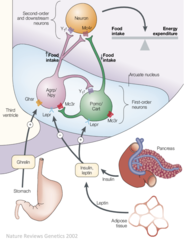
Neural circuits are regulated by ____________________ __________
peripheral cues (hormones sent from gut, pancreas, and fat)
______________ is produced by ________________ ______________ in levels proportional to whole-body fat store
Leptin is produced by adipose tissue in levels proportional to whole-body fat stores
Leptin directly activates ____________ expression and directly inhibits ____________ expression
Leptin directly activates POMC expression and directly inhibits AgRP/NPY expression
What is the net effect of leptin action?
To inhibit food intake and increase energy expenditure
Insulin is secreted from __________________ ________________ upon nutrient ingestion.
pancreatic β-cells
What does the activation of insulin receptors on POMC and AgRP neurons cause?
It changes neuronal sensitivity (long-term regulator)
Insulin potentiates the satiety action of ______________
Leptin
___________ produced by the stomach stimulates food intake
Ghrelin
-Activates AgRP/NPY neurons

What is ghrelin?
A hormone produced by the stomach during the fasted state
What are some intestinal hormones that act on hypothalamic feeding circuits to inhibit food intake?
-Glucagon-like peptide 1 (GLP-1)
-Peptide YY3-36 (PYY3-36)
-Cholecystokinin (CCK)
How can the trillions of microbiota (mostly symbiotic) benefit health?
- Detoxify compounds
- Synthesize vitamins
- Digest indigestible foods
- Yield short chain fatty acids (nutrient source and prevention of chronic disease)
What is total energy expenditure the sum of?
1. Resting energy expenditure
- resting metabolic rate
-obligatory thermogenesis (energy needed to maintain vital functions)
2. Thermic effect of food
- post-prandial thermogenesis (energy needed to metabolize meals)
3. Energy spent in physical activity
- exercise and non- exercise activity thermogenesis
-most modifiable
Factors of resting energy expenditure
-Age
-Sex
-Body size
-Body composition
-> Lean muscle mass
- Hormones
Factors that affect BMR

Physical activity
-energy spent makes second largest contribution
-most modifiable component
-exercise and non-exercise activity thermogenesis
Thermic effect of food
-lowest contribution to energy expenditure
- also called post-prandial thermogenesis
- energy expended to utilize nutrients after a meal during digestion, absorption, transport, metabolism, and storage
- depends on amounts and types of food consumed
- high protein = high TEF
- high fat = lowest TEF
What is anatomy?
A branch of biology concerned with the study of the structure of organisms and organization of their parts
What are tissues?
Groups of cells similar in structure and function
What are the subtypes of tissues?
1. Epithelial tissue (covering)
2. Muscle tissue (movement)
3. Nerve tissue (control)
4. Connective tissue (support)
-> adipose tissue (binding, protection, and storage)
Types of adipose tissue
-Brown
-Beige
-White (majority of body)
______________ __________________ are most abundant
White adipocytes
What is the function of white adipocytes?
-Energy storage function
-Secrete various bioactive substances (adipokines)
________________ _______________ is an endocrine organ
Adipose tissue
__________________ _________________ are least abundant
Brown adipocytes