Citric Acid Cycle

0.0(0)
Studied by 0 people
call kaiCall Kai
Locked
learnLearn
examPractice Test
spaced repetitionSpaced Repetition
heart puzzleMatch
flashcardsFlashcards
GameKnowt Play
Card Sorting

1/9

flashcard set

Earn XP

Description and Tags

TCA cycle steps, reactions, and descriptions

Last updated 6:39 PM on 6/28/26
Name
Mastery
Learn
Test
Matching
Spaced
Call with Kai
Chat

No analytics yet

Send a link to your students to track their progress

10 Terms

1
New cards

Conversion of pyruvate to acetyl CoA

Precursor step to TCA cycle

  1. Removal of hydroxyl group, hydroxyethyl is bound to pyruvate dehydrogenase

  2. Hydroxyethyl is oxidized to acetyl, reducing NAD to NADH

  3. The acetyl group is transferred to Coenzyme A, producing acetyl CoA
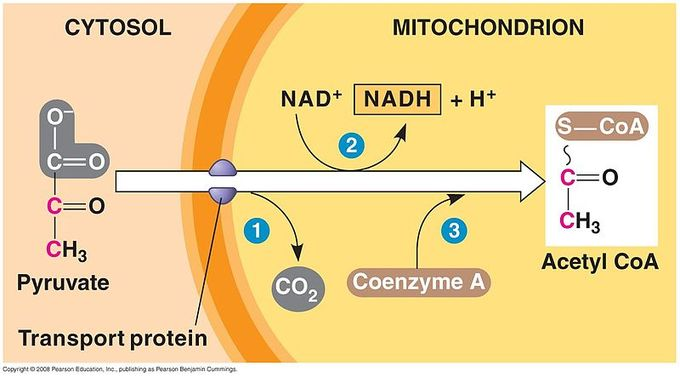
<p>Precursor step to TCA cycle</p><ol><li><p>Removal of hydroxyl group, hydroxyethyl is bound to pyruvate dehydrogenase</p></li><li><p>Hydroxyethyl is oxidized to acetyl, reducing NAD to NADH</p></li><li><p>The acetyl group is transferred to Coenzyme A, producing acetyl CoA </p></li></ol><p></p>
2
New cards

Citrate synthase

Step 1

Condensation of acetyl-CoA with oxaloacetate to form citrate, catalyzed by citrate synthase

  1. oxaloacetate is joined with acetyl-CoA

  2. water molecule attacks the acetyl

  3. Coenzyme A is released from the complex
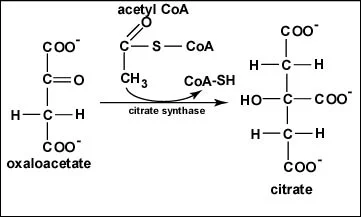
<p>Step 1</p><p>Condensation of acetyl-CoA with oxaloacetate to form citrate, catalyzed by citrate synthase</p><ol><li><p>oxaloacetate is joined with acetyl-CoA</p></li><li><p>water molecule attacks the acetyl</p></li><li><p>Coenzyme A is released from the complex</p></li></ol><p></p>
3
New cards

Acontinase

Step 2

Citrate becomes isomer, isocitrate by removal of water from 3’ and addition of water to 4’
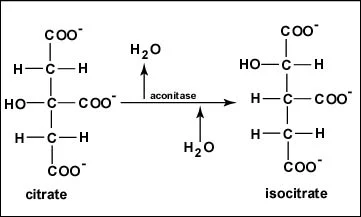
<p>Step 2</p><p>Citrate becomes isomer, isocitrate by removal of water from 3’ and addition of water to 4’</p>
4
New cards

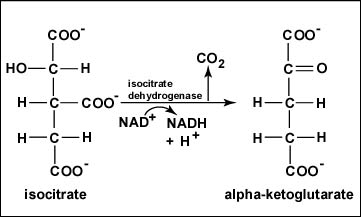
Isocitrate dehydrogenase

Step 3

oxidative decarboxylation of isocitrate to form α-ketoglutarate

  1. oxidation of -OH group at 4’ (NAD to NADH)

  2. intermediate has CO2 removed to yield alpha-ketoglutarate
<p>Step 3</p><p>oxidative decarboxylation of <strong>isocitrate</strong> to form <strong>α-ketoglutarate</strong></p><ol><li><p>oxidation of -OH group at 4’ (NAD to NADH) </p></li><li><p>intermediate has CO<sub>2</sub> removed to yield alpha-ketoglutarate</p></li></ol><p></p>
5
New cards

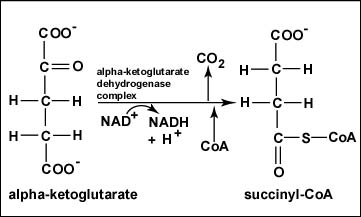
Alpha-ketoglutarate dehydrogenase

Step 4

  1. Alpha-ketoglutarate is oxidized, NAD is reduced to NADH

  2. CO2 is removed and CoA is added to form the 4-carbon succinyl-CoA
<p>Step 4</p><ol><li><p>Alpha-ketoglutarate is oxidized, NAD is reduced to NADH</p></li><li><p>CO<sub>2</sub> is removed and CoA is added to form the 4-carbon succinyl-CoA</p></li></ol><p></p>
6
New cards

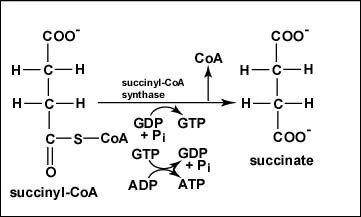
Succinyl-CoA synthase

Step 5

CoA is removed from succinyl-CoA to produce succinate

GDP and free phosphate is used to make GTP through substrate-level phosphorlyation

GTP is converted to ATP
<p>Step 5</p><p>CoA is removed from succinyl-CoA to produce succinate</p><p>GDP and free phosphate is used to make GTP through substrate-level phosphorlyation</p><p>GTP is converted to ATP</p>
7
New cards

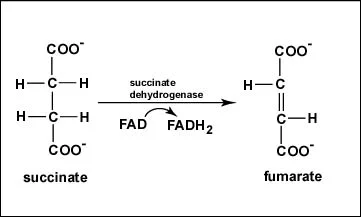
Succinate dehydrogenase

Step 6

Succinate is oxidized to fumarate, enzyme catalyzes removal of 2 hydrogens

FAD is reduced to FADH2
<p>Step 6</p><p>Succinate is oxidized to fumarate, enzyme catalyzes removal of 2 hydrogens</p><p>FAD is reduced to FADH<sub>2</sub></p>
8
New cards

Fumarase (fumarate hydratase)

Step 7

reversible hydration of fumarate to L-malate by adding H2O back to the substrate
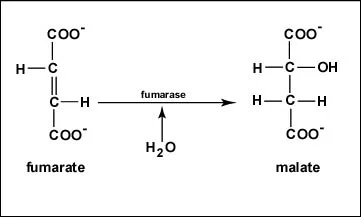
<p>Step 7</p><p>reversible hydration of fumarate to L-malate by adding H<sub>2</sub>O back to the substrate </p>
9
New cards

Malate dehydrogenase

Step 8

Malate is oxidized to produce oxaloacetate

NAD is reduced to NADH
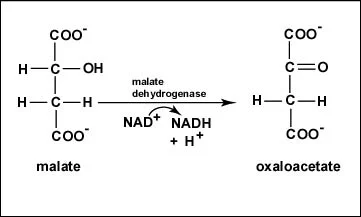
<p>Step 8 </p><p>Malate is oxidized to produce oxaloacetate</p><p>NAD is reduced to NADH  </p>
10
New cards

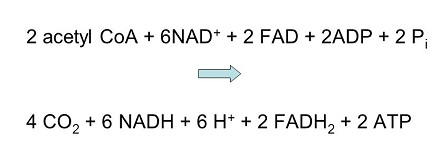
TCA cycle net equation

knowt flashcard image