Mod 17: Gas Laws
 Call Kai
 Learn
Learn Practice Test
 Spaced Repetition
 Match
Match Flashcards
 Knowt Play
1/69

There's no tags or description
Looks like no tags are added yet.
Name | Mastery | Learn | Test | Matching | Spaced | Call with Kai | Chat |
|---|
No analytics yet
Send a link to your students to track their progress
70 Terms
What is the formula for Universal Gas Law?
PV = nRT
Do you need to know the universal gas law for the exam?
YES!
What does universal gas law describe?
behavior of gases and vapors with certain variables
What are the variables of universal gas law?
P = pressure (atm)
n = number of moles of substance
R = universal gas constant (0.08)(requires pressure in atm)
V = volume taken up by mass of gas (L)
T = temperature (K) MUST BE IN KELVIN
What unit must pressure be measured in (universal gas law)?
atmospheres
What unit must temperature be measured in (universal gas law)?
kelvin
Why is temp measure in kelvin (universal gas law)?
because it has no negative numbers
What unit is volume measured in (universal gas law)?
liters
What value is the universal constant?
0.08
What are moles?
a gram molecular weight of a gas
What is molecular/atomic weight?
the sum of all atomic particles (electrons, protons, and neutrons) in atom/molecule
What is an example of an atom’s moles?
helium has an atomic weight of 4
4 grams = one mole of helium
What is Avogadro’s number?
6.023 × 10²³ units
What is Avogadro’s Hypothesis?
one mole of any gas at 0C (273 K) and 1 atm (standard pressure), will expand to 22.4 liters
PV =nrT
What happens when variables in UGL is manipulated?
changes in other variables will occur
What are gas laws mathematical expressions of?
how Boyle’s law, charles, and gay lussac’s law are related
Which each of the 3 laws, …
one variable is held constant.
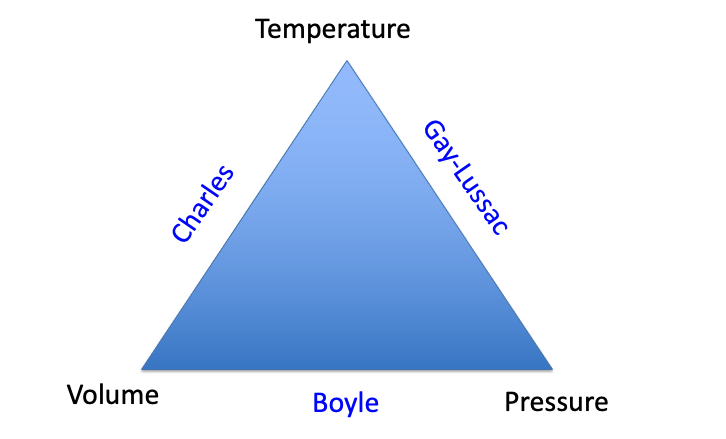
memorize this
What is constant in Boyle’s Law?
temp
In Boyle’s Law, what is inversely proportional?
pressure and temp
nr can also be known as …
k
When solving gas law equations, what it is important to know?
you want the variables (components that are changing) on the same side of the equation together
For boyle’s law how would you write the equation?
Tk = PV
the things changing are on the same side
What is a clinical application of Boyle’s Law?
breathing in and out
What is constant in Charle’s law?
pressure
what is directly proportional in charle’s law?
volume and temp
What is the constant in Gay-Lussac’s Law?
volume
What is directly proportional in Gay-Lussac’s Law?
pressure and temp
What can also call the UGL and why?
the ideal gas law; explains gases behavior if they were ideal
What factors does the UGL omit?
a gas molecule’s small volume
intermolecular interactions
Why was kinetic molecular theory created?
to encompass charles, boyle, and gay-lussac AND laws of motion AND thermodynamics
KMT was created because UGL was …
omitting factors
What does an ideal gas also assume?
no intermolecular forces
What 3 things does Van der Waal’s equation do?
corrects the UGL
accounts for molecular volume
accounts for molecular interaction in a gas
What is pressure in KMT the result of?
molecular collisions on the walls of a container
More molecules in a container =
more collisions = increased pressure
What does Dalton’s Law state?
the total pressure of a system is the additive pressures of each individual gas in a mixture
What will multiple gases in a mixture exert?
a pressure in proportion to its percentage in the mixture
In Dalton’s Law, what is the total pressure?
the sum of all molecular collisions upon the walls of a container
Pt = p1 + p2 + p3 + p4
When are partial pressures equal?
at equilibrium
What does MAC stand for?
mean alveolar concentration
What is MAC?
the minimum alveolar concentration (at 1 atm) at which 50% of patients will not respond/move to noxious stimuli
What is 1 mac of sevoflurane?
2%
What is 1 mac of isoflurane?
1.2%
What is 1 mac of desflurane?
6%
true or false. MAC cannot be used in multiple calculations.
false
What is a vapor?
a substance in its gaseous state, but currently below critical temp
What is a gas?
a substance above its critical temp
What happens to vapor pressure as temp increases?
it increases
liquids with high intermolecular forces have what kind of vapor pressure?
low (h2o)
liquids with low intermolecular forces have what kind of vapor pressure?
high (desflurane)
When does a liquid boil?
when its VP = atmospheric pressure above the liquid
Do boiling points vary with atmospheric pressure?
yes
What happens if a volatile agent with a higher
vapor pressure is added to a vaporizer calibrated
for a lower vapor pressure? The concentration
delivered will be…
higher than normal, Higher Lower Higher
What happens if a volatile agent with a lower
vapor pressure is added to a vaporizer calibrated
for a higher vapor pressure? The concentration
delivered will be…..
lower than normal, Lower Higher Low
What is VP dependent on? (not temp)
solubility of the substance
What is a coefficient?
a constant number that measures a specific material property or how a substance reacts under certain conditions
What is solubility coefficient?
a number that tells you how much of a gas can dissolve in a liquid at a certain pressure and temperature
In is solubility coefficient at equilibrium?
when the partial pressure of gas in vapor state is equal to that in liquid state - no gradient exists to push in either direction
What is a partition coefficient?
number that tell us how a chemical substance splits itself between two mixed, unmixable liquids
what is a blood:gas partition coefficient?
a measure of how an anesthetic gas dissolves in blood compared to the air in the lungs
What is the Ostwald Solubility Coffecient?
a measure of how well a gas dissolves in a liquid at a 37C (body temp)
What is the bood:gas partition coefficient for sevoflurane?
0.65
What is the blood:gas coefficient for isoflurane?
1.46
What is the blood:gas coefficient for desflurane?
0.42
What is the adiabatic process?
rapid expansion or compression of gases that occurs faster than energy can equilibrate with the surrounding environment
true or false. adiabatic process can increase or decrease the energy in the system.
false, it do neither
What is the energy concentration effect?
rapid compression of gas cause ⬆kinetic energy, which ⬆temp when it occurs faster than the energy can equilibrate with the environment
temp will increase proportionally to the decreased volume
oil or grease not recommended for use on cylinder of compressed gas → risk of ignition or burn
What is the energy dilution, joule-thompson effect?
explains the cooling effect that occurs with rapid gas expansion (opposite of rapid compression)
“joule is cool”
frosting may occur
how a cryoprobe works
How does the energy dilution, joule thomson effect actually happen?
rapid pressure decrease of a gas, lowers the energy per area, which lowers the temperature