RAD 112: Radiographic Procedures I Exam Two Study Guide
 Call Kai
 Learn
Learn Practice Test
 Spaced Repetition
 Match
Match Flashcards
 Knowt Play
1/84

There's no tags or description
Looks like no tags are added yet.
Name | Mastery | Learn | Test | Matching | Spaced | Call with Kai | Chat |
|---|
No analytics yet
Send a link to your students to track their progress
85 Terms
The thoracic cavity is surrounded by the walls of the
thorax
The thorax sits between the
neck and abdomen
What is an aperture?
an opening
The thoracic cavity extends from the ___ thoracic aperture to the ____
thoracic aperture
superior, inferior
What anatomic structure separates the thoracic cavity from the abdominal cavity?
diaphragm
What is the job of the bony thorax?
protect the organs within it (heart and lungs)
What is the space between the lungs called?
mediastinum
What are the structures of the bony thorax
sternum, clavicles, scapulae, ribs, thoracic vertebrae
The breast bone is the
sternum
The uppermost part of the sternum is the
manubrium
The connection point between the manubrium and the body is called the
sternal angle
jugular notch, xiphoid, manubrium help with centering
acromioclavicular joint positioning/landmark, the inferior angle of the scapula
The center portion of the sternum is the
body
The inferior portion of the sternum is the
Xiphoid process
The joint connecting the manubrium to the clavicles is called
sternoclavicular
The joint connecting the clavicles to the scapula is called
acromioclavicular joint
the acromion process of the ___ attaches to the clavicle to form AC joints
scapula
Clavicles and Scapulae are both
bilateral
Scapulae
Shoulder blades
coracoid
The head of the humerus sits in the
glenoid fossa
How many pairs of ribs are there?
12
How many thoracic vertebrae are there?
12
The thoracic vertebrae correspond to the
ribs
The spinous process of the seventh cervical vertebrae (C7) is called the
(hump that sticks out on the back of your neck)
Vertebra prominens
Which positioning landmark is used to ensure radiographers are capturing the entire lung field?
vertebra prominens (C7)
Xiphoid process corresponds to which thoracic vertebra?
T10
The inferior angle of the scapula and mid thorax both correspond to which thoracic vertebra?
T7
Three to four inches below the jugular notch is the
mid thorax
What is the Respiratory System’s purpose?
Exchange of gaseous substances
Gas exchange occurs between ___ and _____
air, blood
What are the four divisions to the respiratory system?
pharynx, trachea, bronchi, lungs
What are the three separate parts of the pharynx?
nasopharynx, oropharynx, laryngopharynx
The nasopharynx corresponds to
nose
The oropharynx corresponds to
mouth
What marks the boundary between nasopharynx & oropharynx?
uvula
What is the job of the uvula?
close off the nasal cavity when we swallow
The laryngopharynx corresponds to
What is the larynx?
voice box
The esophagus is part of which system?
digestive
What causes aspiration?
food, liquid, saliva, or stomach acid entering the lungs
the esophagus lies posterior to the larynx and the trachea
the voicebox suspends from the hyoid bone
the larynx extends from C3 to C6
What 2 fused plate-like structures form the anterior wall of the larynx?
thyroid Cartilage
the laryngeal prominence is also known as the Adam's apple and corresponds to c5
ring of cartilage forming the
inferior and posterior wall of
larynx.
cricoid cartilage
What is the job of the epiglottis?
closes airway when swallowing
What is the job of the 20 C-shaped rings of cartilage embedded in the walls of the trachea?
To ensure the airway stays open
The trachea is a fibrous muscular tube located ___ to the ___
anterior, esophagus
The trachea extends from ___ to ___
C6 to T5
What is being shown in this image marked by the letter “A?”
air-filled trachea


What is being shown here?
air-filled trachea

What is being shown here?
esophagus
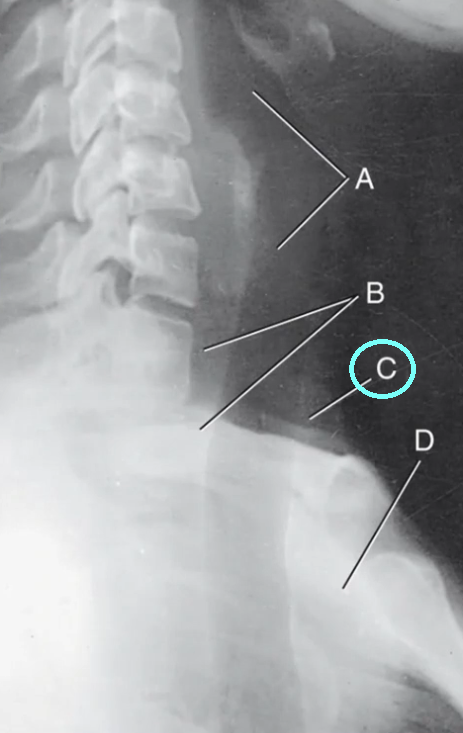
What is being shown here?
thyroid region
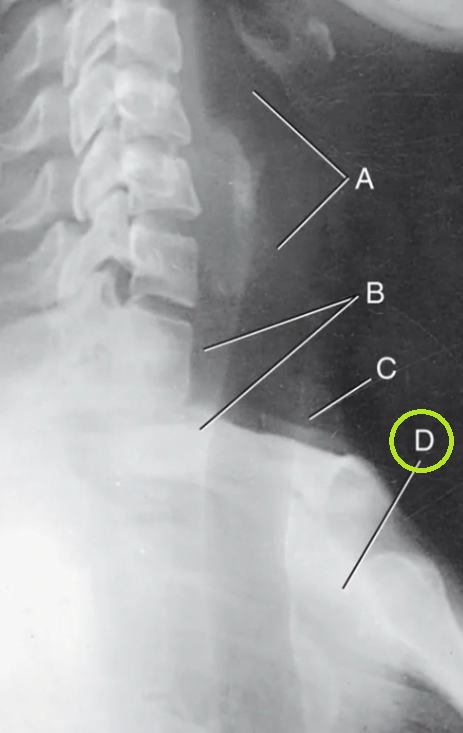
What is being shown here?
thymus region
The tracheal cartilage divides into two portions called the
right and left mainstem bronchi
The point where the tracheal cartilage divides is called the
Carina
The Carina corresponds to level
T5
Foreign objects more likely to be lodged into the right Mainstem Bronchus because it is ___, ___, and more ___ than the left bronchus
wider, shorter, vertical
The right mainstem bronchus divides into how many secondary bronchus?
3
The left mainstem bronchus divides into how many secondary bronchus?
2
Secondary Bronchi
• Divide into
bronchioles
erminal bronchioles
give way to
alveoli
Where is oxygen and carbon dioxide exchanged in the blood?
Alveoli
The elastic spongy tissue of the lungs is called the
parenchyma
What allows for expansion and
contraction of the lungs
parenchyma