Seasons LG Wk3 LO's pt.4

0.0(0)
Studied by 0 people
call kaiCall Kai
Locked
learnLearn
examPractice Test
spaced repetitionSpaced Repetition
heart puzzleMatch
flashcardsFlashcards
GameKnowt Play
Card Sorting

1/49

flashcard set

Earn XP

Description and Tags

Intro to Pharm

Last updated 8:36 PM on 8/20/26
Name
Mastery
Learn
Test
Matching
Spaced
Call with Kai
Chat

No analytics yet

Send a link to your students to track their progress

50 Terms

1
New cards

Background context (definitions)

  • pharmacology

  • pharmacokinetics

  • pharmacodynamics

  • toxicology

  • pharmacogenomics


  • Pharmacology: the study of drugs and their properties

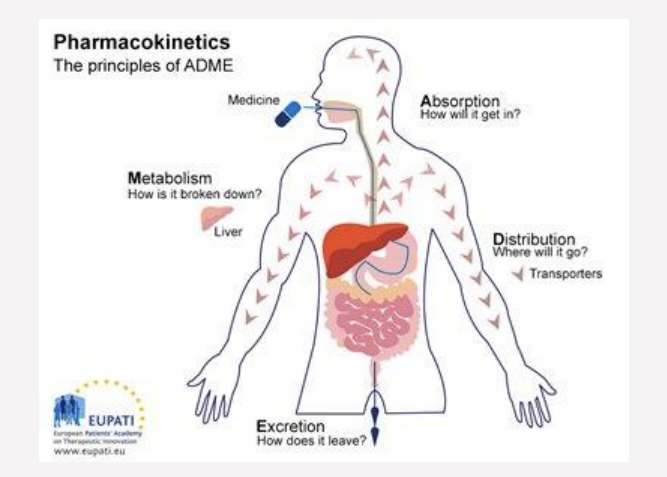
  • Pharmacokinetics: the study of Absorption, Distribution, Metabolism, and Elimination (ADME) aka body effect on drug

  • Pharmacodynamics: the study of the actions of chemicals on the organism aka drug effect on body

  • Toxicology: the study of the harmful effects of drugs (shoutout Dr.Dyer)

  • Pharmacogenomics: relation of personal genetics to drug response


<ul><li><p>Pharmacology: the study of drugs and their properties </p></li><li><p>Pharmacokinetics: the study of Absorption, Distribution, Metabolism, and Elimination (ADME) aka body effect on drug </p></li><li><p>Pharmacodynamics: the study of the actions of chemicals on the organism aka drug effect on body </p></li><li><p>Toxicology: the study of the harmful effects of drugs (shoutout Dr.Dyer)</p></li><li><p>Pharmacogenomics: relation of personal genetics to drug response</p></li></ul><p></p>
2
New cards

Background context: Pharmacokinetics ADME

  • describe what ADME stands for


  • Absorption

  • Distribution

  • Metabolism

  • Excretion


<ul><li><p>Absorption</p></li><li><p>Distribution</p></li><li><p>Metabolism</p></li><li><p>Excretion</p></li></ul><p></p>
3
New cards

Background context: Pharmacokinetics ADME

  • Absorption what it is

  • when is it bypassed


  • Absorption — a drug's ability to pass through barriers such as the intestinal lining, nasal lining, lungs, or skin

  • Absorption is BYPASSED when drugs are administered intravenously


4
New cards

Background context: Pharmacokinetics ADME

  • distribution what it is & how drugs are distributed


  • Distribution — how the drug is distributed around the body and its propensity (natural inclination) to accumulate in certain tissues and organs

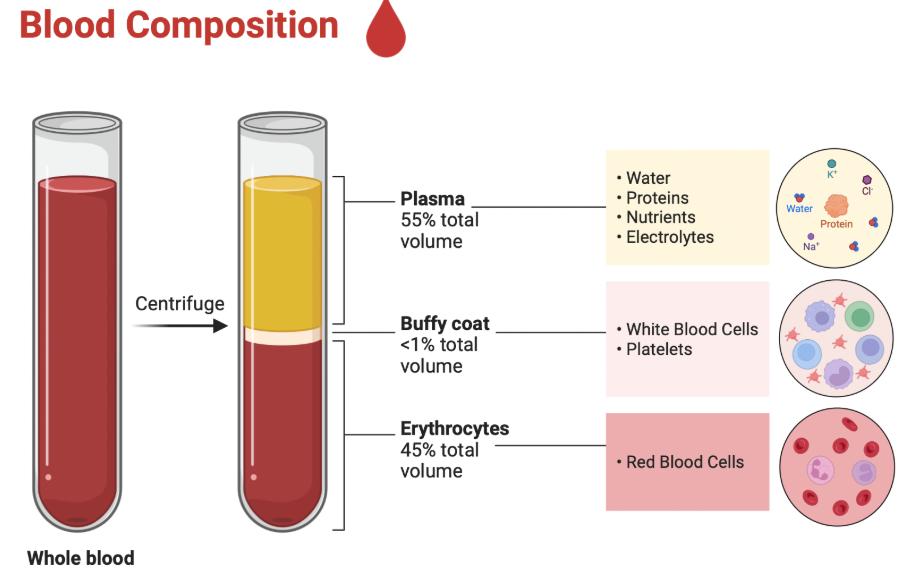
  • Drug is distributed by blood plasma


<ul><li><p>Distribution — how the drug is distributed around the body and its propensity (natural inclination) to accumulate in certain tissues and organs</p></li><li><p>Drug is distributed by blood plasma</p></li></ul><p></p>
5
New cards

Background context: Pharmacokinetics ADME

  • metabolism what it is & what organ is it usually done by


Metabolism — how the body breaks down the drug, normally done by the liver

6
New cards

Background context: Pharmacokinetics ADME

  • excretion what it is

  • what is half-life


  • Excretion — the rate and process by which a drug exits the body

  • Half-life (t½): the time it takes for a drug's active substance in your body to reduce by half


7
New cards

LO 1: what does the route of administration determine

The chosen route of administration determines how quickly the drug reaches the systemic circulation and how much of it remains active after passing through the body’s initial metabolic barriers.
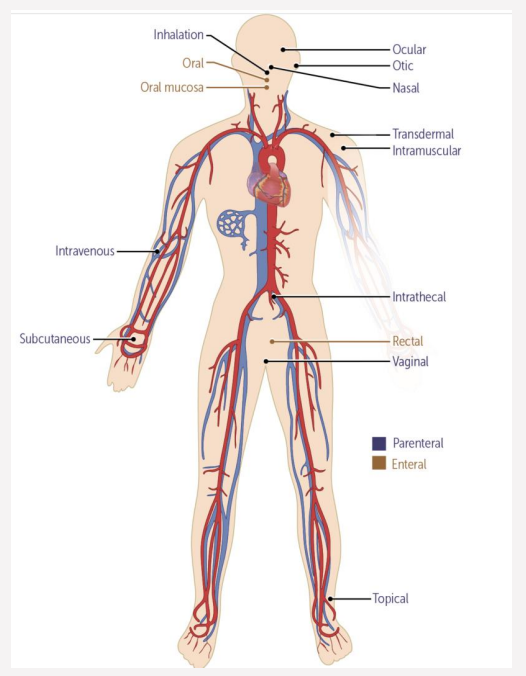
<p><span style="background-color: transparent; font-family: &quot;Times New Roman&quot;, serif;">The chosen <strong>route of administration</strong> determines how quickly the drug reaches the systemic circulation and how much of it remains active after passing through the body’s initial metabolic barriers.</span></p>
8
New cards

LO 1: absorption routes of administration

  • what is absorption

  • enteral route: 2 types & what they are, type of metabolism the drugs face


  • Absorption: the process whereby a drug enters the circulatory system

  • Enteral Routes: These involve the gastrointestinal (GI) tract.

    • Oral (PO): The most common route; drugs are swallowed and absorbed through the intestinal walls. These drugs face first-pass metabolism, where the liver may deactivate up to 90% of the drug before it reaches the bloodstream.

    • Rectal: Used when oral is not possible; it partially bypasses first-pass metabolism.


9
New cards

LO 1: absorption routes of administration

  • what is first-pass metabolism


first-pass metabolism, where the liver may deactivate up to 90% of the drug before it reaches the bloodstream.


<p><span style="background-color: transparent;"><strong>first-pass metabolism</strong>, where the liver may deactivate up to 90% of the drug before it reaches the bloodstream.</span></p><p></p>
10
New cards

LO 1: absorption routes of administration

  • parenteral: types & what they are, bioavailability


Parenteral Routes: These bypass the GI tract entirely via injection.

  • Intravenous (IV): Injected directly into the vein, resulting in 100% bioavailability (F = 1) because absorption is bypassed.

  • Intramuscular (IM) & Subcutaneous (SC): Injected into muscle or under the skin; these require absorption into local capillaries.

  • Intrathecal: Injected into the spinal space for direct CNS access.

<p><span style="background-color: transparent; font-family: &quot;Times New Roman&quot;, serif;"><strong>Parenteral Routes:</strong> These bypass the GI tract entirely via injection.</span></p><ul><li><p><span style="background-color: transparent; font-family: &quot;Times New Roman&quot;, serif;"><strong>Intravenous (IV):</strong> Injected directly into the vein, resulting in <strong>100% bioavailability (F = 1)</strong> because absorption is bypassed.</span></p></li><li><p><span style="background-color: transparent; font-family: &quot;Times New Roman&quot;, serif;"><strong>Intramuscular (IM) &amp; Subcutaneous (SC):</strong> Injected into muscle or under the skin; these require absorption into local capillaries.</span></p></li><li><p><span style="background-color: transparent; font-family: &quot;Times New Roman&quot;, serif;"><strong>Intrathecal:</strong> Injected into the spinal space for direct CNS access.</span></p></li></ul><p></p>
11
New cards

LO 1: absorption routes of administration

  • other 8 routes


Other Routes:

  • Inhalation: Rapid delivery to the lungs/bloodstream.

  • Topical/Transdermal: Applied to skin/mucosa for local or systemic (patch) effects.

  • Sublingual/Mucosal: Placed under the tongue to bypass the first-pass effect by entering the superior vena cava directly.

  • otic route is the administration of liquid medication directly into the ear canal, usually as drops

  • ocular route involves delivering medications directly into or onto the eye


<p><span style="background-color: transparent; font-family: &quot;Times New Roman&quot;, serif;"><strong>Other Routes:</strong></span></p><ul><li><p><span style="background-color: transparent; font-family: &quot;Times New Roman&quot;, serif;"><strong>Inhalation:</strong> Rapid delivery to the lungs/bloodstream.</span></p></li><li><p><span style="background-color: transparent; font-family: &quot;Times New Roman&quot;, serif;"><strong>Topical/Transdermal:</strong> Applied to skin/mucosa for local or systemic (patch) effects.</span></p></li><li><p><span style="background-color: transparent; font-family: &quot;Times New Roman&quot;, serif;"><strong>Sublingual/Mucosal:</strong> Placed under the tongue to bypass the first-pass effect by entering the superior vena cava directly.</span></p></li><li><p><strong>otic route</strong> is the administration of liquid medication directly into the ear canal, usually as drops</p></li><li><p><strong>ocular route</strong> involves delivering medications directly into or onto the eye</p></li></ul><p></p>
12
New cards

LO 1: absorption routes of administration

  • what is fractional bioavailability (F)

  • which route has the highest bioavailability


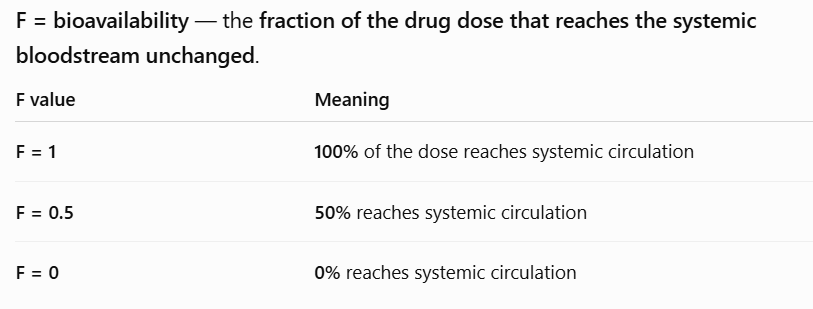
  • Fractional bioavailability (F): the amount of administered drug that enters systemic circulation

Highest bioavailability → IV

IV = F = 1 = 100% bioavailability

Why? The drug goes directly into systemic circulation, so there is no absorption step and no first-pass metabolism.

Downside: Because the entire dose enters the blood immediately, you cannot take it back. Toxicity or adverse reactions can occur rapidly. IV administration is also invasive and carries risks such as infection.


13
New cards

LO 1:

  • ___________ is the fraction of drug reaching systemic circulation; IV is always 1.0.

  • ______ primarily occurs in the liver after oral absorption via the portal vein.

  • Routes like ______ and ______ bypass the liver's initial "tax" on the drug.


  • Bioavailability (F) is the fraction of drug reaching systemic circulation; IV is always 1.0 (means 100% reaches the blood)

  • First-pass metabolism primarily occurs in the liver after oral absorption via the portal vein.

  • Routes like sublingual and IV bypass the liver's initial "tax" on the drug.


14
New cards

LO 1: first pass metabolism & oral administration

  • describe metabolism

  • what happens after absorption in the GI tract

  • liver’s drug metabolizing enzymes

  • what the first pass effect does to oral bioavailability

  • routes that bypass the first-pass effect


  • Metabolism by epithelial cells of the intestine

  • After absorption from the GI tract, the hepatic portal vein transports the drug directly to the liver

  • The liver's drug-metabolizing enzymes can reduce active drug concentration by up to 90% before it ever reaches the bloodstream

  • This first-pass effect reduces oral bioavailability to an average F of 0.7

  • Other enteral routes (oral mucosa, rectal) bypass gut absorption and avoid the full first-pass effect
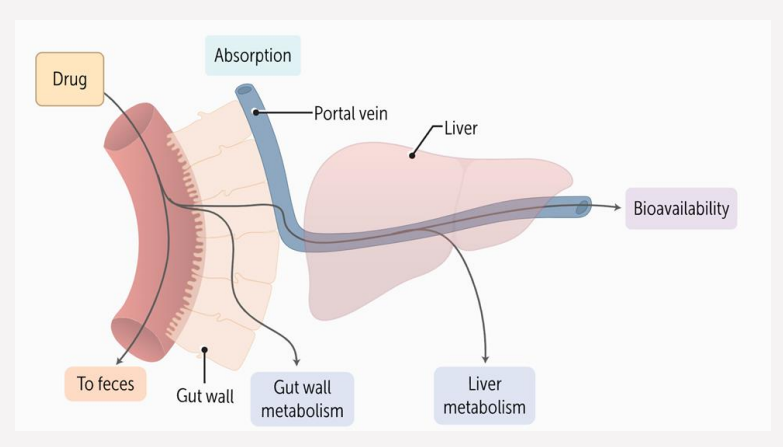

<ul><li><p>Metabolism by epithelial cells of the intestine </p></li><li><p>After absorption from the GI tract, the hepatic portal vein transports the drug directly to the liver </p></li><li><p>The liver's drug-metabolizing enzymes can reduce active drug concentration by up to 90% before it ever reaches the bloodstream </p></li><li><p>This first-pass effect reduces oral bioavailability to an average F of 0.7 </p></li><li><p>Other enteral routes (oral mucosa, rectal) bypass gut absorption and avoid the full first-pass effect</p></li></ul><p></p>
15
New cards

LO 2: hydrophilic vs hydrophobic/lipophilic

  • loves water (hydrophilic)

  • loves fat (hydrophobic/lipophilic).


16
New cards

LO 2: absorption differences

  • hydrophobic drugs: how do they cross membranes & how are they best absorbed

  • hydrophilic drugs: how do they cross membranes


Absorption Differences:

  • Hydrophobic (Lipophilic): These drugs cross lipid-rich cell membranes easily via passive diffusion. They are better absorbed in uncharged forms.

  • Hydrophilic (Water-soluble): These are "border-restricted"; they often require facilitated diffusion or active transport (using ATP) to cross membranes because they cannot dissolve through the lipid bilayer.


17
New cards

LO 2: volume of distribution Vd

  • what is VD

  • low Vd: range & what kind of molecules/drugs

  • high Vd: range & what kind of molecules/drugs

  • describe plasma in terms of hydrophilic vs hydrophobic


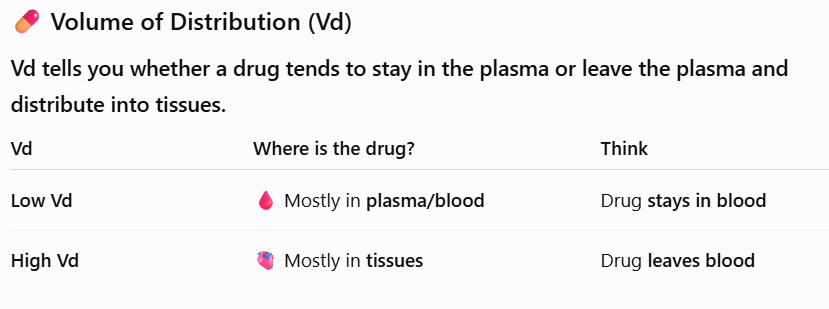
Volume of Distribution (Vd): This is a theoretical volume representing how extensively a drug spreads.

  • Low Vd (< 3-5 L): Typical for hydrophilic, large, or plasma-protein bound drugs (like Warfarin) that stay in the blood.

  • High Vd (> 46 L): Typical for hydrophobic, small drugs that leave the blood to hide in fat and deep tissues.

  • plasma is a water-based (aqueous) environment, so hydrophilic drugs tend to remain in the plasma/extracellular fluid more than lipophilic drugs do.

<p><span style="background-color: transparent; font-family: &quot;Times New Roman&quot;, serif;"><strong>Volume of Distribution (Vd):</strong> This is a theoretical volume representing how extensively a drug spreads.</span></p><ul><li><p><span style="background-color: transparent; font-family: &quot;Times New Roman&quot;, serif;"><strong>Low Vd (&lt; 3-5 L):</strong> Typical for <strong>hydrophilic</strong>, large, or <strong>plasma-protein bound</strong> drugs (like Warfarin) that stay in the blood.</span></p></li><li><p><span style="background-color: transparent; font-family: &quot;Times New Roman&quot;, serif;"><strong>High Vd (&gt; 46 L):</strong> Typical for <strong>hydrophobic</strong>, small drugs that leave the blood to hide in fat and deep tissues.</span></p></li><li><p>plasma is a water-based (aqueous) environment, so hydrophilic drugs tend to remain in the plasma/extracellular fluid more than lipophilic drugs do.</p></li></ul><p></p>
18
New cards

LO 2: volume of distribution

  • formula

  • what it accounts for

  • theoretical volume needed for what

  • what is it used to calculate


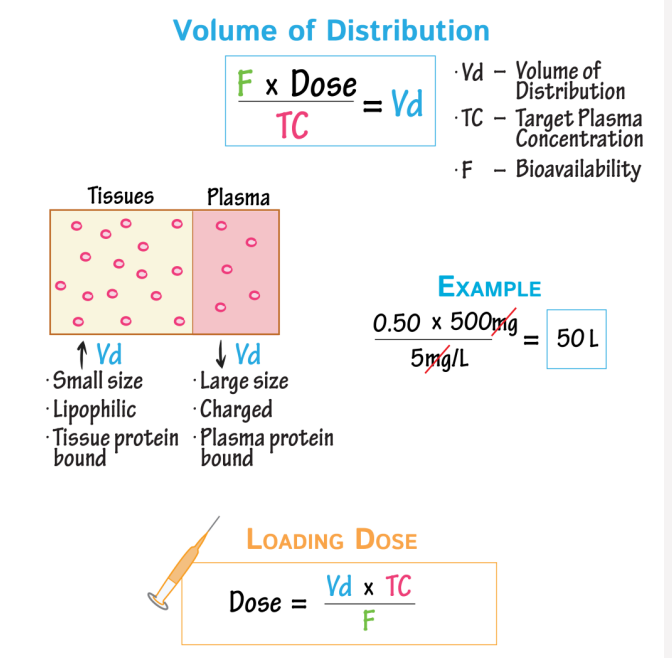
  • Vd = dose administered (mass) ÷ Cmax (mass per volume)

  • A rough accounting of where a drug goes in the body

  • The theoretical volume that would be needed to contain all the drug in the body at the same concentration as the plasma

  • Used to calculate the dose needed to achieve a desired plasma concentration

<ul><li><p>Vd = dose administered (mass) ÷ Cmax (mass per volume) </p></li><li><p>A rough accounting of where a drug goes in the body</p></li><li><p>The theoretical volume that would be needed to contain all the drug in the body at the same concentration as the plasma</p></li><li><p>Used to calculate the dose needed to achieve a desired plasma concentration</p></li></ul><p></p>
19
New cards

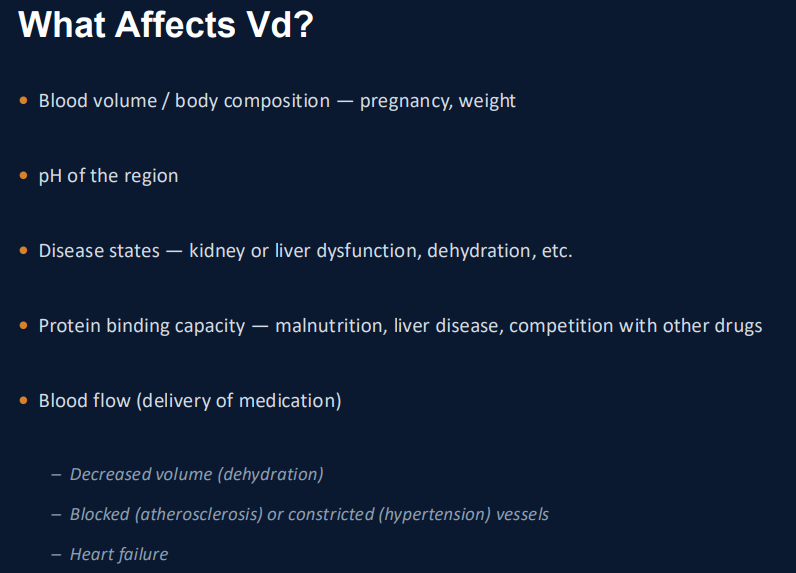
LO 2: what factors affect VD


<p></p>
20
New cards

LO 2: factors that affect Vd

  • describe plasma protein binding (albumin)


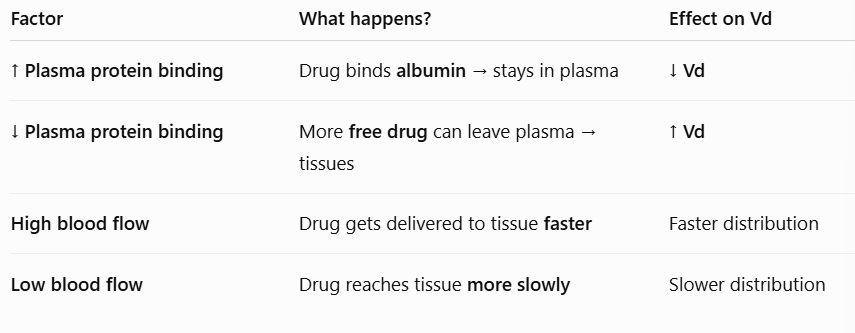
  • Plasma Protein Binding: Drugs bound to albumin cannot leave the blood; only "free" drug is active.

  • Blood Flow: Highly perfused organs (brain, heart) receive drugs faster than "slow" tissues like fat.

<ul><li><p><span style="background-color: transparent; font-family: &quot;Times New Roman&quot;, serif;"><strong>Plasma Protein Binding:</strong> Drugs bound to <strong>albumin</strong> cannot leave the blood; only "free" drug is active.</span></p></li><li><p><span style="background-color: transparent; font-family: &quot;Times New Roman&quot;, serif;"><strong>Blood Flow:</strong> Highly perfused organs (brain, heart) receive drugs faster than "slow" tissues like fat.</span></p></li></ul><p></p>
21
New cards

LO 2: describe blood flow effect on drug distribution


Blood Flow: Highly perfused organs (brain, heart) receive drugs faster than "slow" tissues like fat.

<p><span style="background-color: transparent; font-family: &quot;Times New Roman&quot;, serif;"><strong>Blood Flow:</strong> Highly perfused organs (brain, heart) receive drugs faster than "slow" tissues like fat.</span></p>
22
New cards

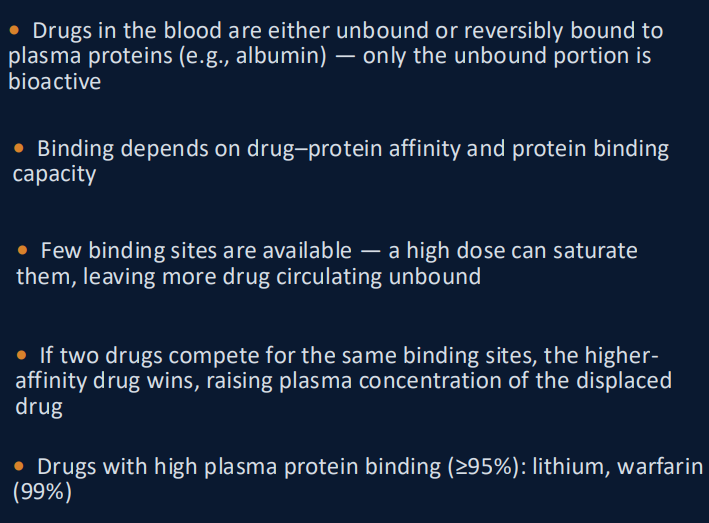
LO 2: bioavailability → plasma protein binding

  • what state can drugs in the blood be in

  • what does binding depend on

  • what occurs when a few binding sites are available on plasma proteins

  • what occurs when two drugs compete for the same binding sites

  • examples of drugs with high plasma protein binding

knowt flashcard image
23
New cards

LO 2: describe membrane crossing & Vd levels in hydrophilic vs hydrophobic drugs

knowt flashcard image
24
New cards

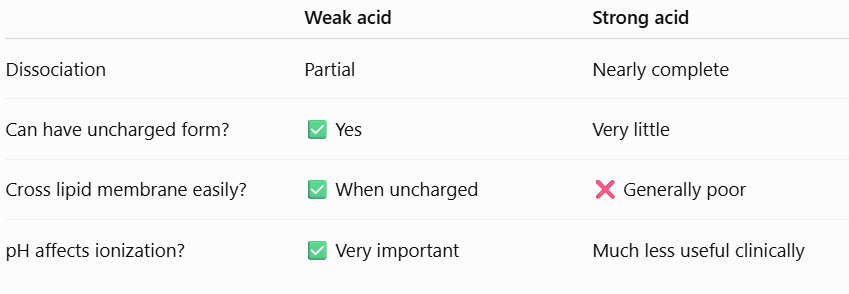
LO 2: describe acidic environment effect on absorption of weak acids

  • what are weak acids vs strong acids

  • acidic environment effect on weak acids


  • A weak acid only partially dissociates, so it can exist in both uncharged (HA) and charged (A⁻) forms. In an acidic environment, a weak acid stays more uncharged, allowing it to cross lipid membranes more easily.

  • A strong acid almost completely dissociates into H⁺ and A⁻, so it exists mostly in the charged form and does not readily cross lipid membranes by passive diffusion.

<ul><li><p>A <strong>weak acid</strong> only partially dissociates, so it can exist in both <strong>uncharged (HA)</strong> and <strong>charged (A⁻)</strong> forms. In an acidic environment, a weak acid stays more <strong>uncharged</strong>, allowing it to cross lipid membranes more easily.</p></li></ul><ul><li><p>A <strong>strong acid</strong> almost completely dissociates into <strong>H⁺ and A⁻</strong>, so it exists mostly in the <strong>charged form</strong> and does not readily cross lipid membranes by passive diffusion.</p></li></ul><p></p>
25
New cards

LO 2:

Lipophilic drugs cross membranes easily and have a _____Vd, while hydrophilic drugs stay mainly in the plasma with a _____ Vd.

Lipophilic drugs cross membranes easily and have a high Vd, while hydrophilic drugs stay mainly in the plasma with a low Vd.

26
New cards

LO 3: metabolism

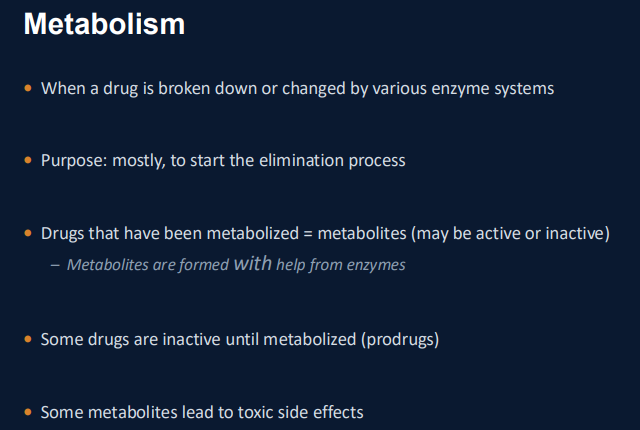
  • what is metabolism

  • purpose

  • substance formed when drug is metabolized

  • what are prodrugs

  • what do some metabolites lead to


knowt flashcard image
27
New cards

LO 3: what is elimination

Elimination refers to the body's process of removing substances (like waste, toxins, or medications) from the system

28
New cards

LO 3: drug metabolism (biotransformation)

  • where does it occur & why


Metabolism (Biotransformation): Primarily happens in the liver to make drugs more polar (water-soluble) for excretion.

29
New cards

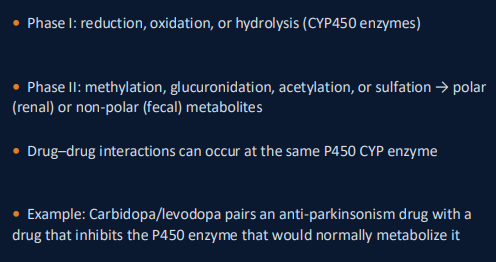
LO 3: drug metabolism

  • phase 1

  • phase 2

  • enzymes involved

  • where can drug-drug interaction occur


  • Phase I: Uses CYP450 enzymes for oxidation, reduction, or hydrolysis. Think of this as "exposing" a functional group. Prepares drug for further metabolism.

  • Phase II: Conjugation reactions (e.g., glucuronidation, acetylation) that "attach" a large polar molecule to the drug. Usually makes drug more water-soluble.

shout out Dr. Dyer
<ul><li><p><span style="background-color: transparent; font-family: &quot;Times New Roman&quot;, serif;"><strong>Phase I:</strong> Uses <strong>CYP450 enzymes</strong> for oxidation, reduction, or hydrolysis. Think of this as "exposing" a functional group. </span>Prepares drug for further metabolism.</p></li><li><p><span style="background-color: transparent; font-family: &quot;Times New Roman&quot;, serif;"><strong>Phase II:</strong> <strong>Conjugation</strong> reactions (e.g., glucuronidation, acetylation) that "attach" a large polar molecule to the drug. </span>Usually makes drug <strong>more water-soluble. </strong></p></li></ul><p>shout out Dr. Dyer </p>
30
New cards

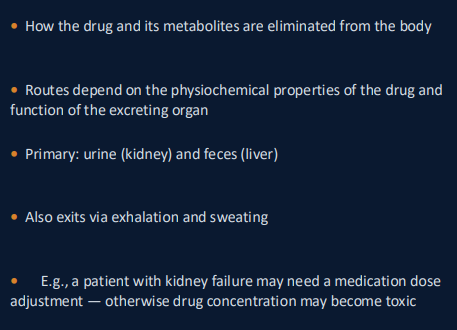
LO 3: excretion

  • what it is

  • what does the route depend

  • primary routes

  • other routes


  • Excretion: The final exit.

    • Renal (Kidneys): Most polar metabolites leave via urine.

    • Biliary/Fecal: Some drugs are excreted into bile and leave via feces.

<ul><li><p><span style="background-color: transparent; font-family: &quot;Times New Roman&quot;, serif;"><strong>Excretion:</strong> The final exit.</span></p><ul><li><p><span style="background-color: transparent; font-family: &quot;Times New Roman&quot;, serif;"><strong>Renal (Kidneys):</strong> Most polar metabolites leave via <strong>urine</strong>.</span></p></li><li><p><span style="background-color: transparent; font-family: &quot;Times New Roman&quot;, serif;"><strong>Biliary/Fecal:</strong> Some drugs are excreted into bile and leave via <strong>feces</strong>.</span></p></li></ul></li></ul><p></p>
31
New cards

LO 3: what is half-life & what is used to estimate how long it takes to remove a drug from the body

  • The amount of time it takes for the blood concentration of a drug to decline to half of its initial value

  • Example: diphenhydramine t½ = 2-13 hours (average 9 hours)

  • Five half-lives is used to estimate how long it takes to remove a drug from the body completely

  • So, it would take about ~10-45 hours to completely remove diphenhydramine (average 45 hrs)


<ul><li><p>The amount of time it takes for the blood concentration of a drug to decline to half of its initial value </p></li><li><p>Example: diphenhydramine t½ = 2-13 hours (average 9 hours) </p></li><li><p>Five half-lives is used to estimate how long it takes to remove a drug from the body completely </p></li><li><p>So, it would take about ~10-45 hours to completely remove diphenhydramine (average 45 hrs)</p></li></ul><p></p>
32
New cards

LO 3: elimination kinetics

  • first order: rate equation, dependence on drug concentration, amount eliminated, example

  • zero order: rate equation, dependence on drug concentration, amount eliminated, example


[A] is concentration of the drug

<p>[A] is concentration of the drug </p>
33
New cards

LO 3: elimination kinetics

  • first-order: describe

  • zero-order: describe


  • First-Order (Most drugs): A constant fraction (e.g., 50%) is removed per unit of time. The half-life (t½) is constant.

  • Zero-Order (Alcohol, Aspirin): A constant amount (e.g., 10mg) is removed per unit of time. The enzymes are saturated, so increasing the dose can lead to rapid toxicity.

It's always 10 mg, regardless of how much drug is present.

Why? The enzymes are essentially working at maximum capacity.

Think of a checkout line with every cashier busy:

More drug arrives → enzymes can't work any faster → drug starts accumulating → toxicity risk increases.


<ul><li><p><span style="background-color: transparent; font-family: &quot;Times New Roman&quot;, serif;"><strong>First-Order (Most drugs):</strong> A constant <strong>fraction</strong> (e.g., 50%) is removed per unit of time. The <strong>half-life (t½)</strong> is constant.</span></p></li><li><p><span style="background-color: transparent; font-family: &quot;Times New Roman&quot;, serif;"><strong>Zero-Order (Alcohol, Aspirin):</strong> A constant <strong>amount</strong> (e.g., 10mg) is removed per unit of time. The enzymes are saturated, so increasing the dose can lead to rapid toxicity.</span></p></li></ul><p>It's always <strong>10 mg</strong>, regardless of how much drug is present.</p><p>Why? The enzymes are essentially working at <strong>maximum capacity</strong>.</p><p>Think of a checkout line with every cashier busy:</p><p class=""><strong>More drug arrives → enzymes can't work any faster → drug starts accumulating → toxicity risk increases.</strong></p><p></p>
34
New cards

LO 3: what is steady state & when is it reached

  • Steady state is when the rate you're giving the drug equals the rate the body is eliminating it.

  • Steady state is usually reached after 4-5 half-lives


35
New cards

LO 4: describe in simple terms

  • potency

  • efficacy

  • therapeutic index


In pharmacodynamics:

  • "How strong is the drug?" (potency)

  • "How much can it actually do?" (efficacy).

  • We then check the Therapeutic Index to see if that dose will kill the patient.


36
New cards

LO 4: what is efficacy & what is greater efficacy on a graph

  • Efficacy: maximum possible effect

  • Efficacy (Emax): The maximal effect a drug can produce. On a graph, this is the height of the curve. A drug with higher efficacy is more "powerful" at its ceiling.
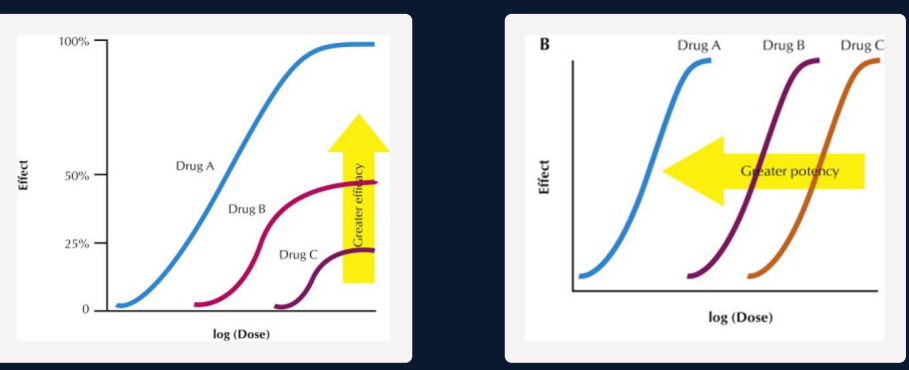

<ul><li><p>Efficacy: maximum possible effect</p></li></ul><ul><li><p><span style="background-color: transparent; font-family: &quot;Times New Roman&quot;, serif;"><strong>Efficacy (Emax):</strong> The <strong>maximal effect</strong> a drug can produce. On a graph, this is the <strong>height</strong> of the curve. A drug with higher efficacy is more "powerful" at its ceiling.</span></p></li></ul><p></p>
37
New cards

LO 4: what is potency & what is greater potency on a graph

  • Potency: amount of drug needed to produce an effect

  • Potency (EC50 or ED50): The amount of drug needed to produce 50% of the maximal effect. On a graph, this is the left-to-right position. The further to the left a curve is, the more potent the drug (it takes less dose to work).

  • EC₅₀: The drug concentration that produces 50% of its maximum effect; a lower EC₅₀ means higher potency.

  • ED₅₀: The drug dose that produces the desired therapeutic effect in 50% of a population.


<ul><li><p>Potency: amount of drug needed to produce an effect</p></li><li><p><span style="background-color: transparent; font-family: &quot;Times New Roman&quot;, serif;"><strong>Potency (EC50 or ED50):</strong> The <strong>amount of drug</strong> needed to produce <strong>50% of the maximal effect</strong>. On a graph, this is the <strong>left-to-right position</strong>. The further to the <strong>left</strong> a curve is, the <strong>more potent</strong> the drug (it takes less dose to work).</span></p></li><li><p><strong>EC₅₀:</strong> The drug concentration that produces <strong>50% of its maximum effect</strong>; a lower EC₅₀ means <strong>higher potency</strong>.</p></li><li><p><strong>ED₅₀:</strong> The drug dose that produces the desired therapeutic effect in <strong>50% of a population</strong>.</p></li></ul><p></p>
38
New cards

LO 3:

  • therapeutic window: what it is & formula

  • therapeutic index: what it is & formula

  • large vs narrow TI

  • TI<2


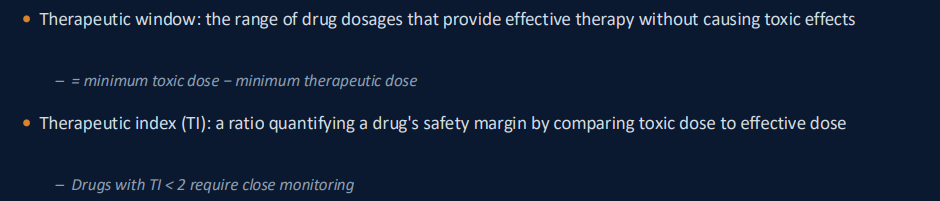
Therapeutic Index (TI): A ratio of safety: TI = TD50 / ED50.

  • Large TI: Wide safety margin (e.g., Penicillin).

  • Small/Narrow TI: Dangerous; requires close blood monitoring (e.g., Warfarin, Lithium, Digoxin).

  • TI < 2 is considered very narrow and risky.

  • ED₅₀ = dose that is effective in 50% of people (median effective dose)

  • TD₅₀ = dose that is toxic in 50% of people (median toxic dose)

<p><span style="background-color: transparent; font-family: &quot;Times New Roman&quot;, serif;"><strong>Therapeutic Index (TI):</strong> A ratio of safety: <strong>TI = TD50 / ED50</strong>.</span></p><ul><li><p><span style="background-color: transparent; font-family: &quot;Times New Roman&quot;, serif;"><strong>Large TI:</strong> Wide safety margin (e.g., <strong>Penicillin</strong>).</span></p></li><li><p><span style="background-color: transparent; font-family: &quot;Times New Roman&quot;, serif;"><strong>Small/Narrow TI:</strong> Dangerous; requires close blood monitoring (e.g., <strong>Warfarin, Lithium, Digoxin</strong>).</span></p></li><li><p><span style="background-color: transparent; font-family: &quot;Times New Roman&quot;, serif;"><strong>TI &lt; 2</strong> is considered very narrow and risky.</span></p></li><li><p><strong>ED₅₀</strong> = dose that is <strong>effective</strong> in 50% of people (median effective dose)</p></li><li><p><strong>TD₅₀</strong> = dose that is <strong>toxic</strong> in 50% of people (median toxic dose)</p></li></ul><p></p>
39
New cards

Dose Response Curves

  • Emax: what it is

  • what does it mean for a drug to have a higher Emax

  • Potency: what it is

  • what does it mean for a drug to be more potent


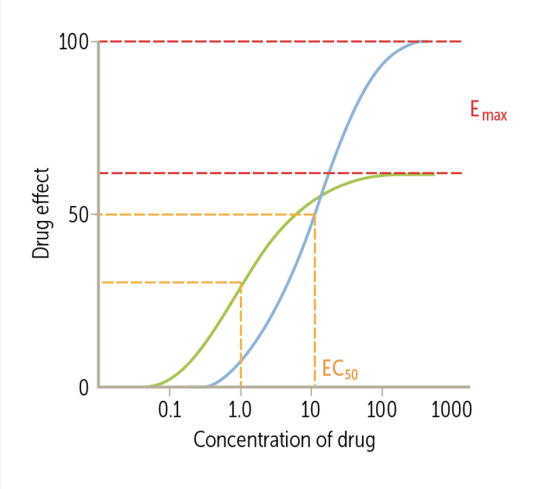
  • Emax: the maximum effect of the drug — efficacy is a measure of the maximal response a drug can produce

  • A drug with a higher Emax is more effective at its ceiling

  • Potency: the concentration at which a drug produces its half-maximal effect (EC50, or 50% of Emax)

  • A more potent drug achieves its EC50 at a lower concentration — less drug is required for it to act

<ul><li><p>Emax: the maximum effect of the drug — efficacy is a measure of the maximal response a drug can produce</p></li><li><p>A drug with a higher Emax is more effective at its ceiling</p></li><li><p>Potency: the concentration at which a drug produces its half-maximal effect (EC50, or 50% of Emax) </p></li><li><p>A more potent drug achieves its EC50 at a lower concentration — less drug is required for it to act</p></li></ul><p></p>
40
New cards

Lo 4:

  • what do drug act on to work

  • what are agonists

  • what are antagonists


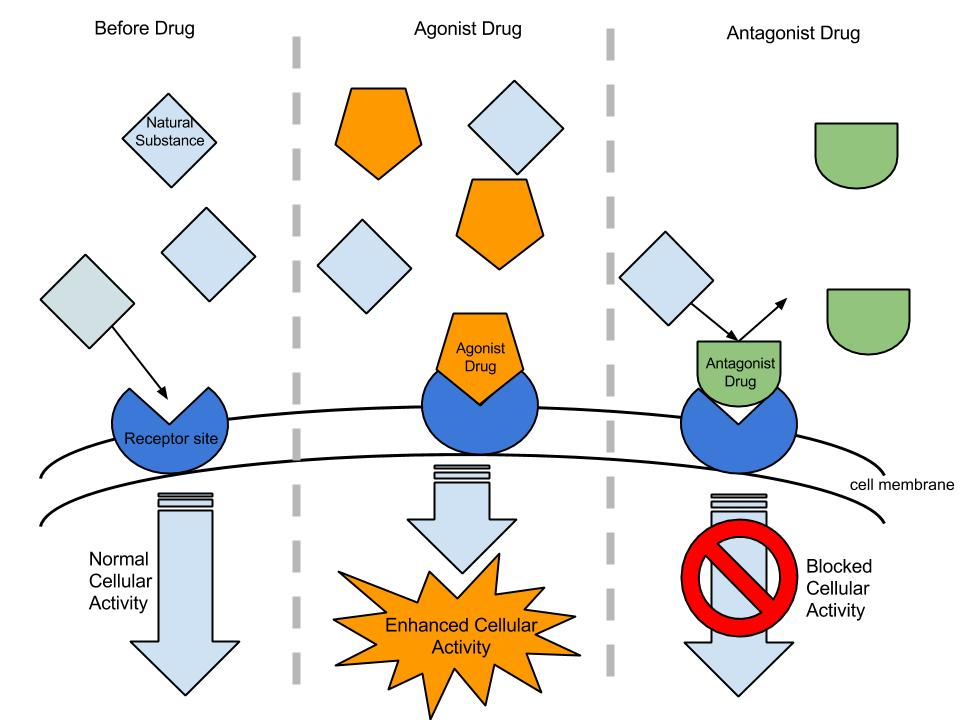
  • Drugs work by acting on receptors.

  • An agonist is a chemical or drug that binds to a cell receptor and activates it to produce a biological response.

  • An antagonist binds to the same receptor but blocks or dampens the response, preventing other molecules or natural signals from activating it

<ul><li><p><span style="background-color: transparent; font-family: &quot;Times New Roman&quot;, serif;">Drugs work by acting on <strong>receptors</strong>.</span></p></li><li><p><span>An </span><strong>agonist</strong> is a chemical or drug that binds to a cell receptor and <strong>activates</strong> it to produce a biological response. </p></li><li><p>An <strong>antagonist</strong> binds to the same receptor but <strong>blocks</strong> or dampens the response, preventing other molecules or natural signals from activating it</p></li></ul><p></p>
41
New cards

LO 4: agonists

  • primary agonist

  • full agonist

  • partial agonist

  • inverse agonist

  • allosteric agonist


  • Primary agonist: binds the same site as the endogenous agonist.

  • Full agonist: activates signaling to maximum capability. Produces 100% of the possible response (Emax).

  • Partial agonist: only partly as effective as a full agonist. Only produces a sub-maximal response, even at 100% receptor occupancy. It can act as an antagonist if it competes with a full agonist.

  • Inverse agonist: stabilizes constitutively active receptors in an inactive conformation — receptor activity drops below baseline levels

  • Allosteric agonist: binds a distinct, non-overlapping site from the endogenous agonist

→ allosteric agonist binds to a different site on the receptor than where the body's natural (endogenous) agonist binds and activates the receptor
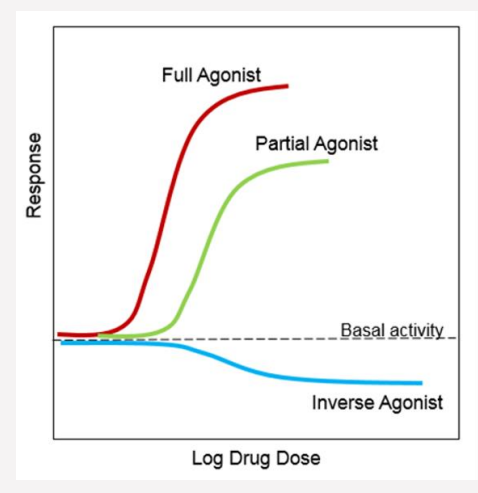
<ul><li><p>Primary agonist: binds the same site as the endogenous agonist.</p></li><li><p>Full agonist: activates signaling to maximum capability. <span style="background-color: transparent; font-family: &quot;Times New Roman&quot;, serif;">Produces 100% of the possible response (Emax).</span></p></li><li><p>Partial agonist: only partly as effective as a full agonist. <span style="background-color: transparent; font-family: &quot;Times New Roman&quot;, serif;">Only produces a sub-maximal response, even at 100% receptor occupancy. It can act as an antagonist if it competes with a full agonist.</span></p></li><li><p>Inverse agonist: stabilizes constitutively active receptors in an inactive conformation — receptor activity drops below baseline levels</p></li><li><p>Allosteric agonist: binds a distinct, non-overlapping site from the endogenous agonist</p></li></ul><p><strong>→ allosteric agonist</strong> binds to a <strong>different site on the receptor</strong> than where the body's natural (endogenous) agonist binds and <strong>activates the receptor</strong></p>
42
New cards

LO 4: antagonists

  • what it is

  • competitive antagonist: can it be overcome, agonist potency & Emax

  • noncompetitive antagonist: can it be overcome, Emax


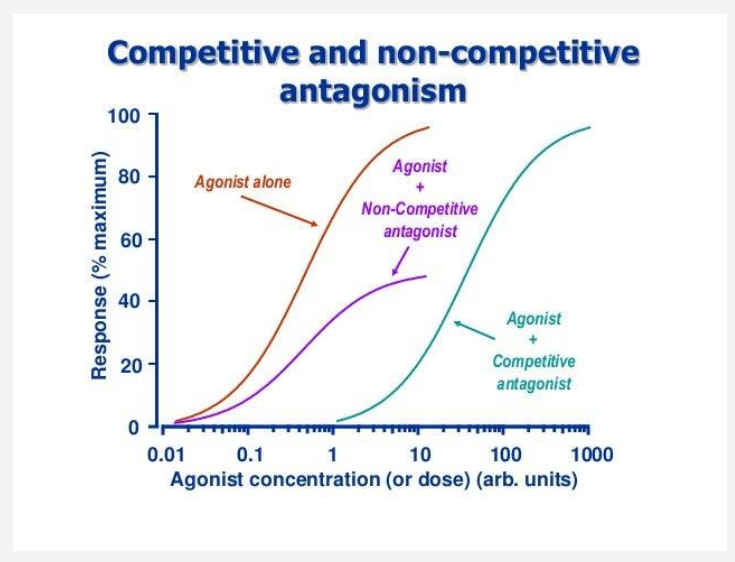
  • Antagonist: a drug that binds a receptor without activating signaling, and interferes with agonist activation

  • Competitive antagonist (most common): competes for the same binding site as the agonist — binding is mutually exclusive

→ Increasing agonist concentration can overcome it

→ Reduces agonist potency, but not maximum efficacy

  • Noncompetitive antagonist: binds an allosteric site, blocking agonist action without affecting agonist binding

→ Reduces potency; max efficacy is unchanged if enough agonist is given


Noncompetitive antagonist binds/blocks receptor function → agonist can't fully activate signaling → adding more agonist cannot overcome it → ↓ maximum efficacy (Emax).

Compare that with competitive antagonism: they're fighting for the same seat, so adding enough agonist can win the competition.
<ul><li><p>Antagonist: a drug that binds a receptor without activating signaling, and interferes with agonist activation</p></li><li><p>Competitive antagonist (most common): competes for the same binding site as the agonist — binding is mutually exclusive </p></li></ul><p>→ Increasing agonist concentration can overcome it </p><p>→ Reduces agonist potency, but not maximum efficacy</p><ul><li><p>Noncompetitive antagonist: binds an allosteric site, blocking agonist action without affecting agonist binding</p></li></ul><p>→ Reduces potency; max efficacy is unchanged if enough agonist is given</p><p></p><p><strong>Noncompetitive antagonist binds/blocks receptor function → agonist can't fully activate signaling → adding more agonist cannot overcome it → ↓ maximum efficacy (Emax).</strong></p><p>Compare that with <strong>competitive antagonism</strong>: they're fighting for the <strong>same seat</strong>, so adding enough agonist can win the competition.</p>
43
New cards

LO 4:

  • Competitive antagonists change________ (_______).

  • Noncompetitive antagonists change _______ (______).


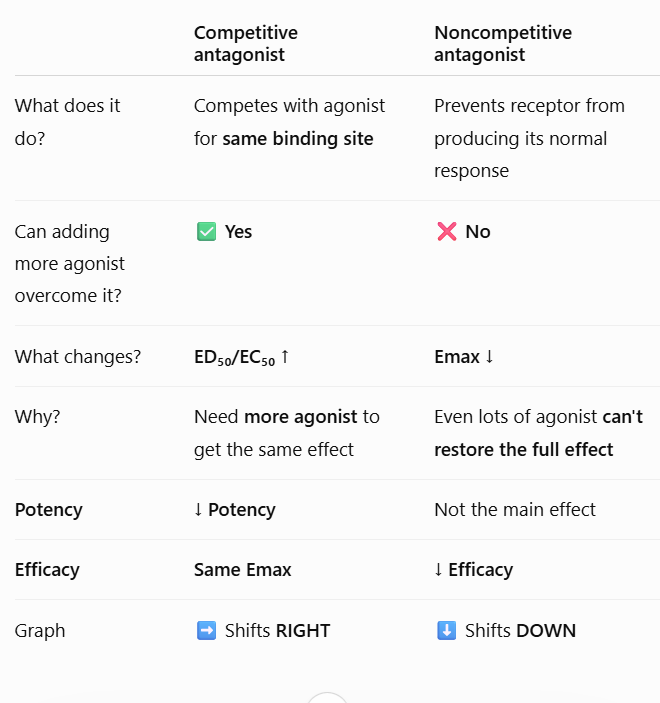
  • Competitive antagonists change ED50 (potency).

  • Noncompetitive antagonists change Emax (efficacy).

<ul><li><p><span style="background-color: transparent; font-family: &quot;Times New Roman&quot;, serif;"><strong>Competitive</strong> antagonists change <strong>ED50</strong> (potency).</span></p></li><li><p><span style="background-color: transparent; font-family: &quot;Times New Roman&quot;, serif;"><strong>Noncompetitive</strong> antagonists change <strong>Emax</strong> (efficacy).</span></p></li></ul><p></p>
44
New cards

LO 5: lidocaine

  • what is it

  • what is infiltration anesthesia

  • what is nerve block/field block anesthesia

  • what is spinal (intrathecal) anesthesia

  • what is the lidocaine Vd=50 what does this mean


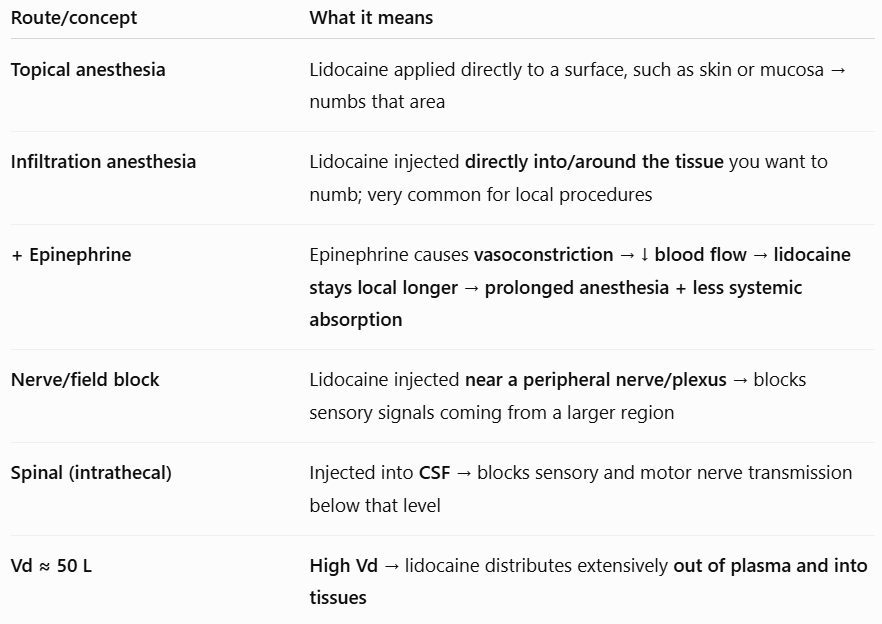
  • Topical anesthesia

  • Infiltration anesthesia — the most common route for local anesthetics – Epinephrine can be added to decrease dose and prolong duration of action

  • Nerve block / field block anesthesia — blocks conductivity of sensory nerves from an area; injected into or adjacent to a peripheral nerve or plexus

  • Spinal (intrathecal) anesthesia — blocks somatosensory and motor fibers, e.g., for lower-limb or pelvic surgery

  • Volume of distribution: ~50 L


<ul><li><p>Topical anesthesia </p></li><li><p>Infiltration anesthesia — the most common route for local anesthetics – Epinephrine can be added to decrease dose and prolong duration of action </p></li><li><p>Nerve block / field block anesthesia — blocks conductivity of sensory nerves from an area; injected into or adjacent to a peripheral nerve or plexus </p></li><li><p>Spinal (intrathecal) anesthesia — blocks somatosensory and motor fibers, e.g., for lower-limb or pelvic surgery </p></li><li><p>Volume of distribution: ~50 L</p></li></ul><p></p>
45
New cards

LO 4: lidocaine

  • volume of distribution: what occurs & which organs show higher concentrations

  • metabolism

  • elimination


  • Absorption: Can be topical, infiltration (injection), or nerve blocks. Epinephrine is often added to cause vasoconstriction, which keeps lidocaine at the site longer and reduces systemic toxicity.

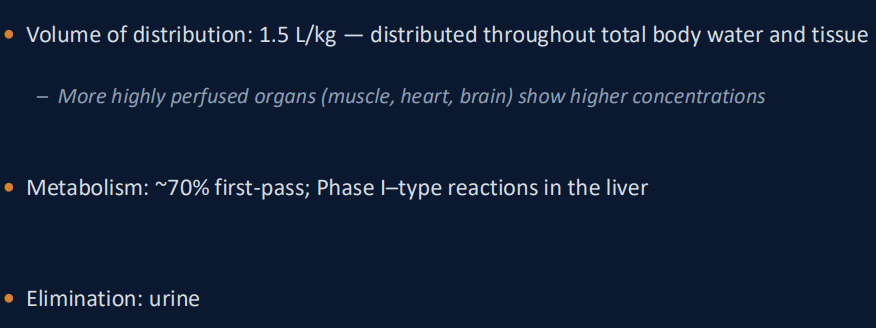
  • Distribution: Vd is ~1.5 L/kg (~50 L total), meaning it spreads through total body water.

  • Metabolism: 70% first-pass in the liver (Phase I) 30% reaches systemic circulation unchanged from first pass

first-pass metabolism mainly matters when a drug is absorbed from the GI tract and travels through the portal vein to the liver. Lidocaine used by injection, nerve block, or topically does not undergo that same initial GI → portal vein first pass.

  • Excretion: Via the kidneys (urine).


<ul><li><p><span style="background-color: transparent; font-family: &quot;Times New Roman&quot;, serif;"><strong>Absorption:</strong> Can be topical, infiltration (injection), or nerve blocks. Epinephrine is often added to cause <strong>vasoconstriction</strong>, which keeps lidocaine at the site longer and reduces systemic toxicity.</span></p></li><li><p><span style="background-color: transparent; font-family: &quot;Times New Roman&quot;, serif;"><strong>Distribution:</strong> Vd is ~1.5 L/kg (~50 L total), meaning it spreads through total body water.</span></p></li><li><p><span style="background-color: transparent; font-family: &quot;Times New Roman&quot;, serif;"><strong>Metabolism:</strong> 70% <strong>first-pass</strong> in the liver (Phase I) 30% reaches systemic circulation unchanged from first pass</span></p></li></ul><p>→ <strong>first-pass metabolism </strong>mainly matters when a drug is absorbed from the GI tract and travels through the portal vein to the liver. Lidocaine used by injection, nerve block, or topically does not undergo that same initial GI → portal vein first pass.</p><ul><li><p><span style="background-color: transparent; font-family: &quot;Times New Roman&quot;, serif;"><strong>Excretion:</strong> Via the <strong>kidneys (urine)</strong>.</span></p></li></ul><p></p>
46
New cards

LO 4: lidocaine mechanism of action

  • Mechanism of Action (MOA):

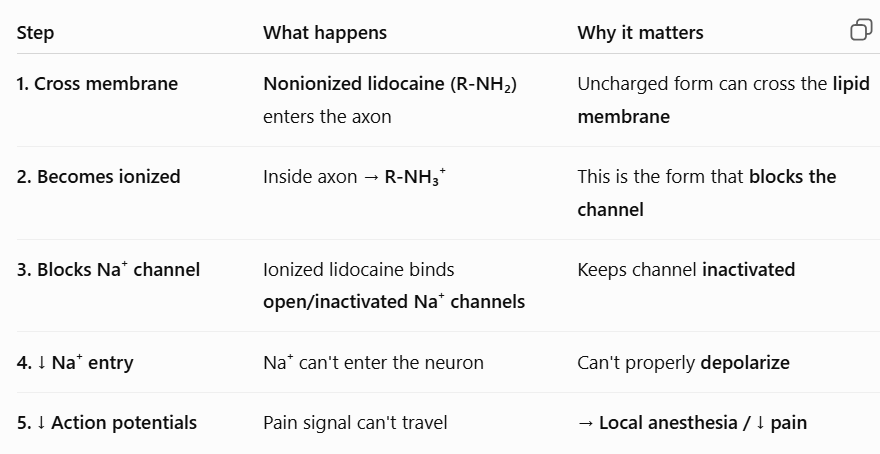
    • The non-ionized form of lidocaine crosses the axonal membrane ((R-NH2)

    • Inside the cell, it becomes ionized (R-NH3+)

    • This ionized form binds to voltage-gated Sodium (Na+) channels in the open state on the inside & inactivates it

    • It stabilizes the channel in the inactivated state, preventing Na+ entry and stopping the action potential (pain signal) from firing.

<ul><li><p><span style="background-color: transparent; font-family: &quot;Times New Roman&quot;, serif;"><strong>Mechanism of Action (MOA):</strong></span></p><ul><li><p><span style="background-color: transparent; font-family: &quot;Times New Roman&quot;, serif;">The <strong>non-ionized</strong> form of lidocaine crosses the axonal membrane (</span>(R-NH2)</p></li><li><p><span style="background-color: transparent; font-family: &quot;Times New Roman&quot;, serif;">Inside the cell, it becomes <strong>ionized</strong> </span>(R-NH3+)</p></li><li><p><span style="background-color: transparent; font-family: &quot;Times New Roman&quot;, serif;">This ionized form binds to <strong>voltage-gated Sodium (Na+) channels in the open state</strong> on the inside &amp; inactivates it </span></p></li><li><p><span style="background-color: transparent; font-family: &quot;Times New Roman&quot;, serif;">It stabilizes the channel in the <strong>inactivated state</strong>, preventing Na+ entry and stopping the action potential (pain signal) from firing.</span></p></li></ul></li></ul><p></p>
47
New cards

LO 4: what does lidocaine’s degree of block depend on (4 components)

  • Concentration of local anesthetic

  • Open state of the Na+ channel — a higher firing rate gives lidocaine more access to its binding site within the pore, prolonging inactivation

  • Myelinated neurons are harder to block (myelin impedes drug entry)

  • larger diameter nerves are harder to block than smaller ones
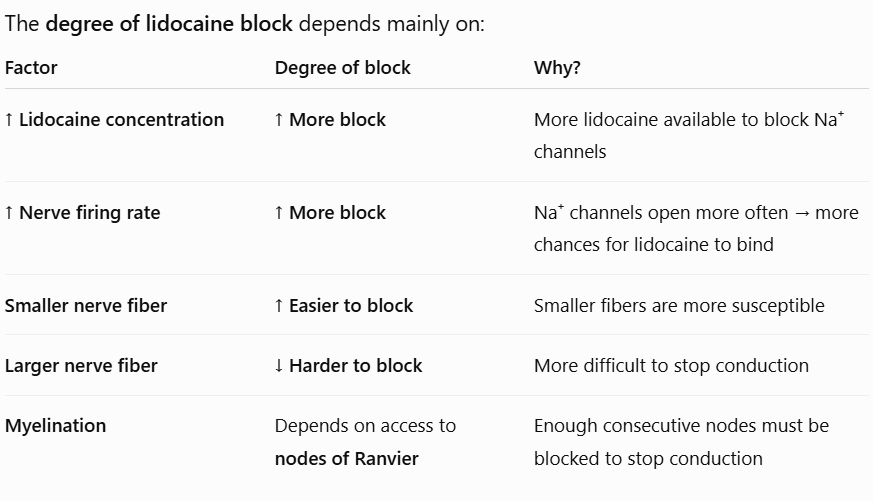

<ul><li><p>Concentration of local anesthetic</p></li><li><p>Open state of the Na+ channel — a higher firing rate gives lidocaine more access to its binding site within the pore, prolonging inactivation</p></li><li><p>Myelinated neurons are harder to block (myelin impedes drug entry)</p></li><li><p>larger diameter nerves are harder to block than smaller ones</p></li></ul><p></p>
48
New cards

LO 4: which phase of the action potential does lidocaine act on & why

Depolarization (Phase 0).

  • During Phase 0, voltage-gated Na⁺ channels open, allowing Na⁺ to rush into the neuron.

  • Lidocaine preferentially binds to open/inactivated Na⁺ channels, stabilizes the inactivated state, and prevents further Na⁺ entry and action potential propagation.


49
New cards

LO 4: lidocaine adverse effects

  • when do side effects occur

  • CNS toxicity: what occurs

  • unintentional intravascular injection: what occurs

  • if epinephrine is co-administered what occurs


  • Side effects occur more commonly near or above the toxic dose, or with accidental intravascular injection

  • CNS toxicity: numbness/tingling around the lips and tongue, tinnitus, blurred vision, agitation, disorientation

  • Unintentional intravascular injection: toxicity can occur suddenly, even at low doses, if injected directly into an artery or vein

  • If epinephrine is co-administered, the patient will also experience tachycardia and hypertension


50
New cards

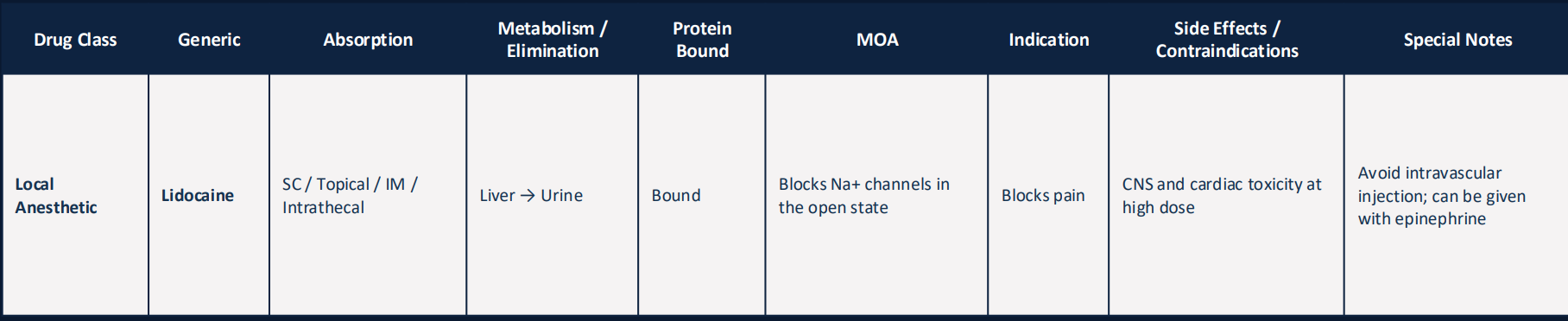
LO 4: lidocaine

  • drug class

  • generic

  • absorption

  • metabolism/elimination

  • protein bound state

  • MOA

  • indication

  • side effects/contraindications

  • special notes


Lidocaine in blood

What it means

Protein-bound lidocaine 🔒

Attached to plasma protein → not immediately available to enter tissues or act

Free lidocaine 🔓

Not attached → can leave blood, enter tissues, and exert effects

lidocaine has an affinity for certain plasma proteins
<table style="min-width: 50px;"><colgroup><col style="min-width: 25px;"><col style="min-width: 25px;"></colgroup><tbody><tr><th colspan="1" rowspan="1"><p>Lidocaine in blood</p></th><th colspan="1" rowspan="1"><p>What it means</p></th></tr><tr><td colspan="1" rowspan="1"><p><strong>Protein-bound lidocaine</strong> <span data-name="lock" data-type="emoji">🔒</span></p></td><td colspan="1" rowspan="1"><p>Attached to plasma protein → not immediately available to enter tissues or act</p></td></tr><tr><td colspan="1" rowspan="1"><p><strong>Free lidocaine</strong> <span data-name="unlock" data-type="emoji">🔓</span></p></td><td colspan="1" rowspan="1"><p>Not attached → can leave blood, enter tissues, and exert effects</p></td></tr></tbody></table><p>lidocaine has an affinity for certain plasma proteins </p>