Carl Rogers; Humanistic Theory
 Call Kai
 Learn
Learn Practice Test
 Spaced Repetition
 Match
Match Flashcards
 Knowt Play
1/30

Earn XP
Description and Tags
“Give me a therapy which supports an individual throughout, upholds an individual, and understands an individual’s subjective experiences, and I will return to you a healthy person.”
Name | Mastery | Learn | Test | Matching | Spaced | Call with Kai | Chat |
|---|
No analytics yet
Send a link to your students to track their progress
31 Terms
Carl Rogers: Background
Family
Born outside of Chicago, 4th of 6 kids
Fundamentalist family (no dancing, cards, movies)
Graduated with a BA in History
Trip to China
Learned about different customs and had reduced family influence
School
Went to Seminary school at Columbia
Discovered Psychology and transferred to child psych.
First Job
Worked with children and taught at Ohio State
Published in Counseling and Psychotherapy with first-ever transcript of a therapy session
Later published Client-Centered Therapy
New Job at Wisconsin
Saw competitive grad students conflicted with humanistic issues
Published on the harmfulness of competitive learning environments
Formed Center for the Studies of the Person in California
Goal was to achieve world peace through encounter group work and sensitivity training
President of APA
Died in 1987
Heart failure during hip surgery
Humanistic Psychology
Emphasizes present experience and the essential worth of the whole person
Promotes creativity and freedom of choice
Fosters belief that people can solve their own problems
Self Theory
Actualizing Tendency
Organismic Valuing Process (OVP)
Actualizing Tendency
The inherent need to survive, grow, and enhance the self
Striving to meet one’s potential
People strive for greater complexity, independence, and social responsibility
Motivation in each person is good and healthy
NOT aggressive and sexual!
What helps me grow?
Depends on my own unique viewpoint of the world
Called phenomenological perspective
Organismic Valuing Process (OVP)
Inherent subconscious guide that evaluates experience for its growth potential
It is our sense of what is good and bad for us
Infants choose nutritious food!
To be self-actualized, we must pay attention to our OVP and avoid negative socialization messages
Creative person may lose this if they listen to messages that, say, drawing is a waste of time
Self-Actualization
The person who follows their OVP is self-actualizing and strives to become a fully functioning person
Such a person has several characteristics:
Openness to experience
Existential living
Organismic Trusting
Experiential freedom
Creativity
Openness to Experience
Some people use defenses to their everyday experiences
Don’t intellectualize insults/criticisms
Recognize, assess, and respond to them!
Rather, people should be open to all experiences and accurately perceive them
Thought of as having “expanded consciousness”
Existential Living
Be flexible
Try to live each moment fully
Be maximally adaptive!
Having “a flowing, changing organization of self and personality.”
Organismic Trusting
The OVP is accurate!
Trust your inner experiences at all times
Decide what is right for you based on your own intuition, without dependence on outside authorities!
Dysfunction:
When someone loses touch with their inner feelings and values
Experiential Freedom
You are ALWAYS free to choose how to act/think
Even in the most dire of circumstances, some people remain optimistic and form close, supportive social relationships
There may be determinism in the world, but one must always focus on what they CAN do in any particular situation
Creativity
Find new ways of living each moment!
Don’t get locked into “patterns,” which are often times maladaptive
Distinguishing Between Experience and Awareness
Experience
Everything that is happening at a given time
Awareness
The part of experience that we symbolize, usually in words
We may erroneously describe our experience, ignore our OVP, and NOT do what is good for us!
The Self
Ideal and real selves may be in conflict
Ideal self may be based on OVP and/or society!
Real self is who you are currently
Listening to OVP (ignoring socialization messages) should lead to congruence!
“To understand someone fully, we must look at how he/she is treated by others.”
When children are made to feel worthy, because there is no discrepancy between selves, they are healthy
Conditional love inhibits self-actualization
Choosing a major?
The Self: Parent-Child Studies
Rogers (1986) found that children receiving conditional love had:
Increased anxiety
Increased hostility towards others
Increased somatic complaints
So what can we do if conditional love has thwarted our self-actualizing process? Or if our real and ideal selves are not close to being uniform?
Client-Centered Therapy!
Client Centered Therapy
The client ultimately knows what is best and how to get it!
Goals of therapy
To bring experience and awareness into congruence
To make self-actualization a life goal
Techniques
Client Centered Therapy - Techniques
Unconditional Positive Regard
Congruence
Empathetic Understanding
Unconditional Positive Regard
Accept client’s statements and give sincere impression that the client is worthy and valued
Must be non-directive
If directive, you messed up the fundamental process!
Congruence
Therapist’s behavior MUST match inner experiences
Be genuine!
Focus on whether patient is following OVP
Empathetic Understanding
Repeat statements to try to fully understand client
Give words and symbols to feelings that are hard to express —> makes these parts of Self known
Especially important in cross-cultural situations
7 Stages of Change
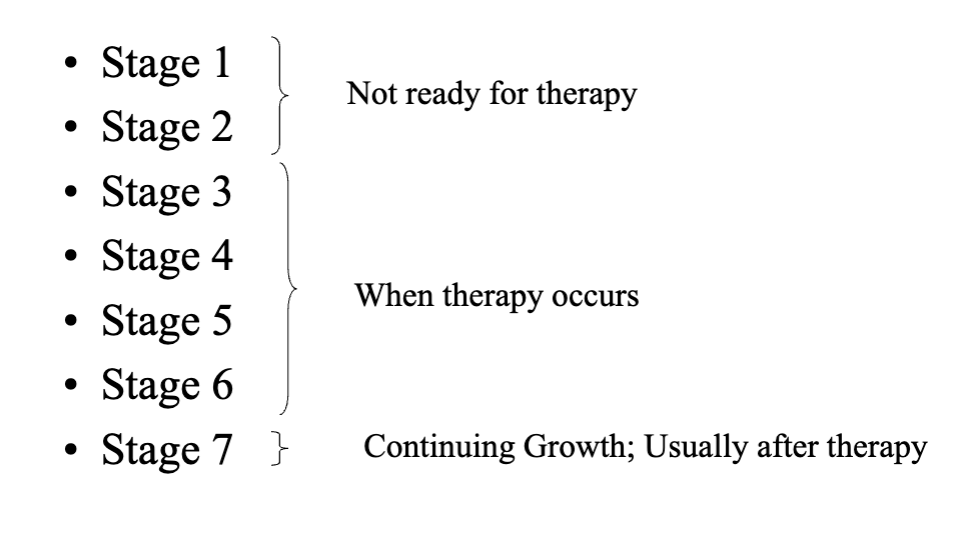
Stage 1 (Pre-Therapy Stages)
Communicates about externals rather than Self
Feelings are not recognized or owned
Fear of close relationships
No desire for change
Stage 2 (Pre-Therapy Stages)
Problems are acknowledged, but
Seen as external
Take no responsibility for them
Feelings are described in past tense or belonging to others
Unaware of contradictions between behavior and OVP
Stage 3 (Therapeutic Stages of Change)
Much talk of Self and past feelings
Present feelings not accepted
Choices seen as ineffective
Stage 4 (Therapeutic Stages of Change)
Feelings acknowledged, but feared and only partly accepted
Recognizes differences between behaviors and OVP
Admits responsibility for patterns of behavior
Stage 5 (Therapeutic Stages of Change)
Feelings expressed in present tense
Feelings are frightening
New personal constructs are made
Desire for “real me,” even if imperfect
Stage 6 (Therapeutic Stages of Change)
Experience of previous “stuck” feeling
Rich immediacy of experience and acceptance of it
Will live “in the moment”
Subjective experience replaces defined “problems”
Stage 7 (Post Therapy)
New feelings experienced richly and immediately
Experience is new and present, not related to past
Self is the awareness of experiencing
Constructs are loosely held; ready to be dismissed
Rich experience of choice
Research
Q-Sort
Given a pile of cards with personality descriptors
Describe self
Describe ideal self
High positive correlation when mentally healthy
Therapy (Rogers, 1978):
Pre-therapy: -.47
Post-therapy: +.59
Criticisms
Some say that this technique is overly simplistic
OVP seems to overlook basic physiological drives (sex, aggression)
Underestimates evil in humankind
Society DOES tell us some things that ARE good for us
E.g., speeding
Self-actualization may not be solely beneficial
May foster selfishness and narcissism
Unconditional positive regard, if total, could lead to confusing world
People fundamentally disagree with one another
Applications - Politics
Encounter groups between Catholics and Protestants in Ireland (16 hours!)
Prejudice changed over course of meeting
Working together with open discussion, we may increase our own self-worth and decrease hatred
Applications - Education
Traditional education is lacking
Teacher-centered
System is evaluative
Solutions
Education should be based on trust; students should decide what and how to learn
No syllabus should be given!
No grades