Exam 2 Study Guide Questions
 Call Kai
 Learn
Learn Practice Test
 Spaced Repetition
 Match
Match Flashcards
 Knowt Play
1/104

Earn XP
Description and Tags
Dr. Gerlach’s animal unit
Name | Mastery | Learn | Test | Matching | Spaced | Call with Kai | Chat |
|---|
No analytics yet
Send a link to your students to track their progress
105 Terms
What are some features shared by all animals? Are these features diagnostic (i.e. if you found an unknown organism with one of these features, could you say for sure it was an animal)?
Are animals monophyletic? What are the diagnostic synapomorphies for animals?
Know figure 22.1. You should know the major clades of animals discussed in lecture (Sponges, Ctenophores, Cnidarians, Placozoans, Triploblasts/Bilaterians, Protostomes, Deuterostomes) and how they are related to each other. (You do NOT need to know the relationships of the clades within Sponges, Protostomes, or Deuterostomes, however.)
What traits / synapomorphies define each of the groups above? Which groups have distinct organ systems? Nervous tissue?
Which groups have multiple differentiated cell layers during development? Which groups do not? What are these conditions called? For those that do, what does each of these differentiated cell layers form/develop into?
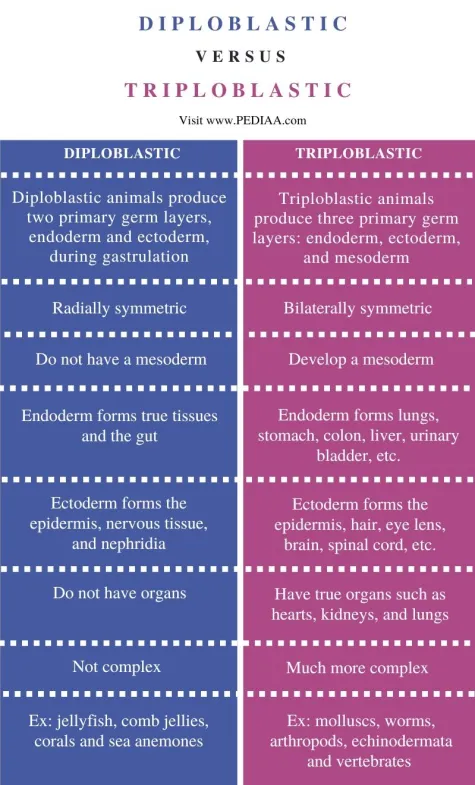
What’s the difference between diploblastic and triploblastic organisms? Which type of development evolved first? Which groups belong to each category? What other features do triploblastic organisms share?
Diploblastic: There are two primary germ layers being the endoderm and the ectoderm that arise during gastrulation. Groups include cnidaria (jellyfish, corals, sea anemones), ctenophora (comb jellies), and placozoa (primitive multi-cellular organisms)
Triploblastic: During gastrulation, there are 3 primary germ layers being the endoderm, mesoderm, and ectoderm. Groups include platyhelminths (flatwors), annelida (segmented worms), mollusca (snails, clams, squids), arthropoda (sea stars and urchins), chordata (vertebrates like humans, birds, and fish)
Evolution: Diploblastic development came first and triploblastic ones evolved from them. This evolution allows more active locomotion and complex internal organs as they have a body cavity called a coelom that cushions the organs and acts as a hydrostatic skeleton. The mesoderm can become muscle, bone, connective tissue, and the vascular system.
What are the different types of symmetry? Which groups have which type? What advantage(s) do bilaterally symmetrical organisms have over radially symmetrical ones?
Bilateral: Body can be divided into two identical left and right halves on a single plane. Includes most animals like insects, worms, and vertebrates. Cephalization is the formation of a head end. Advantages include streamlining the body for more efficient locomotion, cephalization, specialized appendages, etc.
Radial: The parts radiate outward from a central axis like spokes on a wheel. Includes cnidaria and some echinodermata like sea urchins. Most diploblasts are radially symmetrical.
Asymmetry: Lack of geometric arrangement, seen in some stationary organisms like sponges in phylum porifera.
Spherical: Organism is perfectly spherical and parts radiate from a central point, including radiolarians and heliozoans.
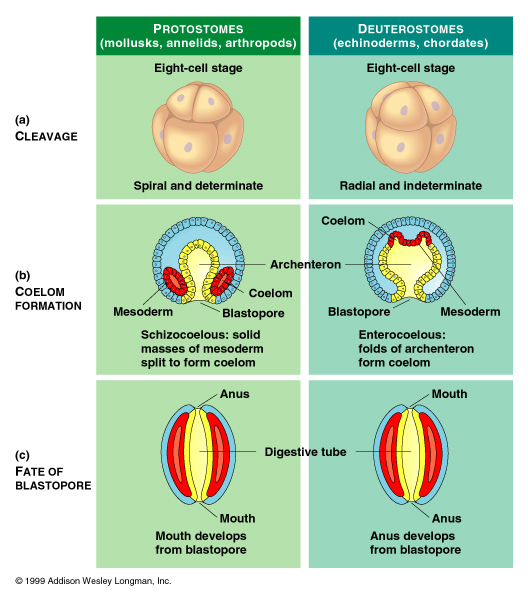
What are the major differences between protostomes and deuterostomes? Which types of familiar animals belong in each clade?
Protostomes: The blastopore (first opening formed during embryonic development) becomes the mouth and the anus forms later. Spiral cleavage where dividing cells are offset at an angle and determinate cleavage (developmental fate of each embryonic cell is locked in very early). Schizocoely where the body cavity forms by a split in the solid mass of mesoderm tissue.
Deuterostomes: The blastopore becomes the anus and the mouth forms later. Radial cleavage where cells stack directly on top of each other and indeterminate cleavage (early cells are totipotent aka stem cells that can specialize later one). Enterocoely where the coelom forms from pouches pinched off from the embryonic gut.
How is the polytomy at the base of the tree in figure 22.1 resolved? Which group is the sister taxon to the other two? What does this suggest about what the earliest animal must have been like?
For all of the traits discussed in previous questions, map their evolution (gains and losses of the trait) onto the version of fig. 22.1 with the resolved polytomy.
How do animals get their energy? What do they convert this energy into? Write the basic equation for cellular respiration. (See Ch. 5 to review if needed.)
Getting energy: Consuming and breaking down organic compounds like carbohydrates, fats, and proteins from their foods.
Conversion: Converts stored chemical energy into usable ATP which powers cellular processes and thermal energy which maintains body temperature.
Equation: C6H12O6 + 6O2 → 6CO2 + 6H2O + energy (ATP and heat)
What is the metabolic rate? How is it measured?
Metabolic rate: Metabolic rate is the rate at which your body expends to maintain basic, life-sustaining functions like breathing, blood circulation, cell production, etc.
Measurement: Measured in energy units per time like kilocalories per day. You can use indirect calorimetry which measures metabolism based on the amount of oxygen your body consumes and carbon dioixde that it produces with a specialized mask. Done while resting to find the basal metabolic rate (BMR). Direct calorimetry measures the actual amount of heat produced. byyour body over a set period.
What factors will increase an animal’s metabolic rate? What factors are correlated with having a high metabolic rate? (i.e. If an animal has a high vs. low metabolic rate, what other things can we predict about that animal?)
Rate increase: Rises in temperature (for endotherms), increased physical activity, digestion, and physiological stressors (pregnancy, illness, etc.)
Factors: Smaller body size/higher SA/V ratio, faster pace of life/shorter lifespans. faster growth rates, smaller animals need more food per unit of body mass, high metabolism is correlated with faster resting heart rates/breathing frequencies, faster temporal visual perception, usually found in places with high net primary productivity (abundant food)
What is the BMR and how is it different from the total metabolic rate?
BMR: Minimum baseline energy (in calories) your body needs to stay alive at rest like breathing, cell production, pumping blood, etc.
TMR: Your BMR and the calories you burn digesting food + performing daily physical activities
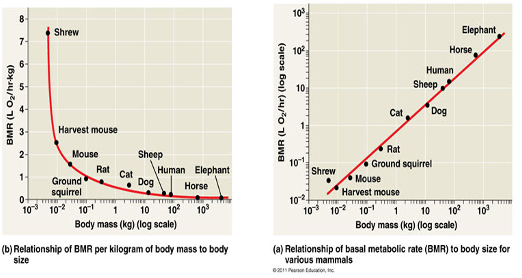
What is the difference between overall BMR and mass-specific BMR? What does the mouse-to-elephant curve tell us about the relationship between body size and BMR?
Overall: The total daily energy expended by the entire organism which scales up with larger bodies
Mass-specific: The energy used per unit of body weight which decreases since small animals require a higher metabolic “pace” per gram to live
Most boxed cake mixes have directions for baking in various size pans (as below). For the same amount of cake batter, why is the baking time for cupcakes so much less than if you are using a single larger pan? How does this rule relate to the limits on cell size? To other aspects of physiology?
Bake time: The smaller individual volumes provide a higher surface-area-to-volume ration which allows the heat to penetrate the center more rapidly
Cell size: This relates to cell size because of the SA/V ratio. As a cell grows the volume increases much faster than surface area so the larger cake is like an oversized cell.
Physiology: Related to thermoregulation (heat diffusion is quicker for small animals), respiration (alveoli allow for rapid oxygen diffusion), circulatory systems (simple organisms can rely on simple diffusion for nutrients to move), etc.
All cells within a multicellular animal must be able to receive nutrients and oxygen and get rid of waste products. How do small animals accomplish this? How do large animals accomplish this?
Small: Direct diffusion works since their higher SA/V ratio allows for gases, nutrients, and wastes to travel across their body surfaces quickly
Large: Specialized organ systems help with transport of materials since diffusion alone is too slow for deeper cells
What are regulators vs. conformers? What is/are the thing(s) that’s being regulated or conformed?
What IS gas exchange and why do animals need to do it?
Gas exchange: Animals absorb oxygen from their environment and release carbon dioxide. The swapping occurs due to diffusion across specialized moist respiratory surfaces like lungs, gills, or skin.
Needed for: Cellular respiration relies on the fuel to keep cells alive. Oxygen is needed to break down sugars and produce ATP, and as cells burn energy they produce CO2 as a waste product which can make the blood acidic if there is too much of it
What is Fick’s law? What does each of its variables refer to?
Fick’s law: The movement of particles from a region of higher concentration to a region of lower concentration. Diffusive flux is proportional to the negative concentration gradient.
Variables: J = -D (dc/dx) where J is the diffusion flux (amount of substance passing through a unit area per unit time), D is the diffusivity (constant for a substance in a medium), dc/dx is the concentration gradient (rate of concentration change over a distance)
Describe the gas exchange systems used by fish, insects, amphibians, and mammals. What adaptations to maximize respiratory gas exchange does each system have? Which part(s) of Fick’s law do these adaptations correspond to?
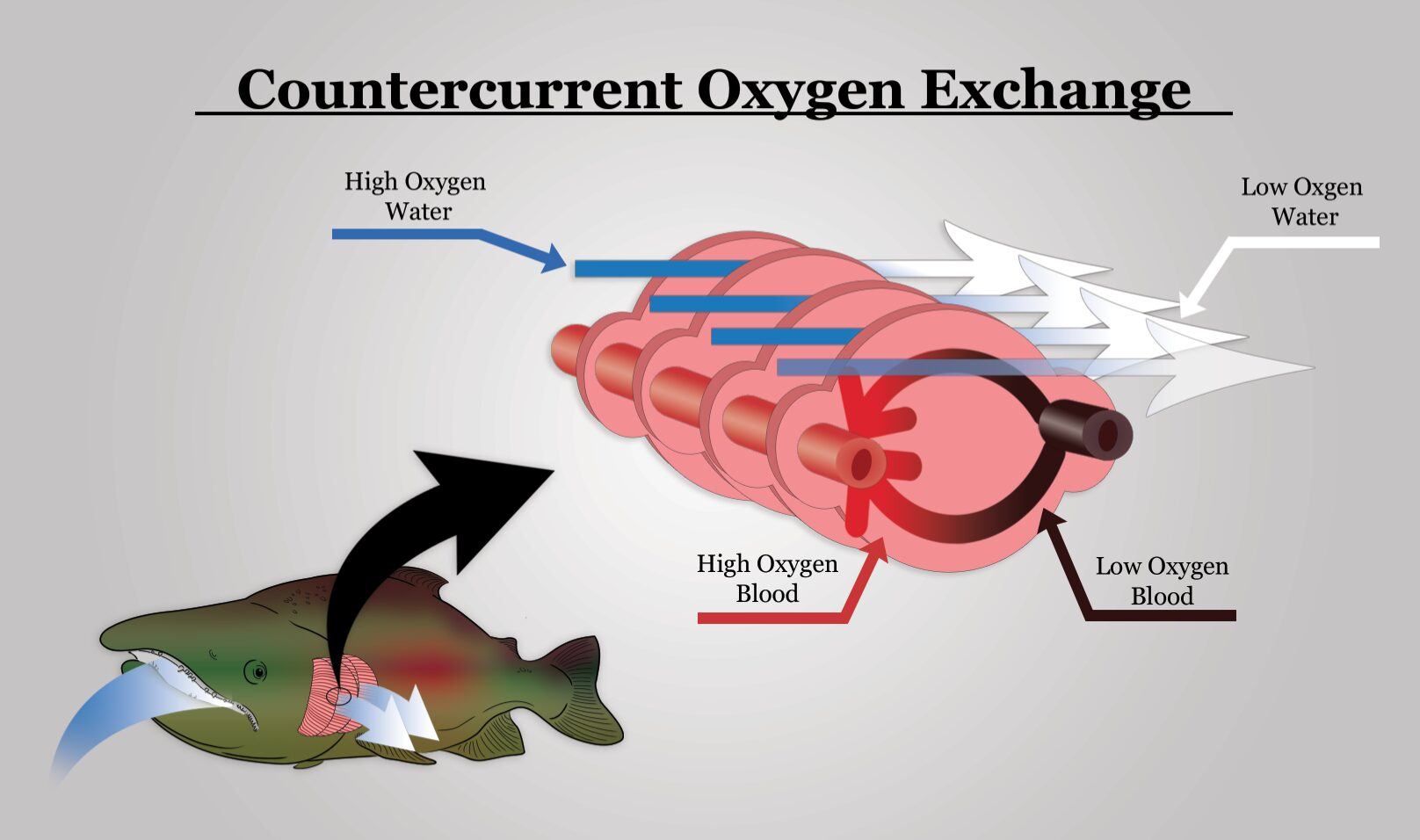
Fish: They have gills which are folded filaments and lamellae. Unidirectional water flow and a countercurrent exchange mechanism is how water flows across the lamellae in the opposite direction of blood flow. For Fick’s law, this increases the surface area and the concentration gradient is maintained at a maximum to ensure continuous diffusion radient of water and blood.
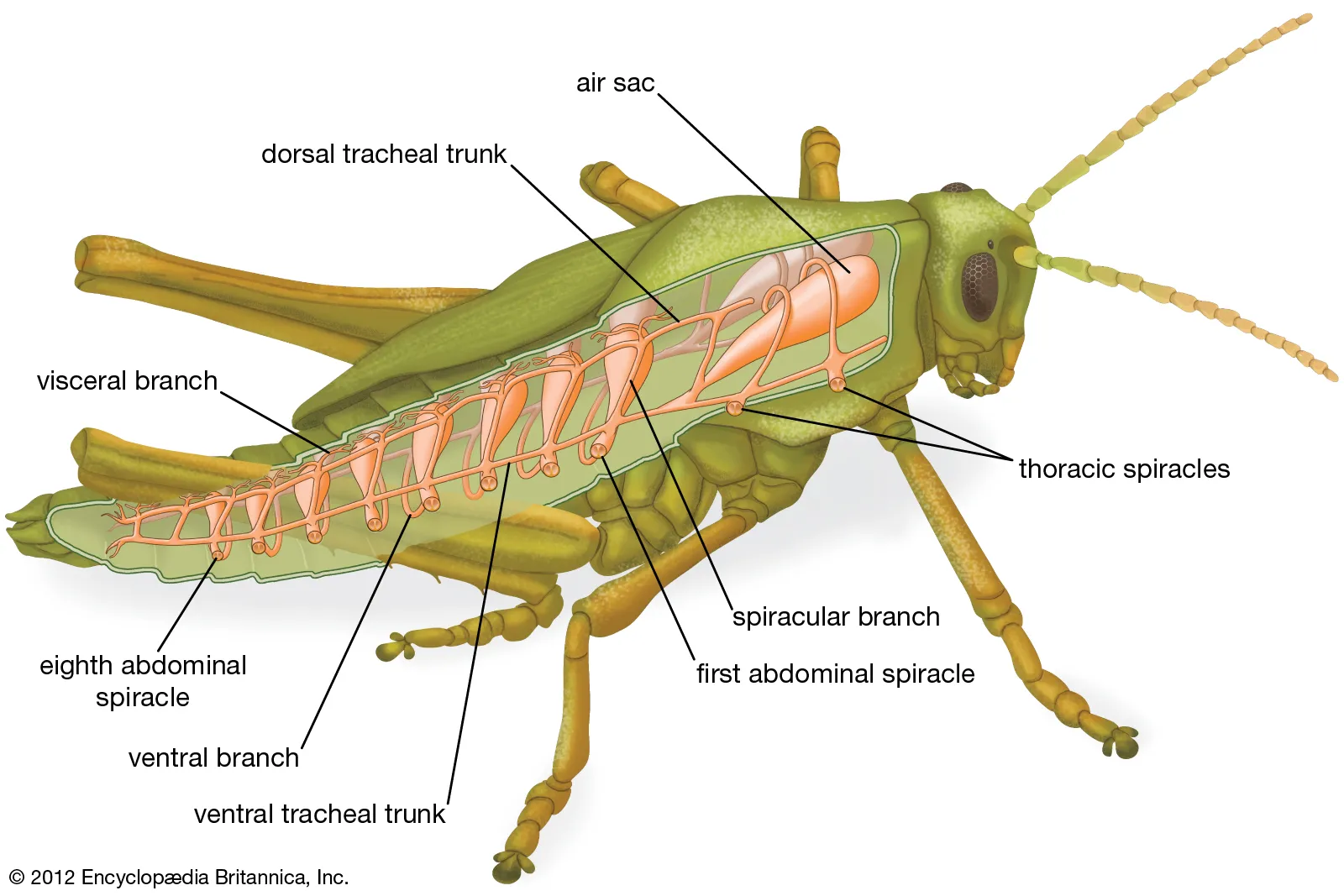
Insects: They use a branching tracheal system of tubes that directly connect to cells via spiracles which can close to prevent water loss while the body actively pumps air sacs for bulk ventilation. finish fick’s law
FINISH CARD HERE
What is countercurrent flow and how is it relevant to gas exchange?
Countercurrent flow: Two fluids flow in opposite directions to maximize the transfer of heat/substances between them
Gas exchange: Maintains a continuous concentration gradient so an organism can extract up to 80-80% of the oxygen from water or air
Why do lungs have to be in contact with a circulatory system but insect tracheae do not?
Lungs: These only interface with the environment at a single location so there needs to be a circulatory system to transport the oxygen through the rest of the body.
Insect: These branching tubular networks deliver air to every cell directly so a respiratory blood supply isn’t needed
How does negative pressure ventilation work? Be able to explain the active and passive parts of the inhale/exhale cycle in mammals.
Negative pressure breathing: Air is drawn into the lungs via suction rather than being forced in. The mechanics relies on Boyle’s law which states that pressure and volume are inversely proportional in a closed space
Active: Muscle contraction makes this active. The diaphragm contracts and flattens/moves downward and the ribe cage simultaneously expands due to the contraction of the external intercostal muscles which make the volume of the thoracic cavity increase so the pressure decreases. The intrapleural and alveolar pressures are more negative relative to the atmosphere so air is sucked in through the airways until pressures equalize.
Passive: The inspiratory muscles above relax so the ribe cage drops downward and inward. The volume decreases and the pressure rises above atmospheric pressure so air is forced out of the lungs until equalization
What is unidirectional vs. bidirectional/tidal flow? What are the drawbacks to tidal flow? What is tidal volume, residual volume, dead space?
Unidirectional: Moves substances through a system in a continuous one-way path
Bidirectional: Moves substances back and forth through the same pathway which means fresh and stale mix in the system
Drawbacks: Gas mixes with fresh and stale inside the lungs so the concentration of oxygen at the gas-exchnge surfaces is lowered. This also increases the work since the respiratory muscles must work against elastic recoil to reverse the direction that air flows (this reversal has to happen for every cycle of breathing which is energetically expensive)
Tidal volume: The volume of air inhaled/exhaled during a single breath that is normal and relaxed which is about 500mL in humans
Residual volume: The volume of air that remains trapped in the lungs after a maximum, forced exhalation which prevents the lungs from collapsing
Dead space: In each breath, some air never reaches the gas-exchange surfaces and doesn’t do anything in the respiration process. Anatomical dead space include the trachea and bronchi whilst alveolar dead space is just the alveoli.
For mammals, be able to trace a molecule of oxygen from the outside world, through the respiratory system, and to a cell elsewhere in the body. What structures does it pass through, in what order? (Requires some info from Lecture 5)
How is oxygen transported in the blood? How does hemoglobin bind oxygen? When will hemoglobin give up / release its oxygen?
How is carbon dioxide transported in the blood? Why is this different from oxygen? Be able to trace the path of a molecule of CO2 from a body cell to the outside world
What is the function of the circulatory system? What are its basic components?
Function: Transports oxygen, hormones, and nutrients to cells through the body. Also helps in removing waste such as carbon dioxide which is a metabolic waste.
Components: Needs a muscular pump like the heart to propel fluid through the vessels. The vessels are pathways to circulate blood such as arteries, veins, and capillaries.There is also a fluid such as blood in humans which transports the substances
What is the difference between open and closed circulatory systems? What are the advantages/disadvantages of each?
What are the components of blood? How does O2 travel in the blood? What about glucose and other nutrients?
For fish, amphibians, birds, and mammals, know:
How many chambers in the heart?
How many times does a volume of blood pass through the heart during a complete circuit?
Does oxygenated and deoxygenated blood mix? If so, how/where? If not, how is it kept separate?
Know the atria, ventricles, and major vessels of the mammalian heart, and be able to trace the flow of blood from the left atrium through the body to the heart to the lungs and back to the heart. Which vessels does a blood cell pass through and in which order? Which vessels carry oxygenated vs. deoxygenated blood?
What is diastole? What is systole? What happens during each? What parts of the cardiac cycle does a heartbeat represent?
How does blood pressure differ among different types of vessels? WHY does blood pressure differ in the different types of vessels? How are the differences in pressure reflected in the anatomy of these vessels?
Application: use what you know about the structure of blood vessels to explain why phlebotomists tie a strap around your arm in preparation for finding a vein from which to draw blood.
What is the lymphatic system? What does it do? How does it relate to blood pressure?
What are the basic functions of the excretory system?
Functions: Remove wastes/toxins and excess substances from the body. This helps maintain homeostasis. Filters blood which regulates pH levels and fluid volume and minerals/salts/solute concentrations.
Key organs: The kidneys, the urinary tract, the skin, etc.
Differentiate between a cell that is isoosmotic, hypoosmotic, or hyperosmotic relative to its environment. How would you classify the environment relative to the cell in each case? What will happen to the cell in each case?
What challenges do marine fish face in terms of regulating their salt/water balance? How do they overcome these challenges? What about freshwater fish?
What is ultrafiltration? How does it happen? What is its product? How does that product compare to blood?
Be able to trace the structures that a water molecule passes through between you drinking a glass of water and then excreting that water as urine.
What is the nephron? What is the glomerulus, the Bowman’s capsule, the proximal convoluted tubule, and the distal convoluted tubule? What is happening in each?
How is the volume and the osmolarity of excreted urine regulated in amphibians? What is the role of ADH in this process? How is this similar to and different from the process in mammals?
The U/P ratio compares the osmolarity of the urine (U) to that of the blood plasma (P). What does a >1, =1, and < 1 U/P ratio mean? Which animals can produce which ratios?
What is the loop of Henle? What is its function, and how does it relate to the U/P ratio? Which taxa is it found in?
Why do animals have to eat?
What makes a nutrient essential? What are the main types of essential nutrients?
How does a gastrovascular cavity work? Which animals have this?
What are the basic steps of food processing?
What structures in the vertebrate digestive tract are parts of the foregut? Midgut? Hindgut?
What’s the difference between mechanical and chemical digestion? Which happens where?
For the major biological macromolecules (proteins, lipids, carbohydrates), know:
Where does chemical digestion happen?
What category of enzymes are responsible for breaking them down, and where are these enzymes produced?
Where and how does absorption happen?
Where do these molecules go once they’ve been absorbed?
What are the four functions of the stomach? What are the jobs of the small intestine? What are the jobs of the large intestine?
What is the job of the liver in relation to digestion? The pancreas? Gallbladder?
Describe how blood glucose is regulated. Which parts correspond to which parts of a negative feedback regulatory system?
What is the difference between foregut and hindgut fermentation? Which is more efficient, and why?
What is the job of the immune system?
When is the immune system of an organism “taught” to recognize the difference between “self” and “non-self”? How does this happen? What features of a pathogen are recognized?
What are allergies? What cells of the immune system are activated? What is happening when an individual develops an autoimmune disease?
What is the difference between innate and adaptive/acquired immunity?
Identify the components of the 1st and 2nd line of innate immune defense.
Explain the steps involved in the inflammatory response. What does histamine do? What does tumor necrosis factor do? What is the job of phagocytes? Why do injuries hurt?
Where are MHC-I/MHC-II proteins found? What do they do?
What are antibodies? What are T-cell receptors? Where are they found? What do they do?
Explain how both humoral and cellular immunity are able to a) detect pathogens, b) mobilize defenses, and c) attack pathogens. What kind(s) of cells are involved in each phase? Are any of these cells are involved in both types of acquired immunity?
What are memory cells and how do they work? Do they form for both B and T cells?
How does vaccination work?
How are the endocrine glands different from the exocrine glands?
What is a hormone? What is a target cell? How do hormones differ from an autocrine or paracrine secretion?
What are the differences between water soluble and lipid soluble hormones? How do they travel in the blood? Which can cross the cell membrane? Where are their receptors located?
The action of hormones requires a) secretion of the hormone, b) transport to the target tissue, and c) response by the target tissue. Explain how each of these three factors can be modulated to affect the overall response.
Explain how pairs of hormones can act together to maintain homeostasis. Which hormone(s) are involved in maintaining calcium levels? Blood glucose levels?
What is the role of the hypothalamus on regulation of endocrine function? What kind of hormones are produced by the hypothalamus?
What’s the difference between the anterior and the posterior pituitary? What hormones are secreted by each? Where are these hormones produced?
What is a releasing hormone, where is it produced/released, where does it act? What is a tropic hormone, where is it produced, where does it act? Identify releasing and tropic hormones on the table in question 1.
Which hormones are regulated by hormone cascades? Draw out these cascades, the glands involved, and the hormones produced at each step.
Be able to trace the hormones involved in the female human reproductive cycle both in the event of pregnancy and if pregnancy does not occur.
For the following hormones, be able to list where they are produced and released, what their primary target tissues are, and their effects:
Melatonin
Thyroxine
Calcitonin
Parathyroid hormone
Glucocorticoids
Mineralcorticoids
Epinephrine
Norepinephrine
Androgens
Estrogens
Progesterone
Antidiuretic hormone (vasopressin)
Oxytocin
Thyrotropin-releasing hormone
Corticotropin-releasing hormone
Thyroid stimulating hormone
Luteinizing hormone
Follicle stimulating hormone
Adrenocorticotropin hormone
Prolactin
Growth hormone
Insulin
Glucagon
What is the difference between sexual and asexual reproduction? How does parthenogenesis differ from the other types of asexual reproduction?
What is hermaphroditism? Distinguish between simultaneous vs. sequential hermaphrodites.
What are the primary reproductive organs? Accessory reproductive organs? Secondary sexual characteristics? Be able to identify examples of each of these in both sexes.
Trace the path of a sperm cell from production to ejaculation. Be sure to include accessory structures. Where are the sperm formed? Where do they mature?
Trace the path of an egg cell from ovulation to menstruation (or to fertilization and implantation). Include all structures involved and where each major event takes place.
Compare oogenesis and spermatogenesis in terms of the stages of meiosis, the timing of each event during the life cycle, and the number and size of the final end products. How are they similar? How are they different?
What are Sertoli and Leydig cells? What are thecal and granulosa cells? What are their functions? Which hormones are primarily secreted by which set of cells?
Be able to trace the reproductive hormones in males and female mammals from hypothalamus to gonads to gametes. What type(s) of feedback is/are involved?
What is a follicle? What is an oocyte? What is the corpus luteum? What hormones are secreted by these structures?