BIOL113 L31
 View linked note
 Call Kai
 Learn
Learn Practice Test
 Spaced Repetition
 Match
Match Flashcards
 Knowt Play
1/53

There's no tags or description
Looks like no tags are added yet.
Name | Mastery | Learn | Test | Matching | Spaced | Call with Kai | Chat |
|---|
No analytics yet
Send a link to your students to track their progress
54 Terms
What are the four distinct processes concerned with acquiring oxygen and transforming it to energy in respiration?
1. Ventilation with water or air, 2. Gas exchange, 3. Transport of gases between the respiratory organs and tissue, 4. Cellular metabolism.
What is the first process in respiration that involves 'breathing'?
Ventilation with water or air.
What is the second process in respiration that involves the uptake of O2 from the environment and release of CO2?
Gas exchange.
What is the third process in respiration that involves the transport of gases between the respiratory organs and tissue?
Transport of gases between the respiratory organs and tissue.
What is the fourth process in respiration that involves aerobic metabolism in the mitochondria?
Cellular metabolism.
What does aerobic metabolism in the mitochondria consume and produce?
Consumes O2, produces CO2 and ATP (energy).
What are the characteristics of air compared to water in terms of oxygen content?
Air is less dense, less viscous, and has more oxygen.
What is the efficiency of gas transfer in a blue whale's lungs?
Up to 90% of inhaled air can be transferred into the bloodstream.
What is the main problem related to oxygen in cells?
need to get it to cells.
What are the solutions to the problem of getting oxygen to cells?
Taking up oxygen across the epithelial surface and transporting it to cells.
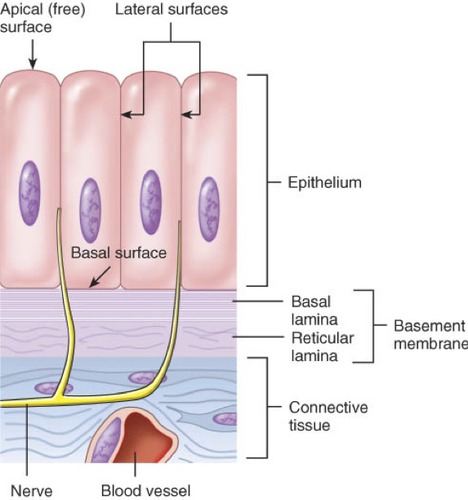
what is the epithelial surface?
The epithelial surface refers to the outermost layer of cells that covers the body surfaces, lines internal organs and cavities, and forms glands. Epithelial tissues serve as a protective barrier, control permeability, and have various other functions depending on their location and structure.
What are the evolutionary consequences related to oxygen requirements?
Selection favours efficiency, especially where energy requirements are higher.
Why is water not a good respiratory medium for animals compared to air?
Due to its low oxygen content and high density and viscosity.
What are the mechanisms of gas exchange in water?
A. Cutaneous diffusion only, B. Cutaneous diffusion plus circulatory system, C. Gills plus circulatory system.
What is cutaneous diffusion?
The net movement of a substance from a high to a low concentration due to the random thermal motion of molecules, usually expressed in terms of partial pressure.
How does the exchange of oxygen occur across cell membranes at the body surface and internal tissues?
By diffusion.
What is Fick's law of diffusion for the rate of oxygen diffusion?
Fick’s law = Ko2 .A . ΔP/d (Krogh’s Constant for oxygen x area x partial pressure difference / thickness of diffusion barrier)

What are the factors to maximize oxygen uptake for animals without circulatory systems?
Maximize area, maximize partial pressure, minimize thickness.
What is the method of gas exchange in flatworms?
Via cutaneous diffusion.
What is the maximum dimension an animal without a circulatory system can have for oxygen to reach its tissues by diffusion alone?
animals must have a dimension less than ~1mm thick for oxygen to reach tissues by diffusion alone.
What are the structures involved in cutaneous diffusion in flatworms?
Epidermis and mesohyl.
How do quite large animals with a thin body wall supply oxygen?
By diffusion alone.
How do flatworms initially obtain food particles?
Flatworms obtain food particles by extending a muscular pharynx to suck in food.
What process is used by the flatworm's digestive system to engulf food particles?
phagocytosis
What are the different gas exchange mechanisms in water?
A. Cutaneous diffusion only (body surface, skin) B. Cutaneous diffusion plus circulatory system (blood) C. Gills plus circulatory system External gills Water 'lungs' Internal gills
What are the problems associated with cutaneous diffusion for gas exchange?
Thin surface for gas exchange conflicts with protective function, limited by available surface area (not all areas suitable), limits size (surface area to volume ratio).
What is the function of gills in gas exchange?
Gills are thin outgrowths of the body wall with high surface area, ventilated externally and perfused internally with blood.
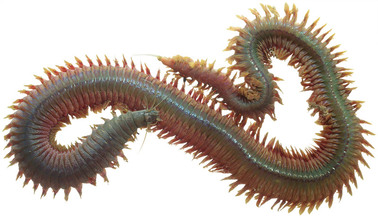
How are Nereis (ragworm) adapted for gas exchange in water?
Nereis has parapodia for swimming and gas exchange, with gills that are thin outgrowths of the body wall with high surface area, ventilated externally and perfused internally with blood.
What are gills?
Thin outgrowths of the body wall with high surface area, ventilated externally and perfused internally with blood.
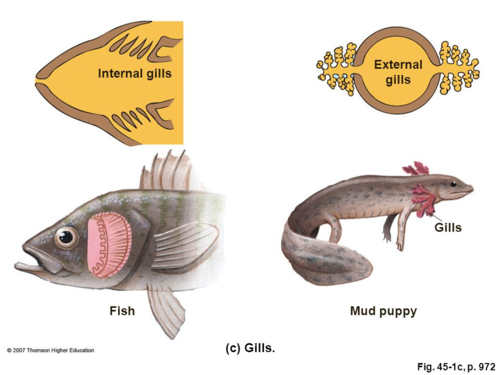
What are the problems associated with external gills?
Vulnerable to physical damage, predators, parasites. Difficult to ventilate efficiently. Increase swimming drag
What are water 'lungs'?
Tidally ventilated water-filled cavity, such as the respiratory tree of sea cucumber (Holothurian).
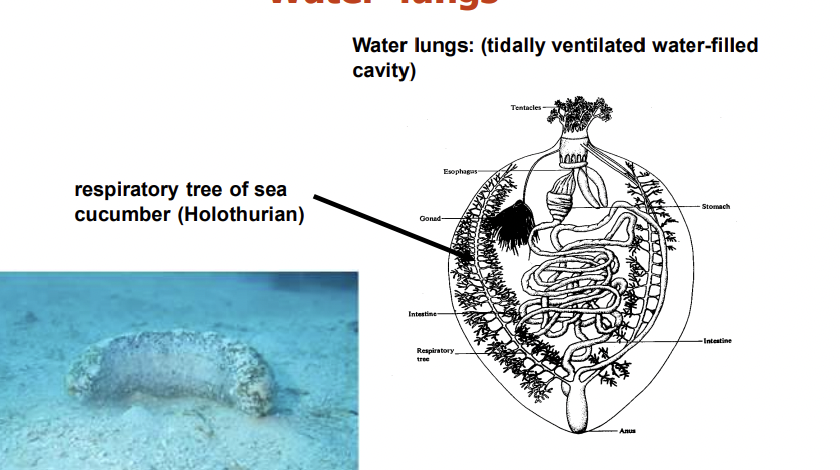
What is the respiratory structure of sea cucumber (Holothurian)?
Respiratory tree, which is a water-filled cavity tidally ventilated.
What are the problems associated with water 'lungs'?
Ventilation is energetically costly and water is heavy.
What is a characteristic of water lungs that makes them relatively inefficient for gas exchange?
They are energetically costly to ventilate.
What is the gas exchange mechanism for cutaneous diffusion only?
Body surface, skin.
What is the gas exchange mechanism for gills plus circulatory system?
Gills plus circulatory system.
What type of gills are located outside the body?
External gills.
What type of gills are located inside the body?
Internal gills.
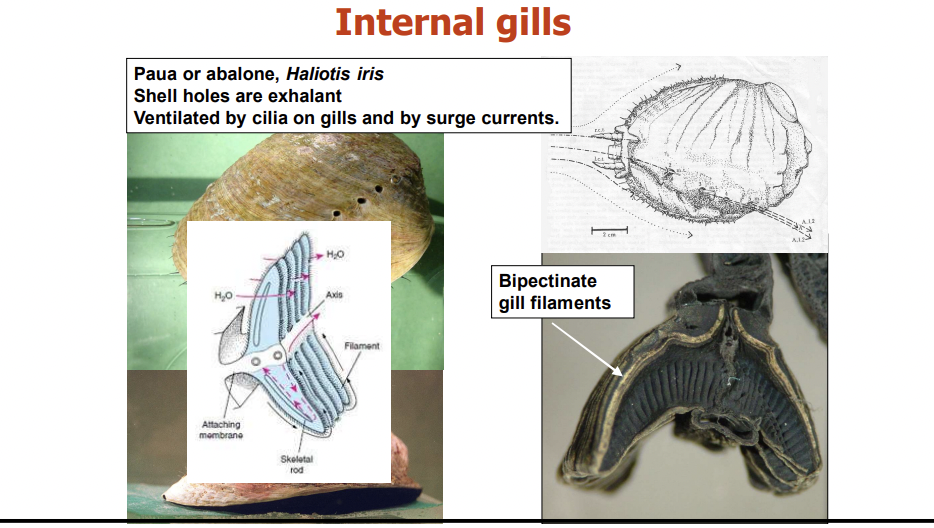
What are the characteristics of the internal gills in Paua or abalone (Haliotis iris)?
Ventilated by cilia on gills and by surge currents.
How are the gill filaments structured in the internal gills of Paua or abalone (Haliotis iris)?
Bipectinate gill filaments.
What is the function of the gill bailer (scaphognathite) in the internal gills of Jasus (rock lobster, crustacean) ?
It pumps water unidirectionally over the gills which are enclosed within the branchial chamber.
How does the water and blood flow in the internal gills of shore crab?
Water and blood flow countercurrent to each other.
How does a fish ventilate its internal gills?
By continually pumping water through its mouth and over the gill arches.
What type of flow do the pumps maintain across the gills for ventilation?
Almost constant unidirectional flow.
what is unidirectional ventilation?
Unidirectional ventilation in internal gills refers to the flow of water in one direction over the gill surfaces, allowing for efficient gas exchange.
What is the purpose of countercurrent exchange in the fish gill?
To maximize diffusion.
In a countercurrent system, what can the efferent blood have higher than the exhaled water?
Oxygen saturation.
What does respiration involve?
The uptake of O2 and its conversion into energy.
What is the relationship between energy requirement and selection pressure in respiration?
The more energy required, the greater the selection pressure to increase efficiency of O2 uptake and transport.
What are the solutions to increase efficiency of O2 uptake and transport?
Increased surface area for gas exchange (gills), incorporation of circulatory system, increased O2 partial pressure difference, improved efficiency of ventilation.
How can the efficiency of ventilation be improved?
Through unidirectional ventilation.
What is meant by 'increased O2 partial pressure difference'?
Active ventilation and counter-current exchange.
what does counter current maximise ?
diffusion
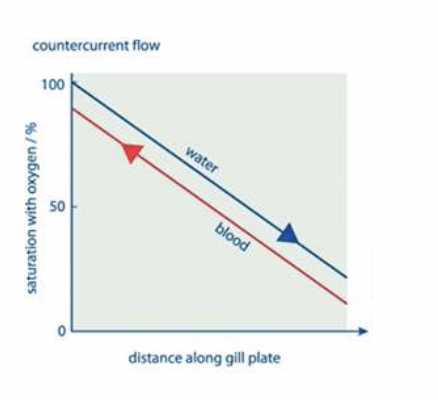
describe counter current exchange in fish gills:
Oxygen-poor blood flows through the gill capillaries in the opposite direction to the water flow, which is oxygen-rich. This ensures a consistent gradient for oxygen to diffuse into the blood and for carbon dioxide to diffuse out into the water.