heme exam A
 Call Kai
 Learn
Learn Practice Test
 Spaced Repetition
 Match
Match Flashcards
 Knowt Play
1/50

There's no tags or description
Looks like no tags are added yet.
Name | Mastery | Learn | Test | Matching | Spaced | Call with Kai | Chat |
|---|
No analytics yet
Send a link to your students to track their progress
51 Terms
What parameters are measured directly on the automated cell counter?
WBC count, RBC count, Hgb concentration
What parameters are measured by electrical impedance?
WBC and RBC count
electrical impedance
Changing electrical resistance as blood cells pass through a tiny apparatuses to count and size them
What parameters are calculated?
MCH, MCHC, Hct, Absolute differential count
3 sites where bone marrow aspirate can be obtained
Posterior iliac crest, anterior iliac crest, tibia (children)
Difference between bone marrow aspirate and bone marrow from peripheral blood
Bone marrow aspirate has marrow spicules (particles)
When do you reject a bone marrow sample
If the aspirate has no spicyles, it’s a dry tap, there’s contamination, there’s clotting
Blood viscosity is assessed by
hct
The linearity of an analyzer has exceeded, what should be done
Dilute the sample then rerun, then calculate the result by the dilution factor
IgM is detected in the sample, what does it cause and how is it resolved
it causes false decreased RBCs and false elevated MCV &MCHC - incubate and warm sample at 37C for 15-30 minutes then rerun
Plt clumping can cause what? And how is it resolved
False decreased plt count, request a redraw (can use EDTA again but to prevent EDTA induced clumping opt for sodium citrate tube (blue top) instead)
Liberia in the sample causes what? How is it resolved?
It falsely elevates MCHC and Hgb- so clear the plasma with saline treatment
Interpret histograms of white cells

RBC histogram
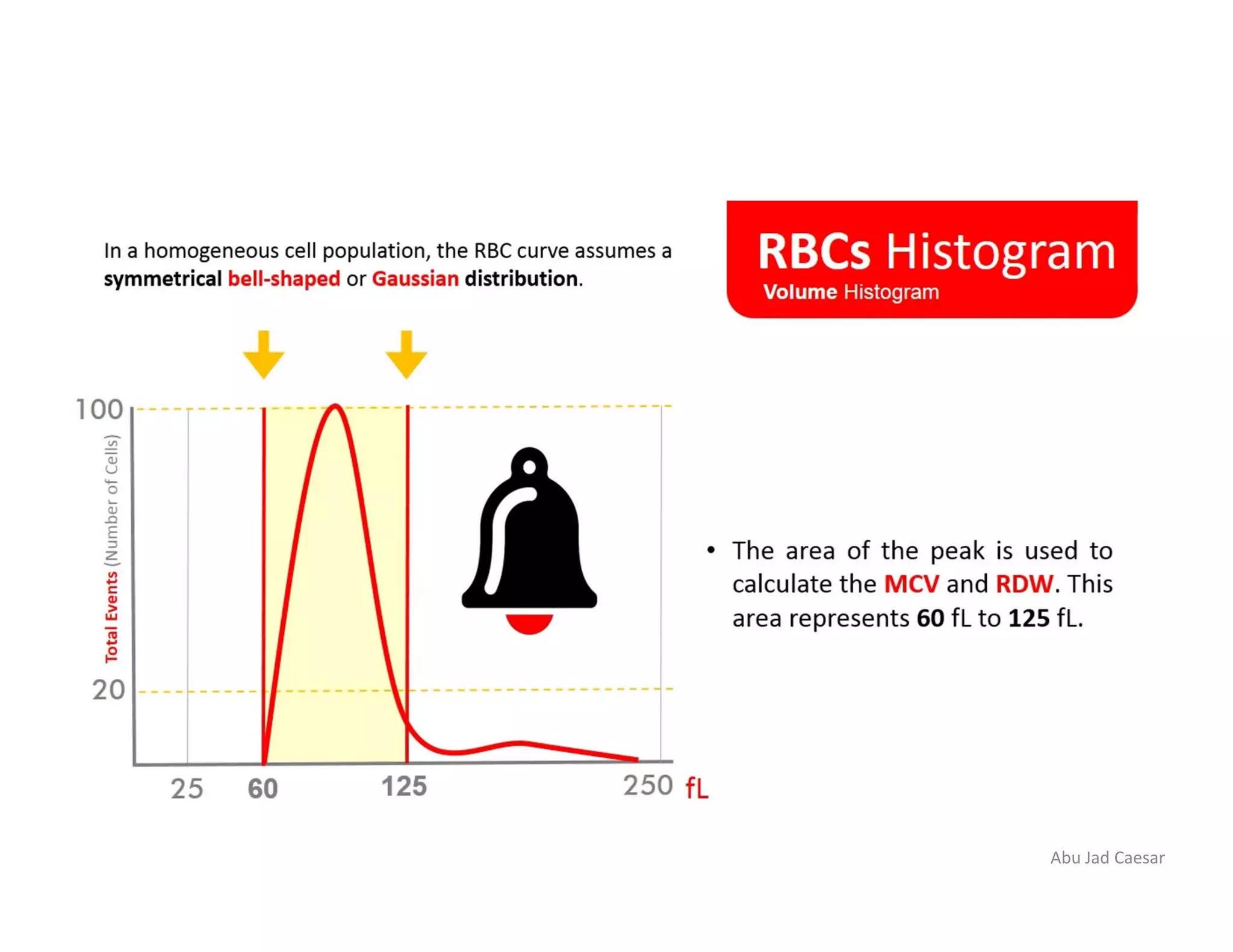
What is the correct specimen tube for hemogram?
EDTA (lavender/purple top)
If an EDTA tube cannot be used when running a hemogram, what should be used?
Sodium citrate (light blue)
flow cytometry: forward scatter
Light scattered at 0-10 degree angle
Detects size
Flow cytometry: side scatter
Light is scattered at a 90 degree angle Detects
Detects granularity
Molecular hemoglobin types difference between infants, adults, and children
Infants carry up to 80% fetal hemoglobin, which binds tighter to oxygen
Children and adults carry adult hemoglobin (HbA), designed to release oxygen more easily to active tizzues
What criteria makes a specimen unacceptable for CBC analysis?
presence of clots, gross hemolysis, underfilled tubes, short draw, dilution with IV fluids, incorrect collection tubes
what cell is this?
10–14 µm; 3–5 nuclear lobes; pink-tan cytoplasm with fine, violet-pink granules
Neutrophils
12–20 µm (largest WBC); indented or horseshoe-shaped nucleus with lacy chromatin; abundant gray-blue cytoplasm often containing vacuoles. What cell is this?
monocyte
Which cell is known for having water-soluble cytoplasmic granules?
Basophils
12–15 µm; condensed bilobed nucleus; cytoplasm packed with large, uniform, bright reddish-orange granules
Eosinophils
10–14 µm; indented or lobulated nucleus (often obscured); crowded with large, dark purple-black granules that are water soluble. what cell is this?
Basophils
lymphocytes
mediates adaptive immunity
T cells and NK cells (cell-mediated)
B cells (antibody production)
Which cell is most associated with Immediate hypersensitivity reactions?
eosinophils are associated with immediate (type I) hypersensitivity
Type IV (delayed type hypersensitivity is mediated by what cells?
T cells only
B cells are responsible for what hypersensitivity reactions?
Type I, II (Cytotoxic), and III (immune complex mediated)
Peripheral blood cells graph (RR and function)

What is the ESR?
The erythrocyte sedimentation rate measures how fast RBCs settle to the bottom of a test tube to detect active inflammation in the body
This is due to proteins clumping RBCs together, so they sink faster= higher ESR= inflammation
It monitors conditions such as RA, lupus
High vs low reticulocyte count
High: bone marrow working harder to replace RBCs (seen in hemolysis and bleeding)
Low: bone marrow not producing enough retics (iron deficiency or bone marrow failure)
The CBC values most useful in predicting peripheral blood picture is? and how are they interpreted?
MCV, RDW,MCH, MCHC, WBC, and Plt volume= they are all measured through an automated analyzer
M:E ratio definition and normal range
NR: 2.1-4.1
Myeloid to Erythroid ratio
Nonspecific esterases (NSEs_ traget?
monocytic lineage
Specific esterases target?
Granulocytic lineage (negative in monocytic leukemias)
What is the TRAP stain associated with?
Hairy cell leukemia (B-lymphocytes with spiny projections)
would have a positive TRAP test is bright red staining
AML is a positive disease state in what cytochemical stains?
MPO, Sudan black (SBB), Specific esterase (CAE)
ALL (acute lymphoblastic leukemia presents with?)
how is it treated with Gleevec?
>20% lymphoblasts, hypercellular marrow
hepatosplenogmegaly
Gleevec (Imatinib) is used specifically for Philadelphia chromosome positive ALL to inhibit BCR-ABL tyrosine kinase
Gleevec (Imatinib) is used specifically for for
Philadelphia chromosome positive ALL to inhibit BCR-ABL tyrosine kinase
Velcade and Aredia are both used to treat what disease?
Multiple myeloma
ATRA (All Trans Retinoic Acid) is used to treat
Acute Promyelocytic Leukemia (APM/M3 subtype) to force immature promyelocytes to mature to neutrophils so DIC risks can be mitigated
Explain the principle of the osmotic fragility test and correlate it an increased or a decreased osmotic fragility result with the appropriate clinical conditions.
The osmotic fragility test (OFT) measures how easily red blood cells (RBCs) burst when placed in salt solutions with lower salt levels than normal blood
Increased OF: RBC break down faster and at higher than normal salt concentrations; seen in hereditary spherocytosis
Decreased OF: thalassemias and iron deficiency anemia associated, have thin or flatter than usual cells
possible sources of error of the erythrocyte sedimentation rate (ESR).
tilted tube: angled tube accelerates settling and causes false elevated results
incorrect blood to anticoagulant ratio or air bubbles
improper mixing and testing delays (like high temps can falsely elevate ESR)
ESR normal range
15-30 ml per hour
Increased vs decreased ESR clinical significance?
An elevated erythrocyte sedimentation rate (ESR) indicates inflammation in the body
a decreased ESR points to conditions that slow down red blood cell settling, such as polycythemia or extreme changes in cell shape
Troubleshooting Wright’s Stain
too blue: too much staining time, poor washing, too alkaline buffer/stain (need to lower pH of it)
too pink Wright’s stain causes
too little staining time, reduce washing, raise pH to neutral bc the stain is too acidic
Adjusting blood smear thickness
decrease to thin the smear
increase the angle to make the smear thicker
When making a peripheral blood smear for neonates, what do you do?
Neonates have more viscous blood, so decrease the spreader angle (25 to 30 instead of 45 degree)
Describe the condition of PCH; include its etiology, pathophysiology (including specific antibody produced), and characteristic lab results
autoimmune hemolytic anemia where exposure to cold temperatures triggers an immune mediated destruction of RBCs
caused by biphasic immunoglobulin G Ab; the Donath-Landsteiner 9D-L) Ab specifically, a polyclonal IgG directed against the P blood group Ag on RBCs