BACTERIOLOGY WS questions
 Call Kai
 Learn
Learn Practice Test
 Spaced Repetition
 Match
Match Flashcards
 Knowt Play
1/28

There's no tags or description
Looks like no tags are added yet.
Name | Mastery | Learn | Test | Matching | Spaced | Call with Kai |
|---|
No analytics yet
Send a link to your students to track their progress
29 Terms
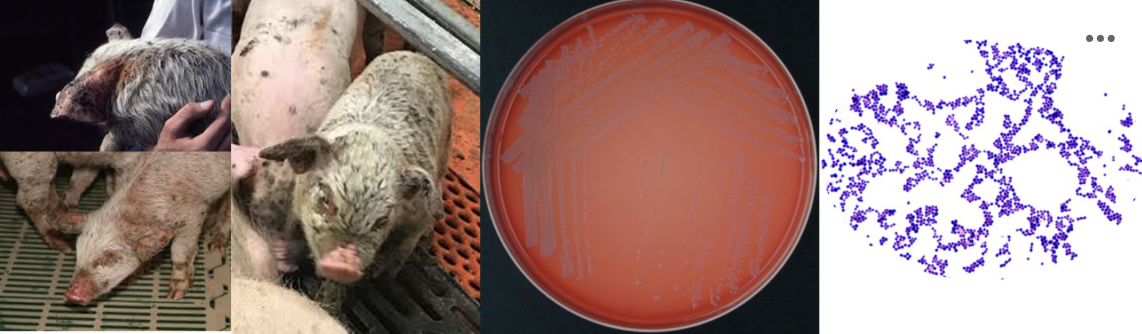
You work as a veterinarian on a farm where you observe piglets with these skin lesions. They appear greasy and dirty, with scabs and a foul odor. You take a sample from the lesions and culture it on blood agar at 37 °C for 24 hours, obtaining these colonies. When you perform a Gram stain and observe the sample under the microscope, you see these other lesions. Which infectious agent do you suspect?
A. Erysipelothrix rushiopathie
B. Staphylococcus hycus
C. Clostridium perfringens
D. Streptococcus suis
B
Indicate the type of hemolysis observed in the previous case.
A. Beta
B. Epsilon
C. Alpha
D. Gamma
D
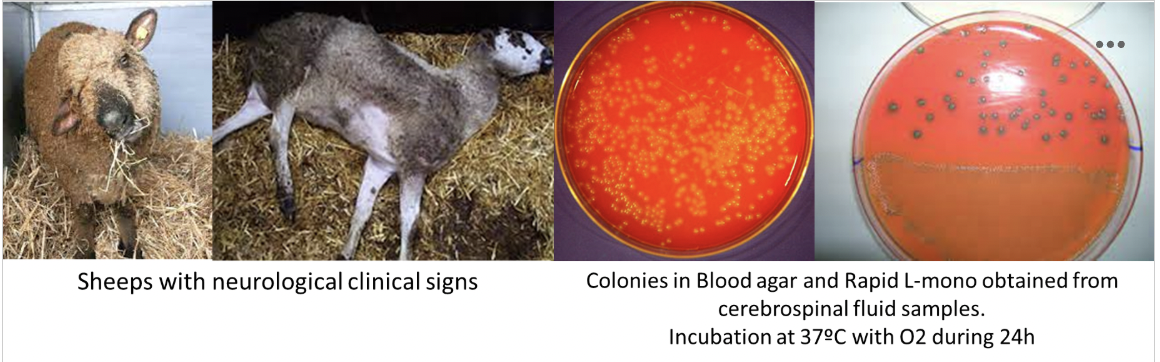
Indicate the possible etiological agent considering these clinical signs and these colonies.
A. Ingestion of Aflatoxins
B. Ingestion of Penitrem A
C. Listeria monocytogenes
D. Clostridium botulinum
C
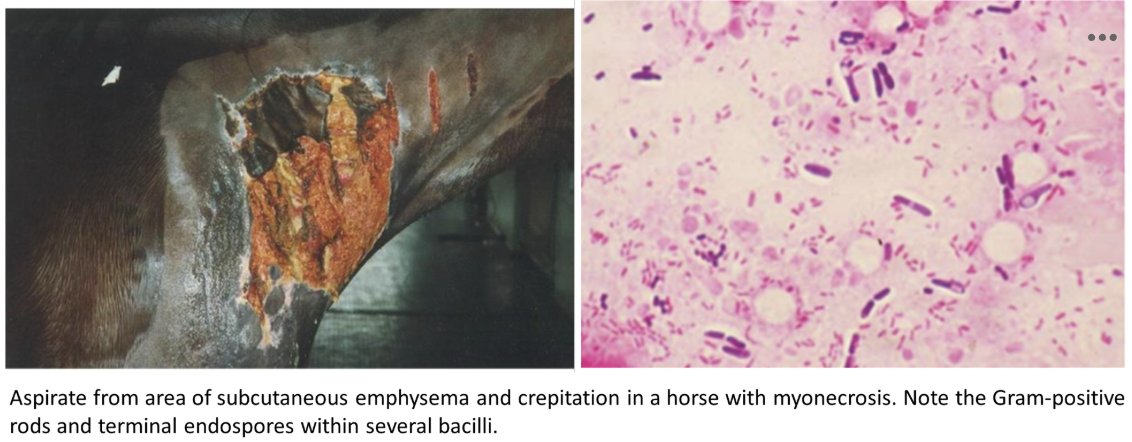
Indicate the possible etiological agent taking into account these images.
A. Nocardia spp.
B. Sporothrix schenckii
C. Clostridium perfringens
D. Histoplasma farciminosum
C
Indicate the possible etiological agent taking into account these images.
A. Actinomyces bovis
B. Staphylococcus aureus
C. Zygomycetes
D. Nocardia spp.
A
You are called because the owner of a horse has noticed that the animal has started to show purulent nasal discharge from its nostrils. When you examine the horse, you observe that it has a fever and that the lymph nodes are swollen, appearing like abscesses. You decide to send a sample of the nasal secretions to the laboratory to identify the etiological agent and begin antibiotic treatment. Indicate the possible etiological agent based on these images.
A. Rhodococcus equi
B. Streptococcus equi
C. Baillus anthracis
D. Mycobacterium tuberculosis
B
The previous disease is called...?
A. Tuberculosis
B. Strangles
C. Broncopneumoniae
D. Anthrax
B
Indicate the possible etiological agent taking into account these images.
A. Corynebacterium pseudotuberculosis
B. Mycobacterium tuberculosis
C. Histoplasma farciminosum
D. Mycobacterium avium subespecie paratuberculosis
A
Indicate the possible etiological agent of this respiratory disease.
A. Streptococcus equi
B. Rhodococcus equi
C. Aspergillus fumigatus
D. Staphylococcus aureus
B
Indicate the possible etiological agent taking into account the following lesions and colonies.
A. Corynebacterium bovis
B. Mycobacterium spp.
C. Nocardia spp.
D. Corynebacterium pseudotuberculosis
B
You detect an increase in animals showing neurological signs, pneumonia, and arthritis on a weaner pig farm. You decide to send a representative sample of each clinical condition — joint fluid, cerebrospinal fluid, and a lung sample — to determine the etiological agent and confirm which antibiotic to use. Indicate the correct answer based on the following results:
A. The etiological agent could be Arcanobacterium pyogenes.
B. The etiological agent could be Staphylococcus hycus.
C. The etiological agent could be Erysipelothrix rhusiopathiae.
D. The etiological agent could be Streptococcus suis.
D
What is the name of the possible etiological agent.
A. Staphylococcus hycus
B. Erysipelothrix rhusiopathiae
C. Bacillus anthracis
D. Clostridium perfringens
B
Indicate the correct name of the previous disease.
A. Dermatophytosis
B. Swine Erysipela
C. Nocardiosis
D. Exudative epidermitis or greasy pig disease
B
From a cow with mastitis, you have isolated the following colonies in blood agar. Indicate the possible etiological agent taking into account the following results.
A. Nocardia spp.
B. Streptococcus agalactiae
C. Staphylococcus aureus
D. Corynebacterium bovis
C
The farmer from a cattle operation calls you because his cows are losing weight and have diarrhea. When you arrive, you observe that the animals are in a cachectic state. You decide to perform a necropsy on one of the animals that has just died and find granulomatous lesions in the intestine (image). The regional lymph nodes show the same granulomatous lesions. You send a sample for histopathology, and they return the following results after performing a Ziehl–Neelsen stain. Indicate the possible etiological agent.
A. Actinomyces bovis
B. Corynebacterium pseudotuberculosis
C. Listeria monocytogenes
D. Mycobacterium avium subsp. paratuberculosis
B
The name of the previous disease was...
A. Pseudotuberculosis
B. Actinomycoses
C. Listeriosis
D. Paratuberculosis (Johne's disease)
D
We have stained with the GRAM staining the following microorganisms isolated in Blood Agar from a dog with external otitis. Indicate the possible etiological agent.
A. Malassezia pachydermitis
B. Staphylococcus intermedius
C. Candida albicans
D. Streptococcus hycus
B
Indicate the name of the possible etiological agent.
A. Listeria monocytogenes
B. Bacillus anthracis
C. Penicillium spp.
D. Clostridium botulinum
D
Indicate the possible etiological agent taking into account these results.
A. Clostridium perfringens
B. Clostridium botulinum
C. Bacillus anthracis
D. Clostridium tetani
C
This dog dies because of tetanus. Indicate the CORRECT answer.
A. Toxins are usually produced in wounds.
B. Toxins inhibit the releasement of the neurotransmitter acetylcholine in the neuromuscular junction.
C. This disease is characterized by muscular flaccid paralysis.
D. Genes which regulate the toxin production are in the bacterial chromosome.
A
Indicate which one is classified as a neurotoxic clostridia.
A. Clostriidum perfringens and C. tetani
B. Clostriidum botulinum and C. tetani
C. Clostriidum perfringens and C. chauvoei
D. Clostriidum botulinum and C. perfringens
B
Indicate the CORRECT answer considering these abscesses in different lymphnodes (onion ring appearance).
A. We are going to observe Zhiel-Neelsen positive cocci and rods from these lesions.
-33.3%
B. Transmission can be produced by pus discharges, nasal or oral discharges, coughing, vectors…
C. Incubation period of this disease is short.
D. It is recommended to open these abscesses in the farm to collect samples for laboratory examination.
B
From a cow with mastitis we have isolated haemolytic colonies into blood agar plates. We have made the CAMP test with Staphylococcus aureus and we have obtained the following result (IMAGE). Indicate the correct statement.
A. The etiological agent could be Corynebacterium bovis.
B. The etiological agent could be Streptococcus dysgalactiae.
C. The etiological agent could be Streptococcus agalactiae.
D. The etiological agent could be Listeria monocytogenes.
C
The small intestine of a piglet with diarrhea appears with these large wide gram positive rods. Indicate the possible etiological agent of these diarrheas.
A. Clostridium perfringens.
B. Staphylococcus hycus.
C. Clostridium tetani.
D. Streptococcus suis.
A
Which one can be zoonotic?
A. Streptococcus suis
B. Listeria monocytogenes
C. Dermatophytes
D. All of them are zoonotic
D
Bacteria can be divided into two main groups: Gram positive and gram negative bacteria, according to their colour when they are stained with the gram method. Indicate the correct answer take it into account this pgram staining.
A. It is oberved Gram + rods
B. It is oberved Gram - rods
C. It is oberved Gram + cocci
D. It is oberved Gram - cocci
A
Indicate the name of this antemortem test and the etiological agent for which it can be used.
A. Tuberculine test. Corynebacterium pseudotuberculosis.
B. Bruceline test. Mycobacterium bovis.
C. Tuberculine test. Mycobacterium bovis.
D. Bruceline test. Corynebacterium pseudotuberculosis.
C
You receive a dog at your clinic with the following skin lesions, which under the microscope appear as filamentous structures. However, they do not grow on Sabouraud dextrose agar but do grow on blood agar. Indicate the possible etiological agent.
A. Nocardia spp.
B. Actinomyces viscosus
C. Candida albicans
D. Staphylococcus pseudointermedius
B
According to the previous image, these microorganisms are...
A. Ziehl-Neelsen - and Gram - bacteria.
B. Ziehl-Neelsen + and Gram + bacteria.
C. Ziehl-Neelsen + and Gram - bacteria.
D. Ziehl-Neelsen - and Gram + bacteria.
D

