Section 19.3: Cardiac Cycle - Terms
 Call Kai
 Learn
Learn Practice Test
 Spaced Repetition
 Match
Match Flashcards
 Knowt Play
1/14

There's no tags or description
Looks like no tags are added yet.
Name | Mastery | Learn | Test | Matching | Spaced | Call with Kai | Chat |
|---|
No analytics yet
Send a link to your students to track their progress
15 Terms
Cardiac Cycle
The period of time that begins with contraction of the atria and ends with ventricular relaxation.

Systole
The period of contraction that the heart undergoes while it pumps blood into circulation.
Diastole
The period of relaxation that occurs as the chambers fill with blood.
Pressure Gradient
The movement of fluids from regions of higher pressure to regions of lower pressure.
Atrial Systole
The contraction of the atria following depolarization, represented by the P wave of the ECG, contributing to ventricular filling.
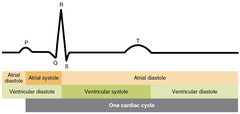
Ventricular Systole
The contraction of the ventricles following depolarization, represented by the QRS complex in the ECG, divided into isovolumic contraction and ventricular ejection phases.

End Diastolic Volume (EDV)
The volume of blood in the ventricles at the end of atrial systole, approximately 130 mL in a resting adult.
Isovolumic Contraction
The initial phase of ventricular systole where the volume of blood remains constant as pressure rises but semilunar valves remain closed.

Ventricular Ejection Phase
The phase of ventricular systole where pressure exceeds that in the pulmonary trunk and aorta, allowing blood to be ejected from the heart.

Stroke Volume
The amount of blood pumped by each ventricle per beat, normally 70–80 mL.
End Systolic Volume (ESV)
The volume of blood remaining in the ventricle after contraction, typically 50–60 mL.
Ventricular Diastole
The relaxation of the ventricles following repolarization, represented by the T wave of the ECG, divided into isovolumic relaxation and late ventricular diastole phases.
Isovolumic Ventricular Relaxation
The early phase of ventricular diastole where the volume of blood remains constant as pressure falls and semilunar valves close.

Heart Sounds
Audible sounds produced by the closing of heart valves, including S1 ('lub') and S2 ('dub').
Murmur
An unusual sound from the heart caused by turbulent blood flow, graded on a scale of 1 to 6.