Motor Learning, Exam 1
 Call Kai
 Learn
Learn Practice Test
 Spaced Repetition
 Match
Match Flashcards
 Knowt Play
1/32

There's no tags or description
Looks like no tags are added yet.
Name | Mastery | Learn | Test | Matching | Spaced | Call with Kai | Chat |
|---|
No analytics yet
Send a link to your students to track their progress
33 Terms
Motor control
The study of how the neuromuscular system functions to activate and coordinate muscles and joints during skill performance.
Motor learning
The study of skill acquisition, performance enhancement, reacquisition after injury, and the behavioral or neurological changes that occur during these processes.
Motor development
issues related to either or both motor learning and control
Motor skill
Task/activity with specific goal, requires voluntary control and movements of joints/body parts; aka actions
Cognitive skills
Task/activity with specific goal, mental activity including decision making, problem solving, remembering, etc.
Characteristics of skills and actions
have a goal to achieve
performed voluntarily
require control of joints and body segments
need to be learned or relearned
Many-to-one relationship
variety of movements can be used to accomplish one goal
One-to-many relationship
one movement can be applied in many contexts
Neuromotor processes
mechanisms with neurons and muscular systems that underlie the control of movements and actions
One-dimension classification system of motor skills
size of primary musculature: gross, fine
specificity of where movements of a skill begin: continuous, discrete, serial (rep of discrete skill, ex., playing piano)
stability of the environment: open (externally-paced), closed
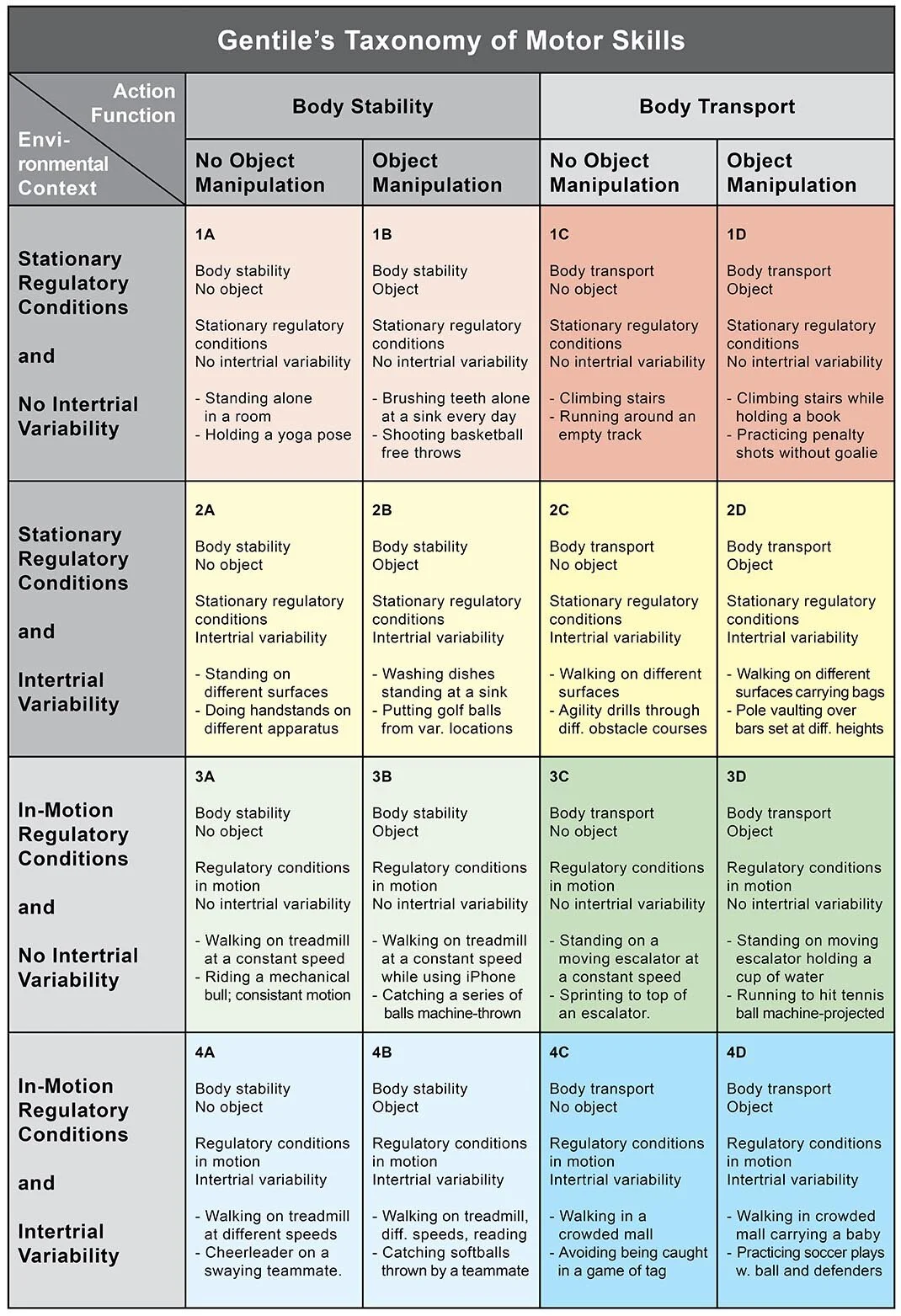
Gentile’s two-dimension taxonomy of motor skills
Environmental context:
Regulatory conditions — stable/predictable; environmental features which movements must conform to; spatial/temporal
(a) Stationary / In-motion
(b) Intertrial variability — whether regulatory conditions change from one trial to the next
Non-regulatory conditions — environment is changing/unpredictable (*not included in the chart)
(a) Intertrial variability
Function of the action
(a) Body transport
(b) Object manipulation
*1A is simplest, 4D is most complex
Performance outcome measure (POM)
indicates outcome/result of performing a motor skill but does not provide info about how action was performed (ex, how far a ball is thrown)
Performance production measures (PPM)
Indicates how the nervous, muscular, and skeletal systems function during the performance of a motor skill (ex, EMG, EEG)
Reaction time (RT)
measures how long it takes a person to prepare and initiate a movement; does not include any movement
Movement time (MT)
Interval of time betweRen initiation and completion of movement. Begins when RT ends.
Response time
Total time interval; reponse time = reaction time + movement time
Types of RT
Simple == involves only one signal and only one movement response
Choice == involves more than one signal, and each signal has a specified response
Discrimination == involves more than one signal, but only one response
Fractionated RT components
Premotor time — quiet period, no increase in muscular activity; between onset of stimulus signal and beginning of the muscle activity
Motor time — period of time from increase in muscle activity until actual beginning of observable limb movement; muscle is preparing to move
Error types for one-dimension movement goals
Absolute (AE) — abs diff between actual performance on each rep and the goal
Constant — signed (±) deviation from target or criterion
Variable — standard deviation of the CE scores for the series of repetitions
Kinematics
description of motion without regard to force or mass; displacement, velocity, acceleration, etc.
Kinetics
Study of role of force as a cause of motion. Human movements involve both internal and external factors
Joint torque/rotary force
Effect of force on rotation of body segments
Electromyography (EMG)
Recording of electrical activity of muscle or group of muscles
Whole muscle mechanomyography (wMMG)
Detects and measures lateral displacement of a muscle belly following maximal percutaneous neuromuscular stimulation
Ability
General trait or capacity of a person; Determinant of potential for skill performance
Motor ability
Any ability that is specifically related to performance of motor skill; Each individual has a varietyG
General motor ability hypothesis
Many motor abilities are highly related and can be grouped as a singular, global motor ability; older idea, less supported
Specificity of motor ability hypotheses
Many motor abilities are relatively independent in an individual; more supported
Balance
postural stability; static or dynamic; can’t conclude that only 1 test is a valid measure of balancing ability
Timing
External — precisely time movement with movement of an external object
Internal — time movements based on knowledge of time
Research: timing ability is specific to requirements of the skill being performed
“All-around” athlete
very proficient at variety of physical activities
actually very rare to find
may have high number of abilities in the “high” range of abilitiesE
Edwin Fleishman taxonomy of motor abilities
Goal was to define fewest independent ability categories to describe performance in the widest range of tasks
Abilities categories (11): speed of arm movement, RT, control precision, etc.
Physical proficiencies (9): static strength, trunk strength, dynamic flexibility, etc. A
Aptitude test
Predicts future performance of motor skill or physical activity