GENE 223 Mod 3 - Plant Development
 Call Kai
 Learn
Learn Practice Test
 Spaced Repetition
 Match
Match Flashcards
 Knowt Play
1/19

There's no tags or description
Looks like no tags are added yet.
Name | Mastery | Learn | Test | Matching | Spaced | Call with Kai | Chat |
|---|
No analytics yet
Send a link to your students to track their progress
20 Terms
Outline the main differences between plant and animal development (3)
Plants have a longer period of morphogenesis, often adapting significantly to their environment as they develop. This is partly a byproduct of plants not being able to move; they can’t switch environments
Plants have cell walls, so they can’t do gastrulation. Their germlines specify much later (relates to 1)
They can tolerate higher genetic loads without major disruption (can have many chromosomes, transposons, and chromosomal rearrangements more common)
How do plants ensure they can always grow back or in response to stimuli?
By use of meristems, meristematic cells are pluripotent and plants produce them their whole life, they are carried through the body and tend to concentrate around the ends.
What is the main model organism for plants?
Arabidopsis thaliana
Why are model plants used to study plant development?
- Easy to study and research community can work together
- Understand influence of genetics on key processes and impact of genetic variation and environmental factors
- Translate understanding into crop plants as they are quite similar
What makes Arabidopsis a useful plant model? (7)
•Short-generation time; ~8 weeks from seed to seed
•Small (adult ~20 cm tall) so easily grown in glasshouse or growth room
•Diploid genome (recessive mutations)
•Self fertile (inbreed) •Small genome size; ~130 Mb; whole genome sequence /great resources
•Research community; resources and knowledge
•Genetic variation in different accessions (over 1000 with whole genome sequence)
•Efficient transformation using Agrobacterium tumefaciens
How do we go about transforming model plants genetically using agrobacterium
Agrobacterium releases T-DNA (Transfer DNA) once it has infected a plant; it has genes that make the host cells produce hormones to promote cell proliferation and make food (opines) for the bacteria.
What structural features of Agrobacterium allow it to proliferate in infected plants.
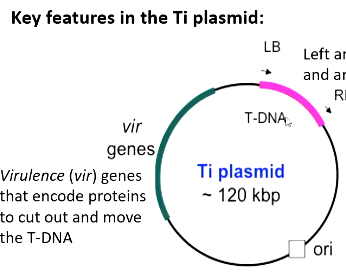
Agrobacterium contains a Ti (tumour inducing) plasmid required for infection. containing the T-DNA. The Ti plasmid contains:
Virulence (vir) genes that encode proteins to cut out and move the T-DNA
Left and right borders (LB/RB) flank the T-DNA and are recognized by the vir gene products T-DNA: Genes with eukaryotic promoters to express genes in host cells (hormone and opine synthesis)
Origin of replication: make more plasmid in the bacteria
How do we adapt the Ti plasmid in agrobacterium to make it useful for plant transformation?
Split the native Ti plasmid into two plasmids:
Helper plasmid: vir genes
Binary vector: LB and RB sequences with a cloning site (+/- plant selection gene), no disease-causing genes. Clone gene(s)-of-interest (promoter:CDS:term) between borders
Both plasmids will have selectable markers (AB resistance genes) that could be the same or different.

what are the main difficulties in transforming DNA into plants with agrobacterium and why is arabidopsis the best organism to do this in?
Transformation requires the T-DNA to integrate into the genomic DNA of one cell (rare) that is then regenerated into an entire plant (hard). For most plants, this requires tissue culture: - establish callus (undifferentiated cells) - transform and select transformed cells (e.g. herbicide in medium) - regenerate into a plant.
This works especially well in Arabidopsis because the cells that form the egg cells are susceptible to transformation.
Describe the general morphology of an arabidopsis flower?
Four organs arranged in concentric whorls. From the outside to the inside:
Whorl 1; Sepals (SE)
Whorl 2; Petals (PE)
Whorl 3; Stamens (ST)
Whorl 4; Carpels (CA) (Pistil; PI)
Give a general overview of how to perform mutant screens in Arabidopsis to find phenotypes for recessive mutations (5)
- generate plants with mutations (making mutants)
- find plants with mutant phenotype
- identify mutated gene
- confirm mutation/gene is causing phenotype
- perform other range of experiments (that you need to know the gene for)
Describe the first step of forward genetic screens, generating mutant plants
Treat plants with a mutagen
Usually chemical (EMS is common) - point mutation/ single nucleotide polymorphism (SNP). It causes mutations from GC-AT, often an early stop codon due to the T.
Radiation - range: SNPS to indels
Could also use Agrobacterium as the mutagen, as the insertion of the T-DNA can cause non-functional gene changes.
Describe the second step of Forward genetic screens in Arabidopsis, after exposing some to a mutagen
Find Mutant Phenotype:
Sow the seeds exposed to mutagen - M1 (Mutated 1) generation - phenotypes not expected because mutations are - heterozygous (recessive) - not present in every cell - number of M1 plants (100s to 1000s) Collect seeds and grow M2 (Mutated 2).

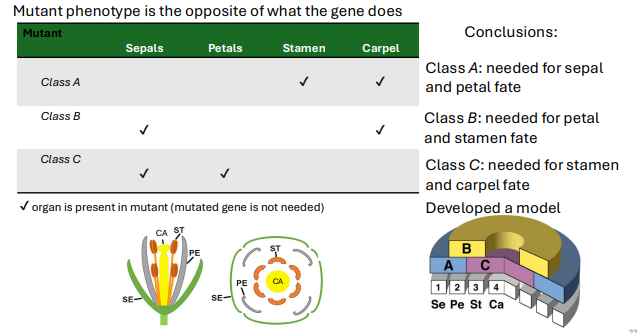
How do we use differing phenotypes in mutant Arabidopsila using a,b,c class mutants
This is a method for classing genes based on the different parts of the plant (whorls) that do not develop properly given a mutation of that gene, giving us a strong idea of the genes role in development
Briefly outline the ABC model of flower development in Arabidopsis
Three different groups of genes were found to have different effects on early flower development, discovered by knocking out the genes and discovering how it affected the flower.
Class A genes: required for sepals and petals and represses Class C genes
Class B genes: works with Class A and C genes for petals and stamens
Class C genes: required for stamens and carpels and represses Class A genes