Chapter 17 - Demand Side Policies
 Call Kai
 Learn
Learn Practice Test
 Spaced Repetition
 Match
Match Flashcards
 Knowt Play
1/37

There's no tags or description
Looks like no tags are added yet.
Name | Mastery | Learn | Test | Matching | Spaced | Call with Kai |
|---|
No analytics yet
Send a link to your students to track their progress
38 Terms
What is Monetary Policy
the set of official policies governing the supply of money and level of interest rates in a country
Who uses MP
a central bank (the bank for banks and the G)
two types of MP
Expansionary MP - raises AD and lowers IR
Contractionary MP - lowers AD and raises IR
how has monetary policy evolved over time in the UK?
1980s - German mark was shadowed to control inflation + strong belief in monetarist theories
‘90 - UK entered EU ERM
‘92 - ‘97 - UK leaves EU ERM (Black Wednesday) and moves back to floating xchange rates set by the G
‘97 - now - The BofE set up to be independent to the G and MPC set up to set IR
How did the European Union Exchange Rate Mechanism (EU ERM) work
Worked by setting an agreed upon central xchange rate for partaking currencies against the ECU and allowing fluctuations (+ or - 6%) in the UK’s case
What happened on Black Wednesday?
16th Sept 1992
the £ fell by >6% against the ECU
The govt tried to perk up the GBP by buying it up with foreign currency reserves and raising IR upto 12% in a day
to no avail as the UK left the EU ERM
Strengths of MP
easily implemented (IR can be altered quickly by BofE)
The BofE is independent - politics don’t impede its function
There’s no crowding out (only IR is affected)
Precise changes can be made - IR can be altered by as little as +- 0.25% (fine tuning)
Weaknesses of MP
time lags - AD takes time to reply to changes in IR
If IR is already low its ineffective at raising AD
if confidence is already low (esp in a recession) lowering IR does nothing
What is credit creation
credit creation occurs when banks lend money to customers, they’ll receive a deposit and loan out more as a multiple of the deposit
what is the minimum reserve requirement (MRR)
the % of a deposit that banks are legally required to hold in reserve incase the depositor needs it (the uk doesn’t have one)
how does credit creation work
someone deposits 100k into my bank (MRR is 20%)
i divide it into 5 packets of 20k (the mrr)
i keep one for the depositor
the remaining 4 i use as the MRR and grant 4 ×100k loans
(I just created 400k)
money multiplier formula
1/mrr
How is the MRR used to control the money supply
if the BofE raises the MRR the multiplier decreases (inv. proportional) this will lower credit creation which lowers money supply which raises IR - (this is contractionary MP)
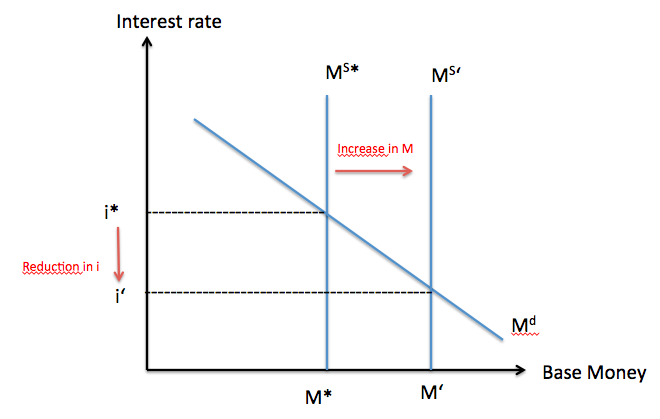
how do open market operations to control money supply
this involves buying&selling of govt securities (bonds) by the BofE (low risk and redeemable after a few years)
If the BofE wants contractionary MP they’ll sell the securities - decreases funds and lowers money supply (IR rises and C+I fall)
(expansionary MP is the opposite)
what does the open market operations diagram look like
did you get it?
what are 3 ways of saying the base rate
minimum lending rate
refinancing rate
discount rate
How does the BofE alter the base rate to control money supply
this is the IR for banks and it influences our own IR
If the BofE wants CMP they’ll raise base rate which raises commercial IR which decreases borrowing snd raises savings so c+i fall as does AD
(EMP the opposite of what i just said)
What is Quantitative Easing (QE)
the introduction of new money into an economy
Expansionary MP
a common form of EMP since ‘08 when IR was low and demand wasn’t rising
steps to QE
Central bank buys securities off of financial institutions
this gives them more reserves - more liquidity (encourages more lending as IR is low too)
C+I rises as does AD
low IR = low xchange rates which raises (x - m)
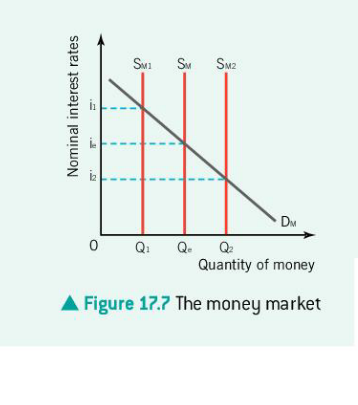
Interest rates are
The price (opportunity cost) of having money OR the reward for saving
Real IR =
Nominal IR - inflation rate
money market diagram
did you get it?
What is fiscal policy (FP)
When tax revenue and government expenditure are used to influence an economy
the 3 types of public spending
Capital spending (investing in Capital stock)
Current spending (ongoing payments)
Transfers (benefits and other things which the G doesn’t expect back)
Aims of FP
maintain a low and stable rate of inflation
a low unemployment rate
stable environment for long term growth
promote an equitable distribution of income
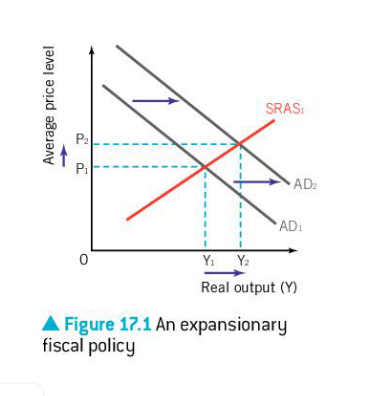
What is Expansionary FP
The G can lower income tax which raises disposable income which raises consumption
The G can lower corporate taxes which increases profit and increases investment
the government can raise their own spending which increases AD
(EFP is a trade off between lower unemployment and inflation
expansionary FP diagram
did you get it
aims of contractionary FP
control economic growth
curb inflation
lower a budget deficit
Strengths of FP
Great at dealing with recessions (Great Depressions and 2008 World Depression)
Govt expenditure can be used to target certain sectors
Tax cuts can also be targeted
Constraints of FP
Time lags (Tax cuts have to be changed democratically and once changed it takes a while to see effects)
Political pressure (the govt won’t raise taxes if they wanted to keep power)
Too much EFP leads to unsustainable debt
crowding out - a rise in The G borrowing leads to them monopolising the available funds so the rise in G spending is negated by the fall in investment
What is Government (national) debt
the accumulation of all the budget deficits over the years & [as a % of GDP] , the amount owed to creditors
what are Debt Servicing costs
the amount of money needed to make payments on the principal & interest of a loan in a given time period
what are the costs of running high government debt
crowding out
rising debt servicing means the G will cut back in other sectors
and if they don’t cut back they’ll raises taxes which leads to falling income and output
Govts with large debts have fewer options when it comes to responding to crises
What is the multiplier effect
an injection of g. spending leads to a larger final increase in national income and GDP. one person's spending becomes another person's income, triggering multiple rounds of subsequent consumption.
how does the multiplier effect work
G. spending and Business investments are injections into the circular flow
these injections are then multiplied through the economy
people receive a share and then spend a part of what they receive
what is the Marginal propensity to consume
the proportion of an extra unit of income that will be spent as opposed to saved
what are the two keynsian multiplier formulae
multiplier = 1/1-mpc or 1/mpw (
what is the MPW
MRT + MPM + MPS

