ECE 1004 Exam 2
 Call Kai
 Learn
Learn Practice Test
 Spaced Repetition
 Match
Match Flashcards
 Knowt Play
1/36

There's no tags or description
Looks like no tags are added yet.
Name | Mastery | Learn | Test | Matching | Spaced | Call with Kai | Chat |
|---|
No analytics yet
Send a link to your students to track their progress
37 Terms
Mesh Analysis Procedure
Identify individual meshes and assign mesh current
Identify super-meshes if a shared current source exists
Develop mesh equations using KVL and Ohm’s Law
Solve the simultaneous equations to find mesh currents, which then allow for the calculation of any voltage or power in the circuit.
REMEMBER SOURCE EQ IF SUPER MESH
Linear two-terminal circuit
Electrical network accessible via two external connection points (terminals)
Passive linear comps: resistors, inductors, capacitors
Independent voltage/current sources, and linearly dependent sources (ex VS)
Connects to external circuits or loads through exactly two external nodes (often A & B)
Thevenin’s Theorem
Any linear two circuit containing multi sources and resistors can be replaced by a much simpler equivalent circuit made of: One voltage source VTh in series w/ one resistance RTh
Complex circuit supples power to load resistor → So we reduce the source network to VTh in series w/RTh
Thevenin → How To
Remove the load
Find the open-circuit voltage
Find RTh (Deactivate → Replace ideal voltage source w/short circuit, and ideal current source w/voltage circuit
Norton’s Theorem
Any linear two-terminal can be replaced by an equivalent circuit consisting of: One current source IN and one resistor RN connected in parallel w/ the current source.
Norton’s Theorem → How To
Remove the load (same as T)
Short the output and find the Norton current (IN = ISC)
Find the Norton Resistance (Same as T: voltage - open, current - open)
then solve for load, draw, etc
Source transformation
Replaces a voltage source within an equivalent current source (or vice versa) without changing the behavior seen from the external terminals
(Ex voltage source in series w resistor → current source in parallel w resistor)
RESISTOR DOESN’T CHANGE : I = Vs/R
CURRENT ARROW(direction) TO POS. TERMINAL OF VOLT
Capacitor
A passive electrical component that stores electrical energy in the form of an electric field
Consists of two conductive plates W/ an insulating material (dielectric) between them
COMPONENT THAT TEMPORARILY STORES ELECTRICAL ENERGY AND RELEASES IT WHEN NEEDED
How does a Capacitor work?
Voltage source is connected across capacitor and electrons push from one plate to another
THUS, one plate is negatively charged and other equally positive
Middle is insulating so electrons can’t pass through
SO, electric field forms between the plates and ENERGY is stored in field
HAPPENS until capacitor voltage equals source voltage, then charging stops and current = 0 and capacitor is OPEN circuit
Voltage creates a electric field
Capacitor Applications
Blocking DC curent
Blocking AC current
Shift phase
Store energy
Suppress noise
Start motors
Provide pulse power
Capacitor Properties
w/DC applied voltage is constant and Current = 0 (i = Cdv/dt, and dv/dt = 0)
Voltage across a capacitor must change smoothly over time (no infinite current or abrupt change)
Decoupling/Bypass Capacitors
Very important for situations where you want to reduce noise on the power rails, basically filter signal (As you know!)
Inductor
A passive electrical component that stores electrical energy in the form of magnetic field when current passes through it
Consists of a core material wrapped w/ winding insulating copper wire and a magnetic forms around it
How do Inductors work
When current passes through the coil, a magnetic field is created around it
Stronger current, stronger magnetic field and more energy is stored
Current creates a magnetic field
Inductor Properties
BASICALLY OPPOSITE TO CAPACITOR!
w/DC applied current is constant and voltage = 0 (i = Cdv/dt, and dv/dt = 0) (SO SHORT)
current across a capacitor must change smoothly over time (no infinite voltage or abrupt change)
Capacitor vs Inductor
Capacitors are..:
charge up fast (peak current is at 0 initial voltage)
discharge quickly too, current changes direction quickly
Inductors are..:
opposing emf resist changes
so inductors charge slowly and discharge slowly
inductor current will not change direction abruptly
Semiconductor
Material who’s electrical conductivity lies between that of a conductor and insulator
Conductor - allows current to flow easily
Semiconductor - conducts current under some conditions and resists current under other conditions
Insulator - resists current
Why silicon
abundant, stable, and suitable (14 electrons total 4 in valence and held by covalent bonds)
Intrinsic semiconductor
Completely pure semiconductor, no doping (mixing)
Electrical conductivity is determined by the thermal energy of material rather than chemical impurities
Electron-hole
At low-temps, electrons in covalent bonds
At room-temps, thermal energy can break some bonds, the breaking allows electrons to move leaving behind holes and if enough energy can create electron-hole pair
Doping
Since pure silicon is not conductive enough on its own, a very small amount of another element is added to improve its electrical behavior
N-type semiconductor
N-type silicon is made by adding an impurity w/five valence electrons, such as phosphorus
One leftover electron, so it can move easily and carry current
Electrons majority carriers, holes minority carriers
N COMES FROM ELECTRON MAJORITY NEGATIVE
P-type semiconductor
P-type silicon is made by adding an impurity w/three valence electrons, such as boron
Four electrons needed to create four bonds, only 3, so one incomplete bond aka HOLE
Holes are majority carriers, electrons are the minority carriers
P COMES FROM POSITIVE BEHAVIOR OF HOLES
PN-junction and HOW
When P-type and N-type materials are joined they form a PN-junction, which is basic structure of diode
how it works
Electrons diffuse from the N-side toward to P-side
Holes diffuse from P-side toward the N-side
Electrons and hole combine near the junction, creating a region nearby that’s depleted of mobile charge carriers called DEPLETION REGION
fixed ions create internal electric field which forms a potential barrier that opposes further diffusion
Forward/reverse biasing
Vd = 0.7 V (of silicon pn-junction)
forward: when voltage > 0.7, diode conducts current since voltage opposes the built-in-field
reverse: increases effect of built-in-field, eliminating possibility of current flow
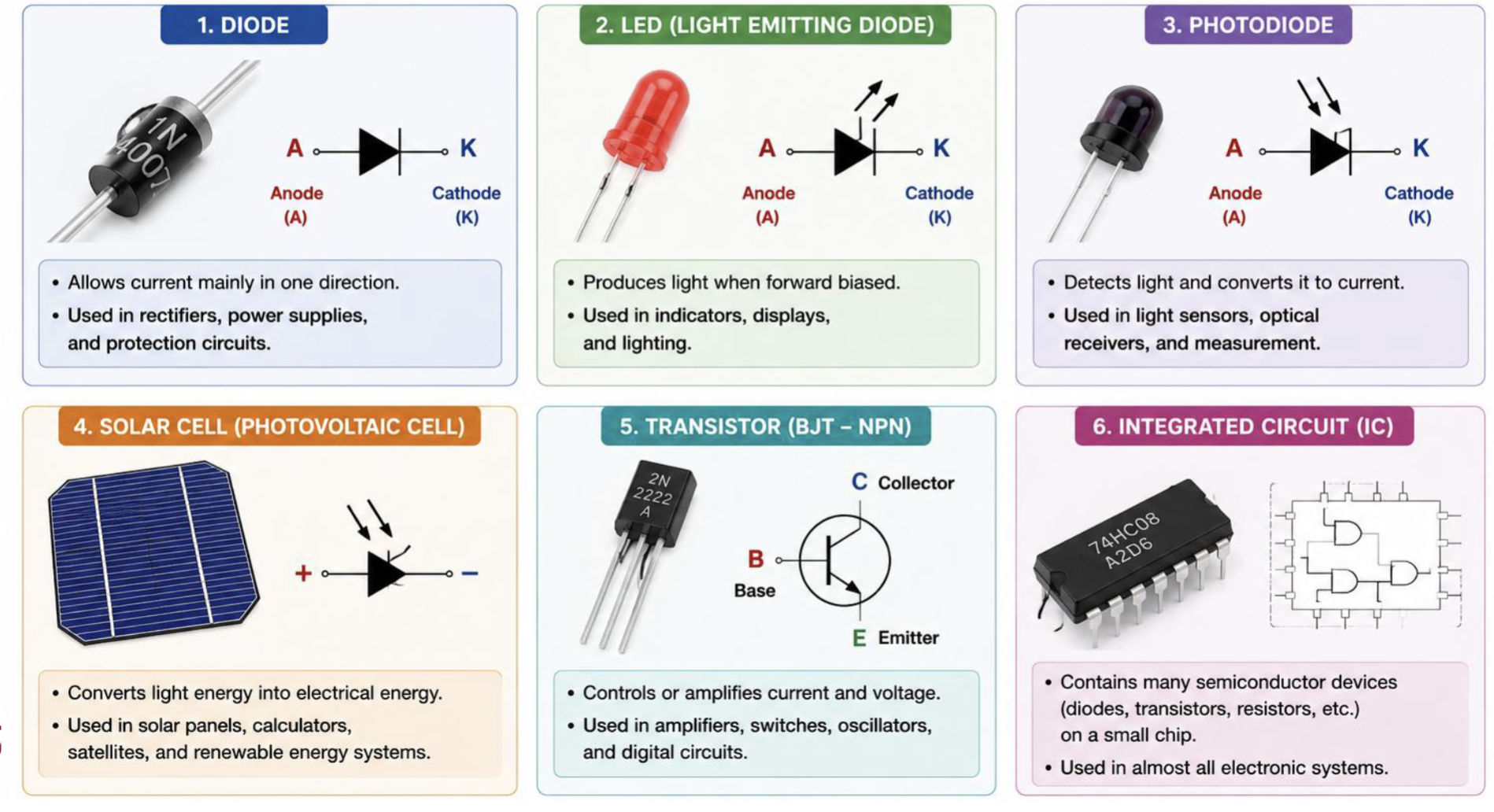
Semiconductors:
Diode
LED (Light-emitting diode)
Photodiode
Solar celL
Transistor
Integrated circuit
Solar panel
sillicon is used, photons of light create electron-hole pairs
E field sweeps electrons out, creating photocurrent
Current sourcing is dependent on the amount of sunlight
Biasing LEDs/Transistor
Biasing LED: must contain resistor, limited current
Transistor: made up of two diodes
Evolution of Computing Technology
Abacus
Mechanical Calculator
Vacuum tubes
Transistors
Integrated circuits
Microprocessors
Personal computers
Internet
Smartphones
Artificial Intelligence
Recent Developments in Technology
Artificial Intelligence
Machine Learning
Internet of Things
Cloud Computing
Edge Computing
Robotics
Self-Driving Cars
Smart Homes
Wearable Devices
5G/6G Technology
Quantum Computing
AI/ML
-Learning
• Reasoning
• Problem solving
• Understanding language
• Recognizing images
• Making decisions
ML IS SUBSET OF AI, MORE FOCUSED ON LEARNING OBVI
Internet of Things
A network of physical devices connected to the internet
These devices collect data, share information, and communicate automatically
EX: smart thermostat/refrigerator/watch/traffic lights/watch
Cloud Computing
Cloud computing allows users to store data and run applications over the Internet
instead of on their own computers.
Access anywhere, Automatic backup, Easy sharing, Large storage
EX: Google Drive, Microsoft OneDrive, Dropbox, Netflix, Gmail
Robotics
Robotics combines Electronics, Sensors, Mechanical engineering, Artificial Intelligence to build intelligent machines.
EX: Manufacturing/Medicine
Data
Data is a collection of raw facts, figures, symbols, measurements, or observations that can be processed by a computer to produce meaningful information.
Data → Processing → Information
Computer stores in binary digits or bits
Decimal conversion to new bases (to convert fractional part of decimal)
Multiply the fraction by the target base
Record the integer part of the result
Keep only the fractional part
Repeat until: The fractional part becomes zero, or you obtain the desired number of digits
Read the recorded integers from top to bottom
Converting Binary to Octal
Group bits in groups of 3 (if bits are not a multiple of 3 then add 0’s)
Convert the three bits to a decimal number
Number in octal is is combination of these numbers