Cell Biology - BIOB10
 Call Kai
 Learn
Learn Practice Test
 Spaced Repetition
 Match
Match Flashcards
 Knowt Play
1/279

There's no tags or description
Looks like no tags are added yet.
Name | Mastery | Learn | Test | Matching | Spaced | Call with Kai | Chat |
|---|
No analytics yet
Send a link to your students to track their progress
280 Terms
Cells
What is the fundamental unit of life?
Hooke
Dawg examined cork under microscope made up of ‘cells’
Leeuwenhoek
Dawg examined pond water under microscope and found ‘animalcules’
Schleiden, Schwann, Virchow
3 dawgs who proposed the cell theory
Cells
3 parts of Cell Theory:
All organisms are composed of one or more …
The cell is the structural unit of life
Cells can arise only by division from preexisting cell
Cell
3 parts of Cell Theory:
All organisms are composed of one or more cells
The … is the structural unit of life
Cells can arise only by division from preexisting cell
Division
3 parts of Cell Theory:
All organisms are composed of one or more cells
The cell is the structural unit of life
Cells can arise only by … from preexisting cell
10
How many universal features of cells are there?
Double stranded
Universal features of cells:
Cells store information in … (2) DNA
Replicate
Universal features of cells:
Cells can … their DNA
RNA
Universal features of cells:
Cells can transcribe portions of DNA into …
Proteins
Universal features of cells:
Cells can translate RNA into …
Gene
Universal features of cells:
Each protein is encoded by a specific …
Replication
Universal features of cells:
Cells can make more of themselves via …
Catalysis
Universal features of cells:
Cells can use proteins as … which speed up chemical reactions without changing
Catalysts
Molecules that speed up the chemical reaction without changing
Acquire, use
Universal features of cells:
Cells can … and … energy to carry out chemical reactions (basic lol)
Plasma membrane
Universal features of cells:
All cells have a … (2) barrier
Movement
Universal features of cells:
Cells have constant …
Brownian motion
Random movement of particles (2)
Phototrophic
Cells obtain energy in different ways:
Sunlight
Lithotrophic
Cells obtain energy in different ways:
Inorganic chemicals in the environment
Organotrophic
Cells obtain energy in different ways:
Other living things and organic chemicals they produce
Bacteria, archaea, eukarya
Types of cells:
3 major classification
Prokaryotes
Types of cells:
Before nucleus (has no nucleus)
Prokaryotes
All bacteria are …
Archaea
Types of cells:
Similar structurally to bacteria but genome is closer to eukaryotes
Eukaryotes
Types of cells:
Comprise organelles w/ nucleus
Unicellular or multicellular, membranes
2 things about eukaryotes of note:
Eukaryotes can be (… or …)
Eukaryotes can also have organelles with no …
Cell walls
Plant and fungal cells have … (2) that animal cells do not.
Cytoskeleton
Since animal cells do not have a cell wall, they rely on … to give strength and shape to cell
Cytoskeleton
Network of long, fibrous proteins giving animal cells strength & shape
Predators
Eukaryotes may have originated as … where some prokaryotes engulfed other hoes (endosymbiont)
Endosymbiont theory
Theory that combination of 2 cells living in symbiotic relationship where 1 cell lives in another (prokaryotes to eukaryotes) (2)
Anaerobic archaeal, aerobic bacterium, mitochondria
An … (2) cell engulfed an … (2) which evolved to become the …
Differentiation
Process by which an unspecialized cell becomes specialized
Environment
Differentiation occurs mostly through signals received from the …
Morphology
Differentiation: Changes often occur in cell … (appearance)
Number, location
Differentiation: Organelles stay the same, but their … and … may differ
Unique proteins
Differentiation: Differentiated cell expresses cell-specific genes via … (2)
In vitro
Cells can be isolated from tissues and grown in culture (2)
Culture
A simplified, controlled environment where cells are isolated from tissues and grown artificially
1
Culture: Most cultures constitute only … type of cell
Cell line
Homogeneous cells that have undergone modifications to grow continuously in culture (can be tumor cells) (2)
Primary culture
Cells obtained directly from the organism (2)
Light
Microscopy: Examining cellular structures at high resolution, produces enlarged images of object
Wavelength of light
Microscopy:
Resolution is dependent on the … (3)
Fluroescence
Microscopy: Uses fluorescent molecules instead of dyes (light)
Green fluorescent protein
Fluorescence microscopy:
Common fluorescent molecule attached to proteins (3)
Fluorescent antibodies
Fluorescence microscopy:
Instead of Green Fluorescent Protein, sometimes we can use … (2) to help visualize proteins
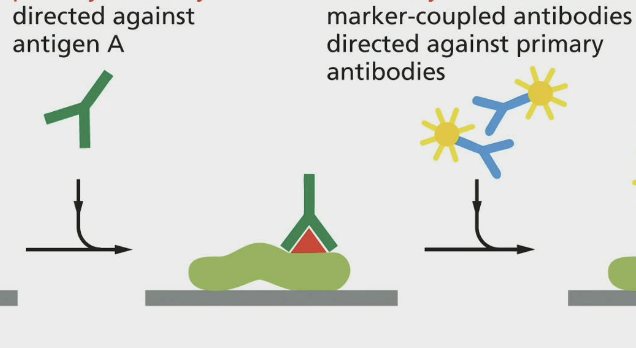
Excited state
Fluorescence microscopy:
Light is shown on molecules making them reach …(2) by absorbing photons and emitting light
Confocal
Microscopy: Produces higher resolution images by excluding out of focus light
Superresolution
Microscopy: Most refined form of light microscopy, produces higher resolution images by overcoming diffraction limit
Electron
Microscopy: Most detailed ever
Pass through
Electron microscopy uses electrons as ‘light’ source by forming an image when electrons … (2) specimen
Scanning electron
Microscopy: Without slicing them into thin sections showing entire cell structure image (2)
Unity of Biochemistry
Organisms are quite uniform at the molecular level (3)
Atoms
Basic unit of matter (protons + neutrons near nucleus, electrons near shell)
Molecules
2+ atoms in definite arrangements held together by chemical bonds
Biomolecules
Molecules made by living organisms
Carbon
Biomolecules are centered around …
Carbon, hydrogen, nitrogen, oxygen
4 atoms that are abundant in atoms
Covalent bonds
The reason why C, H, N, O are important in biomolecules are because they can form … (2) making them stable
Polar
Electron distribution is not equal
Assymetric charge distribution
1 atom has partial negative charge and other has partial positive charge (3)
Electronegative
Atom with the greater attractive force
Non polar
Equal sharing of electrons & lacks electronegative atoms
Ionic, hydrogen, van der waals, hydrophobic
Types of noncovalent interactionsimportant to cells (4)
Ionic
Noncovalent interactions:
Result of electrical attraction because of opposing charges
Ionic
Noncovalent interactions:
Involves transfer of electron(s) from 1 atom to other
Hydrogen
Noncovalent interactions:
Weak bonds as a result of electrical attraction
Hydrogen
Noncovalent interactions:
Keeps DNA together, polar molecules interact w/ other polar molecules (i.e. water)
Van der waals
Noncovalent interactions:
Weak & nonspecific interaction between 2 atoms in close proximity
Van der waals
Noncovalent interactions:
Temporary charges in non-polar molecules called dipoles
Motion
Noncovalent interactions:
Van der waals forces form because electrons are constantly in …
Dipoles
Noncovalent interactions:
Van der waals forces exist because of temporary charges in nonpolar molecules called …
Covalent
In the case of cell biology, what is the strongest chemical bond?
Covalent or ionic?
Hydrophobic
Noncovalent interactions:
Uncharged non-polar molecules do not interact w/ polar molecules (e.g. water)
Hydrogen
Noncovalent bond where electropositive H atom is partially shared by 2 electronegative atoms
Macromolecules
Other than water, the majority of cells is made of …
Linear, branched, cyclic
Biomolecules:
3 ways long chains of carbon atoms used to construct biomolecules
Functional groups
Biomolecules:
Hydrogen is often replaced by … (2)
Functional groups
Particular atom groupings that behave as a unit (often replaces hydrogen) (2)
Methyl, hydroxyl, carboxyl, amino, phosphate, carbonyl, sulfhydryl
7 most common functional groups
Electronegative, polar
Functional groups affect the properties of biomolecules because they contain … atoms and make molecules more (or less) …
Macromolecules
Polymers of building blocks known as monomers
Polymers
Macromolecules are … of building blocks known as monomers
Monomers
Macromolecules:
Polymers are formed by joining …
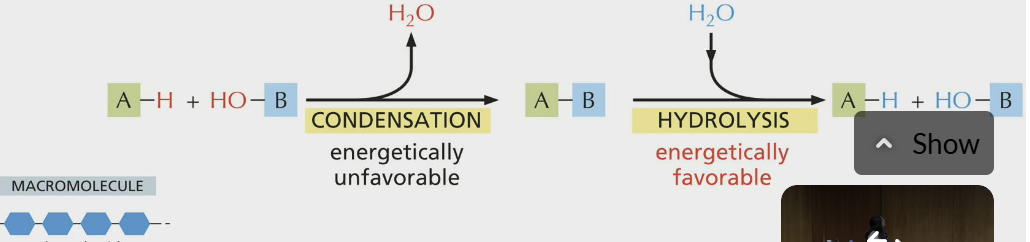
Condensation, removed
Macromolecules:
Polymers form by joining monomers via … where water is …
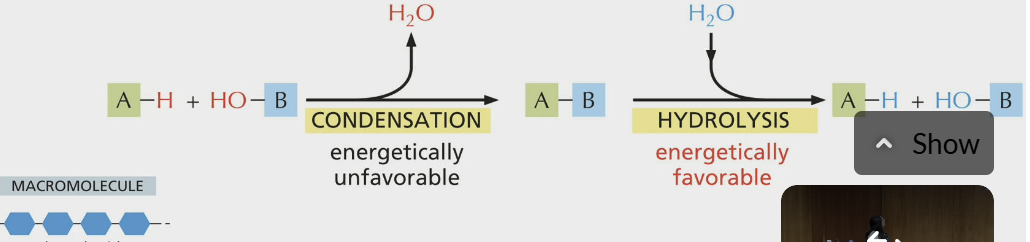
Hydrolysis, added
Macromolecules:
Polymers are broken down into monomers via … where water is …
(CH2O)n
Carbohydrates:
General formula
3-7
Carbohydrates:
Important sugars in cell metabolism have … (range) carbons
Trioses
Carbohydrates:
3 sugars
Tetroses
Carbohydrates:
4 sugars
Pentoses
Carbohydrates:
5 sugars
Hexoses
Carbohydrates:
6 sugars
Ketone, ketose
Carbohydrates:
Carbonyl internal positions forms … which is called …
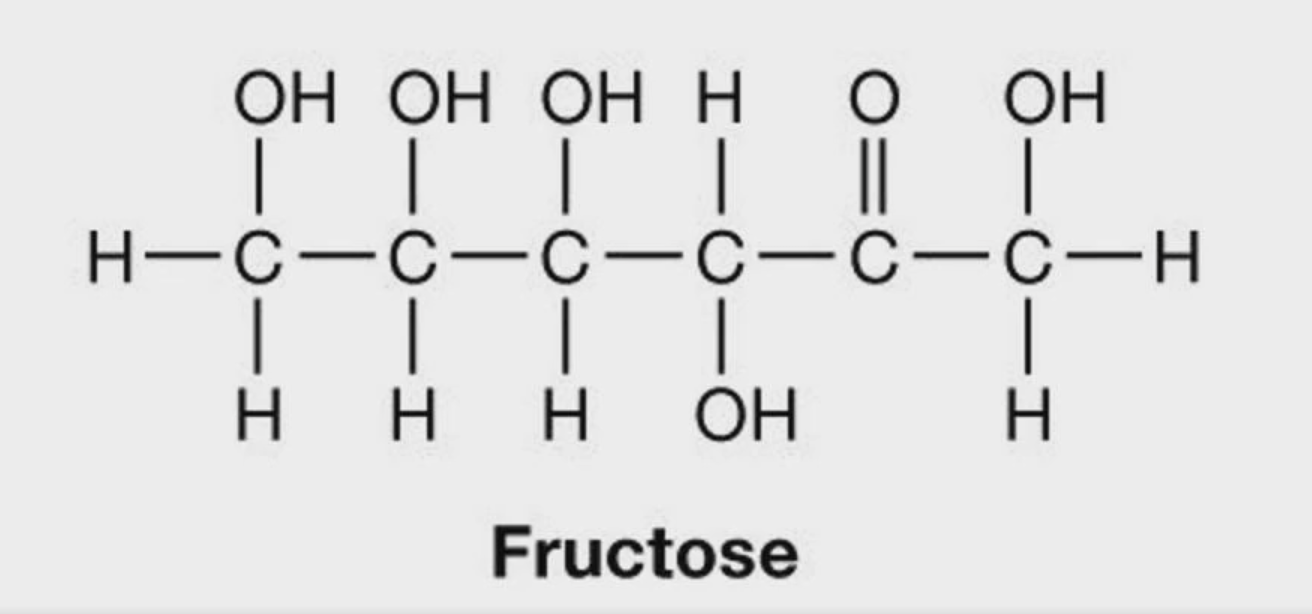
Aldehyde, aldose
Carbohydrates:
Carbonyl at one end forms … which is called …
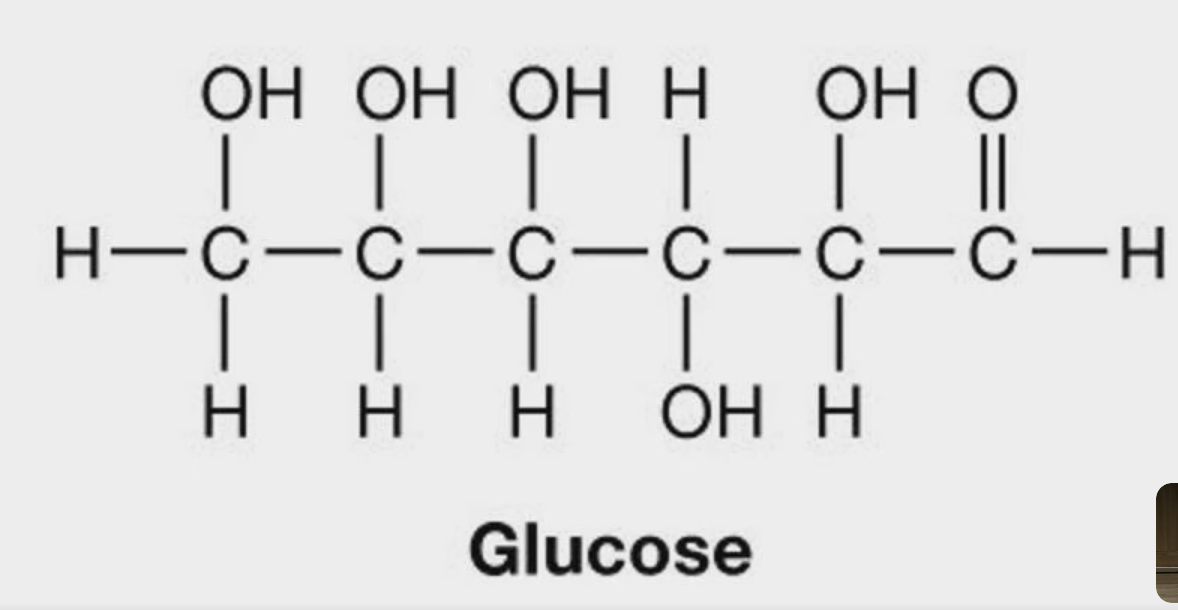
Monosaccharides
Sugars with 5+ carbons form a closed ring structure
Hydroxyl
In aqueous solution, aldehyde or ketone group tend to react with … group of same molecule creating a ring [monosaccharides]