PSYC104 MIDTERM 3 STUDY GUIDE
 Call Kai
 Learn
Learn Practice Test
 Spaced Repetition
 Match
Match Flashcards
 Knowt Play
1/27

Earn XP
Description and Tags
hai :3
Name | Mastery | Learn | Test | Matching | Spaced | Call with Kai | Chat |
|---|
No analytics yet
Send a link to your students to track their progress
28 Terms
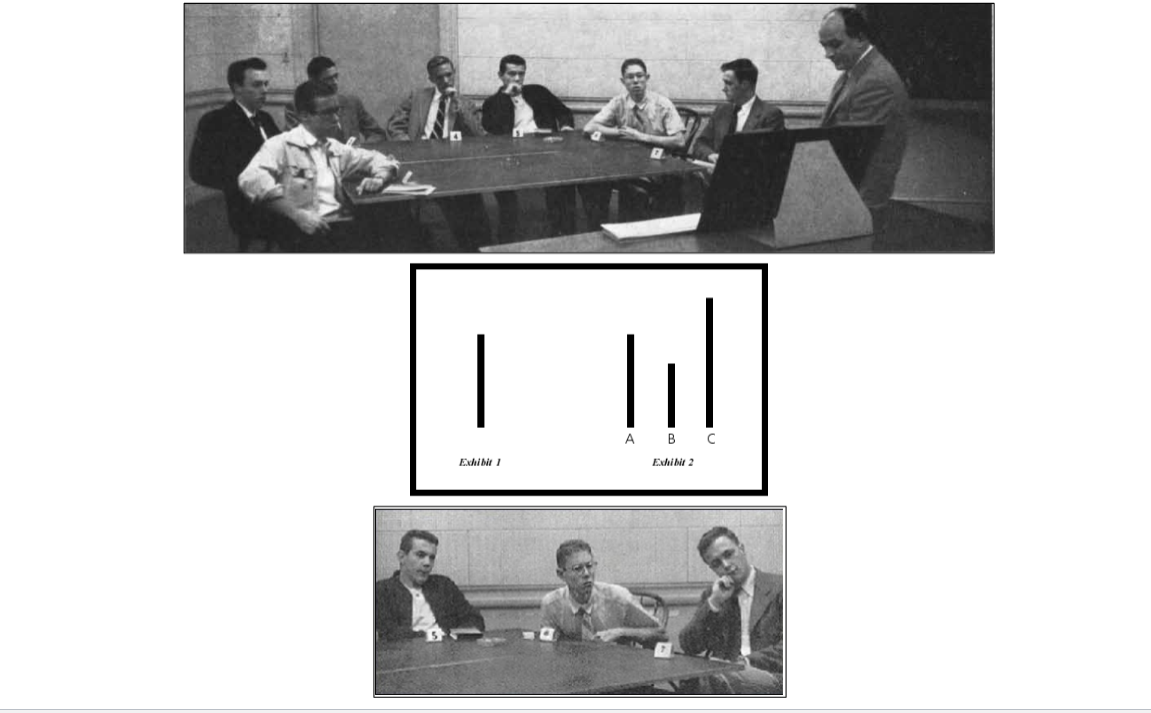
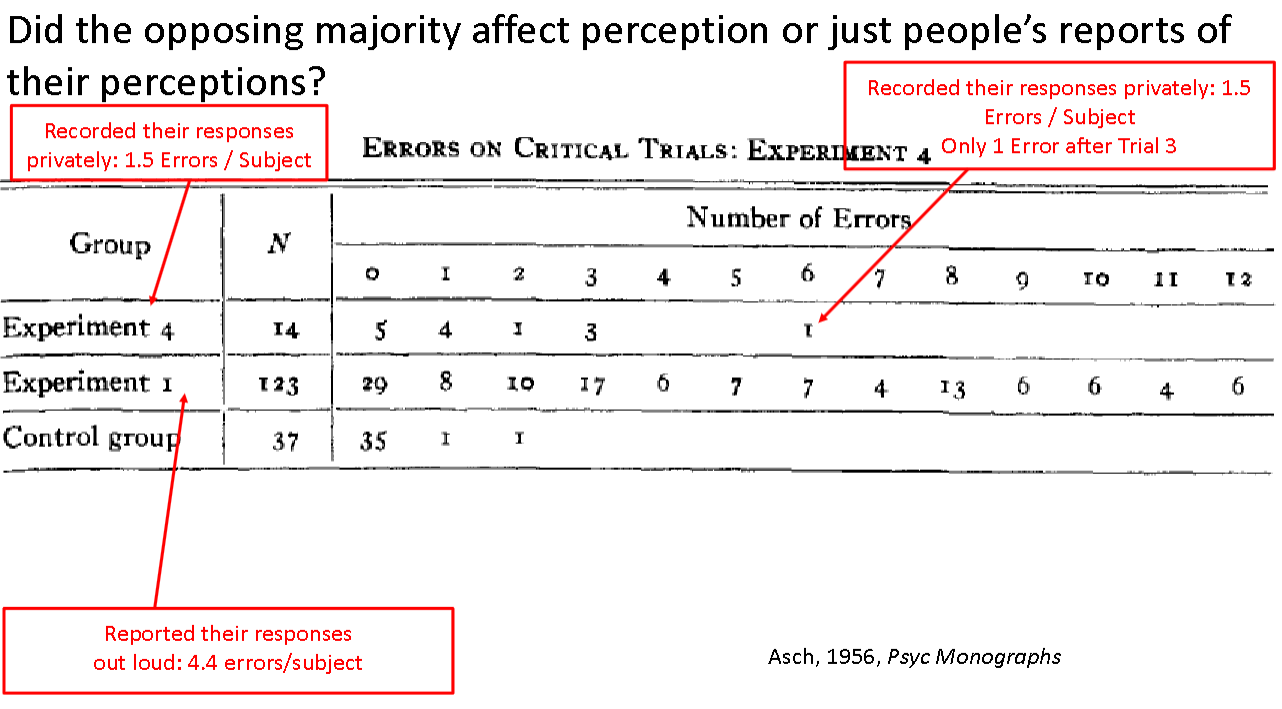
Describe Asch’s conformity experiments and the main findings. Do people actually
change their perceptions in response to conformity pressure, or just their self-reports?
The Asch Experiment: a visual perception test (line length) with one true participant alongside actors participating in the same task.
Participant tended to conform to the group despite not believing the answer was correct
We are aware of what others think so in order to be liked we go along with the group
Our self reports change but our perception doesn’t
1.5 errors/subject when privately reporting
4.4 errors/ subject when reporting outloud
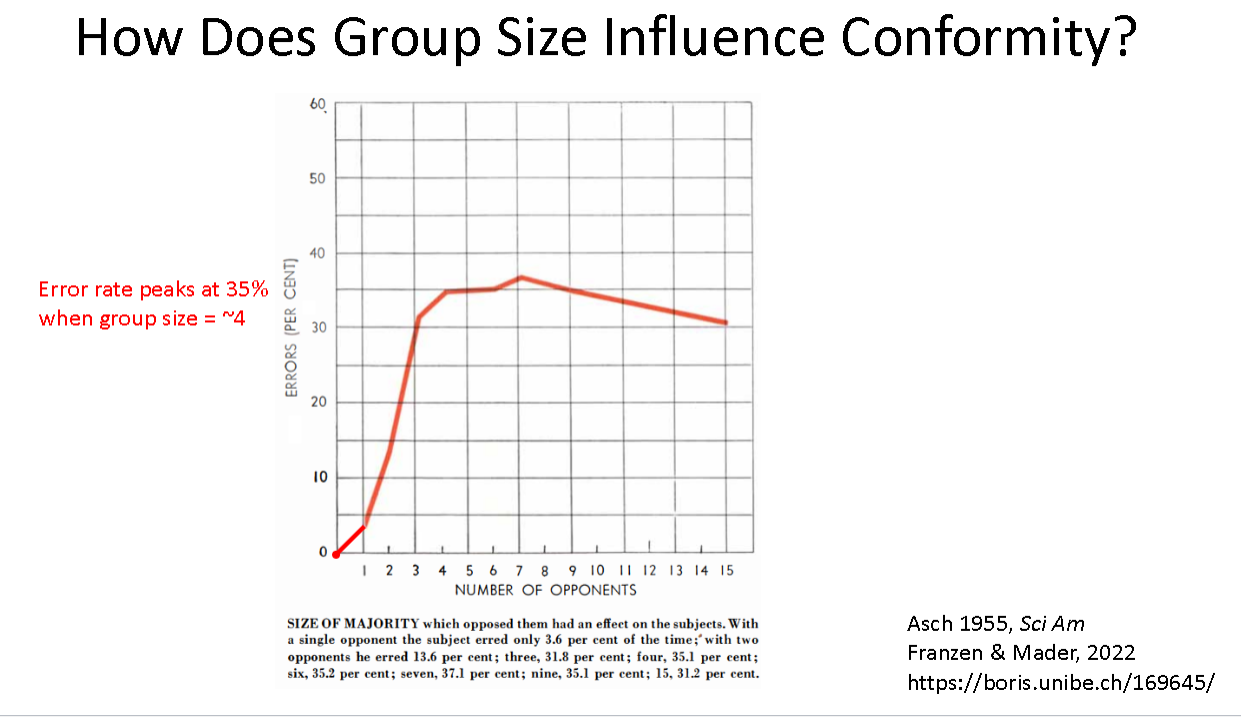
How big does the majority group need to be to maximize people’s tendency to conform?
When group size is around 4 error rates peak at 35%
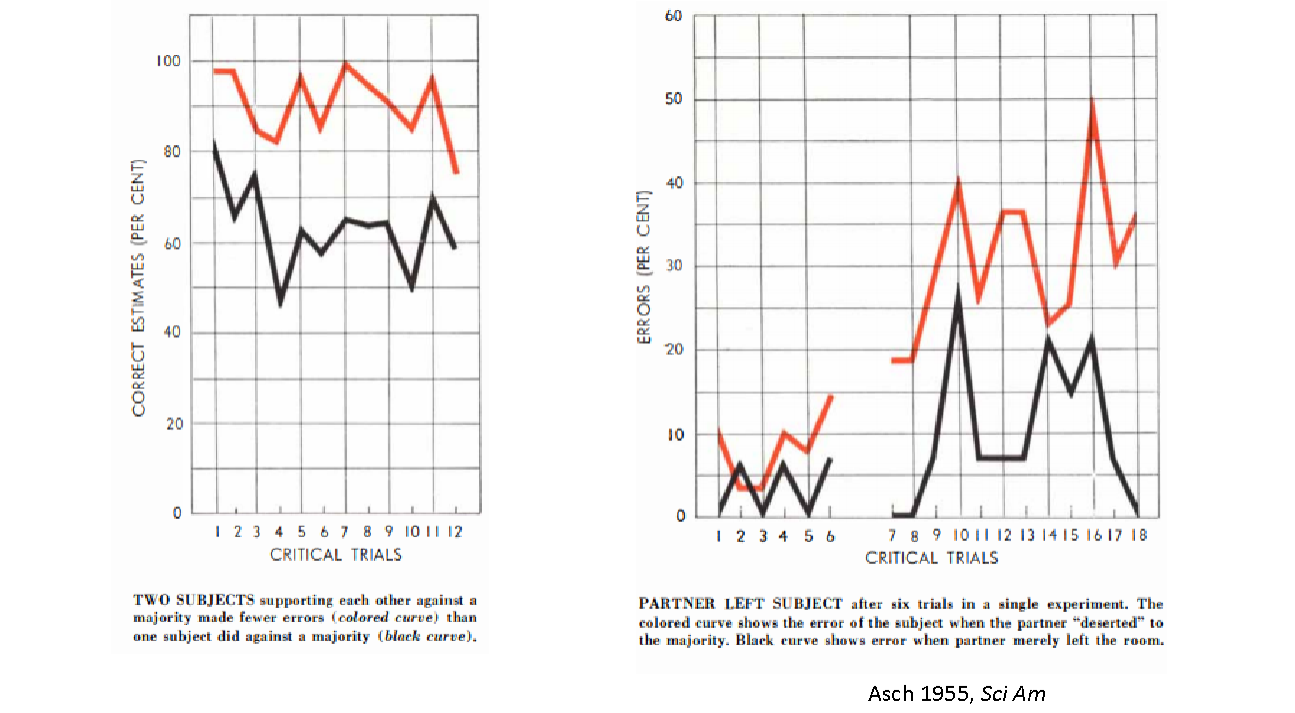
Know how the confidentiality of your responses and the presence of an ally affect error in response (?)
Two subjects supporting each other against the majority group made less errors
When partner deserts subject to go with the majority, the participant makes more errors compared to when the partner merely leaves the room
How did the results of the conformity experiment differ when the majority consists of
people from your ingroup rather than from your outgroup?
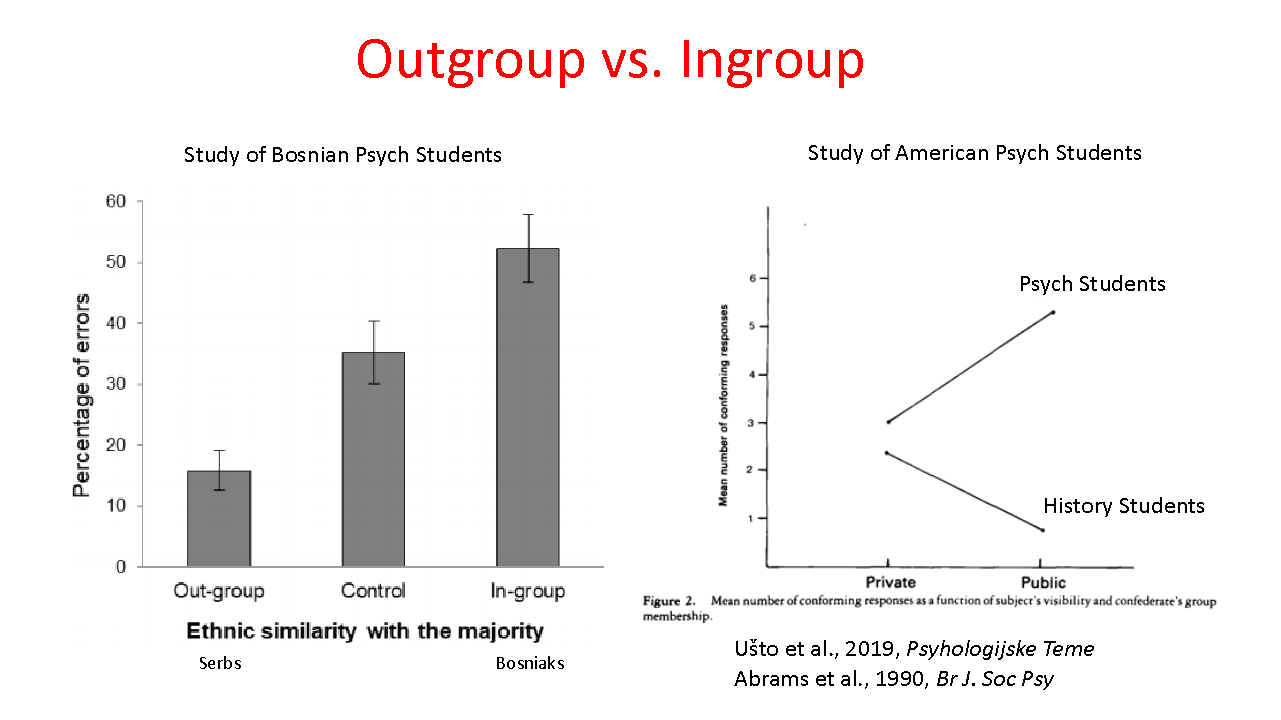
Errors increase most when the majority consists of people in your in group according to Study of Bosnian Psych Students
we care less on what the out-group thinks
In the Study of American Psych Students it is shown subjects in a group with psych students make more errors compared to when with history students especially when reported
What are the costs of dissent in the conformity experiments, and how do these costs
influence how minority decision-makers behave when making public versus private
choices?
Minority decision maker/private decision:
choices based on accurate perception and group judgement to reduce uncertainty
Possible desire to avoid negative effects of dissent
One opponent/ public choice:
Stalemate
3% error rate, perceived equal knowledge between A and B
A has little incentive to use B’s perceptions as information to refine his own judgments
Minority decision-maker, public choices: 35% error (less in groups < 4):
larger=reliable, cost of dissent increases (Difficult to attribute majority’s perceptions to individual errors)
social costs of dissent: low reputation and decreased social acceptance in their eyes
payment>social reputation when effects are little
Two minority decision-makers, public choices:
reliability of the majority is lessened
cost of dissent is lower with the presence of similar opinion (C)
you lose reputation and social
acceptance in the eyes of the opponents, but you gain
in the eyes of c
What is the canonical finding of Milgram’s obedience to authority experiment, and how
does this finding diverge from what psychiatrists and students hypothesized would
happen?
Milgram experiment: Subjects are asked to give their partner in the experiment an electric shock when given the incorrect answer that increases per wrong answer. Tests subjects obedience to orders.
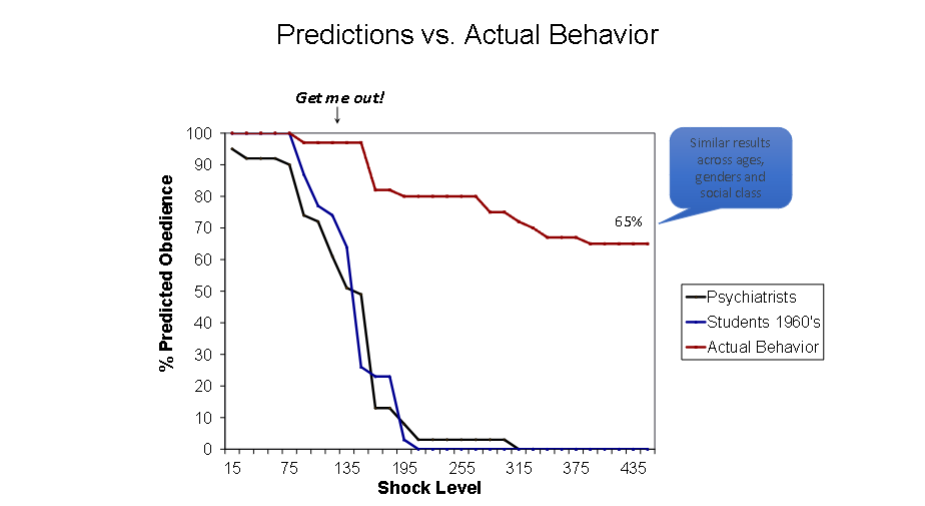
Psychiatrists and students assumed that obedience would drop to zero around 200-315 volts
obedience remained at 65% at 435 volts
In Jerry Burger’s replication attempt of the Milgram experiments, what was the modeled
refusal condition? How did the levels of obedience in the modeled refusal condition
differ from the base condition and from Milgram’s original results?
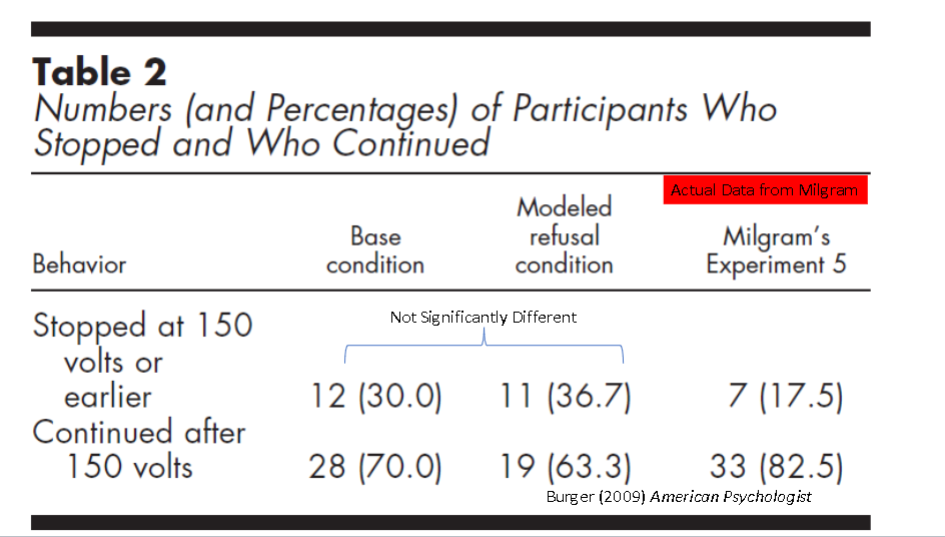
modeled refusal condition: a second confederate teacher refuses to participate after Trial 6
19 participants continued after 150 volts compared to 28 with the base condition and 33 of the original Milgram experiment 5
not much of a difference on who stopped at 150 bolts between base and refusal condition (12-11). 7 from Milgram
How do men and women differ in their responses to Milgram’s experiments? What about
people who thought they had personal responsibility, or people who asked about the
learner’s well-being?
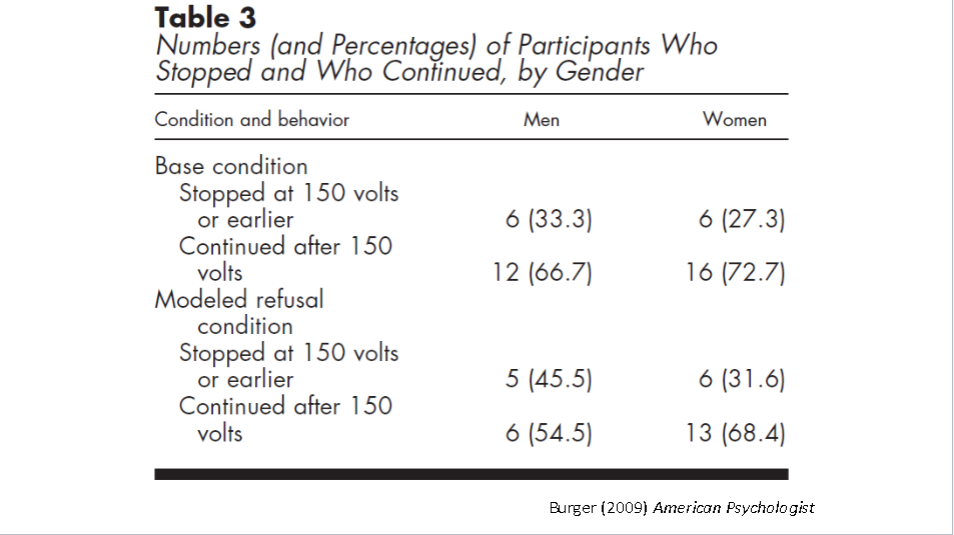
In both conditions less women stopped at 150 volts and more continued after 150 volts compared to men
Those who stopped were more concerned with personal responsibility compared to those who didn’t (66% to 12%)
Both who continued and stopped shared concerned of the learners well-being (51% to 61%)
Subjects with concerns about their own responsibility tend to resist the experimenter
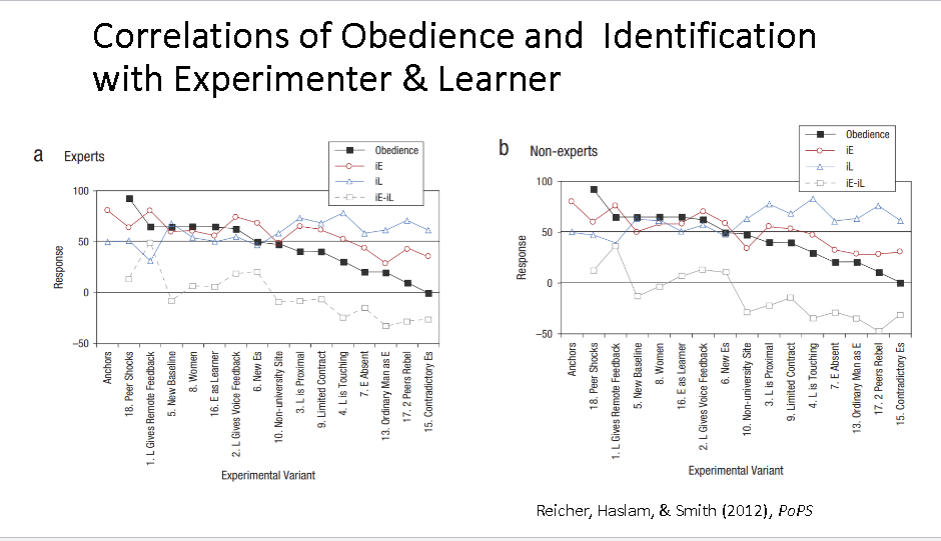
How does identification with the goals of the experimenter/learner affect obedience?
Similarity to Victim Reduces Obedience
Obedience goes up as subjects’ identification with the goals of the experimenter increase;
obedience goes down as subjects’ identification with the goals of the subject increase
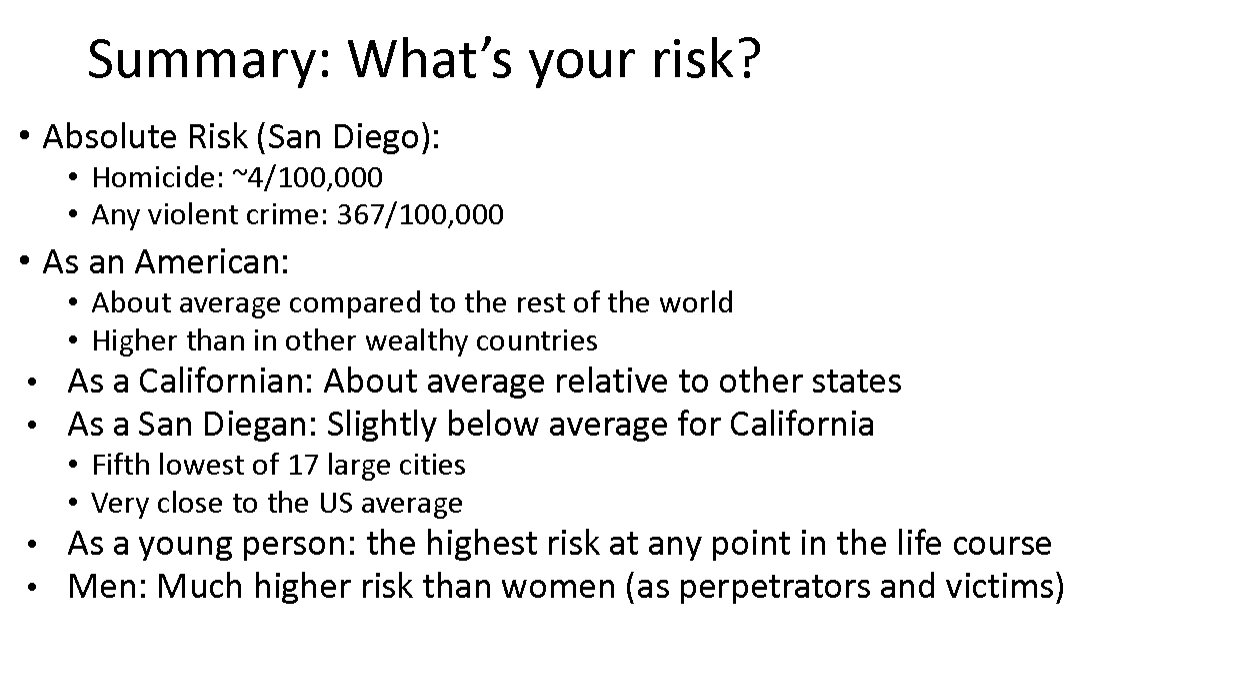
Know about your risks of encountering violence in San Diego, the United States, and
globally? How do these rates compare to historic rates of violence?
San Diego:
5th lowest of 17 larger cities
below average for California
close to US average
367/100,000
The U.S
About average compared to the rest of the world
Higher than in other wealthy countries
Globally
• As a young person: the highest risk at any point in the life course
• Men: Much higher risk than women (as perpetrators and victims
Violence had a spike during 2020 but the overall tend globally is homicide decreasing
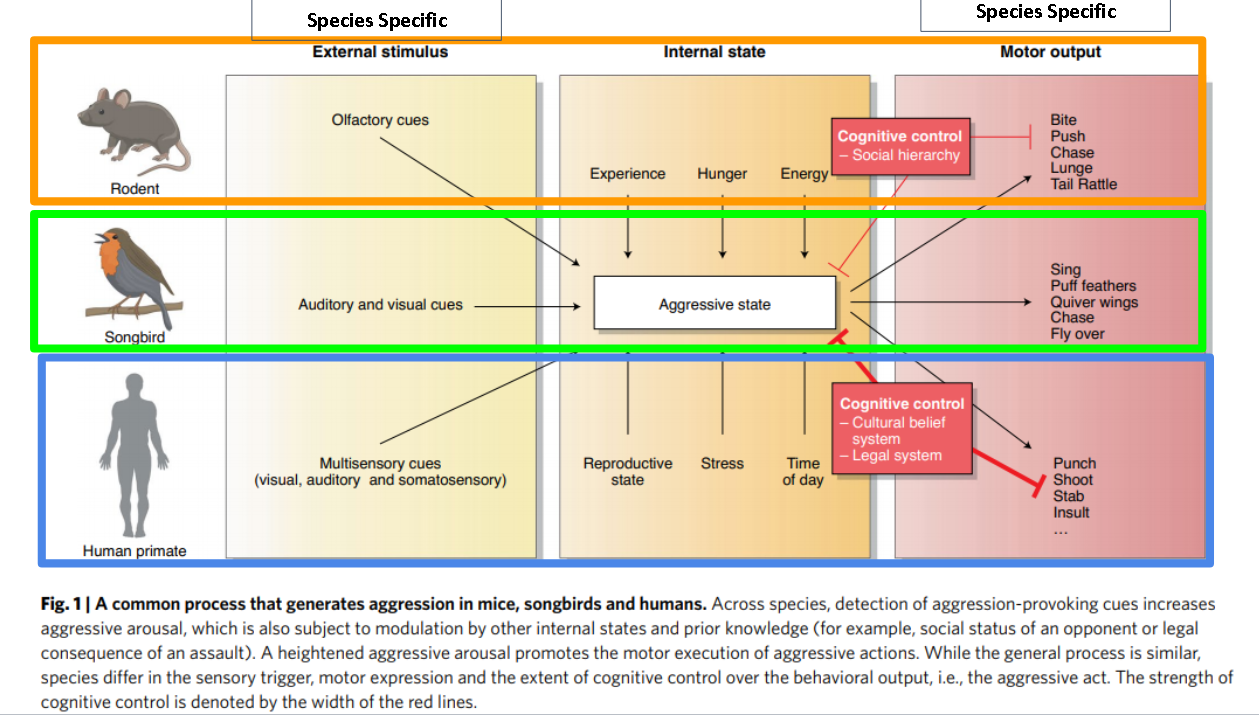
Professor McCullough used a model of aggression that includes cues, internal states,
cognitive control, and learned and unlearned aggressive behaviors to organize his lectures
on aggression. Be prepared to describe some of the model’s basic features and how it can
organize some of what we know about aggression in both humans and sparrows.
Minds produce aggression by two brain systems that process sensory cues unique to each species. These systems produce internal states in the context of the internal environment and motor outputs also unique to each species.
Species differ in sensory trigger motor expression and extent of cognitive control over behavioral output
ex. A bird waving its wing is NOT the same as a human waving their hand, instead they use it as a way to avoid conflict and defend territory
Common process among humans, song birds, and mice:
Brain process aggression-relevant stimuli → consider those representations in light of
internal states → produce aggressive impulses that are then considered
in light of cognitive controls → converted into learned and
unlearned aggressive behaviors
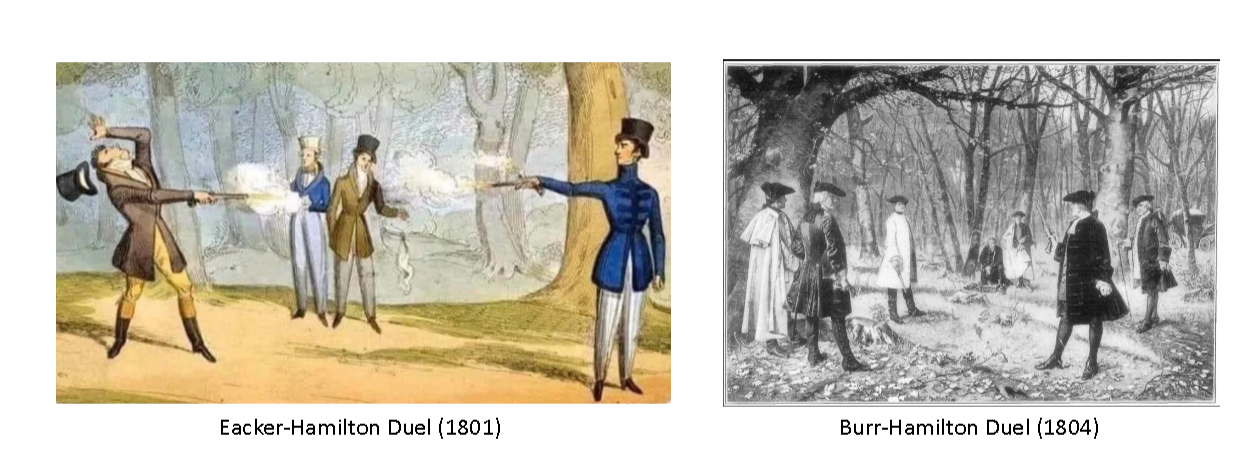
What is the weapons effect? Do weapons increase violence and the accessibility of
cognitive states associated with violence?
Weapons effect: The mere exposure to a weapon causes aggression to increase and elevate violent behavior
Hence why duels are illegal in the U.S (Hamilton)
Threats to honor causes violence (Hobbes)
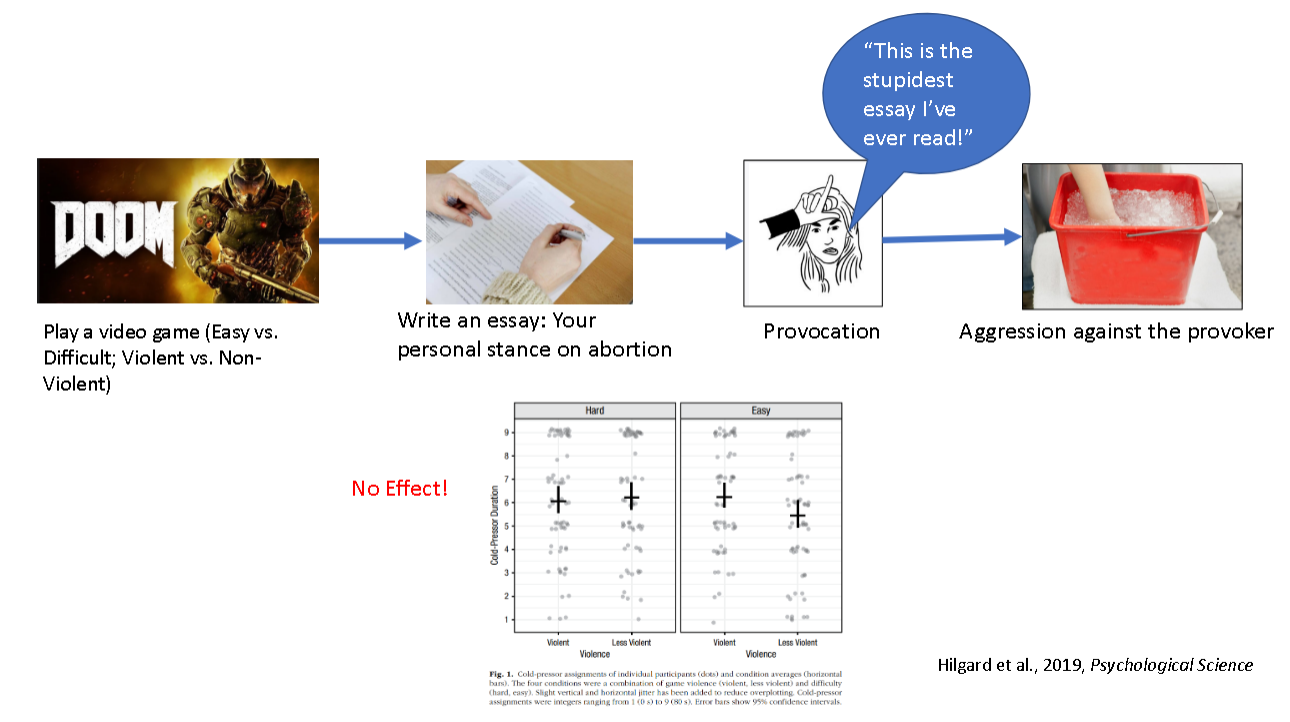
Do violent video games cause aggression?
The relationship between violent video games and aggressive behavior generally fall at or below the cut off for what is considered a small effect.
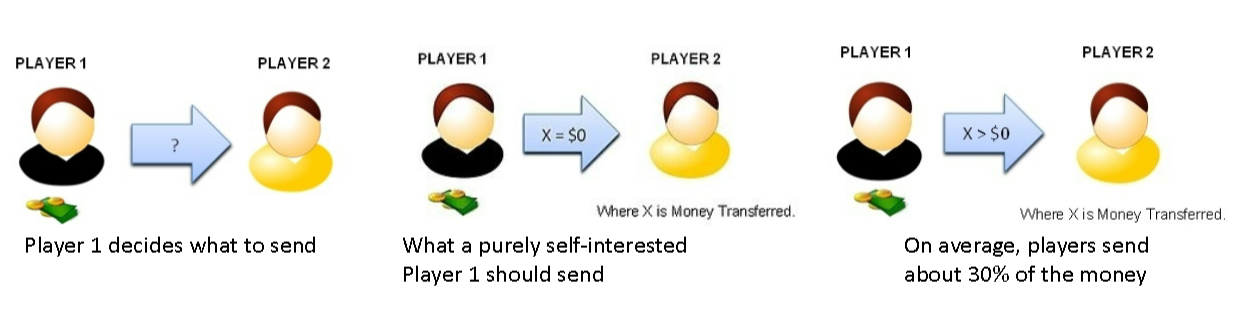
What is the Dictator Game? What result do researchers most commonly find when people
play it?
Player 1 decides how much money they should send to player 2, on average they send around 30%
Explain the four motivations for prosocial behaviors – egoism, altruism, collectivism, and
principlism.
Egoism: desire to get rewarded/avoid punishment (both material and social)
ex. doing good for your own benefit
Altruism: desire to help those in need
ex. doing good to benefit others in need
Collectivism: desire to benefit one’s own social group
ex. doing good to benefit your ingroups reputation
Principlism: desire to uphold a moral principle (golden rule)
ex. doing good because you believe you should and because you’d want others to do the same
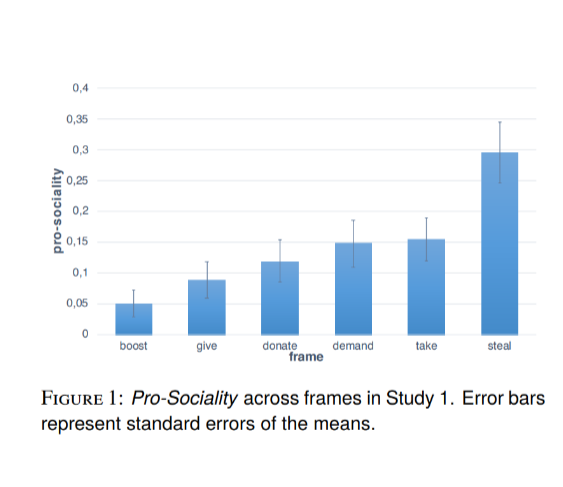
How do different ways of “framing” affect people’s decisions in the dictator game?
When subjects choose between (a) Giving $0.50 to the other and keeping $0.00 or
(b) Giving $0.00 to the other and keeping $0.50, they are likely to pick A when the game is framed to be about stealing and B when it is framed to be about boosting or giving
People help others to fulfill certain motivations (refer to 4 motivations)
Explain the empathy-altruism hypothesis
perceived welfare of someone in need → empathetic concern → altruistic motivation to reduce that need
Empathy activates a motivation to raise the well-being of a
person in need (compassion, pity, focus on the other person’s needs)
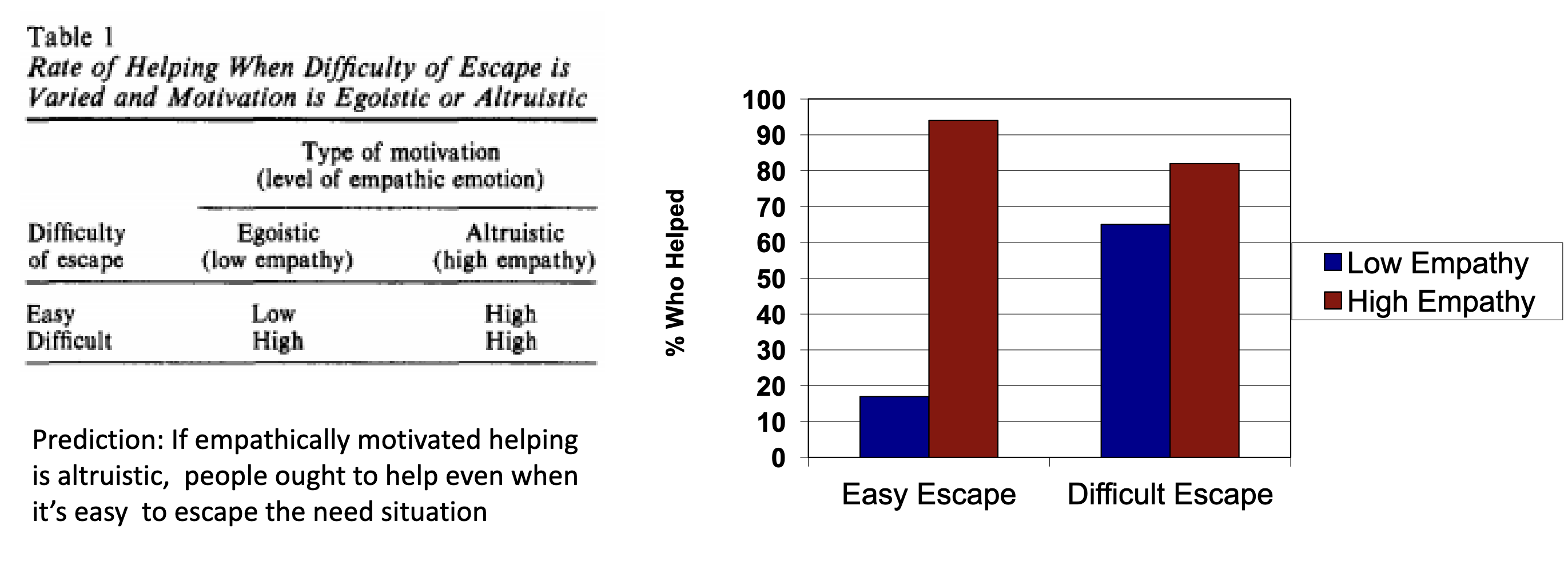
Explain the rationale and results of Daniel Baston’s experiments that featured experimental manipulations of empathy and the opportunity to escape from helping.
Baston experiments: subjects believed they would witness “elaine” receive electric shocks while completely a series of mental tasks
IV1: low/high empathy
IV2: easy/difficult to escape (elaine escaping after first 2 trials or enduring all 10 trials )
elaine becomes increasingly distressed revealing childhood trauma of being thrown into an electrical fence and agrees to allow researcher to ask for help
DV: willingness to take elaines place
Results: When difficulty to escape was high both egoistic(low empathy) and altruistic (high) motivation were also high. When easy escape altruism was high
If empathically motivated helping is altruistic, people ought to help even when it’s easy to escape the need situation
What is Peter Singer’s Shallow Pond Argument? Explain the argument and its relevance to prosocial behavior.
suffering=morally bad
actions to reduce suffering=morally good
If you can reduce suffering without paying costs that lead to an
amount of suffering to be reduced, then one, morally, ought to do it
suggests we should donate to the most effective charity to get the most out of your $
What does it mean for a charity to be “effective?” What do we mean when we say that some charities are more effective than others?
most impact per dollar spent
consider both the cause AND COST EFFECTIVENESS aka do your research.
ex. according to givewell
1. Medicine to prevent malaria
2. Mosquito nets to prevent malaria
3. Supplements to promote vitamin A deficiency
What is the Parable of the Good Samaritan and why does it come up in a social psychology course?
Biblical story about a man who was beaten and stripped away of his clothes otw from Jerusalem to Jericho and crossed paths with a priest and a Levite who passed by him.
It was only until a samaritan passed that the man had help bandaging his wounds and taken into care
Meant to teach to that true neighborly love transcends religious, social, and racial boundaries.
Who was Kitty Genovese? Why was her death important to social psychology? What is true and what is false about how we have come to understand her death?
Kitty Genovese: stabbed to death in front of home
Myths: three attacks, 38 eye witnesses, no one intervened
Reality: two attacks, half a dozen eye witnesses, no one intervened to directly break up the murder
Bystander effect: more witnesses reduce likeliness of help, diffusion of responsibility, conflict of helping when needed and blending with the crowd, fear of getting involved so they wait until someone else get involved
Understand the Hurdle Model of bystander intervention. What are the psychological hurdles we must overcome in order to effectively render help?
Audience inhibition: How would I look if I intervened?
Costs exceed rewards: What am I risking if I help?
Lack of competence: Am I qualified to even help?
Diffusion of responsibility: Someone else will probably handle this
Ambiguity: Do they really need help or just look like it?
relationship between attacker and victim: They’re responsible for their own conflicts
Pluralistic ignorance: Everyone else seems to be ignoring the situation so I shouldn’t worry
Distractions: This isn’t the place.
Self concerns: I have other things to tend to.
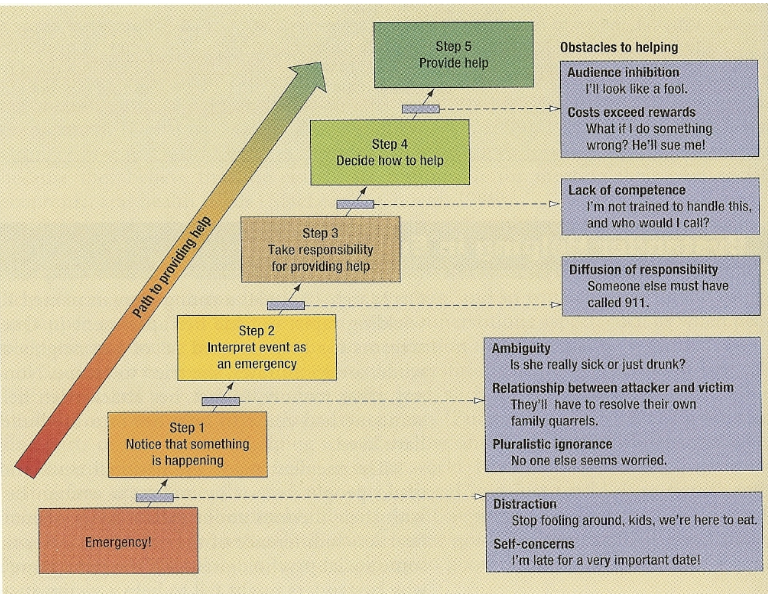
What is pluralistic ignorance?
If others don’t seem concerned we don’t worry either
What is diffusion of responsibility?
We assume someone else will handle the situation or minimize our own responsibility the more people involved.
What did Darley and Batson discover in their Good Samaritan Study? Under what conditions were those ministers-in-training most likely to render aid to that unconscious fellow in the alley?
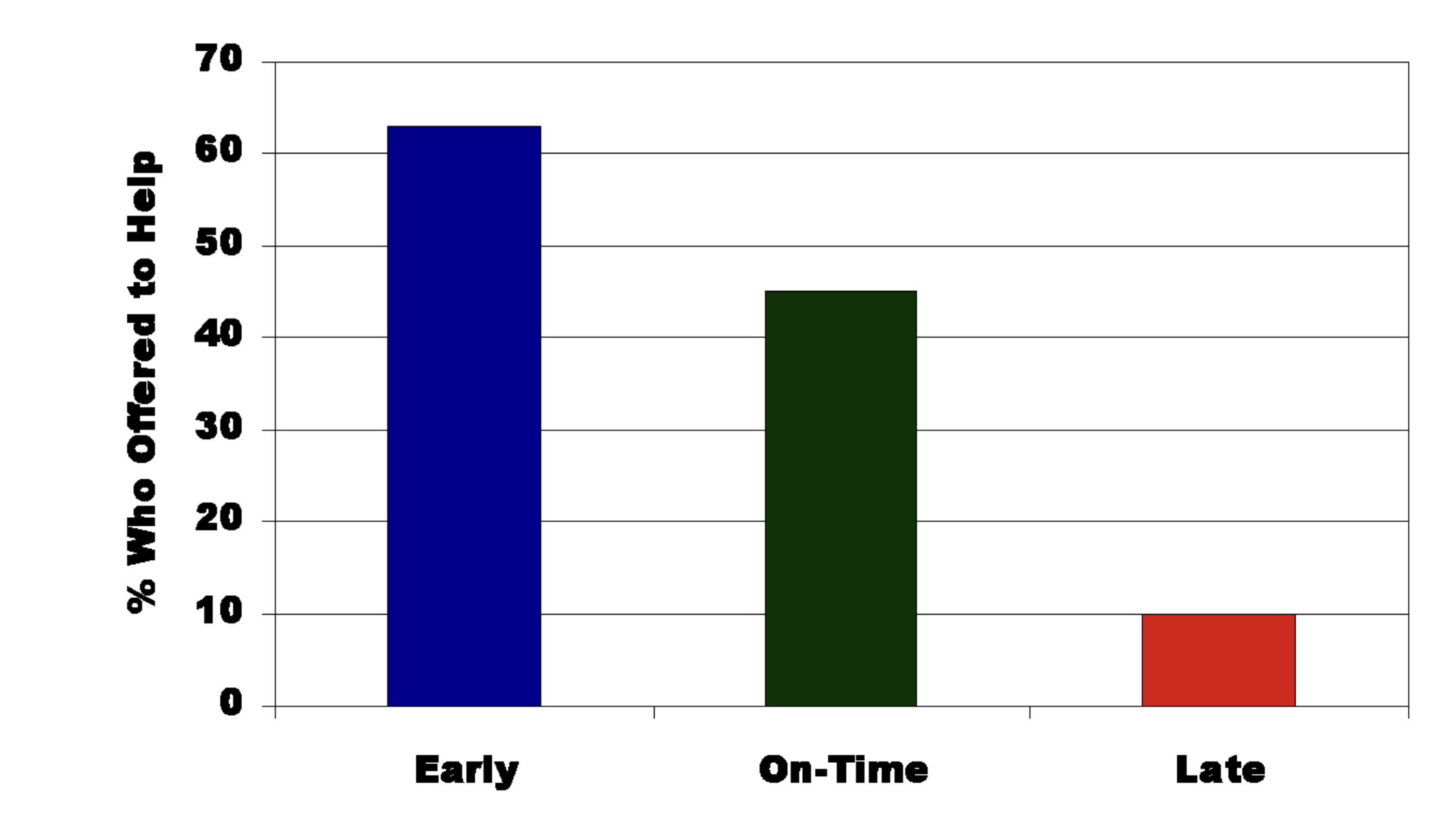
the Good Samaritan Study (Darley & Batson, 1973): ministers in training asked to give a talk on the parable of the Good Samaritan
IV: Early vs. on-time vs. late for the appointment
They all pass a sick man slumped on the doorway
DV: Who was most likely to help?
Results: Mainly those who were early
situational factors (like being in a hurry) dictate helping behavior far more than dispositional factors (like religious devotion or personality)
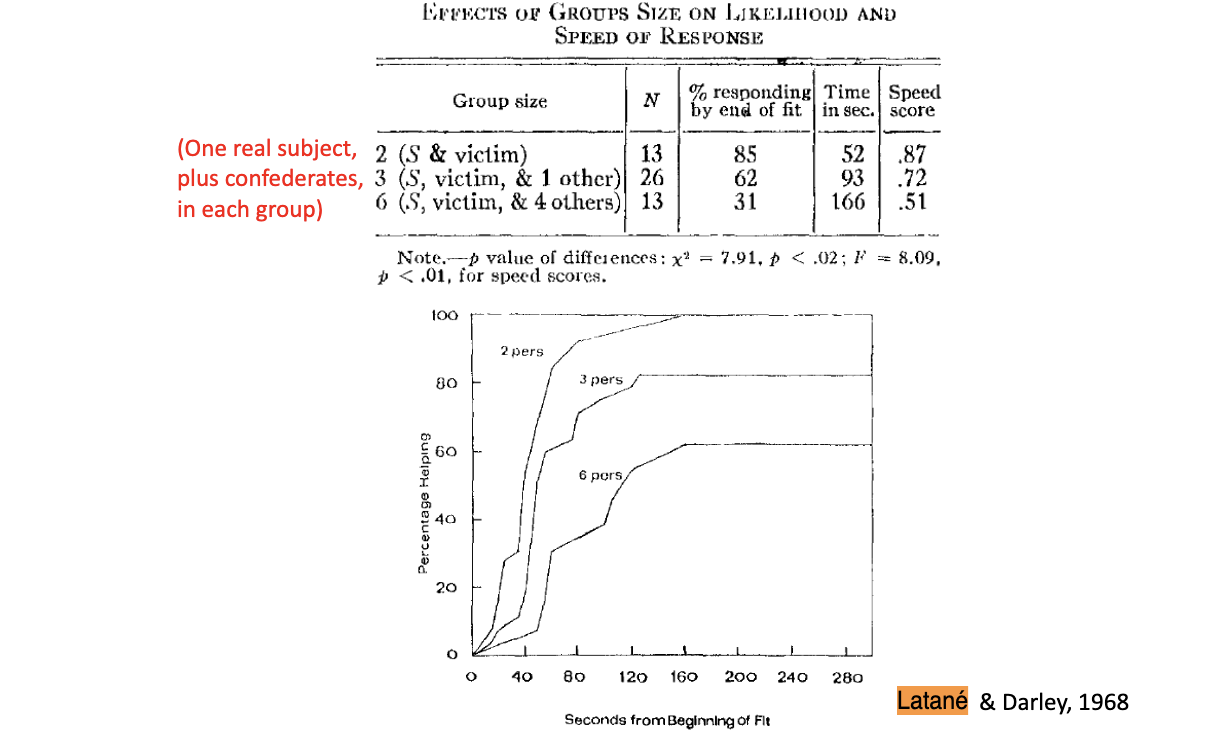
What did Darley and Latané discover about the effects of other bystanders on people’s likelihood of intervening in an emergency?
the more bystanders the less likely someone is to intervene; their urgency to help (speed score lowered) is also reduced as group size increases
Under what circumstances are men more likely to help than women? Under what circumstances are women more likely to help than men?
Men are more apt to help women in experiments:
where men are viewed as stereotypically competent and comfortable helping (tire changing, carrying heavy items)
Also when there’s less risk when helping
When they’re being watched
off campus> in a lab
when they infer that a subject needs help vs when they asked directly
Women are more apt to help men:
In thoughtful helping associated with health and lifestyle
relationship and emotional support
volunteer work
ex. more women are donors, Peace Corps: 46% more women per capita