Unit 2 - Confined Animal Feeding Operations (CAFOs) and the Environment
 Call Kai
 Learn
Learn Practice Test
 Spaced Repetition
 Match
Match Flashcards
 Knowt Play
1/33

There's no tags or description
Looks like no tags are added yet.
Name | Mastery | Learn | Test | Matching | Spaced | Call with Kai | Chat |
|---|
No analytics yet
Send a link to your students to track their progress
34 Terms
Hog Production Stats
•There are 8-9 million hogs in NC
•Most are located in confined animal feeding operations (CAFOs)
•2,500 CAFOs, mostly in Eastern NC → near big processing plants and lots of flat agricultural land
•Hogs produce 19 million tons of waste/yr
•Hogs produce 52,000 tons of waste/day

NC Hog Production
•3,800 hog lagoons in North Carolina, mostly in eastern NC
•550 of those have been abandoned and lack any sort of maintenance or up keep.

Hog Waste Pollutants
Fecal coliform- 3.3 x 10⁶ cfu/100 mL
E. coli- 6.9 x 10⁴ cfu/100 mL
Salmonella- 9.6 x 10³
Cryptosporidium- 3 x 10²
Giardia- 5.3 x 10⁴
- Fecal coliform, and E. coli are indicator microoganisms; cryptosporidium, giardia and Salmonella can cause sickness in humans and are often the culprit of major outbreaks
Confined Animal Feeding Operation
- Hog houses: give hog shelter
- lagoon: where all animal waste is held; solids settle and liquid waste is at the surface
- spray fields: liquid waste is sprayed on fields as a fertilizer; usually growing hay or Bermuda grass as it can uptake a lot of nutrients (N,P, and water)
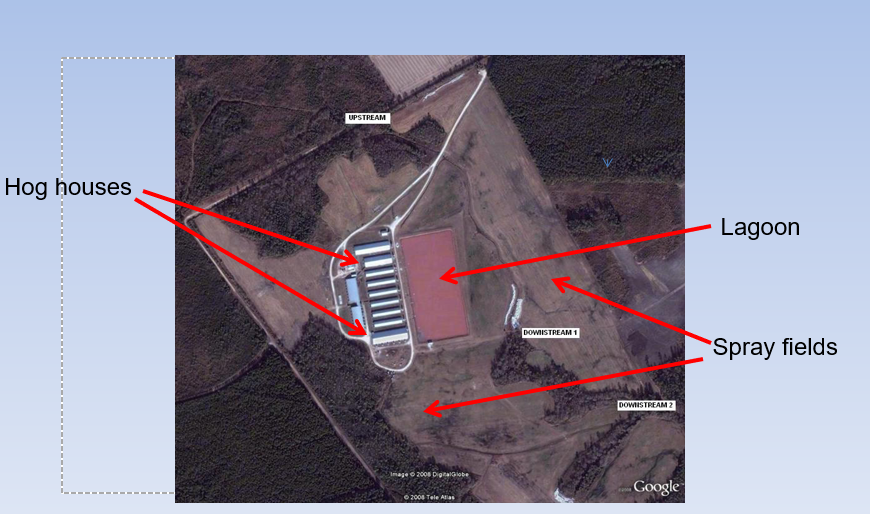
Waste is piped from the hog houses to the _______.
lagoon
- The lagoon should only receive hog house waste and precipitation that falls directly into lagoon- no stormwater runoff.
- Impoundment made by excavation to biologically treat animal or other agricultural waste.
- Storing contaminated wastewater in an anaerobic environment, which will eventually break down the organic matter into nutrient fertilizer, which can be sprayed on fields.

Lagoon layers
The capacity of an anaerobic lagoon includes volumes designed for:
1. sludge
2. Permanent liquid treatment
3. Temporary liquid storage
4. 25 year, 24-hour storm
5. Heavy rainfall factor
6. Freeboard

Sludge
Organic solids which cannot be further degraded by anaerobic bacteria and accumulates in the bottom of the lagoon
Permanent liquid treatment
The amount of liquid which should always be present in a lagoon for optimal bacterial activity → should always have liquid between the minimum and maximum level
Temporary liquid storage
The volume should be based on the amount of wastewater, rainfall, and extra washwater that will enter the lagoon during periods when liquid cannot be irrigated onto a growing crop
25-year, 24-hour storm
The most rainfall likely to occur in a 25-year period over a 24-hour duration (5-9 inches of rainfall for NC) → enough storage for heavy rainfall or storms
Heavy rainfall factor
As a minimum must be equal to or greater than the depth of a 25-year, 24-hour storm on the lagoon surface to allow for excessive prolonged rainfall periods
Freeboard
the required distance from the top of the lagoon dam or dike elevation to the highest allowed waste liquid elevation (at least 1 foot). This distance is in addition to the 25-year, 24-hour storm, and the heavy rainfall factor.
Lagoon liners
Used to reduce the permeability of the bottom and sidewalls of the lagoon. This prevents or restricts the potential for downward and lateral seepage of the waters from the lagoon.
1. Clay = can usually be found near site; requires careful installation with proper compaction at the proper moisture content
2. Bentonite = blended with existing soil; comes from NC; an expansive clay that can shrink or swell
3. Synthetic membrane = normally some type of plastic; requires careful installation by contactors; easy to damage
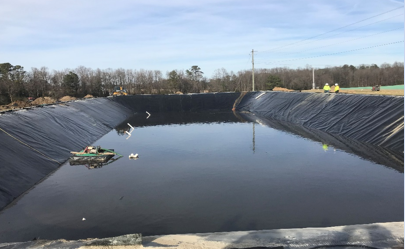
If soil is unsuitable for building a lagoon then a _______.
synthetic liner must be used to prevent groundwater contamination.
Determining when to Irrigate
1. Any actively growing crops or a crop that will be planted or actively start growing in 30 days?
2. A nitrogen deficit remaining for this crop cycle?
3. Is the liquid level in the lagoon above the minimum storage depth (if below will hurt the microbes in the lagoon)?
4. Are the fields dry enough to be irrigated (if too wet → runoff)?
5. Was there a waste analysis within 60 days of this irrigation (waste analysis determines the amounts of nutrients in the wastewater)?
If yes to all questions, then schedule an irrigation.
Irrigate such that:
•No surface runoff during irrigation
•Root zone is not completely saturated at the conclusion of irrigation
•Irrigation water does not leach below root zone → so plants can still take up nutrients
Soil absorption of WW influenced by:
•Rainfall-when and how much it last rained, when is rain next expected
•Crop maturity- water uptake by crop
•Soil type- texture, structure, depth, and cover
•Effective root depth- dependent on soil characteristics and crop type and age
•Evapotranspiration- temperature, wind, relative humidity
Wastewater irrigation should replace the water that has _______.
evaporated from the soil or transpired by crop (Plant available water deficit)
Effective rooting depth
½ the total rooting depth and is where most plant uptake of water occurs
- typically 12-18 inches deep
Plant available water (PAW)
between field capacity and permanent wilting point
Irrigation to maintain between ______.
field capacity and wilting point, more will result in leaching and GW contamination

Irrigation based on ______.
soil moisture- should be below field capacity before irrigating
Silt loam has the most ______.
plant available water
- clay holds on too tight to water
- sand = doesn’t hold on enough to water
- on graph, could tell the because the greatest space aka water available between the field and wilting capacity
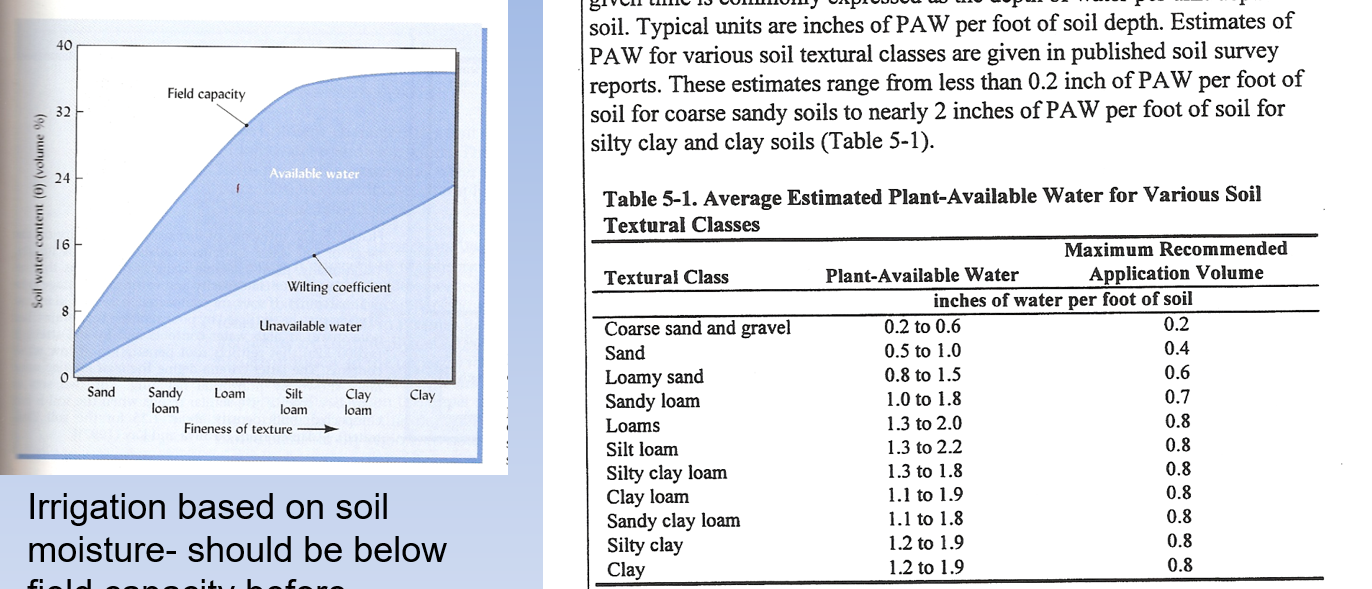
Maximum Plant Available Water Deficit
Effective Rooting Depth x Plant Available Water
- tells you the max amount for irrigation

Eastern NC experiences many hurricanes which causes ______.
environmental concerns for hog production
•Hurricanes- Floyd (99)
•Killed thousands of hogs
•Contaminated water with bacteria, nutrients and organic matter
Environmental Concerns
•Eastern NC has relatively shallow water tables and sandy soils- pollutant leaching risks
•Irrigating during wet periods or irrigating too much can result in the pollution of surface and groundwater with bacteria, viruses and parasites.
•Lagoon ruptures
•Leaking lagoon liners may allow wastewater pollutant to contaminate groundwater and/or surface water
•Tile drains (pipes that lower the water table in fields → outlet water to a ditch → can’t always be seen and documentation of them isn’t updated) beneath spray fields may provide quicker conduit for pollutants to enter drainageways
Ammonia Emissions
- Approximately 80% of NH3 emissions in the U.S. are generated by livestock waste
- The estimated total emission from livestock is 134,000 t NH3 /yr, 73% of which originates from the Coastal Plain
- Atmospheric deposition of nitrogen emissions now accounts for up to 40% of new nitrogen inputs to coastal ecosystems
Hog Farm study in Duplin County, NC
- GW Nitrate concentrations monitored from 7 monitoring wells
- Farm expansion in 1995 from 1 facility to Four and from 3,300 to 14,400 hogs
- GW NO3-N concentrations increased in wells 1-4, but not 5-7 (riparian zone)
- Stayed low in 5-7 because of wet soil → lots of organic matter → denitrification → nitrate lost
- Stream N concentrations increased after construction and operation of new houses in cold months, but no change during the warmer months

Pollutants from Hog Farms
•Sediment
•Nutrients = Phosphorus and nitrogen
•Bacteria = Potential bacteria that cause diseases
•Low Dissolved Oxygen = Oxygen levels too low to support aquatic life
Concentrations in Hog waste vs standards
Hog waste N and P concentrations of 365 and 93 mg/L
Fecal coliform standard 200 cfu/100 mL
Hog waste concentration 3.3 x 10⁶ cfu/100 mL
E. coli standard 126 cfu/100 mL
Hog waste concentration 6.9 x 10⁴ cfu/100 mL
Setback requirements
Setback requirements for lagoons and swine houses:
1. 1,500 ft from any occupied residence
2. 2,500 ft from a school, hospital, or church and 500 ft from property boundaries. Does not apply to swine farms with a site evaluation completed prior to October 1, 1996
3. If sited prior to October 1, 1996 and after October 1, 1995 the setback from property boundaries is 100 ft.
Setbacks for fields receiving land applications of swine waste are:
1. 50 ft from the boundary of property where an occupied residence is located and 50 ft from perennial streams

Registration Criteria
exceed any of the animal threshold numbers must have a waste management plan

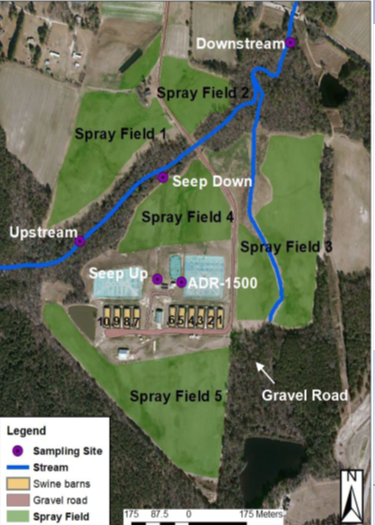
Second Hog Farm study
- placed loggers (recorded NH3 and nitrate concentration) upstream & downstream & seep-down
- spray fields were recently irrigated → seep-down had high concentrations
- air quality = spike in particulate matter in the air after the spray event
CAFO Operator Records
•Permit
•Waste management plan
•Certified Operator-in-Charge = certified and knows how to manage permit
•Sludge survey = keeps track of how much sludge is in lagoon
•Calibration of waste equipment = to ensure its dosing the right amount
•Soil sample analysis = measures the amount of P & heavy metals
•Crop yield records = how much hay is harvested aka are crops taking up nutrients?
•Stocking and mortality of cattle
•Daily rainfall
•Waste level
•Waste Analysis
•Waste application records
–Weather conditions
•Previous inspections